
BONUS – Download a Free Copy of this Blog in PDF Format HERE
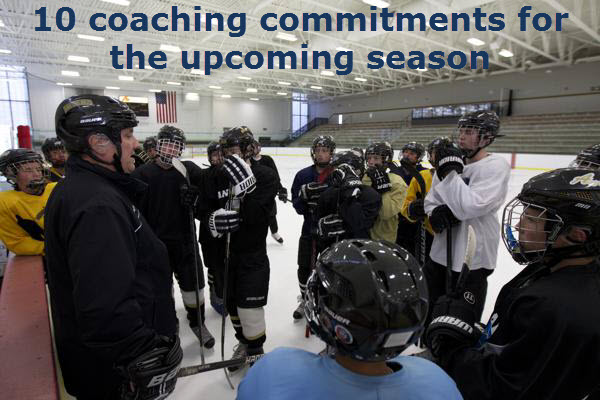
10 Coaching Commitments
Earlier this month USA Hockey announced the 10 coaching commitments they are going to be asking from all their coaches for the upcoming season and beyond.
Why?
Because the want to not only help players become the best they can be but create a lifetime love for the game so they play well into their adulthood.
Below are the 10 commitments with our comments;
1. Commit to Age-Appropriate training
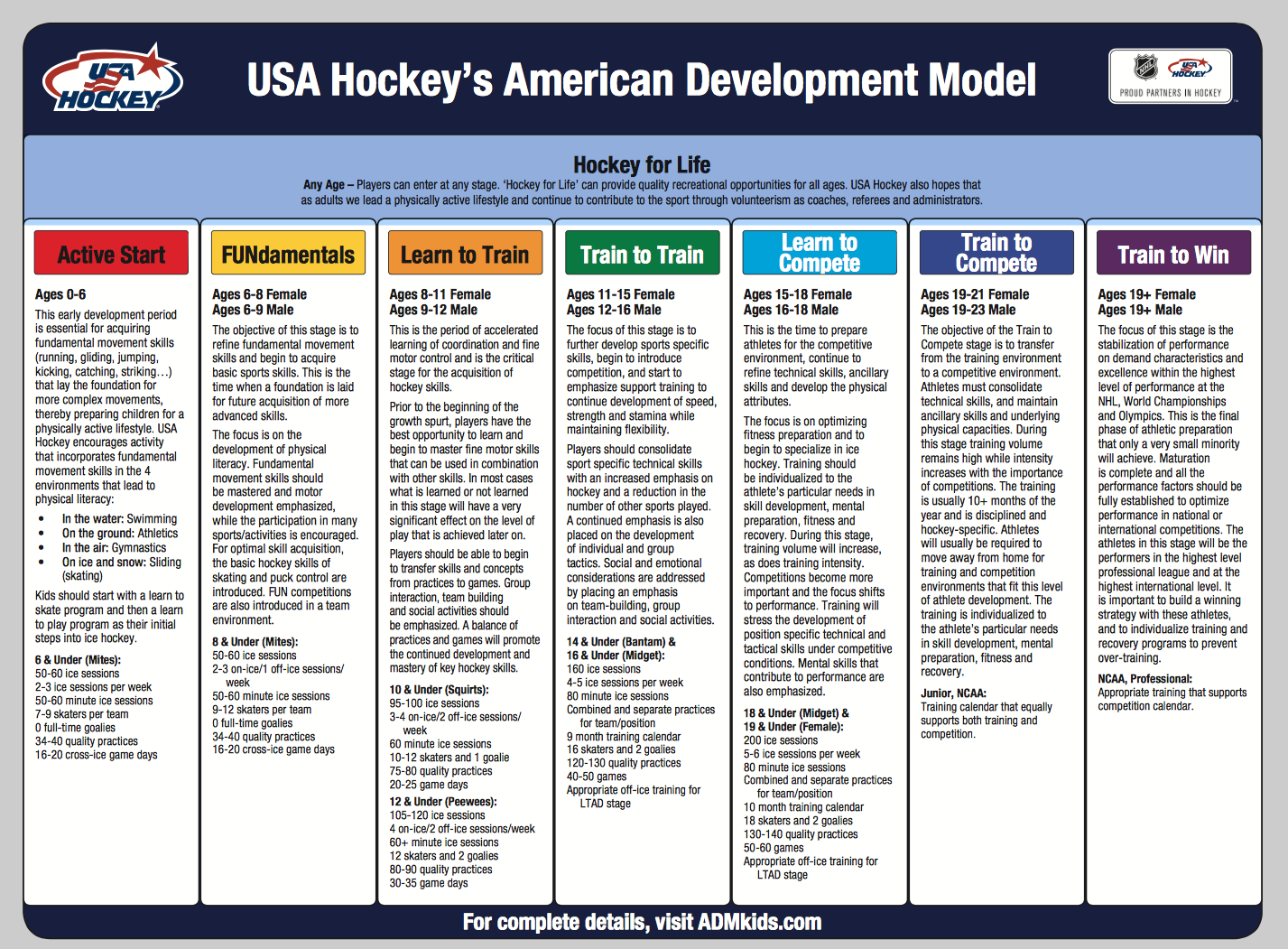
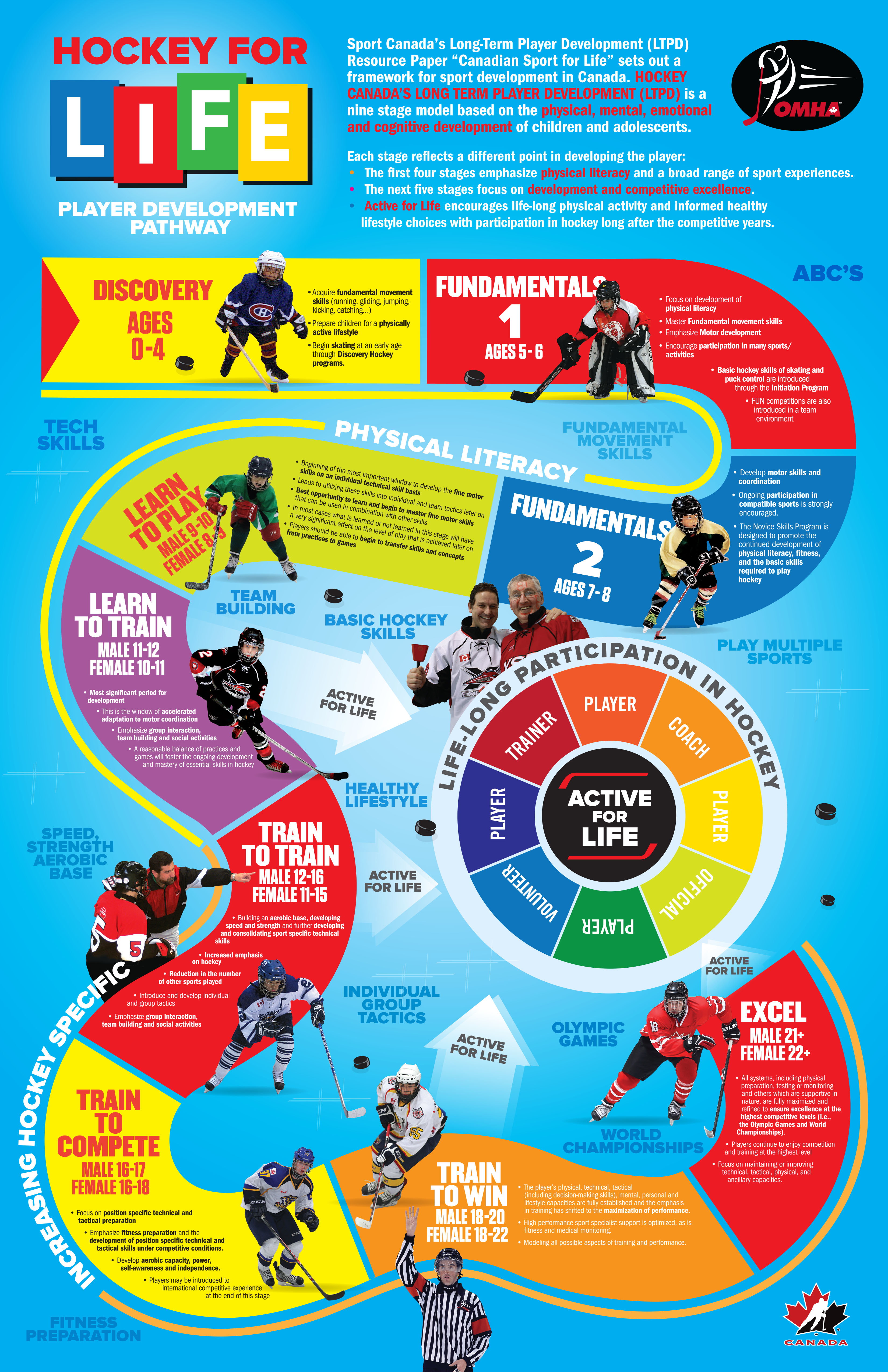
Follow the ADM (American development model) and they windows of trainability. This is the USA equivalent of the LTPD (Long term player development) model that Hockey Canada introduced several years ago so coaches focus on core skill development during the core motor skill development years and introduce systems and tactics afterwards.
Below is an outline of the ADM and LTPD summaries and their respective stages in the development pathways
USA Hockey – ADM
Hockey Canada – LTPD (Long term player development) Model
 In order to ensure that coaches do follow LTPD, one of the steps that Hockey Canada is introducing this year is mandatory cross ice hockey for the initiation age group (5-6 years old) and then in 2019-20 season will make it also mandatory for 7-8 year old players to allow for a transition moving from full ice to cross ice hockey.
This should have happened LONG ago, and it is very apparent that parents don’t understand the science behind the two models as became evident when parents of “elite” 6 year old players on “select” teams threatened to move to other areas to play on a “varsity team”.
All the more reason why parents MUST be educated about the benefits of LTPD, and based on surveys I have done of parents in recent years (including parent coaches), we still have a lot of work to do to educate all parents in Canada regarding the science, once we do so it will alleviate a lot of the mayhem we are seeing in games.
2. Commit to Skills and station-based practices.
The director of USA Hockey Coaching Education program. Mark Tabrum, states that even U16 (top 15 year old players) practices should still include individual skill work for ALL age groups. The core age groups per LTPD (Hockey Canada) for motor skill development is between the ages of 6-12 (Initiation to Peewee Age Groups)
Literally every time I go to the rink I see coaches running practices focusing 2/3rd of their practice slot on breakouts, power play, penalty kill, neutral ice transition and so forth as early as Novice Age Groups. When I talk to them after a practice, they say it is due to the fact they were unable to score on power play, breakout of their own end, enter into the offensive zone or kill penalties.
I counter – the reason your players are not able to successfully run the systems, strategies is to the fact they lack the necessary core skills to do so. Regardless if Novice of Bantam AAA, players must work on core skills so they can execute systems, otherwise they will continue to struggle.
3. Commit to a Culture Change
In lieu of the traditional practice where players show up 20-30 minutes early, practice for one hour, then undress and out of the rink 15 minutes later plan for the same dynamic warm-up that you would do for games followed by a cool down routine after the practice.
Reason – because kids need 60 minutes of activity each day, and even the best run practices they will only be active for 40 minutes but it is also important to warm-up and cool down to avoid injuries like pulled groins, hip flexors that are very common in hockey.
4. Commit to Small Area Games
This holds true not just for the younger age groups (reason why Cross Ice Hockey is being rolled out), but also the older age groups. Hockey is all about time and space, and being able to go where the puck is GOING TO BE (not where it is) in order to move the puck out of your zone and enter opposing zones to create scoring opportunities.
Even coaches in the NHL incorporate small area games in their practices and they are coaching the most skilled players in the WORLD.
Click HERE to read our post on the benefits of Cross Ice Hockey
5. Commit to Off-Ice Training (AKA – multi-sport activities)
Tabrum also comments on the need to develop physical literacy in others areas than just core hockey skills … in the summer time throwing a football or baseball, kicking a soccer ball. “We want to get back to two- and three- sport athletes in high school and get away from specialization”
USA HOCKEY endorses multi-sport participation until high school, so why on earth are parents encouraging and worse yet paying for their kids to be involved in hockey year round starting at 6 years old?
I just came back from New Brunswick where I spoke at CoachNB Beyond Coaching conference and after my presentation several coaches queried how they can stop madness of early specialization. One coach who had been a gymnast, one of two sports identified as an early specialization sport came to me and stated she quit gymnastics at 13 years old as it was too much, 25+ hours a week of training plus competitions and she wanted to try other sports and other activities at school like drama, art, music.
I recently came across this video, one of the elite skills instructors in the world, Sean Skinner who has worked with literally everyone in the hockey world. He started a hockey academy and referenced the 10,000 hour rule originally proposed by Malcolm Gladwell in the 90’s that it takes 10,000 hours to develop elite skills.
This is one of the drivers why parents are putting their kids into skills academies as can’t get there if only practicing 2-3 times a week. In lieu, he uses the Olympian Gymnist analogy (which is an early specialization sport) could be practicing 5-6 hours a day and how his academy offers the same for hockey daily both on and off ice and then they go with their teams and play 3-4 times are week.
Although the 10K was a go to for several years, but recent research by Anders Erikkson in his book Peak released last year talks about Gladwells 10,000 hour rule and provides data and research it is not about the reps, it is about how deliberate the practice is that leads to elite level skill development. One of my daughter’s coaches used the analogy, 10,000 reps makes permanent, but what happens if you do it wrong and don’t correct the mistakes?
Making kids practice 5 days a week, play 3-4 games a week is INSANE, and does not allow kids to be kids which is one of the driving reasons why 70% of kids are quitting by age 13 as they have already “worked” the sport year round racing to get in the 10K hours vs. following the long term development path as hockey players don’t peak in their skill development until their 20’s, goalies even later.
Thank you Mark and all others at USA Hockey for endorsing multi-sport participation for all the benefits vs. early sport specialization hockey academies like the one that Sean Skinner is running in Minnesota.
6. Commit to your goaltender
USA Hockey has introduced materials for coaches called Goalie Nation, much like Hockey Canada who has specialty clinics for coaches to better understand all the basics of the position.
It is the most skilled position on your teams, but unfortunately many coaches use the excuse “I did’t play goalie so don’t know how to coach them”
Visit www.usagoaltending.com for drills and resources to help develop your goalies.
Two recommendations we share with coaches in Hockey Canada clinics is to ensure they plan for goalie development in all drills, don’t just use your goalies as shooting tutors. If you are not comfortable coaching the goalies, one tip is to recruit goalies from older age groups in your association to come out to your practices to work with your goalies. Many schools require that student’s complete community service credits and this is a great means for them to do so and at the same time mentor younger goalies in their associations.
7. Commit to teaching body contact and body-checking
Mark shares that it’s it crucial doing things off ice to teach body contact and body checking confidence starting at the U12 level before body checking is permitted at the U14 competitive level and we could not agree more.
The reason that body checking is part of hockey is to separate the player from the puck, NOT separate the head from the body. Many players that have not developed the confidence for body checking will either raise their elbows to protect themselves or worse yet initiate contact with their elbows with is one of the biggest contributors to concussions.
Hockey is a contact sport even without body checking, and coaches should reinforce the proper checking techniques early on as it is one of the core skills of hockey.
Gone are the days where kids that will be entering levels with body checking only participate in a one hour clinic to prepare them for full contact, it must be a progression just like all the other core skills of hockey as it takes YEARS to develop the confidence for full contact play.
8. Commit to and download the USA Mobile Hockey APP
Here is the link to the USA Hockey Mobile Coach App that provides resources, drills and practice plans in the palm of your hand.
Click HERE to download the USA Hockey Mobile Coach App
The Hockey Canada equivalent is the Hockey Canada Network App,
Click HERE to download the Hockey Canada Network App
It has the entire Hockey Canada digital library of practice plans, videos and various other resources so coaches can plan their practices more efficiently and provide videos to all players and coaches in advance. Don’t make the mistake that many young coaches do and try to design practices on their own, the greatest minds in Canada have contributed to the resource library for decades for Hockey Canada, we highly recommend you use it and will save a lot of time each week.
9. Commit to equal playing time (AKA fair ice policy)
Per Mark Tabrum at USA Hockey “if you choose them, they were selected (BY YOU) to play on your team – and should play like everyone else”
Per Corey McNab, director of player development for Hockey Canada that shared in a recent summit I attended “ If you pick ‘em, you play them”
Coaches need to recognize the importance of the process of player development, following the ADM/LTPD models vs. focusing on the scoreboard. Too many kids are quitting hockey in both countries as a result of winning at all costs philosophies.
The fact that a National Sporting Association is endorsing equal or fair playing time is something we have been pushing for many years. No kid should sit on a bench for undisciplined reasons to win a game or a tournament, as the old cliché goes … you win or lose as at TEAM.
When kids are victims of a short bench strategy, they will probably quit as a result, and our job as coaches is to instil the love of the game and passion so they come back each year.
Don’t be that coach that only plays his favorites and deprives other players on your team you selected to be deprived the opportunity to contribute to the outcome of the game.
Otherwise – you may end up being that kid’s last coach.
10. Commit to emphasizing fun
The number 1 reason why kids play any sport is that it is fun, and the #1 reason why they quit is it no longer is. This holds true for recreational level all the way to the high performance and everything in between.
Even professional athletes state over and over again, they opted not to retire as they were still having fun. Prior to the 2010 Gold game, Mike Babcock told the best players in Canada to “just go out there and have fun”.
Coaches that balance competitive play ensuring that it remains positive and an enjoyable experience at all team activities will realize the greatest reward a coach will receive, when every player returns to play the following season.
Kudo’s to Mark Tabrum and the rest of the USA Hockey Executive team for putting forth their 10 coaching commitments they would like to see from their coaches for this and upcoming seasons.
Let’s work together to bring the game back to the kids … where it belongs.