
BONUS – Download a Free Copy of this Blog in PDF Format HERE
GUEST Contributor – Geoffrey Park, Ontario Soccer Association Official since 2006 and tenured teacher for Ridley College.
I was gratified last night to be an Assistant Referee at a Boys Under 18 soccer game. While nobody involved is likely to take part in a World Cup, the caliber was decent. By and large the players had more physical strength and speed than they had skill. Yet this did not lead to confrontations and the game was played and coached with a high level of sportsmanship. In fact, the coaches closest to me were forgiving when I gave a close call against them resulting in a penalty kick.
I was impressed enough that after the game I made a point of praising the coaches for their behavior. Games like this one are notable, unfortunately, because they are so rare. Often, we find ourselves involved in games when players, parents or coaches stain the game. This culture has reached the point where bad behavior is barely noticed anymore. Bad behavior can be directed at officials, players, or coaches; it is all part of the same thing. It is up to all of us who care, to be proactive to ensure that minor sports do not lose their fundamental raison d’être (reason for being).
I suggest there are at least three concrete steps that can be taken:
- A written code posted at all venues;
- A form signed by coaches and parents at the start of the season;
and
- the use of what are known as “field marshals”.
- Written Code
The Conference of Independent Schools Athletic Association (CISAA) in Ontario established a “Code of Sportsmanship” way back in the 1970’s. It states some things that ought to be obvious, but we all know aren’t. They include that winning is desirable, but winning at all costs defeats the purpose of the game. They also cover respect for officials and opponents. Plaques stating this code are posted at gyms and rinks and changing rooms at member schools. It would be naïve to suggest that this code is always adhered to. I have an anecdote to share of it being ignored, but I do believe that stating these principles in writing and in visible places is a helpful reminder. I have heard officials say they like working games in the CISAA because they know the level of sportsmanship will be higher than average.
The counter-example, for your interest, was this. At the end of a senior basketball final in a crowded gym, the officials had to walk through a few spectators to get to their changing room. One of those spectators was a parent of the losing team. He went after them instantly, verbally abusing them and then even following them out into the lobby. I followed, and happened to catch up to them right in front of the Code of Sportsmanship poster. I didn’t raise my voice, but I did point out to this father the line about respecting officials. His response was for me to grow up. It left me wondering how abusing referees was mature.
Anyway, it shows that the existence of a code and adherence to it are not necessarily the same thing, but at least it is a start.If minor sports organizations invested a small amount of time and money into developing a code of sportsmanship, they would likely see an increase in participation. Evidence is telling us that many kids quit sports because they become tired of the negative atmosphere created by the parents or coaches.
 70% of kids are quitting all youth sports by the age of 13, see our prior blog that also touches on the importance of bringing sportsmanship back to the game “Poor Sportsmanship – the Other Reasons why kids quit sports”.
- A Code of conduct for parents and coaches
A similar code was developed recently in Sweden. “Stop shouting: how Sweden tackled misbehaving parents at kids’ football” is a blog by Marcus Christenson in The Guardian.
It describes how a survey within three of the largest clubs in Stockholm found that one in three kids had considered quitting due to “over-engaged” parents. Over-engaged includes parents’ interactions with children, coaches and officials. In response, the clubs came up with this code of conduct form all had to sign at the beginning of the season:“I, as a parent, will do everything I can to support my child, other children, club staff, referees and parents in training and at games – through a positive involvement.”The response has been positive, including requests to print and publicize the code, and it looks likely to expand throughout Sweden. Wouldn’t it be great if it expanded even more? An additional boost was given by a professional member of one of the senior teams. Imagine if someone with the profile of Ronaldo, Messi, Lebron, Sid, and other superstars put their names behind such an idea.
Hockey Canada has fair play codes for coaches, parents, players and officials like Swedish Soccer has now implemented that all must review and sign prior to the start of every season. We recommend that all hockey coaches also review in initial meetings with parents, players and fellow coaches to reinforce the importance and treat as standards for your teams, in event have to deal with issues is a means to hold those accountable as they signed a contract to adhere certain codes of conduct.
Here are links to examples each of the forms used by BC Hockey Parents, Player and Official Fair Play Codes
- Implementation of Field Marshals
The third and most concrete approach is the use of “field marshals.” I first saw this when watching my nephew play soccer in Georgia. Parents on each team took on the role, on a rotation, of field marshal. Their job was to calmly remind their peers not to yell at players or referees. If the ref felt a parent was out of line, he or she could go through the coach, who would ask the field marshal (identified by a vest) to intervene.
The reality was that the field marshals had little if anything to do, because the system was in place to prevent problems before they started, and the mere existence of the policy was a constant reminder of what everyone already knows is acceptable behaviour.
Many jurisdictions have now adopted this system, including Calgary, Alberta. In some cases field marshals are present at tournaments, and they help with various logistics of the event; management of spectators is only one part of the job. In other places, they are required for all games.
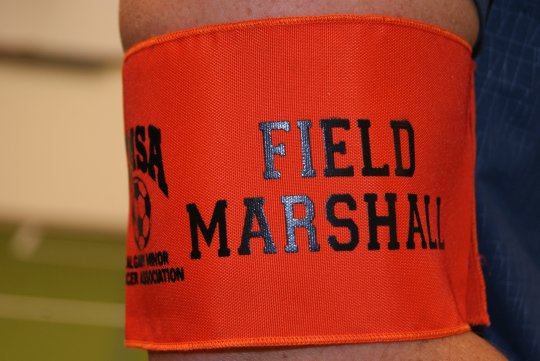
According to the Calgary Minor Soccer Association (CMSA), prior to the implementation of the policy in 2010, 70% of officials quit after their first year. Since the policy came in, attrition has been reduced to 30% as 70% return for a second season.
The CMSA Field Marshall Program
Prior to implementing the Field marshal program Calgary’s attrition rate was more than double the national average of many sports where 33% quit each year (which is still way too high).
Under the policy, each team must designate a field marshal whose name appears on the game sheet. This adult is identified by an arm band.
The stated responsibilities include:
- The Field Marshall is expected to act on behalf of the referee by reminding parents to keep their comments to themselves and refrain from vocalizing their complaints during the game.
- Quickly diffuse potential problems before they arise by either being visible or calmly speaking with the individual(s) involved.
- Deal with, and act on, inappropriate comments, gestures and/or general unsporting behavior directed at referees, players or any other individual by your teams’ spectators or coaches but please avoid getting into a confrontation. If someone is still hostile after being asked to calm down, please gather as much information but do not put yourself in a dangerous position.
For further reading I recommend “Respect Our Referees: A Minnesota State Referee Committee Program. A Guide to Field Marshalling.”
This lays out some excellent advice on how to diffuse situations, at first passively and then, if necessary, actively.
We are all too familiar with problems in minor sports, and something more than hand wringing is called for. If nothing happens sports run the risk of losing their original role in society and will become simply a Spartan, survival of the fittest, race to professional sports, with fewer and fewer participants. There are tangible steps that can be taken, and the longer we wait the harder it will be to turn around.
Geoffrey Park, Official
Ontario Soccer Association
************************************************************************************************************************************************************************************
We would like to thank Geoff for his great contribution and look forward to other insights he may share in future.
Let’s work together to bring the game back to the kids.