
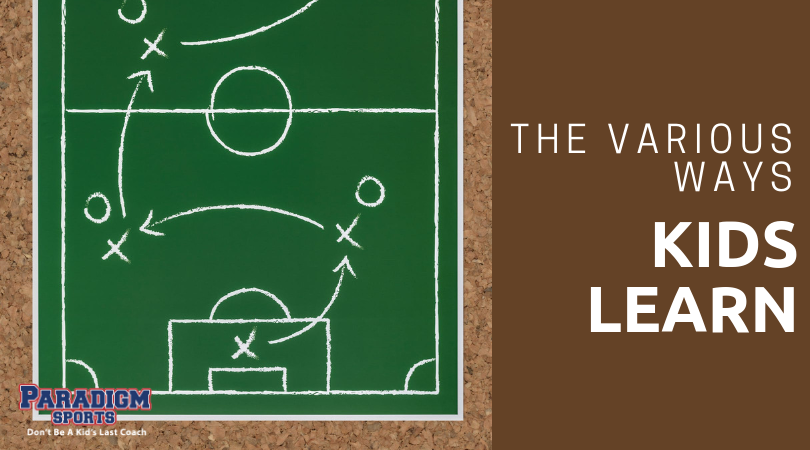
- Some of the kids on your teams will have strong IQ’s for the sport and will get it merely by merely seeing the X’s and O’s on a white board and these are usually the kids at the front of the line in drills, usually top 1/3 in terms of skill level on your teams.
- Some will understand what your taught them by seeing the X’s and O’s and hearing the instructions from you (provided that you are speaking clearly, see all of their eyes and they are following one of my cardinal rules … when the coaches speak, ZIP THE LIP).
TIP – your problem child’s are usually the ones you can not see, stand or kneel, even lie down behind you, they are the ones you should always have front and centre in your sight light to ensure they stay out of trouble
- Another group of kids need to see the drill written, hear it explained and see a demonstration of what to do. These are the kids that usually line up in the middle of the line as they like to see the demonstration but also see the first few players go in front of them so they can follow their lead.
TIP – don’t always let these kids go to the middle of the line, encourage them to start a drill at times and encourage them it is OK to make mistakes so they are safe to fail, something you should be encouraging for all of your players. One of the reasons why kids quit sports is due to coaches screaming at them during drills as they did not run it the way the coaches wrote it up (more often than not they did not communicate it well so that kids would run it correctly)
- Then there are what coaches refer to as drill killers I counter back that these are the kids that need to see the drill written up, explained, demonstrated and watch majority of their team mates do the drill before they understand what is expected of them. Often, it is not the kids that kill the drill, it is the coaches from the get go as they did not go thru all the steps to cover all the ways kids learn.
TIPS – try to keep the number of drills you have to a minimum and merely add progressions to them as you run again in practices (I normally have 20-25 drills that I run each season but build on them by adding progressions each time).
Name a drill after each player on the team (the drills they do get and enjoy) and then change on the fly during a practice (i.e. start without pucks then add pucks). NEVER introduce a new drill at the end of practice, it should be done right after warm-up when kids are fresh, as they tire during practice, they deprive their brains of O2 and will be harder to grasp new concepts especially if you have early morning practices before school or late practices on school nights for older age groups.
Many years back when I was in college taking a sales course, I learned a valuable tip from the tenured instructor, he said in every class to 100+ students, make sure you clarify, clarify, clarify. If you work on connecting with your players early in the season and figure out what they need in terms of learning, the big key is to clarify with them to ensure that they actually do get it. Ask them to repeat back to your what you instructed them to do. Do so by looking at their eyes, ALL of their eyes, if you can’t see their eyes they can’t hear you nor can your read it they understood you. You also can figure out as I so affectionally refer to is “deer in headlights”, if one or more of your players look at you with glazy eyes then ask them to come see you before they head off to do the drill. Don’t let them the head off if you see what I saw recently, many deer along the road on the way home but for the first time EVER … COWS IN HEADLIGHTS.