
BONUS – Download a Free Copy of this Blog in PDF Format HERE
Many parents feel pressured to specialize their child in one sport early either because they are showing early promise or coaches are pushing extra weekly sessions and year-round training.
According to a survey done by TD Ameritrade as they were concerned that parents were not investing enough for their retirement, although the survey found that 47% of parents felt youth sports was too expensive, 67% aspired for their kids to get a NCAA full scholarship, 43% aspired for their kids to play professionally and 34% potentially would participate in the Olympics.
The reality – less than 1% reach these elite levels of sport. Use Hockey as an example, over 1.5 Million youth play globally (just wait for China to ramp up and this will increase exponentially) and there are approx 700 player roster spots in the NHL (with the new Vegas Knights franchise) so only 0.3% of those playing will have a shot of playing in the NHL.
Unfortunately many of the coaches that are for early specialization are working for “development” organizations who are making the recommendations for the mere purpose of protecting their livelihood and don’t have the kids best interests at heart. It has turned into a HUGE business model, and has lead to the professionalization of youth sports vs. when kids played for the love of the game itself.
Kids develop very differently and if you push a child to one specific sport keep the following information in mind.
Aspen Institute Project Play, along with USA Tennis and 50 partner National Sporting Organizations are promoting the benefits of Multiple Sport Participation as a result of declining sports participation the last five years.
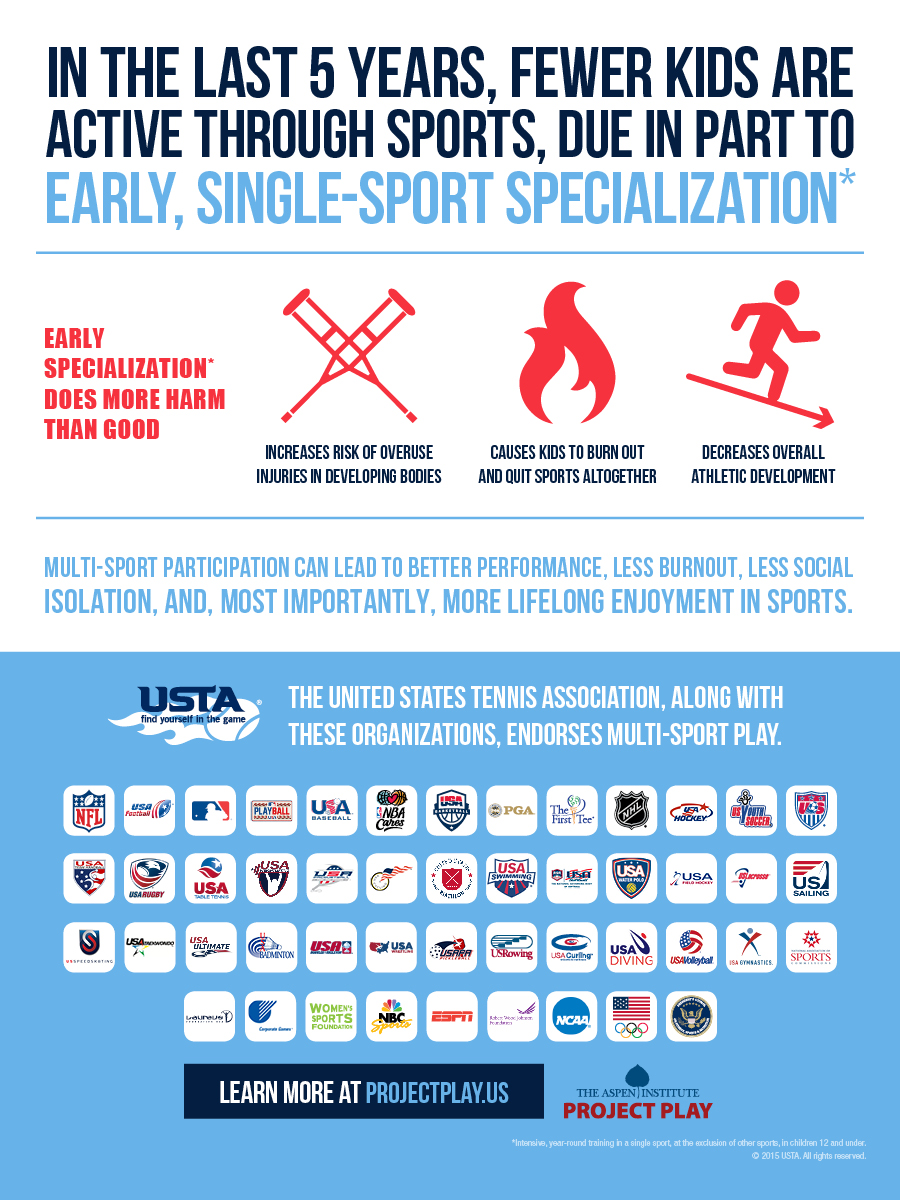
The three main issues kids should not specialize early in a sport are;
1.Increased risk of overuse injuries
ACL Surgeries have seen a 400% increase between the ages of 10-17 since 2002, the highest incidence is in female soccer.
Now over 50% of the Tommy John Surgeries are pitchers from High School (15-19 Yrs. Old) , a 9% increase this past year ALONE. This a major surgery on the ulnar tendon that was originally for major league pitchers to extend their playing careers into their 30’s, not provide kids robotic arms in their late teens. Research shows that once the surgery is done, it does not last. Many pitchers will see a 3-5 MPH decrease in speed due to the surgery.

One example is Roberto Asuna, pitcher for the Toronto Blue Jays, who had Tommy John Surgery at 18 years old and in one of the pennant race games last season literally pulled himself from the game as his elbow was too sore to continue.
Why do you think that concussions have escalated to the level they have in recent years ? It is not just due to the contact kids are taking, it is the type of contact and lack of respect for their opposition and how early it is happening.
Refer to our prior post ” Are contact sports in jeopardy?” and watch the videos of young football players under 10 years old hitting at a level of collegiate players.
The level of contact at earlier age groups has lead to a 200% increase in concussions since 2010 between the middle school age group (9-12 years old) which was one of the driving reasons why USA Hockey and Hockey Canada opted to defer bodychecking until the Bantam Age Group (13-14 years old).
We are demanding too much from developing bodies. These are major surgeries needing medical attention and are a direct result of kids playing one sport year-round with the same repetitive motor movements.
2.Burnout
70% of kids are quitting ALL organized sports by the age of 13 and replacing their former play time with screen time. The game they once loved and showed early promise in, are being encouraged by parents and coaches to specialize in one sport as early as seven years old. Over six years it is the equivalent of over 50-175 % more playing time of one sport compared to the multiple sport model
Kid should play sports seasonally. Their bodies are less likely to be permanently damaged and their chances of staying active for life increases significantly.
Due to specialization, kids are playing less than 2 sports per year now vs. prior generation would play 3-4 sports plus a multitude of free play activities. Do you remember when you grew up just playing for playing sake? Going to a basketball court, playing street or pond hockey, running, biking, swimming at your local pool? Gone are those days where kids play for hours on end because they loved doing so.
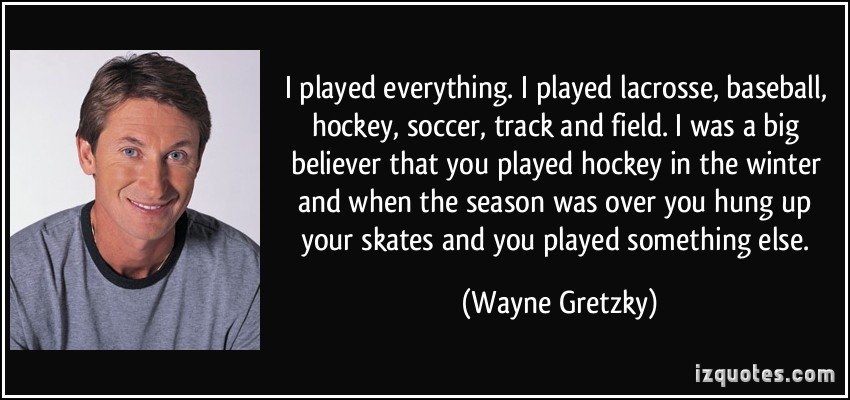
See quote below from the great one, like Wayne Gretzy when he grew up and I believe all would say he turned out to be “pretty good” although he only played hockey seasonally, not year round as many kids do today.
3. Decreases in Overall Athletic Development
The science behind Alberta Lacrosse’s Long-Term Athletic Development (LTAD) or Hockey Canada’s Long-Term Player Development (LTPD) models shows that kids are better off focusing on fundamental movement skills across a broad range of sports during their key development years. Motor skill acquisition at 6-12 years old along with organized and unorganized free play through kids’ teens is the recommended method to introduce kids to a wide variety of activities.
They also cite the benefits of cross training from one sport to the other, for example benefits of playing soccer helping hockey players receive a puck on their skate and kicking to their stick.
For more insight on Physical Literacy and LTAD, visit Sport for Life’s website www.sportforlife.ca
As coaches or parents of young athletes, ask yourself the following;
- Do you know what you want to do in life?
- Do you know what your true purpose is?
Whenever I ask those questions at any presentation I do very few hands go up as many do not know the answers until well into their adulthood.
THAN How can we recommend to a 7 year old kid to specialize in one sport for the rest of his or her life?
On the flip side, here is a short clip from John Smoltz’s MLB Hall of Fame induction speech where he touches on the perils of early specialization.
Let’s work together to bring the game back to the kids.

3 thoughts on “Early sport specialization does more harm than good”