
Why Sports Participation in Canada is Declining
By Glen Mulcahy

BONUS – Download a Free Copy of this Blog in PDF Format HERE
I recently came across some stats published by True Sport that reinforce the challenges we are having with youth sport participation in Canada today.
“In Canada, sport participation rates peak at age 10 to 13 and then decline steadily with age.”
According to a Government of Canada youth survey conducted in 2003, the leading reasons for kids not participating in sport were “lack of time” (34 percent) and “lack of interest” (30 percent).
Due to the increasing time commitments coaches are imposing on their players and their families, many parents are unable to make those commitments and their kids are having to pull out as a result. The lack of interest is in part due to too much structure and not allowing free play in practices, but also in games which develops the joy or passion for the sport that I referenced in prior article “No Participation Trophies.”
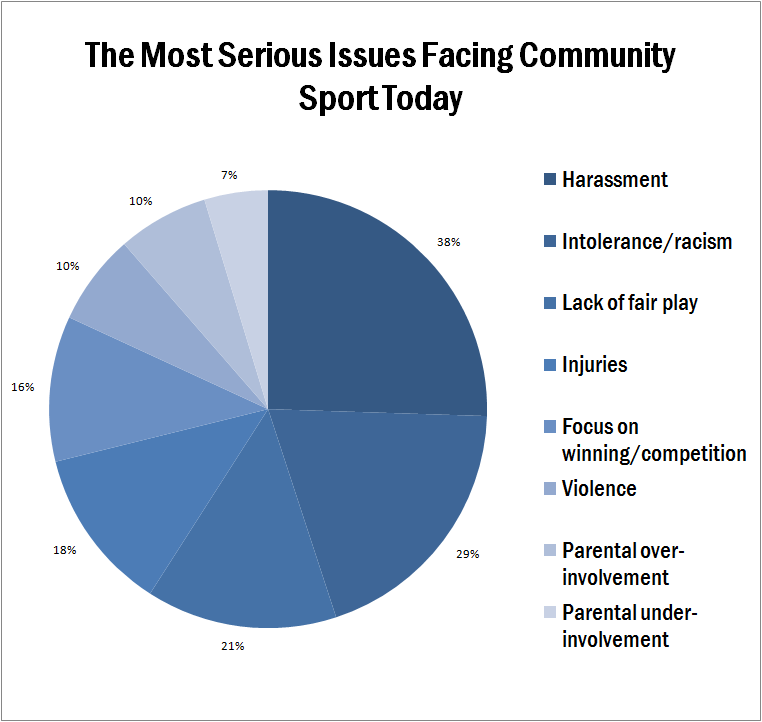
A Decima survey of Canadians highlighted a range of issues that may be partly to blame. Respondents identified the following as the most serious issues facing community sport today:
Source: 2002 Decima Study of Canadians / True Sport Report 2008
Why is it that harassment is identified by Canadians as the most serious issue facing community sports, yet when I have done research into association’s policies most merely provide links to their respective provincial or federal safety policies?
More often than not there tends to be very brief statements like “Hazing or harassment of any kind is not permitted.” They rarely define the varying degrees of harassment to include hazing, bullying, cyber bullying, and other forms of mental and physical abuse. If we are going to ensure that harassment is not a serious issue, we need to work on educating all those involved.
Although every year I make clear to all of my teams that I have a code of conduct which includes a zero tolerance policy to any forms of harassment, I haven’t ever elaborated with a follow-up meeting or any documentation that will further educate both parents and players where the line is drawn. Unfortunately, it appears we still have a lot of work to do to ensure it’s no longer a serious issue.
Of those parents who felt their expectations for their child’s sport experience had not been met, the following were the most cited reasons:
-
Lack of interest/participation (25 %)
-
Poor coaching/supervision (14 %)
-
Too much emphasis on winning (12%)
-
Parental influence/pressure (8 %)
Parents wish for their kids to contribute. This is one of many reasons why we see the sometimes disorderly parental behavior we do in the stands. They want to see their kids play instead of watching the coaches running short benches to win games. 90% of kids would rather play on losing teams than sit on the bench for winning teams. I know I played on many teams that had sub 500 records, but we had fun, learned many life lessons and had great coaches that focused on developing our skills so in later years we did win more. It takes years to develop and the sooner that the adults realize it is a marathon, not a sprint to the finish, the better.
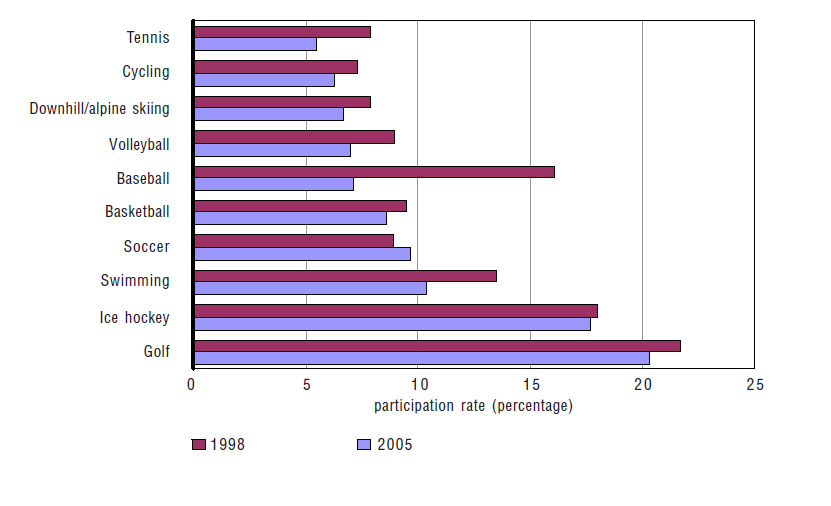
Another study I found was done by Statistics Canada, where they compared total sport participation (youth and adult) in 1998 vs. 2005 with the % of participation for the top 10 sports in Canada below:
Source: Statistics Canada – Total Sport Participation 2005
The #1 sport played by all Canadians was golf followed by ice hockey, both with slight decreases over a 7 year period. All but one of the other 8 sports also had decreased participation, the highest drop being baseball with an almost 50% decrease!
The same trend that is happening in Canada for little league baseball is happening in the US. See the short video below posted by the Wall Street Journal Digital Edition.
Although baseball has long been known as the national pastime in the USA, having both played and coached baseball, softball and slow pitch for the better part of my life I know that all of those kids and adults are losing out on a truly great game. There was no better feeling on a tournament weekend in the spring than when I walked out on the field with dew on the grass, slid into home base after a rainfall, or felt the ball connect with the sweet-spot of the bat.
There has been a shift away from hockey, with soccer becoming the #1 team sport in Canada.
In fact, the only sport in the top 10 that saw an increase in participation rates was soccer. Soccer has over 775,000 youth sport participants compared to our winter national sport of ice hockey which currently has approx. 625,000 registered players.
In the very young age divisions, youth participation in hockey continues to grow for females and for boys ages 5-8 years old thanks to programs like First Shift sponsored by Bauer. Unfortunately once rep hockey is introduced at 9 years old that is when the attrition rates grow and players begin quitting; by first year bantam 70% are hanging up their skates.
Compare these statistics with a survey done by Harris Interactive in 2004 who surveyed over 1,200 8 to 18 year olds about their participation in organized sports in the USA. Below is a summary of the negative experiences they had in sport:
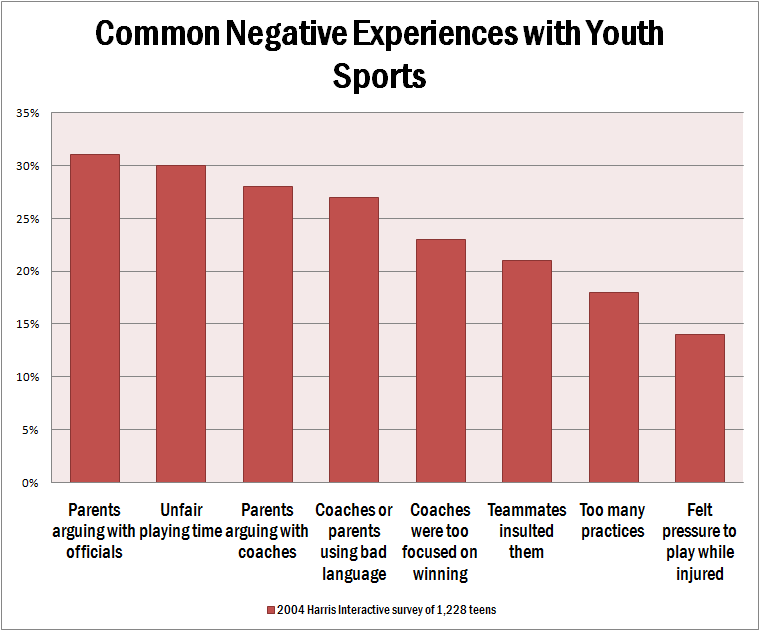
Source: Harris Interactive Survey – 2008
The top 3 reasons from this survey are still evident, if not worse, over a decade later:
-
Kids saw parents yelling at or arguing with officials – this is what is leading to 33% of officials quitting each year as I outlined in “Why officials Quit”
-
Kids did not to play as much as they wanted – AKA coaches ran short benches to win games as I outlined in “Lack of Fair Play – The Other Reasons why Kids Quit Sports”
-
Kids saw parents yelling at or arguing with coaches. The main role of parents is to unconditionally love their kids and just “Love watching them play.” Cheer them on, be positive and let the coaches coach.
In addition to the hundreds of hours youth coaches volunteer to plan and run practices, coach games, and conduct individual player and team meetings, they first have to get qualified to coach. This includes police record checks, concussion awareness, respect in sport, online and face to face clinics, making ethical decisions and some even have to be evaluated running practices.
Many sports require that coaches obtain NCCP (National Coaching Certification Program) credits each year to maintain their qualifications to coach. It is a vicious circle in any sense: parents are challenging coaches who have stepped up to coach which results in the fact that many others don’t put their arm up as a result. Hence the reason why every parent I have interacted with knows I have in my agenda “Let the Coaches Coach.” I had one coach in a clinic say “coaches coach, players play, and parents pay.” This I do appreciate, with rising costs of sports, is one of reasons why parents have high expectations of the coaches. But remember, like the players, it takes years for coaches to develop their skill sets.
Last season in a hockey clinic I was running I had a coach go up one side of me and then down the other arguing that the commitment to coach now was just too much. This is another challenge in itself just like the issue of recruiting and training officials; all sports organizations today are having challenges recruiting and training coaches.
I appreciate there is a lot required of coaches today, and it is a big time commitment, but like that particular coach in that clinic I remind all others who complain that we are in it for one reason.
It’s all about the kids and helping them become they can be, both as a player but also as a person.
I suspect if we did the same survey of 8-18 year olds in Canada now the top three responses would be the same.
Fast forward 13 years since the Harris Survey and other stats I outline above, and it is even worse… now 70% of kids are quitting sports before they enter high school in Canada, US and other countries globally.
We need to stop the insanity and recognize that youth sports should be just that, a game that kids play for the love of the game, not one that has evolved to adults competing with each other through kids to win at all costs.
Here is a short video about Mark Sertich, who loves the game so much he still plays hockey 3 days a week at 95 Years of Age !!
Let’s work together to bring the game back to the kids … where it belongs.

2 thoughts on “Why Sports Participation in Canada is Declining”