Wear your parent hat at home, coach hat at the rink/field.

Posted Posted in Coach, Organization Executive, Parents

Years back I started a tradition with my family as I was traveling extensively for my day job then and when traveling in lieu of buying various touristy items for my kids I opted to buying the latest movie that we would watch when I returned home.

Although my kids have now become adults, as they are still going to college/university, they still reside at home (much like every other 20 something in the lower mainland of Vancouver due to the high costs of housing) and last night we decided to watch “Antwone Fisher” based on a young man who lost his father when he was 2 months old and was given up for adoption by his mother and had an abusive foster family environment until he entered the Navy.

Due to various emotional issues, particularly anger the led to him getting into numerous fights, he was ordered to see the Navy Psychiatrist brilliantly portrayed by Denzel Washington who helped Antwone overcome the various emotional struggles he experienced from losing both his father, turned over to what was an abusive foster care environment by his birth mother and then he lost his best friend in his late teens.

You’re probably wondering why I am sharing this, but the reason I am doing so is that I can relate to Antwone’s journey on a few fronts which is why I get very emotional when I watch the movie.

#1 – Like Antwone, I lost my father when I was very young, at 8 years old and as a result of his work we had had moved 8 times already to be close to the buildings he managed (so can relate to all the military brats out there), but also how disappointed I was that he was unable to honour his promise to coach my baseball team as he died half way thru the season.
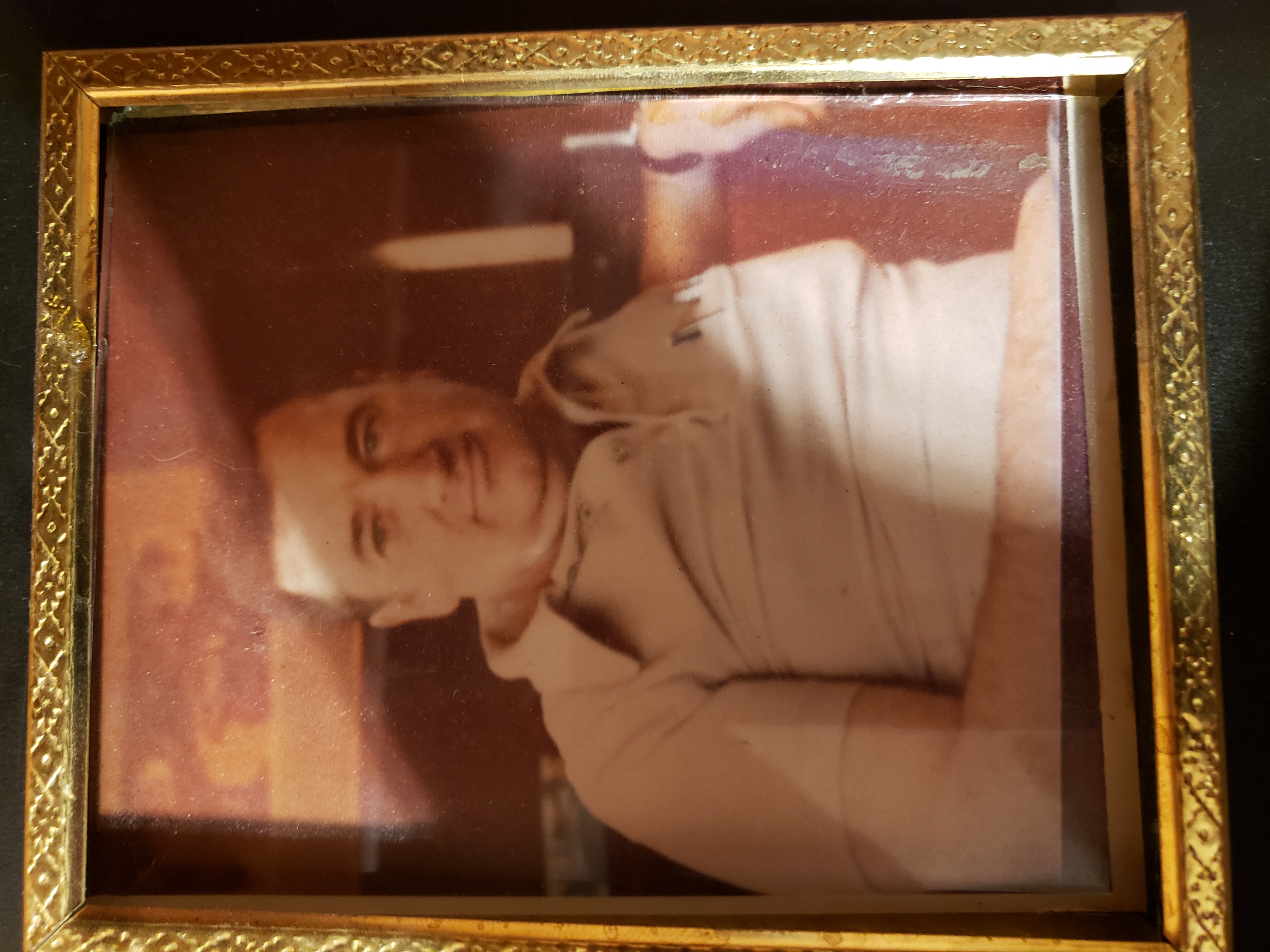
My favorite picture of my Dad that I actually took when we were on the train heading from Montreal to our new home in Vancouver when I was 7 years old

#2 – Like many youth without a father, I ended up hanging out with a group of misfits, my non-sport “friends” in my teen years but also continued to play various sports, in particular contact sports hockey, football and rugby as I too had issues with my temper from not having a Dad to turn to but the team mates in sports and coaches I had help me keep it in check, would say to me all the time to use my temper in a positive fashion by being tough to play against.

One of the main reasons that I am so passionate about sports and kids is all the amazing coaches that I had and team mates who helped steer me down the right path vs. “my friends” that went down the wrong path (many of which did not graduate high school, were imprisoned for various reasons so who knows where I would have ended up)

#3 – Although playing contact sports did keep my temper in check at times, one that I did not try and several said should have was boxing as I did in more than my fair share of bar brawls over the years into my mid  20’s until I lost my “first and last fight” (to that point I had lost a fight in any of the brawls I had been in) and was beaten up so bad that I made the original Rocky pic of Sly look like like he only had a couple of love taps that lead to me recovering from a concussion for several months and ended my collegiate rugby career and chance to represent Canada Nationally as I had been invited to attend the national camp later that year.

All of that is water under the bridge now, as I transitioned to working a day job to coach after I completed my post secondary education at night/weekends  and when I became a parent I made a promise to myself having lost my father so early that I would be there for my kids, be their coach like he couldn’t and support them to the best of my ability.

This Saturday I did a presentation of my core talk “Don’t be a Kid’s Last Coach” for Ontario Lacrosse virtual 4 day conference and shared a couple of tips for the coaches as majority of youth sports are parent coaches;

Tip #1 – When you are a parent coach, ensure you wear your parent hat at home/in the car and when get to the rink/field/court put your coach hat on and vice versa

When I shared that analogy to coincide with a video on the ride home that I have shared for a hockey clinic, one of the coaches came up to me during the break and was in tears and I asked him if he was ok and he said he never thought about it, but his 10 year old son shared with him that he was going to quit hockey as was not having fun that he was wearing his coach hat all the time.

He coached him at home, at the dinner, breakfast tables, in the car to and from the practices and games and shared with me that he will take my advice and only coach at the rink.

The clinic was in November, in March I received an email from the coach later that season sharing how appreciative he was of the advice and the relationship between him and his son was so much stronger and happier,  and his son was looking forward to playing soccer in the off season and told his dad thanks for being his coach and was looking forward to next season in hockey.

Tip #2 – Treat your son or daughter the same as all the other players and ensure they call you Coach when you have your coach hat on and Mom/Dad when you have your parent hat on.

Two things can happen when coaching your kids, you can either make them one of your favorites and give them more playing time, top lines, positions (which is the big reason why competitive hockey now has tried to go the non parent route but at huge cost for honorariums for coaches) OR you can be too hard on them.

The latter is one that I saw in my third year coaching minor hockey,, one of the coaches of the U8 team that shared ice with for practices would constantly scream at his son for making mistakes, although he was an early bloomer and one of the top players in our age group, I could tell every time his Dad did so he lost a little more of the joy he had for the game.  Although I would talk to his Dad numerous times when he beraded his son reminding him he was just a kid, game should be fun, treat him the same as others it went on deaf ears.

I heard the following year that his son had quit hockey and all other sports, his Dad also was not invited to come back to coach again as a result.

I know all too well how hard it can be as a parent coach to ensure you are not biased either way,  I also know how big of a time commitment it can be for all of us that juggle many things including work, perhaps other children, perhaps coaching multiple teams and sports as a result.

Although I know I made my mistakes as well, probably the greatest reward I received was when my son was 19 and was asked to play on a Junior Ball Hockey Team that several of his team mates and he had talked and asked if I would help coach the team as the head coach merely put up his hand as they were having a tough time finding coaches.

To which I humbly said, yes, I would be glad to help out and had a blast coaching my son and many of his friends who he grew up with playing a myriad of sports.

Sadly I don’t get to watch him or my daughter play youth sports any more, but I can look back with a big smile on my face how much I loved watching them and all their friends (part of my extended family) play the sports they loved and continue to be active in their adulthood.

At the end of the day, that is all we can ask for as parents and as coaches, if they play at a high level beyond their high school years that is just cherry on the cake.
PS Tagline - Dont be a kids last coach


Why Officials Quit (2019)

Posted Leave a commentPosted in Athlete, Coach, Organization Executive, Parents

A couple of years back I posted Why Officials Quit and have continued to do a lot of research on the subject due to the fact that every sport organization that I work with is not only having challenges with player attrition, they also are losing officials to the point where many say they have to scale back on number of teams or games as a result, and in some states in the USA they have declared many of their sports programs are in jeopardy due to lack of officials.

This weekend I will be doing a talk on that very subject for Softball BC, titled “How to attract, retain and increase the number of officials in your organization”

It is based in part on the post I followed up with last year called “Why do Officials Officiate” but for purposes of this post wanted to share why we are losing so many officials year after year.

Top Reasons why officials are quitting are;

  1. It is not safe to fail:

Having talked to many officials and those responsible in various sports organizations, the trends are consistent, as I shared prior Hockey Canada loses 30% of their officials every year, as does every sport that I have talked to as we started to partner with various other sports organizations.

Why?  Because the officials who take a lot of pride in not make mistakes, are quitting because of the abuse that they are taking from adults (parents, coaches or fans) when they do make a mistake OR when they believe they made a mistake.

This is one of the videos I came across that shows very clearly that the umpire made the right call, but received 17 different abusive phrases from parents who were seated in the visitor section (along the 1st base line) who did not have the same perspective as the umpire.

He clearly made the right call as did have the right perspective, but all the parents on the visiting team thought nothing of screaming out their perspective which was wrong.


  1. Poor Sportsmanship: 

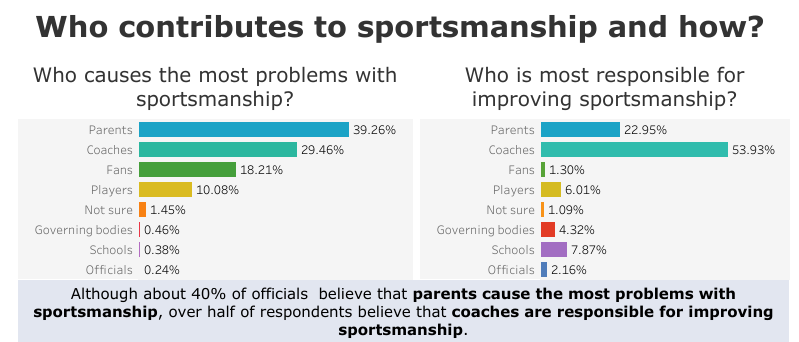
Above are the results for the largest study I have come across where over 17,000 officials replied to a survey from multiple sports done in 2017.  Almost 40% stated it was the parents that were causing the problems, followed by almost 30% of coaches, combining for approx. 70%.

Poor Sportsmanship was also one of the top 3 reasons that were the reasons why 11,000 players quit playing lacrosse in the retention report Alberta Lacrosse shared with me.

No matter what organization that I reach out to potentially partner with across Canada regardless of the hat I am wearing, even though 70% of the issues leading to officials quitting which goes hand in hand with the players is poor sportsmanship, when I ask what they are doing to curve the problem, they say they don’t have budgets for coach or parental education.


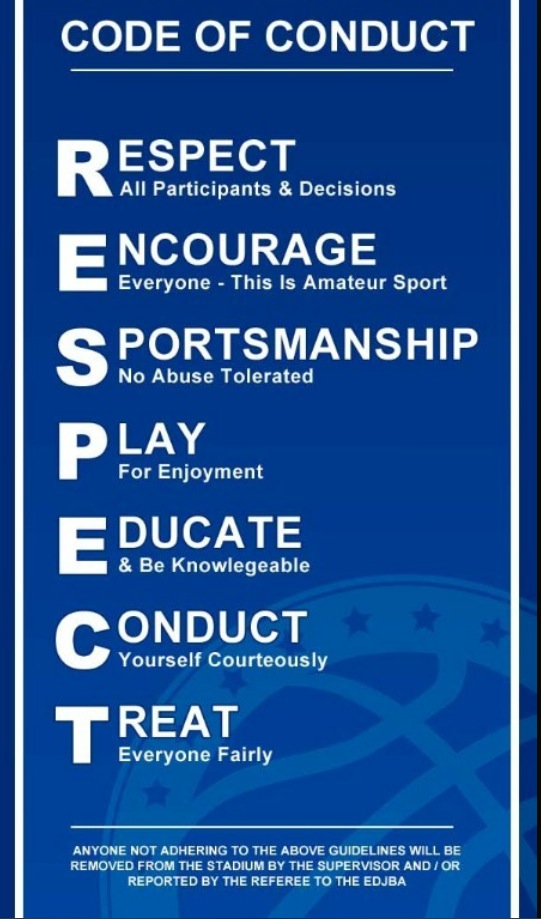
Translation: They keep doing the same thing over and over again expecting different results (Insanity), posting signs at rinks or fields like the ones above, making it mandatory for parents and coaches to take respect in sport online course for approximately 3 hours but don’t rigidly enforce policies for a zero tolerance for ANY forms of harassment.


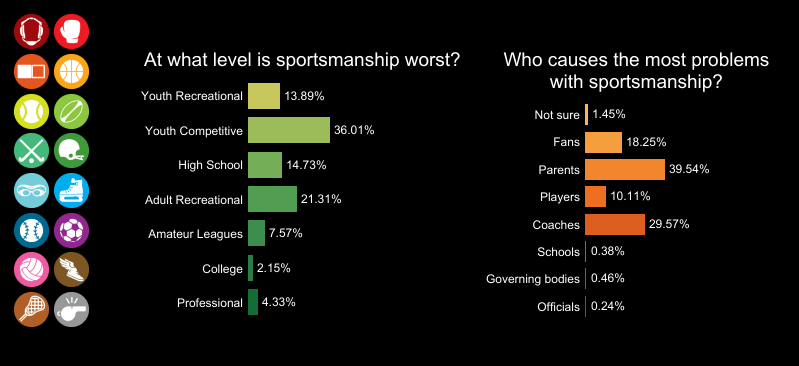
When asked at what level is sportsmanship the worst, 36% of the officials stated it was the youth competitive level, followed by 21.3% adult recreational level.

These results did not surprise me at all.

Youth Competitive due to high expectations from parents due for a return on investment for the tens of thousands of dollars they invest in their child’s completive youth sports experience to get an NCAA scholarship or play professionally is what is translating to the vocal minority of parents screaming and umpires when they perceive they made a bad call.

Parents – the majority of these officials are just a level above your son or daughter, and many officials start at the age of 12 years old, and within 3 years associations are starting all over again to recruit officials as most have quit.

The second highest level, adult recreational, having played adult rec hockey, as well as slo-pitch for many years, I saw it firsthand how many who were playing adult rec thought they were living the dream playing professionally and took it a wee bit too far and would go at refs or umpires like they lost a Stanley Cup or World Series Game.

Every time I would approach them and say, relax, it’s just a game (yet another PSA campaign by Hockey Canada in 2004 when things really started to ramp up in terms of parental behavior in the stands).

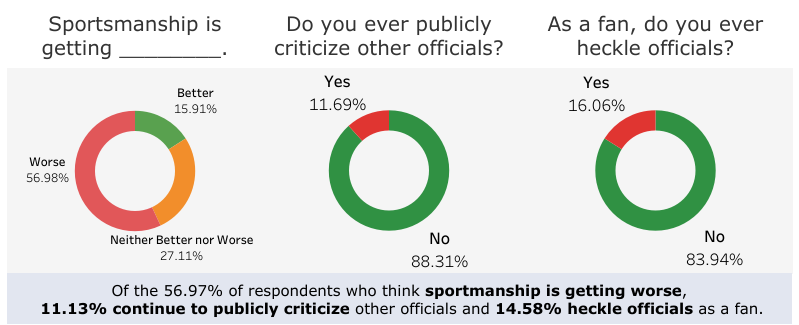
When officials were then asked if Sportsmanship is getting _______, almost 57% said it was getting worse, 27% neither better or worse but thankfully the remainder, close to 16%, stated that sportsmanship was getting better.

This I believe is due to all the organizations and awareness campaigns that have come to fruition in the last decade (including our own) to combat the impact of poor sportsmanship that is impacting the quality of the youth sports experience for kids.

What I was truly surprised with, however, was the fact that some officials responded (11.69%) publicly criticized other officials and when a fan at games, just over 16% confess they heckle their own fraternity.  If truly are going to change the way officials are treated, they must adhere to the very same Respect rule I have for all my teams and NEVER criticize your teammates.


  1. Fear for their Safety

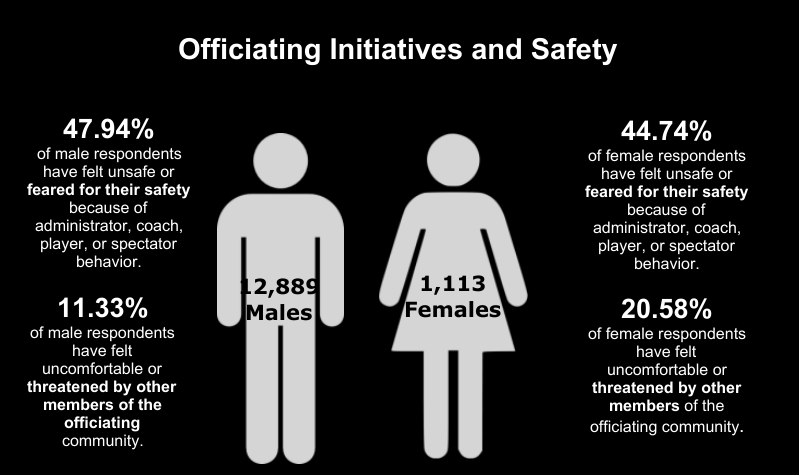
I shared this in the prior post that Almost 48% of the male respondents, and 45% of the female respondents shared they feared for their safety because of administrator, coach, player of spectator behavior?

What I did not highlight is just over 11% of male and 20% of female official felt uncomfortable or threatened by members of their very own officiating community.

Really?

What happened to all being it in together as a team?  Again, officials have to respect all others and avoid threats towards others in their community if we are going to reverse their fear for their own safety.

How then do organizations reverse these trends by ensuring that officials have a safe to fail environment, take pride in becoming the best they can be, are not in fear, that sportsmanship includes respecting ALL calls made by officials?

Organizations have to stop putting up signs, sending out public service announcements and as a means “to deal with parents”.  Most people don’t read signs anyway (thanks to my past experience working in the hospitality industry) and the time for PSA’s/Whitepapers is OVER.  It has come time to activate strategies so that sports organizations are accountable for everyone’s safety and creating a quality sporting experience.

In lieu, invest in parent education and teaching their coaches how to engage parents in lieu.

The vast majority of parents are AMAZING people who are doing everything they can to support their kids navigate what has become professional youth sports in lieu of kids playing kids like it was when I grew up.

They also have to recognize that officials are key stakeholders to ensure that today’s youth have a positive sporting experience, without them, kids will merely be having practices.

I worked at BC Place Stadium in security for many years and worked many BC Lions games as well as concerts and if fans became unruly (more often than not due to drinking too much) it was really simple, they were removed from the facility.

If they got into a fist of cuffs with fellow fans, we escorted them to the Police Wagon where they were brought to the station and potentially charged.

If we did so at professional sports events, why then do we not do it at youth sports events?

In lieu of having security surveying the stands, coaches and parents should be doing the same just as they did a generation removed.  If someone was acting up, a coach, parent or board member would approach them and eject them from the facility.

If a parent, coach or fan becomes unruly, too emotional, abusive, they should be removed so they can calm down and not permitted to return no differently when coaches are ejected.  The vocal minority of parents that do so be held accountable to the point where future incidents are treated with longer suspensions and using the same 3 strike rule, if a repeat offender;

Sorry we will miss you.

Meaning, we will not permit you to be a member of our organization.  Just like playing youth sports is a privilege (now more than ever due to pay to play model), so is that of being a member of the organization as parent, official, board member.

As far as I am concerned, no one, whether it be player, coach, official or board member should be in fear or a victim of verbal, worse yet potentially physical abusive threats and we need to bring the game back to the kids.

It’s time to stop doing the same things over and over again and expecting different results (Insanity)

Just like we should see the smiles on players when they are at games, the same should hold true for officials of any sport, they too should have a quality sport experience, otherwise the trends where 30% quit every year will just get worse.


Let’s all work together to bring the game back to the kids … where it belongs.


Don`t be a kids last coach

The Reality vs. the Dream of NCAA Scholarships and Going to the Show

Posted 21 CommentsPosted in Athlete, Coach, Organization Executive, Parents

Every day I come across another study, article, or blog post about the dangers of early sport specialization and the driver for same is parents aspiring for their son or daughter to receive a NCAA scholarship for their chosen team sport to ultimately be drafted to play professionally.

Translation – Get a full ride to get an education and save Mom and Dad over $200K USD, get drafted and then you can take care of us with your Multi-Million Dollar Salary playing professional sports (ROI = Return on investment)

As I have shared with every coach, parent over the years, if that truly is your goal for your son or daughter, start a RESP (registered education savings plan in Canada) or the whatever the equivalent is in your nation when your son or daughter are born.

By the time they are ready to apply for post-secondary education, you will have their scholarship.

IF, you roll the dice and encourage them to specialize as early as 7 years old, these are the real statistics that you need to be aware of before you do so;

  1. Specialization will lead to burnout, even though they may love the sport you encouraged them to specialize in early, the trend where 70% of kids quitting that sport and all sports in general before they enter high school still continues in many developed nations across the globe.

Translation – the 10’s of thousands of dollars, thousands of hours you and your child invested chasing the scholarship or ultimately playing professionally will be for not

  1. They will potentially suffer one or more major injuries that could end their season, worst case, career ending due to overuse

Translation – Again the 10’s of thousands of dollars, thousands of hours you and your child invested chasing the scholarship and ultimately playing professionally will be for not

  1. Full Ride scholarships also are few and far between, most are partials, approx 8.7K – 10.6K USD. Majority of those are for Div 1 schools only (the most expensive tuition and hardest to get into), some in Div II and none in Div III schools.

Translation – Even IF your child gets thru 1 and 2 and is offered a scholarship, it will only partially offset the  actual out of pocket costs.  Compound that with tuition fees alone for international students to the very same schools that offer scholarships can exceed $40K per year it will still leave the family with huge financial outlays each year.

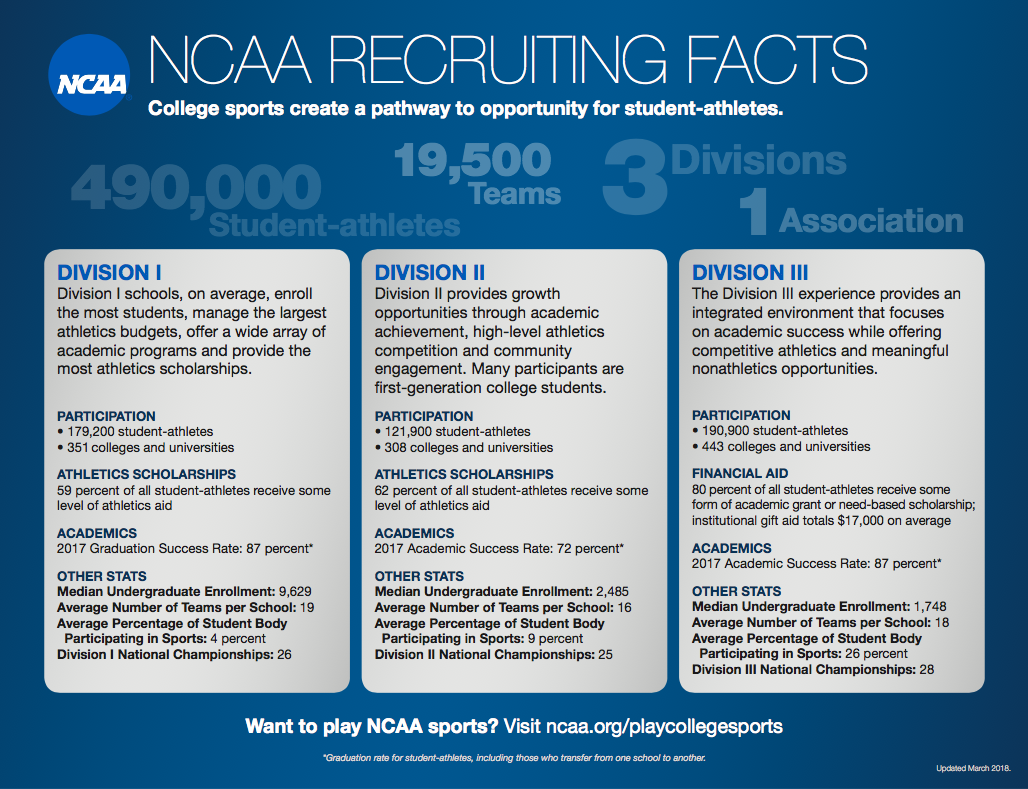
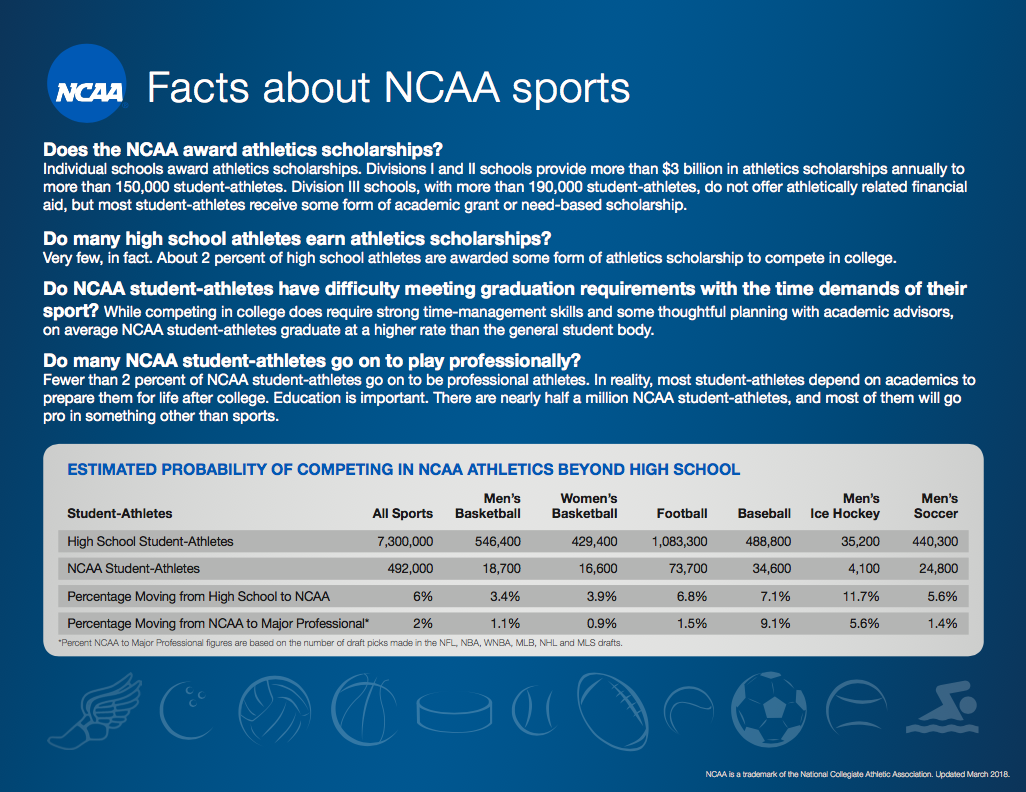
See below for the NCAA facts from March 2018


FACT – Only 2% of the NCAA athletes will be drafted to their major professional team sports but there is no guarantee they will actually PLAY even one game.

The two main NCAA team sports that are driving specialization are Baseball and Men’s Ice Hockey that have much higher % of players being drafted to their major professional levels (9.1%) and (5.6%) respectively vs. other team sports.  Being drafted is one thing, but being drafted, signing a contract, playing a game or a having a long career is another thing altogether.  One of the downsides of specialization is even those that do get to play if specialized starting in high school they will have shorter playing careers than those that continued to play multiple sports until or even in college/university as we shared in our January post

Early Sport Specialization does more harm than good

In the early 90’s, the OHL did a study based on the 1975 birth year of players, approx. 30,000 registered at the time in Ontario,  when they were eligible for the NHL draft and this is what they found;

  • 262 were drafted to the OHL (0.87%)
  • 113 drafted to the NHL (0.37%)
  • 38 Signed an actual contract (0.13%)
  • 22 Played only one game (0.07%)
  • Only 11 were active at 24 years old (0.04%)

I have yet to come across a similar study for MLB players drafted vs. those that will play for the major-league clubs they signed with, but like NHL, the majority come from the first round and after that will potentially have long careers for their minor-league affiliates.

Here is the math based on current trends of kids specializing at 7 years old and entering clubs/academies for 10 years before they even reach the collegiate level.

Most Current Data Set Available from 2013 for team sport participation

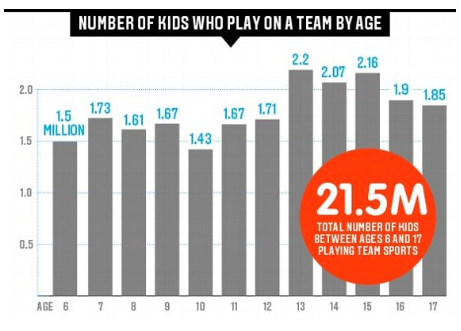
21.5M kids playing youth team sports in the USA;

  • Of those 7.3M will play team sports in high school (football being number one with over 1M) = 34%

Per March 2018 NCAA Facts (of those that played team sports in high school that went on to play in the NCAA)

  • 492K went on to play at the NCAA level = Only 2.3%
  • 59% of athletes at Div I schools offer a handful of full ride scholarships, majority are partials
  • 62% of athletes at Div II schools receive some level of financial aid/smaller scholarships
  • 80% of athletes of Div III school athletes receive some form of financial aid only, no scholarships

Student-athletes in Div II and III schools aid is more in student loans than actual bursaries or scholarships, subject to being repaid back (which puts further stress on the family to do so) vs. scholarships for Div I schools do not require repayment.

  • According to Mark Emmet, President of the NCAA, when players on NCAA men’s basketball teams were surveyed, 75% of Div I, 50% of Div II and 25% of Div III athletes believed they would play professionally when just over 1% were drafted to the NBA in 2017
  • Assuming 2% of NCAA Athletes go on to major professional levels, that is 9840 of the 492K student-athletes
  • Going back to the total 21.5M that played team sports from 6-17 years of age as the feeder group to those that went on to play at the NCAA level, those that were drafted to major professional sports (9840) only equates to  0.04% 

This is the same % that I have shared from numbers shared at the Hockey World Cup Summit in Toronto in 2016;

  • Approximately 2M kids playing hockey globally, Canada and USA accounting for 1.2M, the rest for other nations in Europe and did not even include the sleeping monster China
  • 700’sh roster spots in the NHL = 0.04%
  • The number of NCAA scholarships offered to Ontario born players has dropped 63% the last 10 years. Why? Because the USA has developed their ADM (American Development Model) over the same time period and is developing their own vs. those born elsewhere

Similar Stats in terms of soccer (MLS) based on registration numbers in the US in 2014;

  • Approx 5.7% of the 414K boys played soccer in high school
  • 7% (23,602) will go on to play soccer in college
  • About ½ of those (2.8% or 11.6K) will play Div 1 level (where athletic scholarships are available)
  • Average scholarship = $8.7 – 10.6K USD (gone are the days of full rides, now the average is approx 8.7K for all sports other than football and basketball that the average is 10.6K USD falling well short of that the actual annual costs will be)
  • Only 72 of those playing in college will go on to PLAY professionally = 0.02%
  • BUT 26% of parents think their kids will play professional soccer

I suspect the same % would hold true for English Premier League (European Football), NFL or other professional sports programs where players salaries have increased to the millions of dollars (not including the lucrative endorsement deals)

TD Ameritrade did a study with their clients in 2015 as they were concerned they were not investing enough for their retirement.

  • Many of those that replied stated a large portion of their disposable* income was being spent on youth sports.


  • 43% of those stated that youth sports were too expensive.


  • 67% aspired for their child to get an NCAA scholarship (only 2% potentially will)


  • 47% think their kids will play professionally ( reality = less than 0.5%)


  • 34% think their kids will become an Olympian (reality = less than 0.1% will)

* How many of us actually have disposable income anymore, with rising costs of housing, gas alone, more and more families are living paycheque to paycheque

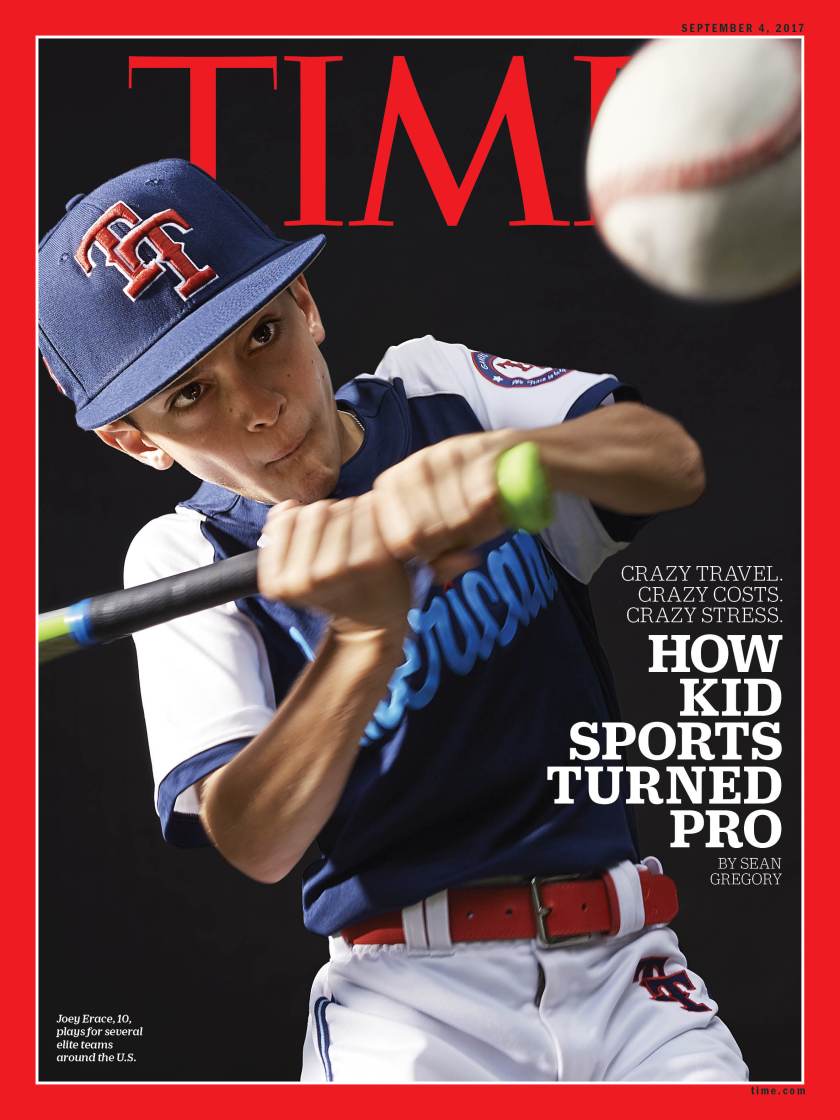
Two Years Later – Time Magazine shared that youth sports in the USA had evolved to a $15 Billion Industry due largely to specialization and the growth of private for-profit clubs and academies.  The industry has literally doubled in revenue in less than a decade!


These private programs are now costing anywhere from $15 to 50K per year (some include travel costs, some do not) so using an average of $25K per year (for travel, programs, gear, specialty trainers etc), and you signed up your “talented” child to year-round program starting at 7 will exceed $250K even before they get to college (AKA – NCAA PREP)

This does not include the opportunity loss of taking personal days, weeks off from your job to chauffeur or fly your child to all the prospect tournaments, games so a scout may “potentially” see them play (if they are good enough, they will be seen TRUST ME, you don’t need to spend all that extra money and time and if you truly aspire for that level, majority of college and professional coaches are recruiting multi-sport ATHLETES)

This is roughly the equivalent what it would work out to for a Div I school tuition for an international student which “may” only be offset by partial scholarships (literally covering meals) of 8K per year (full rides are about as rare as the Giant Panda).

This also does not include the equipment, apparel or other costs that I call “the fluff”

Drum roll …….

NET out of pocket for NCAA PREP (academies) and NCAA education WITH partial scholarship support can still cost …

ALMOST HALF A MILLION DOLLARS invested chasing the dream of playing professionally when the average is only 2% of NCAA athletes will get drafted and even if they do the majority will never play other than for their minor club affiliates and the actual number that may play in the Show works out to 0.02-0.04% in all the data referenced above).

Sadly, many parents are chasing THEIR dream, not their child’s dream, and when I have talked to parent’s almost all share they have not kept track of the math as either too scared to do so or they merely were trying to provide their child the same opportunity as others (AKA keeping up with the Jones).  Thanks to the traditional less costly community and high school sports programs competing with private clubs and academies they all get caught up in the same race only to find out at the end, the costs far outweigh the rewards.

One of the hardest things that I had to tell my son in his last year of minor hockey (when he was 17 years old) was I could not justify paying for AAA hockey thanks in part to mandatory travel tournaments that would push our out of pocket costs over $10,000 for the winter season.  This was MINOR HOCKEY, not an academy where the costs can push 20-50K.

Ironically it was the same conversation I had with my mother she shared that she could no longer support me playing hockey as my father’s life insurance ran out (well before specialization, spring, summer camps, $300 sticks, $1000 skates, Mandatory Travel tournaments)

What did I say to her?

It’s Ok Mom, I love hockey, but I would like to keep trying other sports, so I signed up for football in the fall ($125 reg fees that included all the equipment but cleats), rugby in the Spring (No reg fees, just $200 for jersey and cleats) and taught myself to play golf in the summer (junior fees were free or very low and I bought a used golf set for $100.00).  I had already won provincials (equivalent to a state title) in Hockey, and then went on to play for teams that won provincials in Football and Rugby.

What did my son say?

He understood and said he would rather play High School Volleyball ($125 athletic fees plus a pair court shoes) and Rugby  ($125 athletic fees plus a pair of cleats) and golf in the summertime so he could just go out there, work up a sweat, have fun and be with his friends.

At the end of the day, that truly is the reason why kids PLAY sports.

Sometimes we have to hear from the mouth of babes to bring us back to reality.

Let’s all work together to bring the game back to the kids … where it belongs


PS Tagline - Dont be a kids last coach