

Make it Safe

Posted 1 CommentPosted in Uncategorized


One of the key takeaways that I share in every presentation that I do is the importance of making it safe to fail and from all forms of harassment, in this post I will expand on the latter.

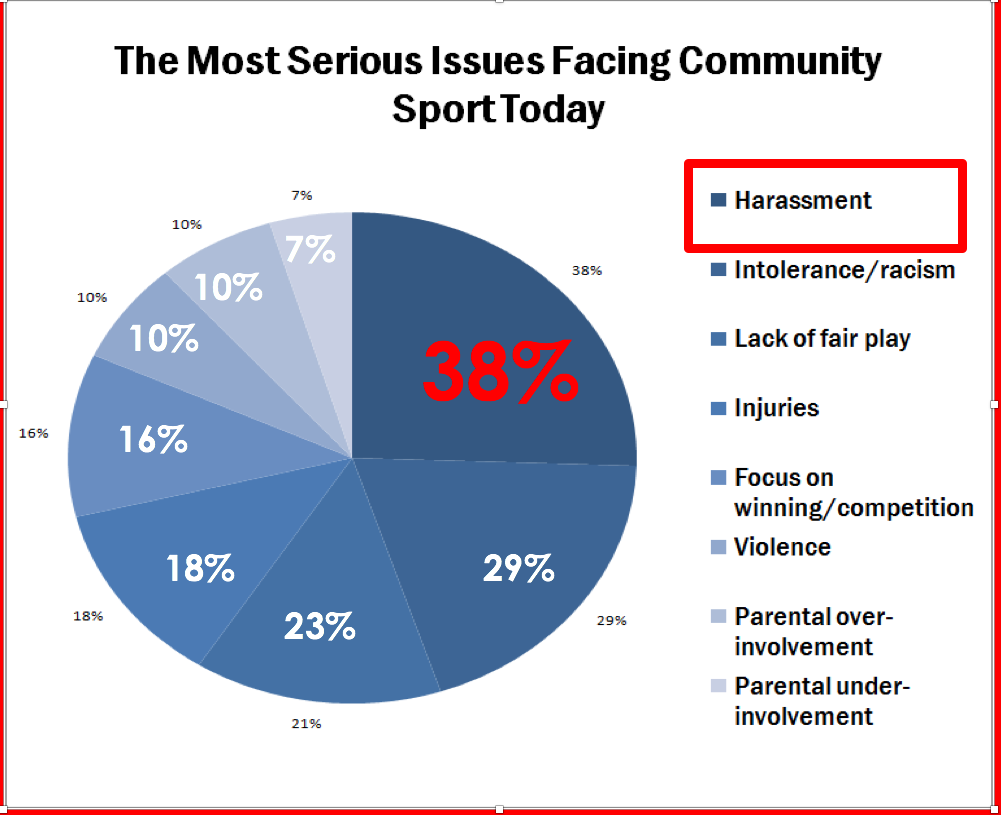
Below is a summary of survey results of a study that True Sport posted in their 2008 report where respondents stated what they felt the most serious issues facing youth sports.
BONUS – Download a Free Copy of this Blog in PDF Format HERE  


Source: 2008 True Sport Report

1.  38% of those surveyed stated that the most serious issue facing community sports was Harrassment.


This includes bullying, cyberbullying, sexual harassment and hazing.


Sadly, I have either dealt with various forms of harassment personally as a parent or coach, or heard thru various colleagues who have.  The biggest challenge that we all have is many parents don’t know the differences nor do they know how they can escalate to the point where it can cause serious psychological, even physical harm to those who are victims of harassment.


Several initiatives have evolved the last two decades to remove harassment from sport but we still have so much work to do to educate coaches, parents and sports administrators what the various forms of harassment are and what we can do to remove for sport.


  • Respect Group – formed by Sheldon Kennedy in 2004 as a result of the physical abuse he suffered while playing junior Hockey. They are responsible for the respect in sport program that parents, coaches, officials must take and now take refresher online course every few years.

Website:  www.respectgroupinc.com

  • Erase Bullying – Established to eliminate bullying from sport.

Website:  www.erasebullying.ca

Here is a great video from some of sports icons in British Columbia in partnership with ViaSport


  • Prevnet – Canada’s authority on research and resources for bullying prevention

They provide resources as well as links to all the other initiatives in Canada that are working on eliminating bullying from sport.

Website: www.prevnet.ca

  • Stop Hazing – A Leading Resource for Hazing Research and Prevention

Website:  www.stophazing.org

Facebook: Make Hazing Stop

Hazing has traditionally been the right of passage for those pledging for universities and collegiate sports programs, but is now happening in youth sports.

Hazing differs from bullying as it is more about inclusion to participate (making the teams) vs. excluding individuals and it can start with subtle hazing (rookies having to pick up the pucks in practices) to hazardous hazing including drinking excessive alcohol, having to digest chewing tobacco and other vile substances or various forms of sexual harassment.

In 2005, one of Canada’s most prestigious universities, McGill, scrapped their football season due to a hazing incident and since that time there has been 40 other reported hazing incidents in Canada and the USA.

The biggest issue with Hazing, is that majority of incidents are NOT reported as the victims do not want to be the whistleblowers and jeapordize their opportunities to be included or accepted on the teams they are rookies on.  Some even feel that going thru hazing is the right of passage and any identifying marks they receive are “badges of honour”.

Below is another recent example where rookies on the Vancouver Whitecaps had their heads shaved (badge of honour) by their team mates;
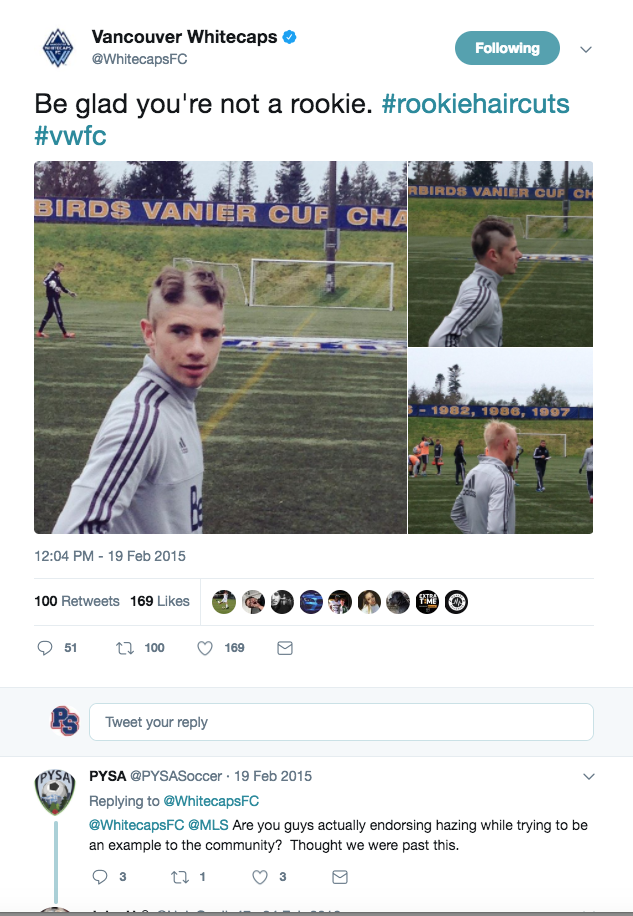
 

If you go to the original tweet and review the comments, approximately 100 people tweeted and all but a few were beside themselves that rookie initiations like this were still happening.

  1. The second most serious issue by 29% of the respondents was intolerance or racism.

Many organizations have developed campaigns to address the intolerance towards minorities, LGBT or those with disabilities.

Here are just a few that are doing great work

Here is a short clip from Team Canada Athletes standing up for inclusion in sport


  1. The 3rd most serious issue (23%) was the lack of fair play, click here to read prior post how lack of fair play policies are one of the reasons why kids are quitting sports.

It still amazes me how one of the most serious issues facing youth sports contributing to the 70% drop out rate by age of 13 how few NSO/PSO or Regional/Local sporting associations don’t have fair play policies.  Even when they do, will turn a blind eye or sweep under the rug vs. disciplining towards coaches that breach the policies.  The argument that I receive all the time is it is so hard to get coaches to volunteer so associations would rather have challenges with retention than removing coaches who violate fair play policies?

In my third year coaching minor hockey, I found out that a player who was on our “team” (initiation no formal games played) who was 5 years old was sat on the bench for all games in his second year as the coach (who did not return to our association) sat him “because he was too small to play”

HE WAS 6 Years old!!!

The following year I reached out to his coach to do what he could to get him back on the horse, ensure he got playing time in games (which he said was a no brainer) but he quit hockey as too much damage was done the prior year.

Almost every year thereafter I heard similar stories, kids being deprived the opportunity to contribute to the outcome game after game and as a result, would quit a sport they once loved.

  1. 18% of those surveyed stated injuries that kids were sustaining in youth sports.

This I believe is due to the early sport specialization phenomena that has arisen over the last decade where private business reach out to parents of kids are early as 7 years old to invest in private instruction, equipment and play year round to chase the dream of a NCAA scholarship or playing professionally.

Click here to read prior post on how early sport specialization does more harm than good

  1. The fifth most serious issue from 18% of the respondents was focusing on winning/competition.

In the last couple of weeks two instances have arisen in the USA that we shared on our Facebook page.

The first was when the coach of little league world series team consisting of 12 year players agreed to accept a 2 game suspension in lieu of permitting one of his players bat when it came his turn in the batting order.  Really?  The kids were 12!  The little league world series is just that, LITTLE LEAGUE.  Another example how adults are competing with other adults thru kids.

Click Here to read the article

The second how a California High School Baseball Player is suing his former coach for $150,000, claiming that benching him was bullying.

Click here to read the article

Bullying Definition: The abuse and mistreatment of someone vulnerable by someone stronger, more powerful.

His lawyer is arguing the player was benched in 14 games over the course of 4 months as a result has not had an opportunity to demonstrate his offensive or defensive capabilities …“is an abuse of the coach’s discretion.”

Is it bullying or is it a coach having a fall-out with his player (AKA in the doghouse)?  Does it warrant the player filing a lawsuit for $150,000?

It has created a lot of debate amongst those in the youth sports space where in fact it is bullying or not.  Also if it warrants suing his head coach but only time will tell if it does go to court, and if so, it will be a precedent setting case for either side of the argument.

If you are a coach, administrator or the parent of a youth sports athlete, please do your research to understand the various forms of harassment affecting youth sport today so that we erase all forms so kids don’t suffer psychological or physical harm.

In lieu, provide them the opportunity to be included in a positive environment and instil the love of the game so they come back each year ultimately with a big smile on their faces and are active well into their adulthood.

Let’s work together to bring the game back to the kids … where it belongs.

 

PS Tagline - Dont be a kids last coach


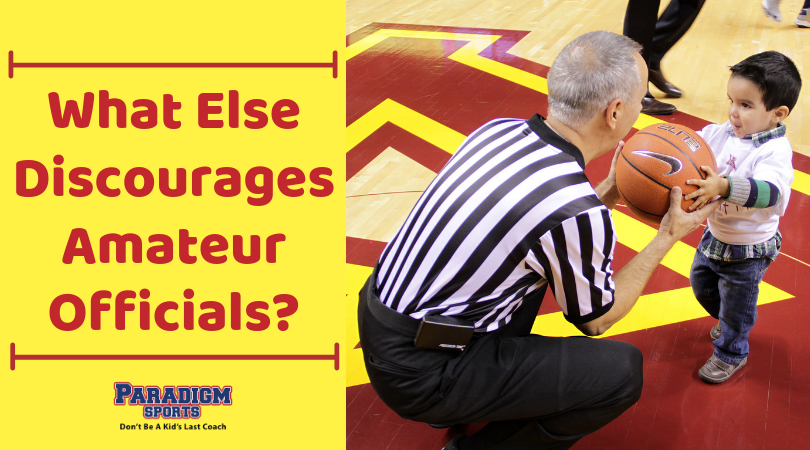
What Else Discourages Amateur Officials?

Posted Leave a commentPosted in Uncategorized

What Else Discourages Amateur Officials?

The life of an amateur umpire explained by long-time official

Michael Yamaguchi

April 04, 2017

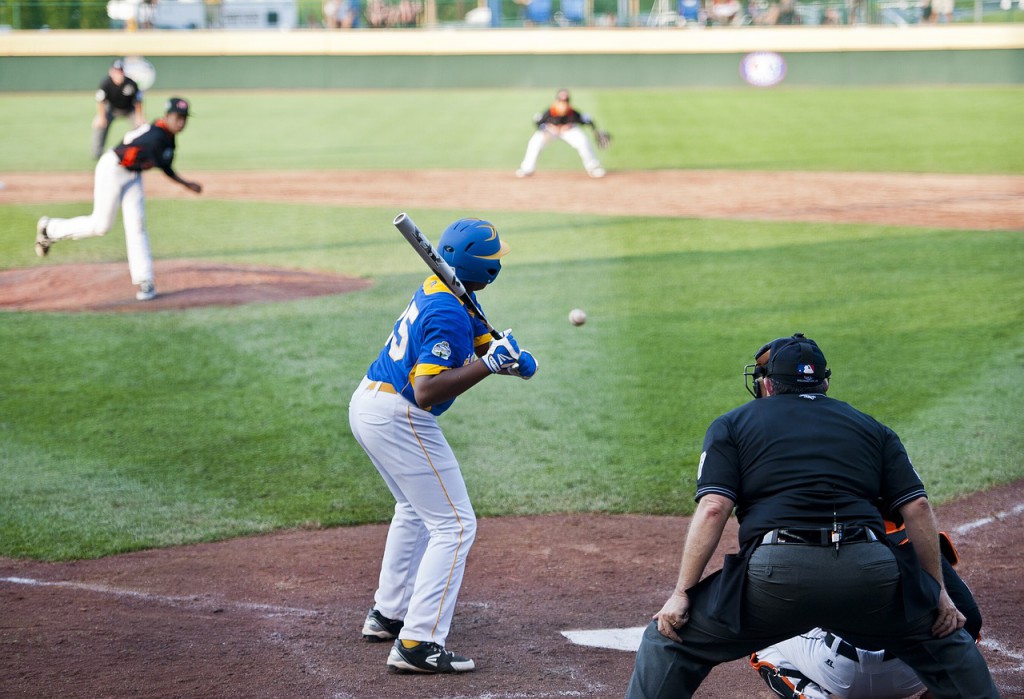
umpire at baseball game

BONUS – Download a Free Copy of this Blog in PDF Format HERE  

Over many years as a sports official for various leagues and in numerous provincial and national championships, I have been the recipient, have witnessed, or have heard of numerous cases of physical or verbal abuse towards youth sports officials. As mentioned in a previous blog post, the need for parent and coach education in regards to treatment of officials cannot be overemphasized.

However, it’s not just abuse from coaches or parents that’s driving officials out of officiating. While it is arguably the main cause, there are numerous other reasons that contribute to the high attrition rates. Specifically, I have noticed a few other causes:

  • Lack of recognition
  • Lack of a development system
  • An official’s own fear of failure

Lack of Recognition

How often are officials noticed during games? Normally never, until a questionable call is made by an official. I rarely hear fans or coaches compliment an official on getting a call right. Yet, when a questionable call occurs against their team, they’re often the first ones to criticize them.

Even today, I appreciate positive feedback from coaches or parents. Although it may not seem like a lot, positive feedback is a big difference to many young officials, similar to athletes. A finding from the study “Understanding Factors Contributing to the Retention of Canadian Sport Officials” suggests that praise and recognition from respected individuals has a positive effect on recruiting and retaining officials.

Some may say that coaches or spectators may not be able to recognize quality officiating in terms of distance, angles, timing, etc.  But there are a couple things that most people can recognize from officials without really paying attention to them – hustle and effort. On that note, senior officials will likely recognize traits of a good official. That leads me to my next point.

(Study – Livingston, L. A., and S. L. Forbes. “Factors Contributing to the Retention of Canadian Amateur Sport Officials: Motivations, Perceived Organizational Support, and Resilience.” International Journal of Sports Science & Coaching 11.3 (2016): 342-55. Web.)


Lack of a Development System

I began umpiring baseball in the fourth grade, and at the time, I wasn’t sure if I wanted to do it. My parents had encouraged me to try it, as they felt it would help me develop vital skills for the future. The only interest I had in umpiring was due to the fact I liked baseball at the time, and that I could maybe save up for a new bat.

At the start of my first game, I was nervous and absolutely terrified of everything: making mistakes, looking bad… you name it. Fortunately, I was paired with a more experienced umpire that supported me throughout the game. As the game went along, I received positive feedback and advice from my partner in-between innings and after the game.  Afterwards, I sort of looked forward to umpiring my next game.

In my current role as head umpire for a minor baseball association, I reflect back on this experience many years ago when considering how I can help aid the development of our younger officials. Apart from the occasional “disagreement” every now and then, my first year officiating was a great experience, and I wish the same upon the novice officials. Globe and Mail Reporter Hayley Mick suggested that more associations do the same back in a 2009 article on young sports officials.

Mentoring is crucial to an official’s development. Why? Unlike athletes, many officials do not practice their craft during the season. Typically, clinics are held at the beginning of the season, and after that, officials are all on their own. Many will show up to a game and perform their duties, often without thought to their signals, footwork, or coverage responsibilities. Without due care, officials can develop bad habits, and performance will deteriorate over time. A mentoring system will help officials improve, and eventually, will open up more opportunities for higher level officials in the sport.

More importantly, however, it’s inevitable that conflicts will happen between coaches or players and officials. An experienced official on the field can help an overwhelmed younger official deal with these situations. In my younger years, this has happened on numerous occasions, and my more experienced partners were able to “take the heat” for me. Had it not been for these senior officials taking charge, I would have packed in officiating years ago.


Fear of failure

For Major League Umpires, 95% accuracy is the accepted standard for balls and strikes. In an average ballgame at that level, there’s roughly 300 pitches. An umpire at MLB level can be wrong on 15 pitches, and still perform at an acceptable level by Major League standards.

If an umpire that makes their living calling balls and strikes can make around 15 mistakes every game, it seems that the “acceptable standard” should be much lower for amateur umpires. We don’t have high tech “K-Zones” like they do on ESPN, but I’d imagine that somewhere between 85-90% accuracy would be reasonable for a top notch amateur umpire working a high school game… two to three times as many mistakes as the professional standard! Mistakes, and lots of them, are inevitable when officiating any sport… especially when officiating is a hobby or part-time job, not a living!

The pressure of being right 100% of the time tends to get the best of many officials, surprisingly even the more experienced officials. I can’t tell you how many former officials I have worked with over the years that have either dropped officiating or get frustrated due to the stress of being perfect.  Also, I have met many who have expressed interest in officiating, but do not want the added stress of being “perfect.” The intrinsic pressure is enough, and the extrinsic pressure from coaches and parents doesn’t help at all. In fact, a study conducted by researchers at Middle Tennessee State University suggests that making a wrong call causes higher stress than receiving verbal abuse from coaches or spectators.


So, what can we do?

I encourage coaches and parents to personally compliment officials that hustle and put in effort during their team’s game. A simple “Thanks for working hard today, ref!” may not seem like a lot, but does mean something to a young official.

Associations should look to invest into some sort of development or mentoring system for their officials. Kudos to minor sports associations who currently offer some sort of system to their developing officials, but more can be done throughout.

There are many things that an association can do, including:

  • Having senior officials attend games to give feedback, emphasizing positive feedback.
  • Offering brief mid-season meetings or on-field clinics.
  • Convincing and offering remuneration top-ups to senior officials to officiate some games at levels they don’t normally work to help guide younger officials.

Sure, paying extra for an official to work a lower level game or to observe officials from the bleachers may seem like an added expense for the association. However, over time, these initiatives will improve officiating, leading to more enjoyable experiences for officials and indirectly for players and coaches as well.

My last point on the fear of making mistakes is more of a message towards fellow officials –chances are we’re going to make many, many more mistakes than a professional official who makes many mistakes! Always remember to put things in perspective, and like athletes, learn from the mistakes. After all, officiating for most of us is just a fun hobby!

Why Officials Quit

Posted 2 CommentsPosted in Uncategorized

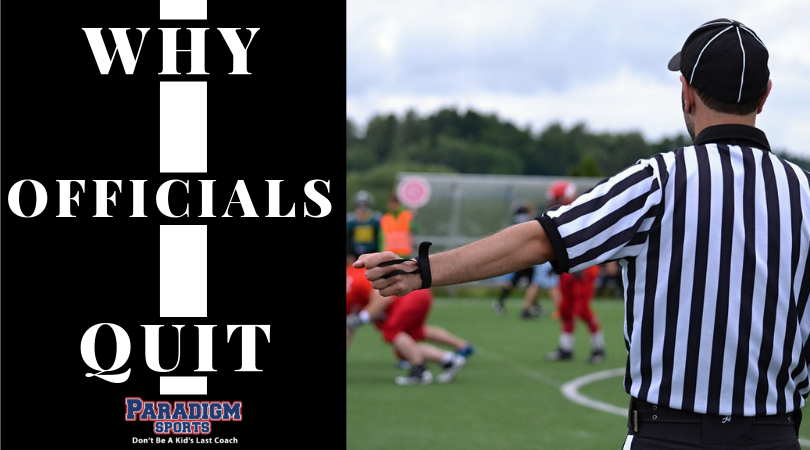
Why Officials Quit

Attrition rates for youth sport refs and umpires is too high

Glen Mulcahy

March 13, 2017

ref

BONUS – Download a Free Copy of this Blog in PDF Format HERE  

Recently, I came across some statistics about hockey officials’ attrition rate in Canada. Did you know that there are approximately 30,000 officials registered to officiate minor hockey games in Hockey Canada’s registry? Of those, approximately 10,000 quit EVERY YEAR – that is one out of every three officials!

Several Referee in Chiefs (RIC) that I have talked to who are in charge of recruiting and training minor hockey officials estimate that they lose approximately 50% of the officials that start at the age of 12 by the age of 15. I recently talked to the Umpire in Chief (UIC) of a minor baseball association and he told me that their attrition rate is similar to hockey officials. He stated that their association loses approximately 25% of their umpires annually.

The #1 reason why so many officials are quitting each year is due to the verbal abuse they are taking from parents, coaches, and even players.

These statistics bring back a painful memory to when I was coaching an Atom Recreation Hockey Team. We qualified for the bronze medal game of a tournament, but sadly that was the only good thing I recall about that day. The events that transpired were the starting point to why I started researching issues in youth sports.

During the game, our smallest and youngest player was skating down the ice with his head down and accidently skated into a player on the opposing team. Both players fell backwards and hit their heads. The coaches of the other team started screaming about how it was an intent to injure. They screamed at me and the officials, while their parental group followed. I was dumbfounded that they had no concerns about either of the players and the potential injuries that might have occurred.

I have been a long time believer in respecting the game and promoting a positive playing environment. This was merely an accidental contact of two very young players. After constant yelling from the coaches and their parents, the official escorted my player to the penalty box. Although I did not agree with the call, I understand why the officials felt it was necessary. Even with the penalty called, the coaches insisted that the player should be ejected for an intent to injure.  Through the pressure from the coaches and the parents, the officials decided to eject my player out of the game. As much as it pained me to do so, we finished the game and won the bronze medal. Instead of a celebration, our dressing room was concerned more about our player who was ejected. He and the officials were a victim of verbal abuse that nobody should experience in ANY youth sport. I followed-up with the tournament coordinator and the league to look at suspensions for the other coaches as a result of their behaviour. Unfortunately, no suspensions occurred.

I was told later that the two young officials had resigned because they were scared of the abuse from the coaches and parents. I reached out to the officials through the tournament coordinator and apologized to them about the situation. I told them that they were victims of abusive behaviour and that I would do everything I can to change the environment of youth sports.

When talking to parents over the years, many complain about the quality of officiating. I remind them that most officials are only one age group above their child’s. Just like hockey development, it takes years to develop and understand the rules of the game.

We don’t condone that behaviour at school nor at work, but why do we continue to condone it in the stands of sidelines of youth sports?

I counter those that challenge the quality of officiating in youth sports by stating that if parents and coaches encourage officials during their course of development and focus more on the process instead of game outcomes than amateur youth sports can retain more officials annually.

Don`t be a kids last coach

Why Kids Quit Hockey

Posted Leave a commentPosted in Uncategorized

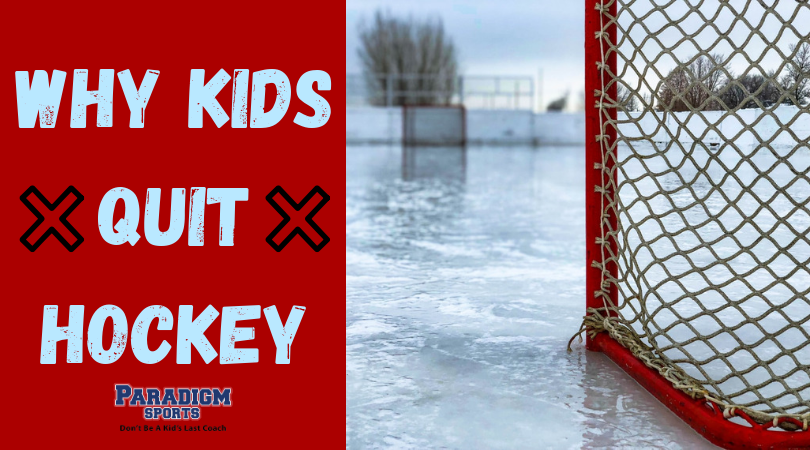
Why Kids Quit Hockey

The 5 core reasons why kids quit playing minor hockey
Glen Mulcahy March 11, 2017 empty hockey net

BONUS – Download a Free Copy of this Blog in PDF Format HERE  

After a CBC Radio interview, I was asked why kids are dropping sports in record numbers and in particular, hockey.  So I decided to break it down into the 5 core reasons why kids quit hockey: #5 – To Avoid Coach or Parent criticism I also have seen my share of coaches criticizing players in both games and practices for making a mistake .. some even screaming at their top of their lungs that it cost the team the game.  This is simply unacceptable and our youth do not need to experience this at such a young age. In January, 2015, Vancouver Island Amateur Hockey Association (VIAHA) wrote a letter proposing to ban parents from the stands because they continued to criticise every play and it was causing minor hockey officials to quit.  Saskatoon had similar challenges a couple of years back when one of their associations with over 1000 kids registered were in jeopardy of having their season cancelled due to a lack of referees. One of the ideas may be to follow the lead of BC Soccer or European hockey and push the competitive games to later age group.  In Europe many countries do not have competitive hockey until 13-14 and even then, they only play one game a week to ensure the optimal development of their youth. Criticising young minds causes stress and suppresses creativity. Let’s give kids the opportunity to be kids and PLAY without fear so they participate well into their adulthood. #4 –  It Costs Too Much In terms of the most expensive sports to participate in Canada, hockey was ranked #2.  First and third are water skiing and equestrian riding. 1/3 of youth in Canada do not participate in ANY youth sport due, in part, to high costs.  The average AAA hockey player costs families $8,000 – 12,000 per year and this number skyrockets for players in academies and specialized programs.  Then there are the out-of-town tournaments where after paying for tournament fee, hotels, transport, and restaurant meals families are out of pocket another $1500. It is no wonder why more and more kids are dropping out of hockey and pursuing other sports. #3 – The Time and Travel Commitment Rep Hockey in particular is a 5 day a week commitment for 2 practices, 2 games and 1 dryland session running from Sept to March.  These players are pressured to feel they need to participate in competitive spring hockey to stay in the rep-calibre levels. Some teams have consecutive weekend spring travel tournaments and have to commit for 6 consecutive weekends – so much for spring break.  Not only does the time/travel become strenuous, it does not help financially either. #2 – Too Competitive Coaches who focus on the outcome (winning) as early as the Atom Age group (9-10 years old) to achieve that goal.  This concerns me as hockey is a long-term development sport where players do not reach their peak performance until their mid 20’s. Some coaches even practice tactics like line matching, dedicated power play, penalty kill units, and pull players off the ice all in an effort to win. It is disappointing to see Canada’s second most expensive sport deprive kids the opportunity to PLAY in all situations and improve as a result.  Parents pay an equal share, so kids should play an equal amount. This is why BC Soccer recently eliminated scorekeeping from games U12 and under.  This gives kids an environment that is safe to fail.  When kids are less pressured, they work on skills and creativity in game play in a positive environment and worry less about making mistakes and being criticized. Amada Visek did a study in Washington DC asking kids what was fun about sports and the top 5 reasons were the following:
  1. Trying your best
  2. When coaches treated player with respect
  3. Getting playing time – 90% of kids would rather PLAY on a losing team than sit on the bench and not contribute to a winning team
  4. Playing well together as a team
  5. Getting along with your teammates
Ironically, although educators, coaches and parents believe that winning is important it does not align with where kids felt it was in terms of the characteristics of fun.  Of the 81 characteristics that Amanda found in her study, winning did not even fall in the top 40 answers. Although kids enjoy winning, there are many other driving factors.  Other studies show winning is not in the top 10 of reasons why kids play, so we need to educate parents, coaches and executive members what the top reasons why kids play vs. quit so are all on the same page to ensure the youth sports experience is a positive one for everyone. #1 – It is no longer fun Regardless what study I have come across over the years, the #1 reason why kids play sports is because it is FUN.  The reason they quit is because it no longer is.  Although reasons for quitting any sport or hockey differ slightly, the reason they quit starting as early as peewee (11-12 Years old) is that the hockey experience isn’t fun. Don`t be a kids last coach

The Ride Home

Posted Leave a commentPosted in Uncategorized

The Ride Home

Is coaching from the car really helping our children?

Glen Mulcahy

January 10, 2017

kid in back of car getting lectured by father on performance at practice

BONUS – Download a Free Copy of this Blog in PDF Format HERE  


One of the least talked about, but I believe is one of the biggest contributors to why kids quit sports is the ride home with parents.

In a recent coaches clinic that I ran, I talked to coaches about the importance of parent coaches wearing parent their coach hat while at the rink, courts or fields, and as soon as they left the facility, switch their hat from the coach hat to the parent hat as vast majority of youth sport coaches wear the dual hat as parent of one of the players on the team.

I believe that the ride to/from the rink, facility should be a positive one, for both of my kids that I coached on many different teams, or even when I was just the “hockey dad” our ride to/from was the same, they would pick their favourite music and we would crank it so they would get ready for games, practices, or after games in particular the opportunity to decompress regardless of the outcome.

One thing I would do, however, is zero in what I called a TSN turning point, something that either did that lead to a positive result, whether my son made a great pass that helped his team get out of the zone, or my daughter pitching a strike under pressure in a 3-2 count.  I then would remind both how much I loved watching them play and ask what music they wanted to listen to as well as what “snack” they wanted on the way home (for my son the snack evolved to full meals as he grew into a teenager).

Too often when I have either been wearing my coach or parent hat, have I seen first hand parents (who may also be coaches of their kids teams),  “coaching” their kids as they were heading to their cars so the “ride home” started well before that, and if they were criticizing their kids to that extent before they got in the car, I can’t imagine what it was like for them on the way home.  Think about the fact that at times the ride home can take up to an hour for many sports or possibly more for those sports played in rural areas.

Worse yet, parent or coaches may at times not turn off the coach hat at home, at the dinner table or other family activities.

In the particular clinic I ran, one of the coaches came to me at the end of the day literally in tears, he thanked me for bringing to his attention that at times he did not take off his coach hat and was coaching his son literally everywhere, at the rink, in the car to/from, at home and made for a very stressful experience.  His son was only 10 years old, second year Atom in hockey, and had already hinted to his father that he was thinking of not playing the following season even though his Dad stated he used to love the game, was anxious to get on skates at 5 and played outside (when weather permitted) all the time shooting on net or small pickup games with his friends.

He subsequently shared with me that he would stop “coaching” other than when he was at the rink, although he had the best of intentions merely to help his son become the best he could be, recognized there needed to be a time and place to coach.  Other coaches I have given the same advice to over the years have sent me short emails to thank me as it changed not how they were coaching, but how they interacted with their child athletes at home for a much more positive experience overall and both they and their kids were still involved in the same sport several years later.

Thanks to my friends at True Sport, below is a powerful video from the other side, the son being driven home by his parent.

As parents, or parent coaches, all we need to do in the ride home is talk about the positives, the process of learning (not the result of a game) and tell our kids how much we love watching them play.

By doing so we will instill the passion, love of the game so they not only play the following season but ultimately for many, many years to come vs. the current trends where 70% of kids are quitting all organized sports by the age of 13.

Let’s keep them in the game, that’s all it is, for various reasons youth sports have become way too competitive and only a small % of kids may play behind minor sport level, the majority “hopefully” will play adult recreationaly if we all do our jobs right as parents, coaches and directors by developing the love of the game in today’s youth so they are active for life.

Don`t be a kids last coach