
Why Kids Quit Lacrosse
The Shockingly Dwindling Numbers of Youth Lacrosse
April 27, 2017

BONUS – Download a Free Copy of this Blog in PDF Format HERE
Regardless of which hat I am wearing, running clinics, doing talks or workshops, the same issue comes up over and over again from coaches, parents and sports administrators … the challenges of retaining their players year after year.
It is not surprising as the current trend is that 70% of kids quit all organized sports by the age of 13, unlike my generation where we sampled many until we specialized in our late teens.
I recently was provided a three year retention report by the Alberta Lacrosse Association who surveyed approximately 1,100 families as they were concerned about retention numbers; over the course of 3 years they had lost 11,343 players!
Below is a summary table showing the total new male and female players as well as attrition for both genders over the course of 3 years. Although sports like lacrosse and minor hockey have seen exponential growth in female registrations in recent years, as a result of attrition each year the ALA’s (like many other sporting bodies year after year) overall growth is flat or only single digit increases. This could potentially be much higher if we able to retain more players.

(Alberta Lacrosse Association)
Summary of both box and field lacrosse retention data over 3 years
Each of these three years the ALA attracted new players to the great game of lacrosse starting at 5-6 yrs old (Mini Tyke) but also lost close to the same amount of boys each year. Approximately 5% more girls sign up than those that quit, so like minor hockey, where girls enrollment has seen exponential triple digit growth in the last 10 years, girls signing up for ALA lacrosse is what is leading to the game growing in Alberta much like I suspect is occurring in other provinces in Canada.
Why then are they no longer playing lacrosse?
Below is a summary table outlining their reasons for not returning the following season;
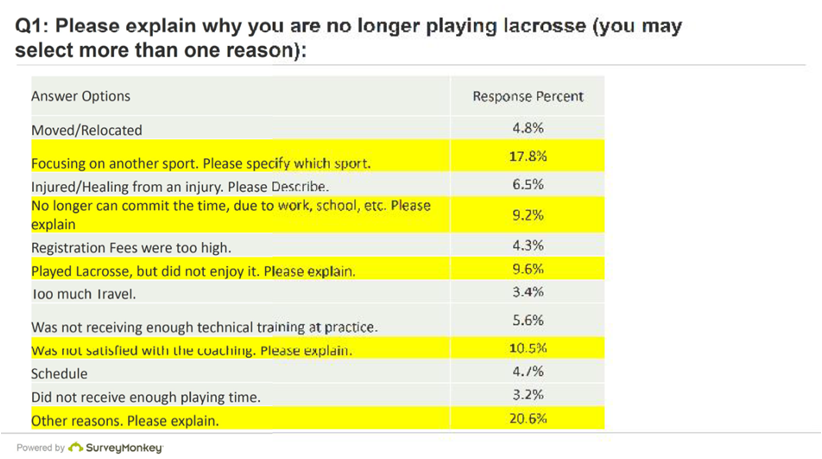
The second most common reason players were no longer playing lacrosse was due to focusing on another sport (17.8%). These are the sports they were focusing on (potentially specializing in) in lieu of lacrosse;
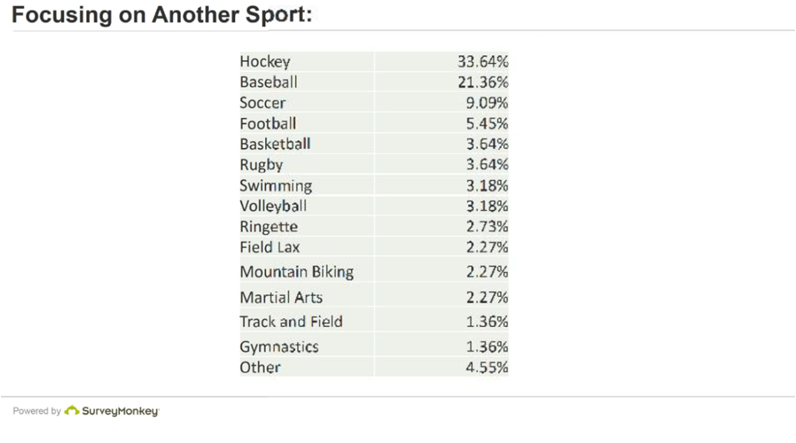
Hockey was the top sport that players were shifting to as opposed to returning to play box or field lacrosse (33.64%), closely followed by baseball (21.36%). This is due largely to the explosion of popularity of spring and summer “elite” showcase teams and tournaments. Baseball is a great spring sport, and a viable option once hanging up the skates after winter hockey season as well; but talking to many parents of kids that play baseball, it too has evolved to have summer ball, fall ball, and winter conditioning camps as baseball is another sport that player salaries have escalated totally out of control (it is the only professional sport of the top 5 that has no salary cap), plus chasing NCAA Div 1 full ride scholarships.
The results don’t surprise me. Although there are parents aspiring for their son or daughter to get an NCAA scholarship for lacrosse (unlike other professional sports, pro lacrosse players only get small salaries), this only represents a small % of those that believe that the more lucrative path is to focus on hockey. More and more players are being drafted from college to the NHL which, if then signed and played in the NHL, can equate to MILLIONS of dollars in salary. (Although only 0.03% of those that play minor hockey will play in the NHL,and the average playing career is only 6 years).
So rather than playing for the love of the game, like the great Bobby Jones who is the only golfer in history to win all 4 majors as an amateur, or Michael Jordan who had a love of the game clause in his contract to play pickup basketball anywhere/anytime, youth sports for kids has changed from play to work as a year round commitment.
Do kids ask you when interested in a sport “Mom, can I work lacrosse or hockey?”
No.
They ask “Dad … can I PLAY lacrosse or hockey?”
The sad thing is that the science, thanks largely to Sport for Life and their research promoting long term athletic development, says concentrated specialization is the wrong path. The research shows that kids should sample as many sports and free play activities as they can to develop physical literacy and as many fundamental movement skills as possible during their key development years (6-12 years of age) then narrow down to 2-3 sports per year (not playing concurrently but seasonally so they don’t have conflicts or suffer burnout), and then finally specialize in the sport they are most passionate about in their late teens.

Summary table for the retention report, other reasons why kids stop playing lacrosse
The age level with the highest percentage of players opting to focus on another sport (33% Hockey) is TYKE (7-8 yr old) with double digit attrition through to Peewee (11-12 yr old). Kids should be playing multiple sports, not focusing on one sport. Many famous and successful hockey players have cited the benefits of hanging up their skates at the end of the winter season and instead playing lacrosse in the spring. The cross training is proven to help build hand-eye coordination, contact confidence, balance, agility etc.
I think you may have heard of one of them … Wayne Gretzky .. AKA the great one.

I think you would all agree that Wayne was a “pretty good” hockey player, but it was due largely in part to the fact that he was an athlete first that he was able to play in the NHL from age 18 until 39 years old, though the average playing career is only 6 years. This is due to the fact that he had the necessary recovery and rest off season and developed other motor skills that helped him in hockey and vice versa.
Below is a video from current NHL player, John Tavares, Captain of the New York Islanders, talking about the benefits of multi-sport who was also an elite lacrosse player and who’s uncle John is the highest scoring player in the history of indoor lacrosse over the course of 22 seasons in the National Lacrosse League.
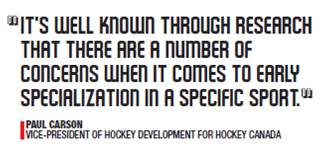
Paul Carson, VP of Hockey Development for Hockey Canada says there can be troubling consequences for athletes that live a hockey only lifestyle. “We know that there are over-use injuries…. mental burnout is also a big problem because it results in youth athlete getting tired of a sport, which leads to a decrease in participation because they have lost interest in the only activity they have been involved with..” (Source – Hockey Now March 26, 2016 – Mike Toth)
Here’s a couple of other University Lacrosse Coaches promoting the benefits of multi-sport:
|
|
The path that kids should follow is not early sport specialization, and as mentioned previously the ALA retention report founds kids as early as Tyke 7-8 years old were leaving lacrosse to focus on hockey. Instead, to follow the LTAD (long term athletic development) model, kids should play as many sports and extracurricular activities as possible during their key development years. Play hockey in winter, hang up the skates after the season and play lacrosse or baseball in the spring and summer and most importantly be a kid … go to the beach, free play soccer, ride your bike, swim, camp and so on. Summer should be the time for free play. Too much structure in organized sports is one of reasons why we are seeing kids quit by age 13.
Ask yourself .. do you know what you want to do in life? Many don’t know until their 30’s – 40’s IF they ever do.
How then can we recommend to a young athlete as early as 7 years old they should specialize in one sport only as they show early promise? Most high level coaches and scouts I talk to look for mult-sport ATHLETES, not hockey or lacrosse players when recruiting.
Let’s work together to bring the game back to the kids … where it belongs.

3 thoughts on “Why Kids Quit Lacrosse”