
10 Tips to run effective practices

Posted Posted in Coach

That time of the year where I get a break from various hockey hats after a whirlwind season with all the ups and downs of dealing with COVID-19 return to play, pivoting to running virtual coach clinics, coordinating coach evaluations that complied with safety protocols and marking a record number of written assignments due to ease for coaches to take clinics virtually vs. face to face in various parts of the province.

While it was top of mind, I thought this would be a good opportunity to share some tips for running effective practices based on this and past years evaluations for coaches that are generic to carry over to other sports, then late summer will share one specifically for hockey coaches are they ramp up for what hopefully will be a better normal than this past pandemic season.

#1 – Have a Plan

Depending on the level you are coaching, as the cliche goes, if you fail to plan you plan to fail.  The practice plan is probably one of the most important things you need to run an effective practice and it should be based on what you overall season plan is (another blog in itself) but making sure that you are not a game reactive coach (i.e. focusing on errors that were made in a prior game, but staying the course to develop over the course of a season

#2 – Ensure that every player has a full water bottle 

Even during Covid-19 I have talked to several evaluators that observed practices where coaches did not pay attention to the number of water bottles that players had when they came to the practice, and as a result, players ended up sharing with their team mates.  Regardless if cohort or not, but players must have their own FULL water bottle before practicing and given regular hydration breaks

#3 – Consider using computer software or an app

This will permit you to plan and share your practices in advance with coaches and players, ideally using ones that have video demos for drills so it will make your practices much more efficient

The other benefit, is everyone will be able to READ the practice plan, drill and key teaching points.  Having marked hundreds of practice plans over the years, it amazes me how many coaches have the handwriting of physicians and practice plans are very difficult to follow.



#4 – Don’t try to do it on your own

If you are just getting started coaching a sport or have for many years, I can’t emphasize the importance of finding a coach mentor so you can pick their brain for drills, best way to identify errors and correct them connect with players, engage parents and so on.  I have always argued that we should provide as much support for those starting out as they could have a positive or negative impact on kids early one when they are developing their core skills.

#5 – Watch/Listen to webinars/podcasts not only what, but HOW to coach

Too often I have seen coaches short and long term goals focusing on the what (skills/drills/tactics) but not on how to coach (leadership, communication, interpersonal skills).  Having surveyed thousands of coaches over the years, the characteristics they have shared of the greatest coaches they had did not have to do with the what, it had to do with the how … how much they cared about them as people, how they connected to them as individuals, how they taught them valuable life lessons and so forth.

#6 – Ensure that your practice plans adhere to your sports LTPD/LTAD model

Too often I have seen coaches having tons of high level flow drills, strategies, tactics for young age groups when it should be the polar opposite.  In lieu of team tactics/systems, should focus on core skills and individual tactics until kids are in their teen years.  Without the skills, they can’t execute the systems and strategies

# 7 –  P&R = Patience and Repetitions

Terry Crisp, long term hockey coach shared with a colleague of mine who shared with me Terry’s philosophy on practices, as a coach you had to have a lot of patience and also permit players to do numerous repetitions to get it right.  Often I have seen coaches in many sports run practices and when players are making mistakes they scream at them for doing so.  In lieu, what you should be doing is encouraging them to make mistakes and come out of their comfort zone

#8 – Remove the joystick

In lieu of treating your players like mini-me’s or robots to do drills exactly as you drew it up on the whiteboard, what you should provide them the opportunity to do is to figure it out on their own (AKA – FIO per Corey McNabb at Hockey Canada).  One of the biggest issues that all sports face to day is players are too robotic, lack creativity and is a direct result of being over coached

#9 – Make it Safe to Fail

Much like I did coaching all the kids on teams that I coached for a myriad of sports, I have fostered a safe to fail environment for the co-op students we have sponsored over the years who have been instrumental in helping us build out our websites, host summits, webinars, podcasts and so forth.  They all work on terms of 4 months and I know when they start it will take several weeks for them to get up to speed with our various platforms, and provide them a safe place to make mistakes (within reason) while they do so.

#10 – Smile

Last but not least, regardless of what type of day you had before you got to the field, rink, court for the practice, I can’t emphasize enough the importance for you put you coach hat on when you arrive and smile and greet all players when they arrive.  Ask they how their day went, how school was, what they learned and various other queries to get to know them better as people, then when you run the practices and are on the bench/sidelines for games they will know that you have their back and truly care about them as people first, athletes second




The Costs of Going ALL IN

Posted Posted in Athlete, Coach, Early Sport Specialization, Organization Executive, Parents

The Costs of Going ALL IN


This week we came across an article and W5 Episode that aired last spring highlighting two families where they have gone all in to support their kids in chasing their dreams of playing NCAA on full-ride scholarships, national teams or professionally.

In the first of three-part series, they focused mainly on young hockey players and ended with an interview with the chief executive officer of a marketing research company based in the US that focused on the costs of youth sport participation not only in the US but internationally.

Their findings had my head spinning and although I have always encouraged players to chase their dream whatever they aspire to (regardless if it is sport, music, drama, academics) but what this 3 part series showed is a reflection how so many families are chasing the dream it has lead to youth sports exploding into multi-billion dollar industries primarily in Canada and the USA with no signs that it will slow down anytime soon.

A couple of years back Time Magazine’s front page highlighted that the US Youth Sports industry had then exceeded $15 Billion USD (approx. $20B CDN based on current foreign exchange).  The highlight of the article was a young baseball phenom appropriate nicknamed Joey Baseball

The article and spin-off videos highlighted how Joey Erace, then 10 years old, and his family were chasing the dream for him to play MLB.  He was playing on multiple travel teams, getting private one on one instruction for pitching ($100/hr), one on one fielding sessions ($100.00/Hr), had his own home batting cage, was getting sponsorship offers, over 24K followers on Instagram and even being asked for autographs from fellow aspiring young kids who were following him.

His life had evolved to baseball, baseball, baseball.

All this at 10 Yrs. Old?

Fast forward to 2019 and the US Youth Sports Industry had grown to over $17 Billion as a result of more and more players and their parents continuing to chase the dream to reach those lofty goals of representing their countries on national teams, getting NCAA scholarships, what is now multi-million salaries in various professional sports and possibly the Olympics.

Coming back to the W5 episodes shared last Spring, the marketing research firm WinterGreen whose chief executive Susan Eustis was interviewed at the tail end of episode one shared that the Canadian Youth Sports Industry in 2010 was $1.2 Billion, had grown to 5.2 Billion mid-way point of the 2000’s but in 2017 had climbed to $7.6B and last reported number for 2018 was a staggering ….


$8.7 BILLION DOLLARS!!! 

THAT’S OVER A 400% INCREASE SINCE 2010


Based on the current exchange this is approx. $6.5 B USD.

Compare that to the USA with 9X the population of Canada (327 M vs. 37M) whose last reported number is $17 Billion USD

As a result, Canada’s youth sport participation costs are the HIGHEST cost per capita than any other country in the world.

Highlighted in the episodes were two youth sports players and their families who were all in as either a hockey or soccer family;

Ethan Mcfarland – 14 years old at the time the episodes aired who aspires to get a full-ride Michigan State Scholarship to play NCAA Div 1 hockey and be drafted and play in the NHL.

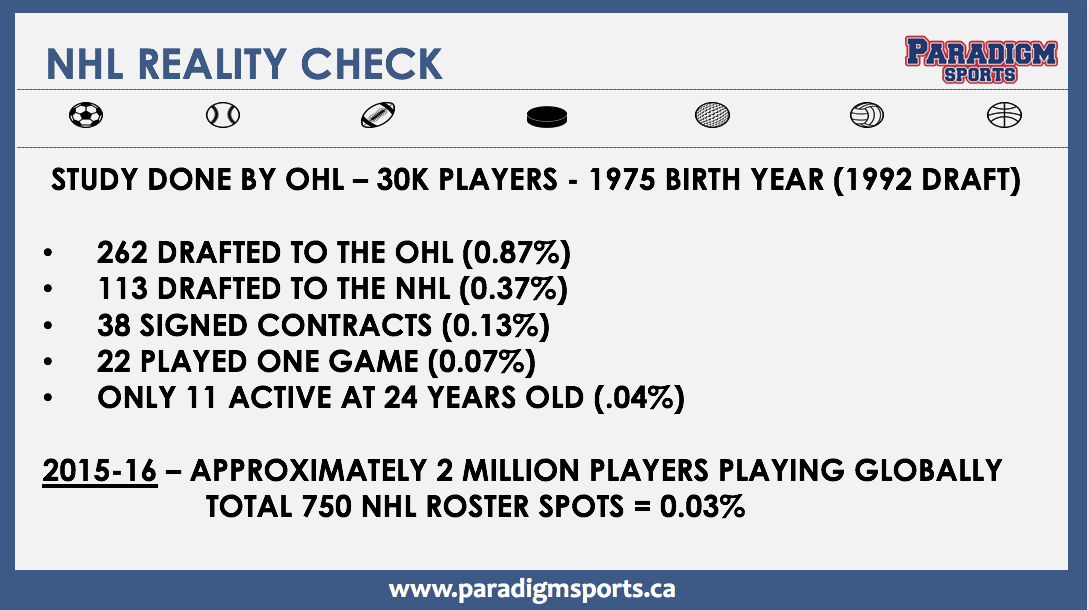
No different than many kids have growing up in prior generations, playing shinny with their buds on frozen lakes, outdoor ice rinks, stick and puck for hours on end BUT the sad reality is 0.3% of those will reach that level as I have shared out in talks across Canada.


The cost for him to reach that goal is he has abandoned what all the powers that be and sports medicine research has shown is multi-sport participation so he becomes the best athlete he can be.

He also has a modified school course load geared specifically for “elite” athletes as a hybrid to homeschooling so he can make it to all of his shooting, skating, puck control sessions both on and off-ice in addition to sessions with Psychologists, nutritionists, custom skate, stick equipment manufacturers

All the while his parents seem to be nonchalant about the fact to support doing all of this is costing them tens of thousands of dollars a year much like thousands of other kids across Canada that are doing the same to chase the dream.

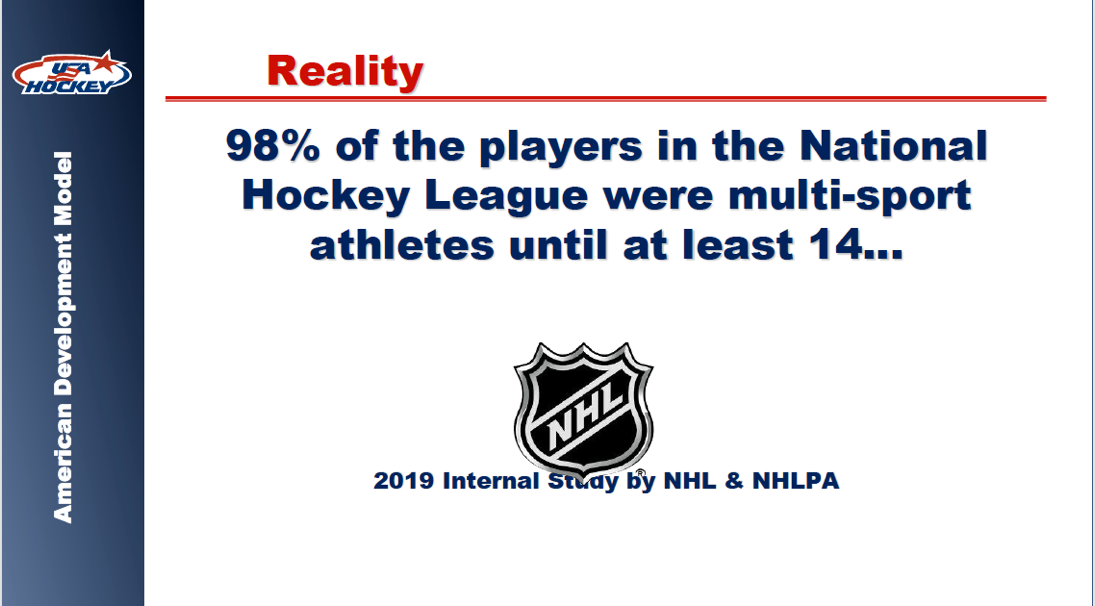
Probably one of the best data sets that I can provide to hockey parents to reinforce the importance for their kids to avoid this excessive time and financial commitment to focus on hockey, hockey, hockey is the NHL players association was surveyed last year and as Ken Martel (technical director for USA Hockey) shared with me and has now shared with other sports orgs, below is a slide from presentation he did for New Zealand Hockey (yes they play hockey in New Zealand)


Another statistic – Since 2010, there has been a 63% decrease in full-ride scholarships offered to Canadian born players to play in the NCAA which is a direct correlation with the ADM model in the USA, more and more US-born players are being recruited for those scholarships vs. past years seeking Canadian born players.

The other family highlighted was the Nicolazzo family whose three children, Xavier (7 at the time), sister Kiarra (10), and older brother Romero (13).  Their Dad Frank coaches both boys teams.

Year-Round Soccer, Soccer, Soccer, every day all year long including indoor session when Canada’s winter kicks in including playing on numerous travel teams costing tens of thousands of dollars every year.

REALITY CHECK – a colleague of mine shared me the soccer statistics which I reciprocated with hockey a few years back regarding NCAA/Professional path of US Soccer Players


As admirable as it is for all three of their children to chase the dream, like Hockey, the reality that they will reach that level is a longshot at best and depends on so many factors for all the stars to align.

The sad reality for both families and their kids who are rolling the dice and going all-in with one sport year-round as early as 7 years old is there is a very strong possibility that one or all of the issues below may happen;

  1. Kids are suffering pressure as early as 9-10 years old W5 highlighted in their episode.

Shouldn’t 9 -10-year-olds be playing a game for the sake of it, not feeling the pressure to reach a lofty goal 10 years or more down the road?


  1. All the research and data shows that these young players may quit (62% in the US are quitting by age 11, 70% by age 13 with similar trends in Canada and many other nations) due to pressure, burnout, not having fun as a result of focusing on winning at all costs chasing the dream because they are not having fun


  1. They may suffer a season-ending, worse yet a potentially career-ending injury like multiple concussions, tears of ulnar, medial, anterior cruciate ligaments


  1. May suffer depression, anxiety IF they make it to the NCAA, pro-level as they were deprived of a normal childhood which has been identified by many NCAA athletic directors is a major issue of new players coming into their programs now vs. a decade ago


  1. Worse case –  may consider, or actually do commit suicide as there has been a 56% increase in the suicide rate the last 10 years from 10-24 years of age. If you don’t think this is a reality, I personally know of 3 kids who committed suicide, the third happened to be the brother of one and cousin of two other players I coached so really hit me hard.  This stat was shared by Corey Hirsch, advocate for mental health and the Hockey Talks program the day that Tyler Motte shared he is dealing with depression and anxiety issues with amazing support by the Vancouver Canucks.  Why?  Because 7 years ago Rick Rypien committed suicide as a result of similar mental health issues stemming from the pressure to perform.

All of the above aside, many of the single-sport players I have interacted with as they got to older levels (15+) stopped smiling, stopped laughing, appeared methodical, robotic when they came to training sessions, games, other activities.

Why?

Because they lost that original love for the game they had which many parents argue with me is the reason when they support their kids to play year long, pay for all kinds of development the grind of playing one sport all year long starting as early as many kids do today became a job.

When they originally started down the path did they ask if they could WORK hockey, soccer etc?

No – they asked if they could PLAY hockey, soccer etc.

Last but not least, in the event that you have not been following business news of late, many countries are looming towards another recessionary period so the tens of thousands of dollars that parents are spending each year, much of which via credit facilities including second mortgages, credit cards, lines of credit will put the entire family in harm’s way if one of the dual incomes is lost to downsizing.

Is it really worth taking that risk going all in with one sport?

In lieu of looking at youth sports as a return on investment, we should be looking at all the other benefits it provides, developing character, valuable life lessons, healthy (both physical and mental) lifestyles, friendships, social skills being part of teams, being well rounded and becoming the best ATHLETE they can be.

If at the end of the day they are one of the select few to reach the level of NCAA, National or professional level then that is just icing on the cake.

Let’s all work together to bring the game back to the kids ….. where it belongs.


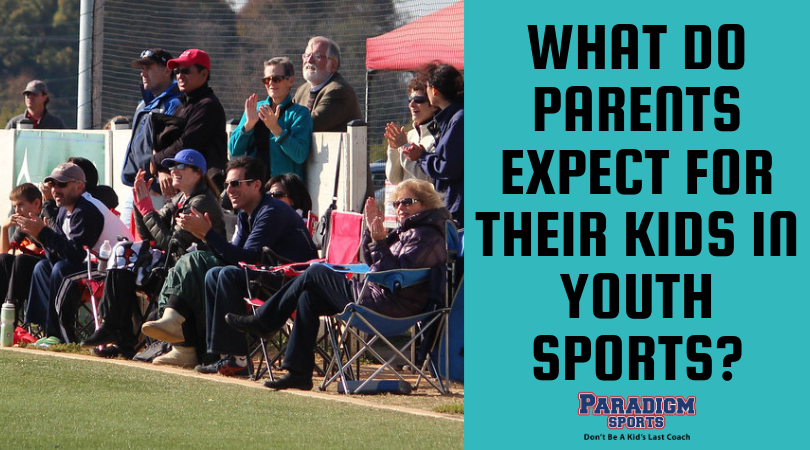
What do parents expect for their kids in youth sports?

Posted Posted in Athlete, Coach, Organization Executive, Parents

As we head into another fall season of a myriad of youth sports, thought this would be a good time to share with coaches the importance of having answers to the top 3 questions that parents will be asking in their upcoming parent meetings.

#1 – What is your background as a coach?

This is particularly top of mind for parents in the competitive streams, many of which will make decisions whether they will support their son or daughter trying out for competitive teams based on the coaches that have been selected by organizations.

When it comes to the recreational stream, particularly the earlier age groups, parents more often than not are happy that someone put their hand up to coach the 5-8 year old age groups and are more concerned when/where they should drop their kids off for various team events than whether their kids are in qualified hands.

Whether it be recreational grassroots level or higher level older age group teams, however, this is an answer that all coaches should have the answer to before they meet the parets for the first time.

Things like;

  1. Playing experience in the respective sport they are coaching
  2. Certification they have completed
  3. If they have children themselves (more often than not parents are those that start coaching the youngest age groups)
  4. How many years they have coached
  5. How committed they will be (dedication is key, coaches should be there for the kids)

#2 – Why do you Coach?

It amazes me when I speak and ask coaches the questions to provide answers to that very question how few hands go up to begin with but am thankful for those that to stand up and share all kinds of reasons why they coach like;

  1. They love the game and want to give back
  2. They want to help kids learn the skills of the game, but also skills of life
  3. They Love Kids and watching them grow
  4. They want to help kids have a positive experience
  5. They don’t want kids to have a bad coach like they did

It is at this point where I also hear coaches shared their core values like respect, sportsmanship, winning with humility, losing with dignity, developing leaders and teaching various other life skills that the kids will need beyond the sport.

Then the one that gets me the most, when they share how passionate they are about the game and kids to love it as much as they do.

One of the things I share all the time is kids should love the game more at the end of the season than they did at the beginning of the season.

Ironically, as we shared in last weeks post, the #1 thing that parents are looking for in terms of their kid’s sports experience is that they develop character, which is followed by them having fun and making friends.

Great Coaches, as we have shared in past, are ones that truly care about the kids the coach, and those that are passionate about the game, as a parent, they had me at HI.

#3 – What is your coaching philosophy?

This again is one that I find we really need to work on with grassroots coaches, when I prompt coaches to share their philosophies either en masse or in small groups, only a small % are able to do so.  In part because they are still developing their philosophies of coaching, in part because they have never put it in writing.

Once they do so, it makes them accountable so if they talk the talk, they must walk the walk not just for the players but also for the parents, board members, officials etc.

I remember last year when I put forth the query in a clinic I was running, one of the coaches stood up and shared a very detailed coaching philosophy, so much to the point, that I then worked with him after the fact to tweak it so it was not more than a couple of sentences.

Think about it being your mission statement for WHY you coach, what your raison d’ê·tre (reason for being) which goes hand in hand with your core values that you have learned from parents, family, education, work etc.

Like that coach, I had a very lengthy coaching philosophy that was several paragraphs long until I reviewed it with one of my mentors and he told me that it had to be no more than two sentences … there was no way I would be able to share my philosophy with board members when I was interviewing for coaching positions or parents after the fact when met them for the first of several meetings over the season.

My philosophy evolved over the next couple of years to one statement:

FUNdamentals, not winning, at all Costs.

Why is Fun in Caps?


I believe strongly in developing kids skills of the game in part, but more so the skills of life to make a difference by developing youth into adults.

AND

I Have learned there is a fine line between winning and winning at all costs.

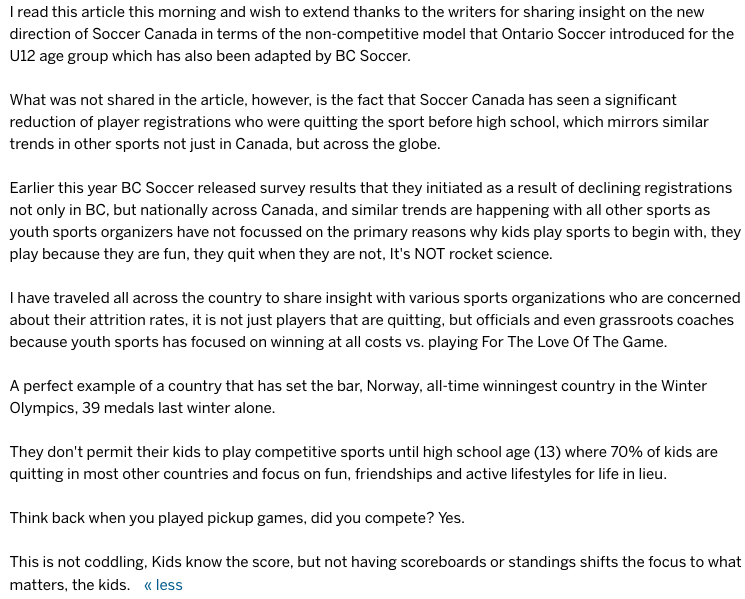
Without going into a deep dive on the article itself, just wanted to touch on a recent article co-authored by two faculty members at the University of Waterloo posted in the conversation which was reshared by the Vancouver Sun under permission.

The Conversation Title:

“Making Youth Soccer less Competitive: Better Skills or sign or coddling kids”

In the paper edition of the Vancouver Sun the article was titled:

Removing Competition: Good or Bad for Kids?


In the Vancouver Sun Digital Edition the article was titled:

Ryan Snelgrove and Daniel Wigfield: Is less-competitive youth soccer a sign of coddled kids?

My comments to the digital edition version:


Below is a image we shared out in the fall where the GTHL had a novice hockey game (8 yr olds) still playing full ice hockey where the final score was 41-0 although they only showed 6-0 on the scoreboard so as to “not hurt the kids feelings” that was referenced in the article why Ontario Soccer has shifted to the model of not keeping track of scores U12.


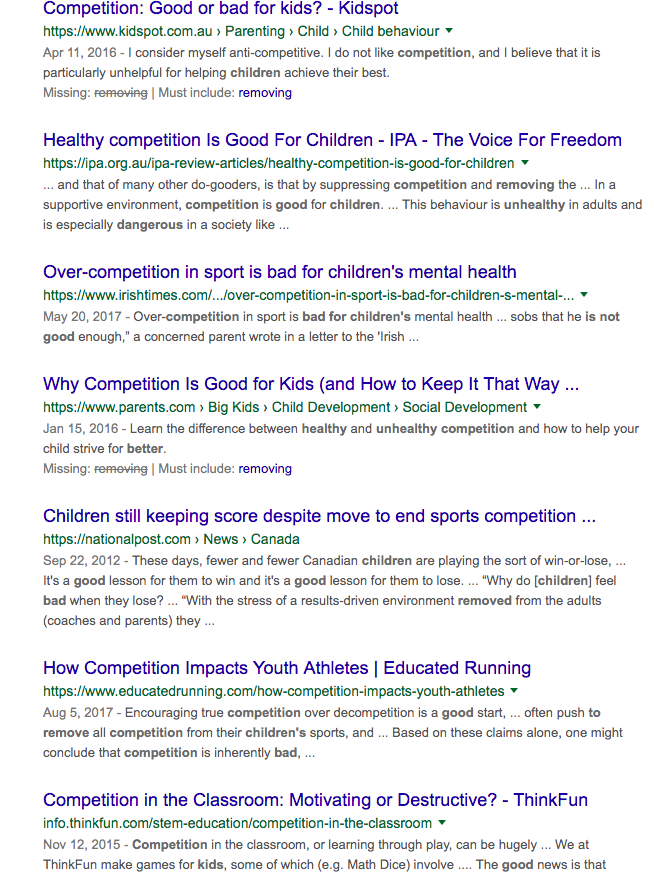
Like the Ontario Soccer article, there were two sides that came forward, those supporting the move to push competitive play to later age groups, and those arguing that competition introduced at earlier age groups teaches kids life lessons.

Below are just a number of other articles on page one of google pertaining to the pros and cons of competition with several other articles on subsequent pages with those for and those against having scoreboards, scoresheets for the younger age groups


I know that there is always two sides to every story, but if we let the adults who are pushing the pay to play winning at all costs model becomes the norm, not the exception, the kids LOSE regardless of the age group.

What coaches must be cognizant about as they head into the upcoming seasons is what both parents and the kid’s expectations are.

The top three Parents expectations they share with me when doing presentations are for their kids to build character, have fun and make friends.

The top three kids share why sports are fun (the reason they play) per Amanda Viseks research and my surveys of kids in numerous sports is when they get to try their best (work on their skills), when coaches treat them with respect (by treating them with fairness, teaching them the skills of the game and of life) AND when they get playing time (kids just want to PLAY).

And if you are the naysayer or sarcastic adult think that removing the scoreboard is for the kid’s sake, not hurt their feelings, coddle them no, it could not be farther from the truth.  Kids keep track of all the goals, assists, who the top players are, who the players are that need to develop and so on.  Before youth sports became adultified as it is now, kids formed their own teams, made and enforced their own rules, rebalanced as needed so games were competitive NOT blowouts or having coaches run short benches to win games to pad their resumes, not to develop all kids on their teams.

The reason why there is no scoreboard in the earlier age groups already in Soccer, Hockey, Baseball and many other sports to follow is so that the parents and coaches don’t take the game too seriously which has led to bench-clearing brawls involving the most infamous one to date of parents fighting at 7-year-old baseball game because a 13-year-old official made a call the spectators did not agree with.


Really?  Is winning or losing at that age group really matter? Should it not be about developing the kid’s love for the game, working on the core skills, and all the other benefits kids can reap from playing sports?

Having worked with many parents I can tell you first hand none went to this game expecting to get into a brawl, they had hoped to just go watch their kids play but as winning has become the epicenter of youth sports, anything impacting a win or loss (in this case the call by a KID) set fuel to a fire.

We (as in all the adults) must remember that youth sports are games played by KIDS, with many of the official’s kids themselves, and too many are quitting before they should and once they do, many don’t return to the game they once loved.

Let’s all work together to bring the game back to the kids … where it belongs.

Don`t be a kids last coach


What US Lacrosse is doing to promote Multi-Sport Participation

Posted Posted in Athlete, Coach, Early Sport Specialization, Organization Executive, Parents

I recently sat in on the first webinar hosted by Project Play which highlighted three different US National Sports Bodies (NGB’s) that were promoting multi-sport participation, one of which is one of the few youth sports in the US that is growing year after year, US Lacrosse.

The insight was shared on the webinar by Erin Smith, currently the Managing Director of Education and Training for US Lacrosse and has worn many other hats over with US LAX the last 15 years.

Why is US Lacrosse one of the organizations that are bucking the trends?

Unlike many of the youth sports organization in Canada, US and globally, they continue to see increases in their membership year after year, now have over 430,000 members and continue to grow.

As a national sports organization in the US, they are still in their infancy, 9 former regional orgs merged together in 1998 to become the national sports body for the US.

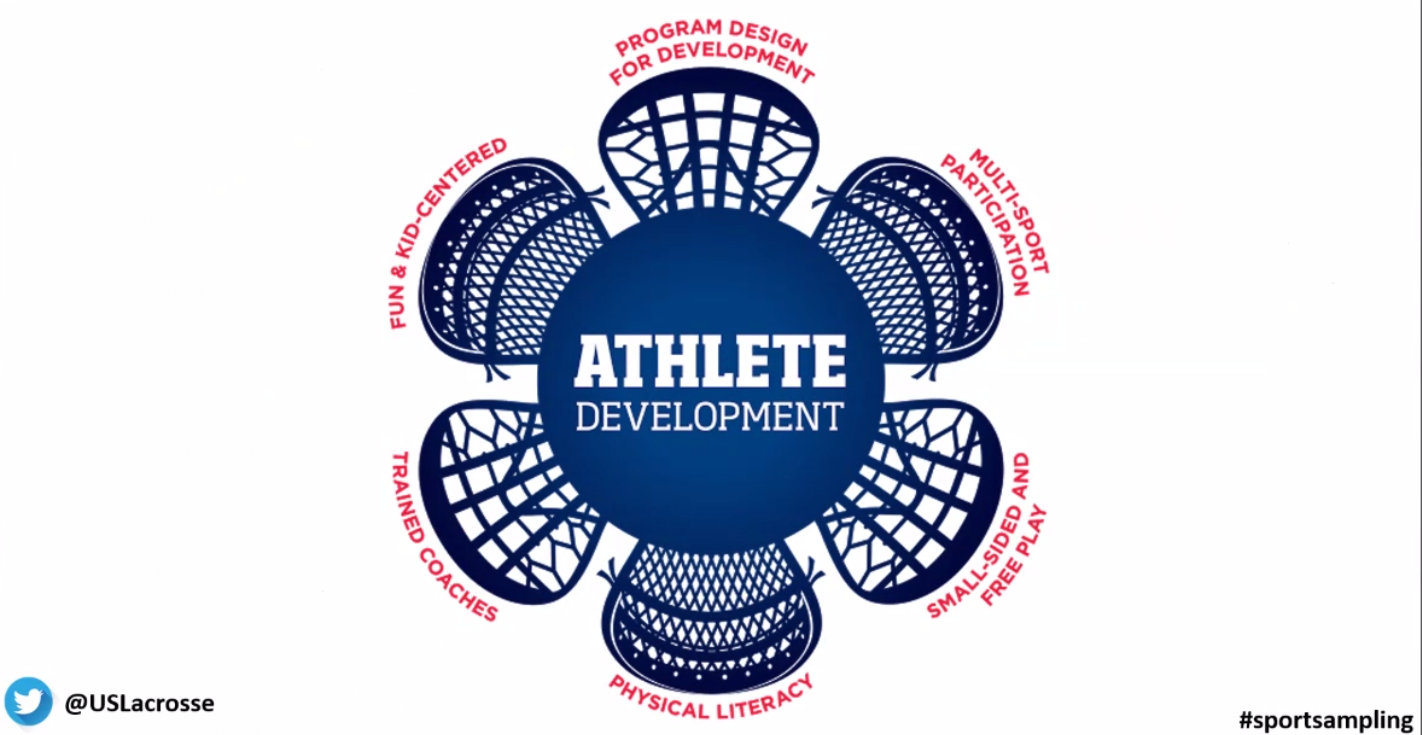
In 2015-16, largely due to the great work that USA Hockey has done in terms of developing the American Development Model, US Lacrosse created their first version of their Athlete Development Model with 6 core values.

#1 – Fun and Kid Centred

HMMMM … perhaps the sports organizations that continue to experience negative comps year after year could learn something by focusing on similar core values?

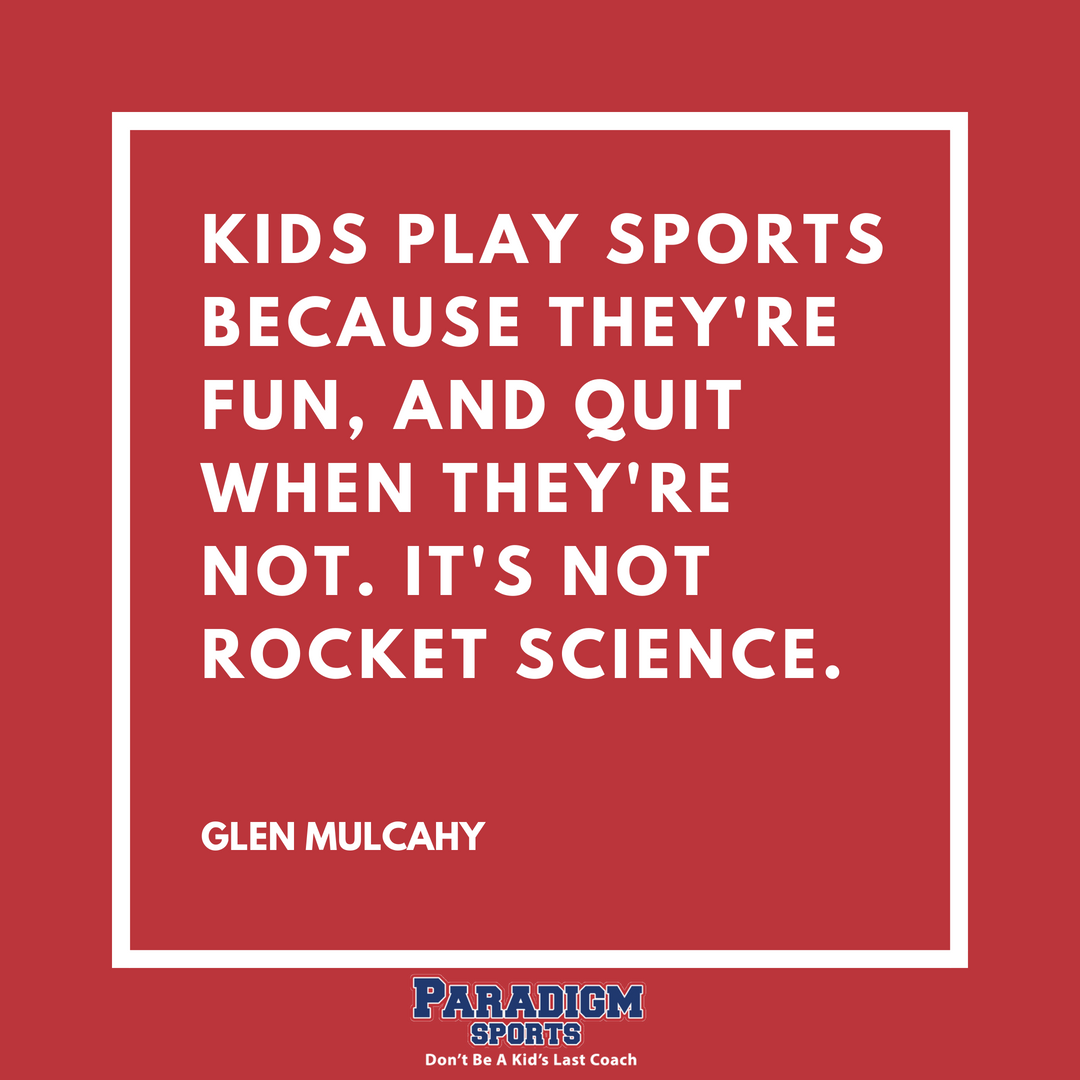
As I have shared for years, kids play sports because they are fun and quit when they are not, it’s NOT rocket science and I was so happy to see that a NGB has Fun and focusing on the kids (the end users/consumers) and believe many other orgs that are suffering high rates of attrition should do the same.

#2 – Program Design for Development

Development as in skills vs. winning at all costs?

It is great to see a NGB understand that the purpose of Youth sports organizations is developing youth into adults.

#3 – Multi-Sport Participation

Promoting Multisport participation, as the President of Greater Edmonton Lacrosse shared with me last year, Lacrosse is a great complementary sport and requires so many technical skills that will transfer to other sports.  Perhaps that is one of the reasons why Wayne Gretzky, John Tavares, Steve Stamkos and other NHL’ers were or are pretty good?

#4 – Small Sided and Free Play

Many national sports organizations in Canada and the USA who have incorporated LTAD models have incorporated small sided games that are age appropriate, examples being USA and Hockey Canada’s cross-ice hockey for ages 5-8 years old, soccer small area games with 3, 7 players, tennis, volleyball, basketball lowering the nets etc.

What really excited me about US Lacrosse was they also are focusing on the importance of Free Play that many researchers have identified in recent years is a critical to ensure optimal skill development, decision making, handling adversity and overall fundamental skill development.

#5 – Physical Literacy

Still one of the biggest challenges that many face in the grassroots segments is having coaches understand the importance of developing all fundamental movement skills so kids are not only proficient in their respective sports (thanks largely to the pitfalls of early sport specialization) so kids are confident, competent and ultimately active for life.

#6 – Trained Coaches

In terms of trained coaches, although the course content has been revamped to educate coaches on areas like multi-sport participation it was only done last year and only 5+ Years will you see the cause and effect of updated coaching modules.  I suspect in a few years you will see the changes that US LAX is aspiring for and will receive a higher grade accordingly down the road.

How do I know this?

After running Hockey Canada Clinics as one of my hats for over a decade, each time that Hockey Canada revamps the clinic materials, it takes a few years for the materials in new modules to get to the coaches that have already taken a clinic IF it gets to them.

This is why I am a big advocate for the NCCP program requiring ongoing Professional Development Credits to ensure that coaches learn the latest and greatest to be the best they can be.

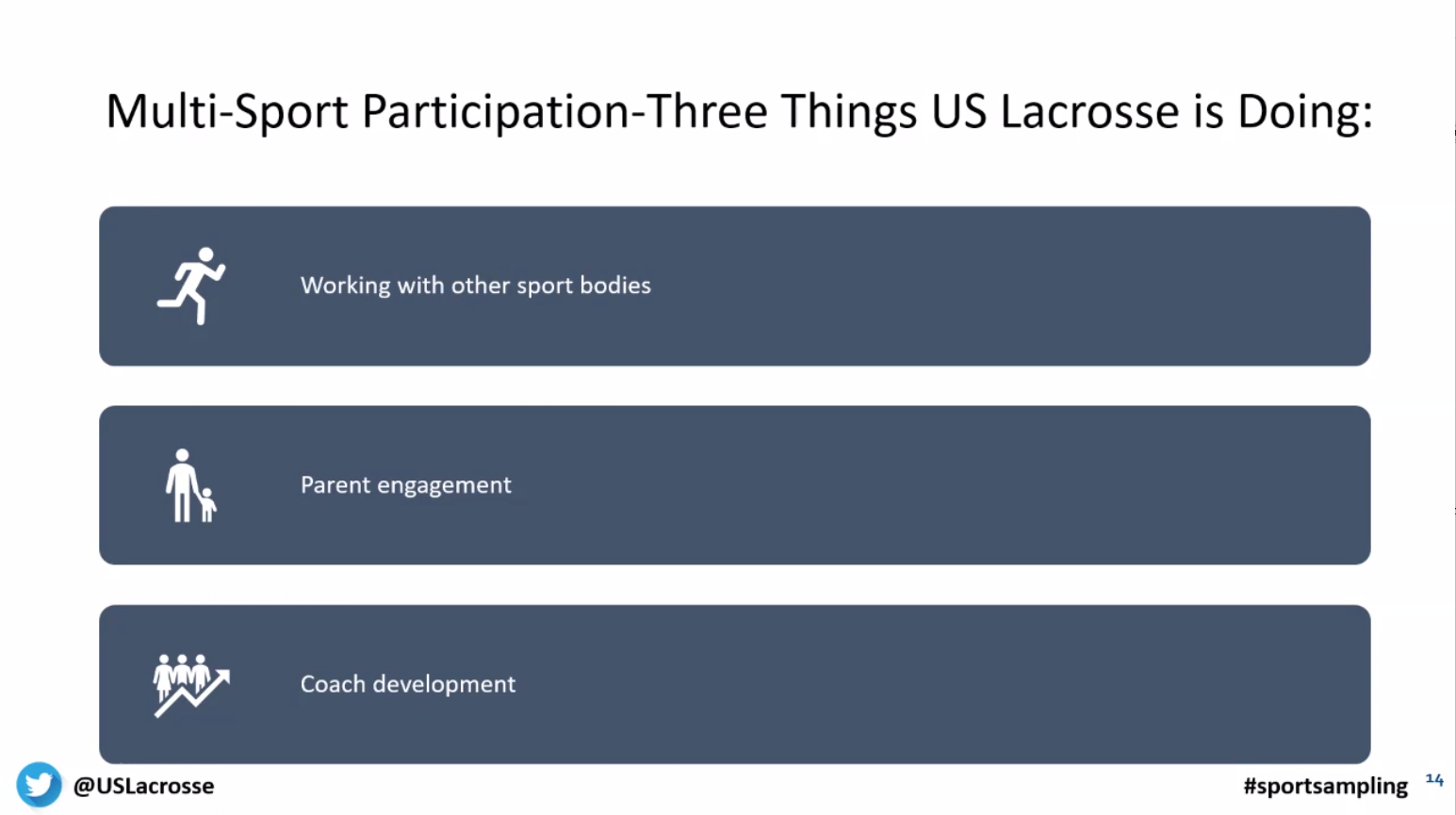
The three core areas of the Project Play checklist that US Lacrosse is focusing on to promote multi-sport participation in particular are;


#1 – Working with Other Sports Organizations

Collaborating in lieu of competing for the same player so they can play multiple sports?

KUDOS to US Lacrosse for doing so.

Here is insight from Dave Newson, the executive director at Semiahmoo Minor hockey organization who spoke with us for our winter 2018 virtual event how they were collaborated with their fellow soccer association to permit scheduling so kids could play both soccer and hockey

After they did so, many other local sports organizations started to do the same, the dominoes they are falling as kids want to PLAY more than one sport.

#2 Focused on Engaging parents

In addition to providing resources to coaches to share with parents in their parent meetings, they are promoting multi-sport participation on social media and video below using the analogy of eating pizza every day would be like playing one sport every day, not good for the kid’s development overall.

INSERT QUOTE OF THE WEEK HERE

Play More (sports) to play better (as an overall athlete)

#3 – Focused on improving their coaching development

Like US Hockey, US Lacrosse now has 4 coaching levels that ties in their athlete development model, starting at the grassroots level up to the high-performance level.

Last year they redid all of their coaching courses and the Level one course now highlights the benefits of multi-sport participation so the grassroots coaches (many of which are moms or dads that get recruited to coach because their kids are playing) get educated on the benefits right from the get-go.

The added benefit, as many are parents themselves, they can share with the parents on their teams as well as others they know so the word of mouth will spread.

Probably one of the biggest issues that I have come across when I have interacted with coaches in Canada that are just getting started regardless of the sport is there lack of knowledge or even awareness of their respective sports long term athletic development models or fundamental movement skills required to be proficient at ANY sport, let alone the ones they are now coaching.

Things like balance, agility, running, falling, getting up, throwing, catching, one handed and two handed hitting, running which are all fundamental movement skills that every kid should have but thanks to PE programs being cut so much at the school levels, too much structure taking away free play, too many kids can’t perform the basic skills as our past generation did.

KUDOS to US Lacrosse for recognizing the importance of not only talking the talk (via core values, public service messages (PSA’s), Whitepapers (PDF’s) and education but WALKING THE WALK.

Let’s all work together to bring the game back to the kids … where it belongs

PS Tagline - Dont be a kids last coach

Why Kids (May) Quit Soccer

Posted Leave a commentPosted in Athlete, Coach, Early Sport Specialization, Organization Executive, Parents

Why Kids (May) Quit Soccer

Last post we shared the reasons why Kids play Soccer based on responses from the BC Soccer 2018 Retention Survey, in this post will highlight the responses to the two other areas BC Soccer was looking for insight from their players;

#1 – The Likelihood of playing Next Year (Why Kids (May) Quit Soccer)

And

# 2 – What was not so good about their program this year (what areas received fair or poor rankings but the players)


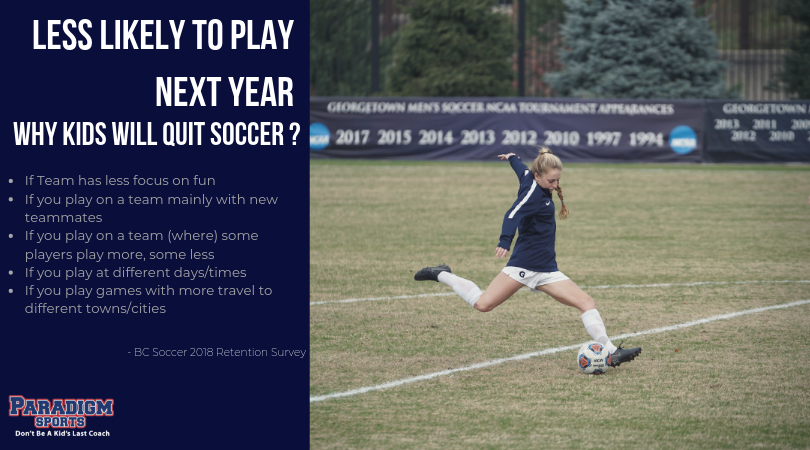
LESS LIKELY TO PLAY NEXT YEAR

When asked “Will you come back next season”.. the top 5 reasons kids would be less likely to do so (high probability they will NOT come back to play soccer) 


SURVEY SAYS…

#1 – If your team has less focus on fun

#2 reason they would return back if their team focused on fun, second only to focusing on skills.

HMMMM … Similar to Amanda Viseks top reasons why sports were fun, #1 reason is when kids had the opportunity to try their best (focus on skills)

#2 – If you play on a team mostly with new teammates (not with their friends)

Two things that kids ask after games (sometimes during the games)

What is the snack? As Steve Simmons shared in an article he wrote many years back he continues to share every year Attention Coaches, parents: Minor Hockey is for the Children where he shares the anecdote of a novice player who stated:

“I Hope they don’t bring apple juice, I don’t like Apple Juice”

And the last question as they leave the field/rink/court…

When do we play again? (emphasis on PLAY not work as is now the case with early sport specialization)

If you loved sports as a kid and continue to play adult rec team sports ….

First question you ask after a game – Who has/how much is the beer? 

AKA – THE SNACK

Last question you ask after a game – When do we play again?

Hmmm … if we love sports in our youth, we love them as adults because they are fun, we get to play with our buddies and we play for the love of the game.

#3 – If you play on a team (where) some players play more, some (play) less.

Translation: Coaches running short benches where their weaker players sit on the bench so they can win at all costs.

90% of kids would rather play on a losing team, in ALL situations, than sit on a bench for a winning team.

As my son shared after he had the misfortune sitting on the bench with some of his teammates for the better part of a game as coach was infamous for playing his favorites and shared how he felt after the game,

“I am pissed because I was deprived of the opportunity to contribute to the outcome”.

He was only 14 at the time, and I will never forget it because it was a month after he lost his Nanny (my mother) to a 2 year battle with cancer prior to that tournament game that the coach shared with me prior to the game he dedicated the game to her in her memory.  Had she still be alive and attended that game, I can tell you she would have had some not so nice words to share with that same coach as she, like I, just loved watching my son and all of his teammate’s PLAY.

As far as I am concerned, the only reason why kids should be sitting on a bench is discipline (they took a bad penalty, acted inappropriately, hit an opposing player that could lead to injury etc.), other than that kids should PLAY.  Coaches that rely on short bench tactics to win games is a short-sighted tactic/strategy that more often than not will backfire. If you focus on the process of developing all players on your teams, care about them, believe in them, connect with them,  and develop their competence and character over time collectively as a team will improve and winning will be a byproduct NOT the focus.

There is a real simple fix to address this, incorporate fair play policies so coaches are only given a get out of jail free card for the last few minutes of a game only IF it is close and it should be the players that have BROUGHT IT that game (even if they are not the coaches “favorites” that get rewarded to be out there in latter part of the game.

This also will address the parental issues we see on social media every day, parents just want their kids to PLAY, coaches that run short benches as a far as I am concerned are a victim of their own demise.

#4 – If you play at different days/times

With every family in the lower mainland of Vancouver and many cities across Canada forced to have dual incomes now to pay mortgages and all other household expense PLUS rising costs for kids to play youth sports, scheduling consistency is critical for sports organizations so families know when/where they have to be over the course of the season, not just 4 weeks at a time.

#5 – If you play games with more travel to different towns/cities.

As soccer is now the #1 team sport in Canada, where provinces have organizations with thousands of players, why would kids even have to travel to begin with?  Community sport should be just that, community sport (the exception being smaller rural communities that do require travel to play)

The evolution of the travel teams and prospect tournaments that are driving the $17 Billion industry in the USA is based on the premise that scouts, coaches will be at these events to see “prospects” for NCAA scholarships or be drafted to Professional sports.

News flash – with the evolution of the digital era, almost any of these prospect tournaments have all of their games streamed, scouts don’t even have to leave their houses to see kids play against others on “elite” teams.  As every scout or high-level/collegiate/professional coach has shared with me, if they are good, they will be found regardless if they attend these prospect tournaments.

Note also in Amanda’s study, of 81 characteristics what is fun about youth sports, traveling to new places to play ranked right near the bottom of least fun reasons, 73rd out of 81.

It is not the kids that want to travel, it is the adultification of youth sports that has forced many families to spend their holiday time at ball fields, ice rinks, soccer pitches when they should be lying on a beach, taking a hike, swimming in a lake, going to amusement park of other TRUE forms of holidays.

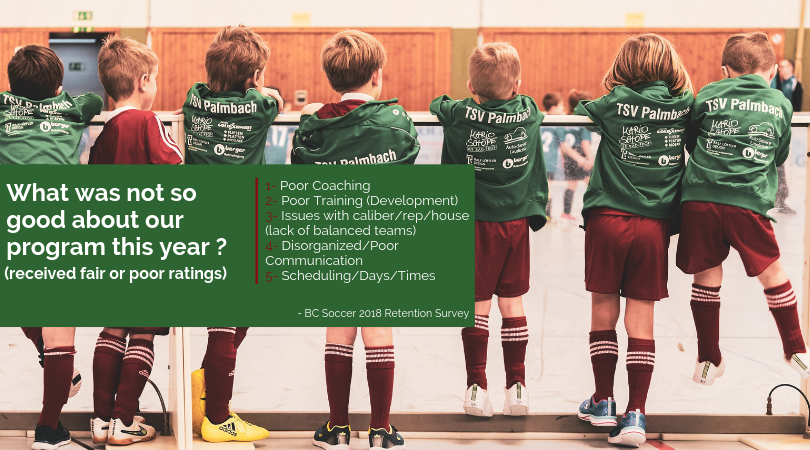
What was not so good about our program this year? (received fair or poor rankings)

SURVEY SAYS….

#1 – Poor Coaching

With the roll-out of NCCP program for all levels of coaching in soccer this will help address the what of coaching relative to the age groups to adhere to LTAD, small area games, age-appropriate drills, focusing on skill development vs. tactics and strategy and so forth.

It also will take several years to see the cause and effect as many other nations have experienced like Iceland who made the same commitment to coaching in 2000 and started to see the results once they qualified for the 2016 Euro Cup and 2018 World Cups of Soccer.

It also won’t address HOW to coach, How not be a kid’s last coach, coach beyond the game, how to connect with your players, how to engage parents, how to coach generation Z, LTAD vs. Early Sport Specialization, How to coach girls vs. boys, Grow your Mindset, Make it Safe to fail and from all levels of harassment, How to develop your philosophy and culture of excellent on teams etc.

Hmmm … this is why we have coaching modules to address all of the above, not WHAT to coach, but HOW to coach.

#2 – Poor Training

Goes hand in hand with #1, poor coaches are poor teachers and vice versa

This is not the fault of coaches that have the best of intentions to coach, is due to lack of experience and training at the grassroots level and like players, it takes YEARS to develop all the skills to become a great coach to teach the skills of the game, but also the skills of life.

#3 – Issues with caliber/rep/house/unequal skill on the teams

This comes down to player evaluations to form balanced teams, in lieu of subject measurement (which has led to a lot of politics associated with team selections), organizations should be using quantitative means to evaluate players and have baselines beginning of the season, mid and end of season skill evaluations to track development.

The only one that we recommend to all organizations is the personal sport record  as many sports orgs across the globe are looking at or have already adapted for quantitative measurement including Norway Sport Federation who know “just a tad about being successful at the international level being the all-time winningest country in the winter Olympics in terms of medals”, Sport New Zealand,  US Olympic Committee, BC Rugby, GTHL and many others.

Click on the logo to go the website for more information:


In lieu, the current model used by orgs is how many wins did the teams have?

How many banners did we win?  Who scored all the goals and assists?

Focusing on outcomes, not the process.

For more insight the impact of the shift to winning at all costs has had on youth sports, reach out to us to schedule a FREE screening of The Cost of Winning followed by a Q&A session where sports leaders from across the globe provide their insights on the state of play in youth sports and the importance of bringing the game back to the kids.

#4 Disorganized/Poor Communication

From a coaching standpoint, one of the biggest asks I get all the time is how do I “deal with parents” to which I respond you should engage parents, not deal with them.

Engagement includes ongoing communication starting with a culture of excellence, a well-run parent meeting, team meetings, mid and end of season meetings as well as regular communication to all stakeholders (players, parents, fellow coaches) to ensure the ship (team) moves in the right direction.

#5 – (Poor) Schedule/Days/Times

This should be a focus for all local sports organizations to ensure consistency.

I suspect, like Amanda Visek’s Study, many other sports organizations not only across Canada but globally will be referring to BC Soccer’s Retention Survey for their current and seasons to come IF they truly aspire to buck the trends and attract, retain and grow their membership.

Kudo’s to all the board members at BC Soccer for taking this on, and now that have the answers “out of the mouth of babes” and better understanding of the motivations for their key stakeholders (players and parents) so their regional and local organizations can implement the changes to also buck the trends seen across Canada with declining numbers.

One sports org that did so that has shown it is possible, is USA Hockey who is setting the bar for all other sports organizations globally for all the great work they are doing to grow the game.

Several years back they were losing 60% of their kids by peewee (11-12 yrs. old)

They did three things to reverse the trends


  1. Rolled out their version of LTAD, the American Development Model, ADM, that focused on age appropriate training and coaching certification
  2. Emphasized fun for all age groups (regardless if rec or competitive streams)
  3. Cancelled their U12 national Championship that put too much pressure on parents and players who aspired to play in that championship

The result?

In lieu of 60% attrition, they retained 92% of their kids, only a 8% decrease.

For the naysayers that say it can’t be done or those that keep doing the same things over and over again expecting different results (insanity)…..

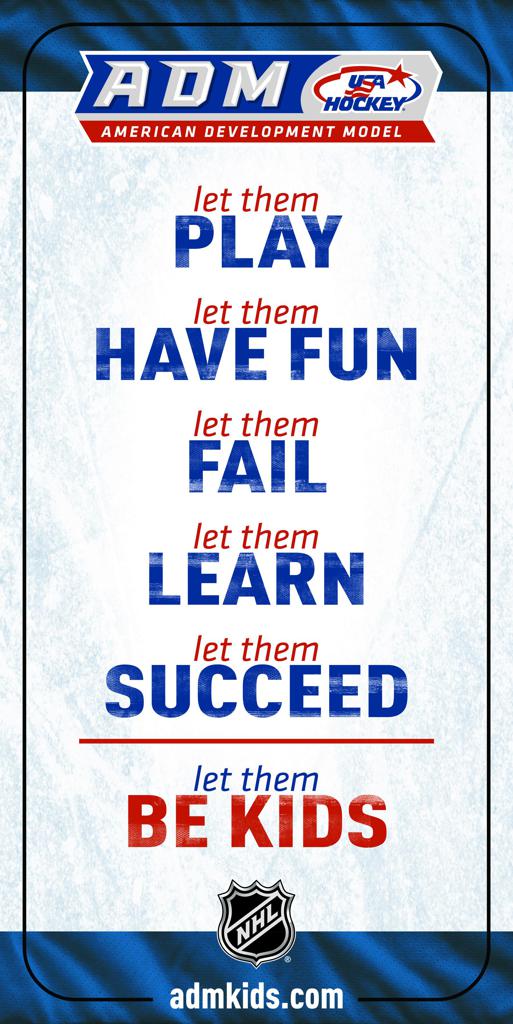
….. It CAN be done, as USA Hockey showed it takes a village to raise a child and requires collaboration by all parties concerned to focus on the things that matter most to the kids, Fun, Friends, Quality Coaching and having the opportunity to PLAY and contribute For the Love of the Game.


Don`t be a kids last coach