Why the stars are aligning for Dallas

Posted Posted in Athlete, Coach, Early Sport Specialization, Organization Executive, Parents

I never thought in my lifetime that I would be having discussions with people regarding the NHL playoffs in September when all prior years they were finished by May/June timeframe.

Nature of the beast as they say during the COVID-19 era that the NHL and all other professional sports are dealing with to complete or start their seasons with various protocols to ensure the safety for all parties concerned.

Although I am a long time Habs Fan having grown up in Montreal, and was disappointed when they and then the Vancouver Canucks were knocked out of this years Bubble Playoffs, I am happy to see that Rick Bowness and the Dallas Stars will be heading to the final for the first time in 20 years.

Two reasons why I feel that the “stars” have aligned for them to get there this year, the amazing coaching job that “interim” coach Rick Bowness has done since he took over the reigns after former head coach XXXXX was fired mid season and the later is the leadership from team captain, Jamie Benn, whom I have highlighted in numerous talks and interviews when I been asked to share insight on the benefits of multi-sport participation.

RICK BOWNESS – AKA BONES
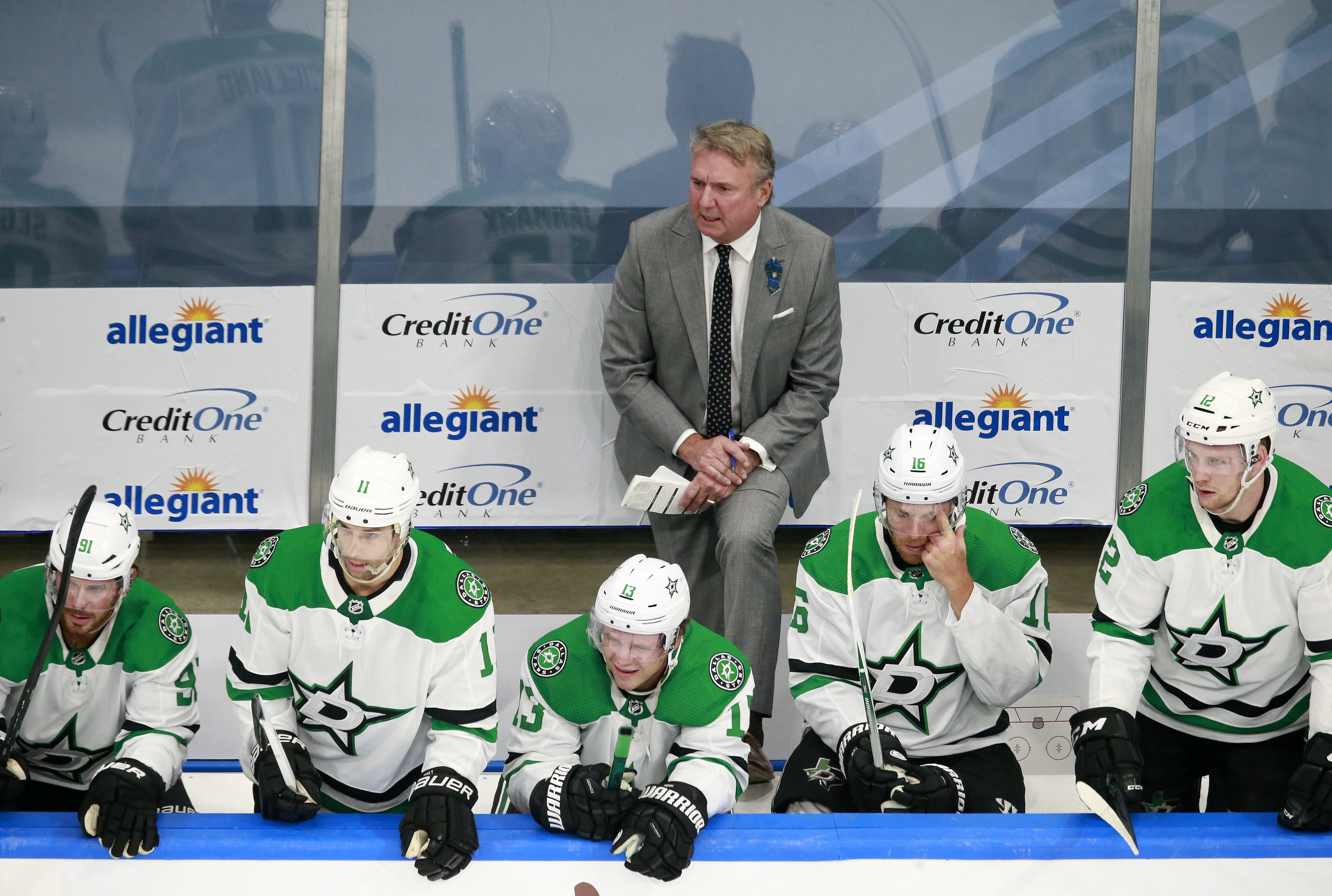
(Photo by Jeff Vinnick/Getty Images)

Rick Bowness played in the NHL for a number of teams like many other NHL coaches after he played Major Junior and in the NHL.  He has been a head coach for a number of NHL teams but this is the first time in his career that he has lead a team to the Stanley Cup Final

His coaching career ironically started out in 1982-83 as a player coach (AKA Reggie Dunlop for the Chiefs in Slapshot) for the first Winnipeg Jets minor league affiliate Sherbrooke Jets.

Much like the infamous “Chiefs” in Slapshot, the team really struggled under his watch so he retired as coach and player at the end that season and a year later was recruited by Winnipeg Jets Head coach in 1984 to join his coaching staff as an assistant.

He has gone on to coach a number of teams in the NHL since, many as the head coach and several years as associate or assistant coach, including the Vancouver Canucks where he was Alain Vignault’s right hand man when they had their amazing run in 2011.

He moved on from the Vancouver Canucks in 2013 and was with Tampa when they advanced to the final in 2015 but lost to Vancouver’s long time nemesis, Chicago Blackhawks.

Rick has now been in the NHL as a player and now a coach for 45 years and many are pulling for him to win his first Stanley Cup.

Why are so many pulling for him?

#1. He is a player’s coach – loved by all of his players who will do everything they can to win for him

#2. He truly cares about his players as people, not just as hockey players.

The list of players under his watch for decades have all shared in interviews time and time again how he connects with them as individuals, is approachable and takes the extra time to help them not only become better players, but better people.

“He Cares about his players. You can just see it in his actions. He will never chastise them, he will never embarrass them in front of his peers or in front of other people, if there is a tough conversation to have he does it behind closed doors.”  George Gwozdecky (Tampa Assistant Head coach with Rick 2013-2015)

#3. He has a high level of emotional and social intelligence.

Although this past Hockey Season the NHL saw several coaches fired from their roles due to what many feel are no longer (nor were they ever) appropriate coaching styles, Rick has always set the bar as the players coach

“He’s a coach you just want to do everything for, lay your body on the line for”

Jamie Benn

#4 – He has coached more games than any other coach EVER in the NHL, now over 2,500 games leaving Scotty Bowman’s record of 2,164 3 years ago and he is still going

#5 – He has adapted to being either a head or an assistant coach depending on the team needs, many of his head coaching stints he took over mid season when the head coaches were let go much like this season with the Stars.

#6 – Cody Hodgson played under Rick and Alain while in Vancouver and shared that “you get some coaches that are very talented but not necessarily good people (as the firings in recent year showed).  But Rick ‘s a great coach and a great person …. and will be able to stick around as long as he wants to”

#7 – He is very humble.  Whenever people try to give him credit for his leadership, he defers to the players, much like he did when was interviewed after they advanced the final.

#8 – He’s a great coach.
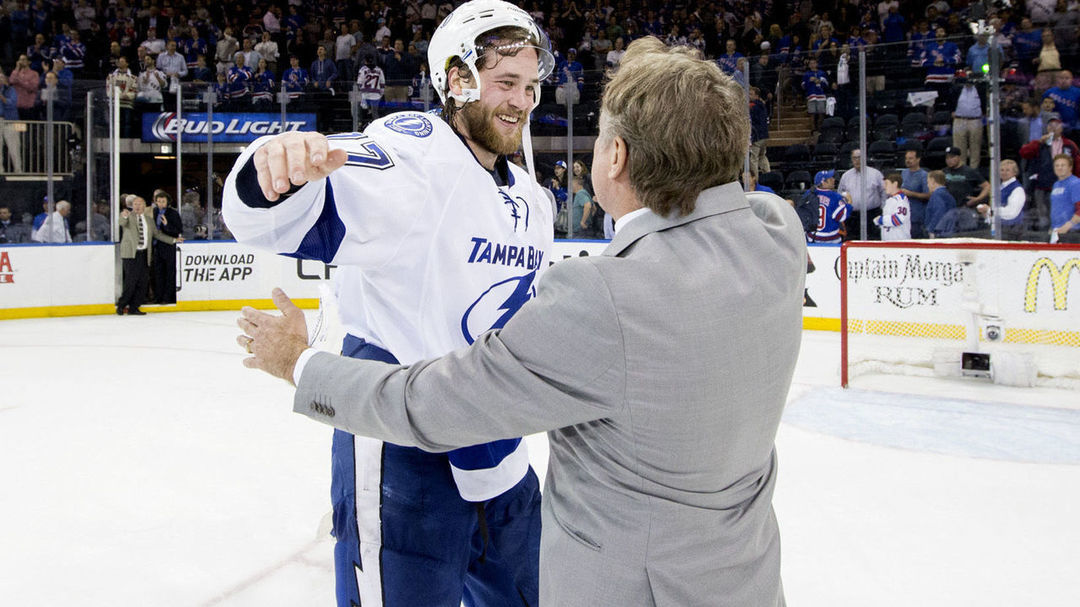
 

Ironically he played as a forward, but has spent much of his coaching career working with defence and is acclaimed for helping develop many D-Men over his career, most recently was helping Victor Hedman become one of, if not the best, d-men in the NHL currently.

#9 – He is transformational and focuses on connecting with his players vs. many coaches still focusing on the X’s and O’s.  Per former player he coached, Brad Barry who is now coach of University of North Dakota X’s and O’s are one thing, but if you don’t have the communication skills or the ability to connect, then I don’t think the X’s and O’s matter anymore.”

#10 – He loves the game as much now as he did when he was a kid.

In every talk I do with coaches I end with key takeaways and one is the measurement of a great coach is one that creates a culture on their teams where kids love the game more at the end of the season then they did at the beginning and come back the following year with big smiles on their faces.

JAMIE BENN – AKA Chubbs

Below is a slide from one of my core talks LTPD vs. Early Sport Specialization where I talk about Jamie Benn’s path to the NHL.
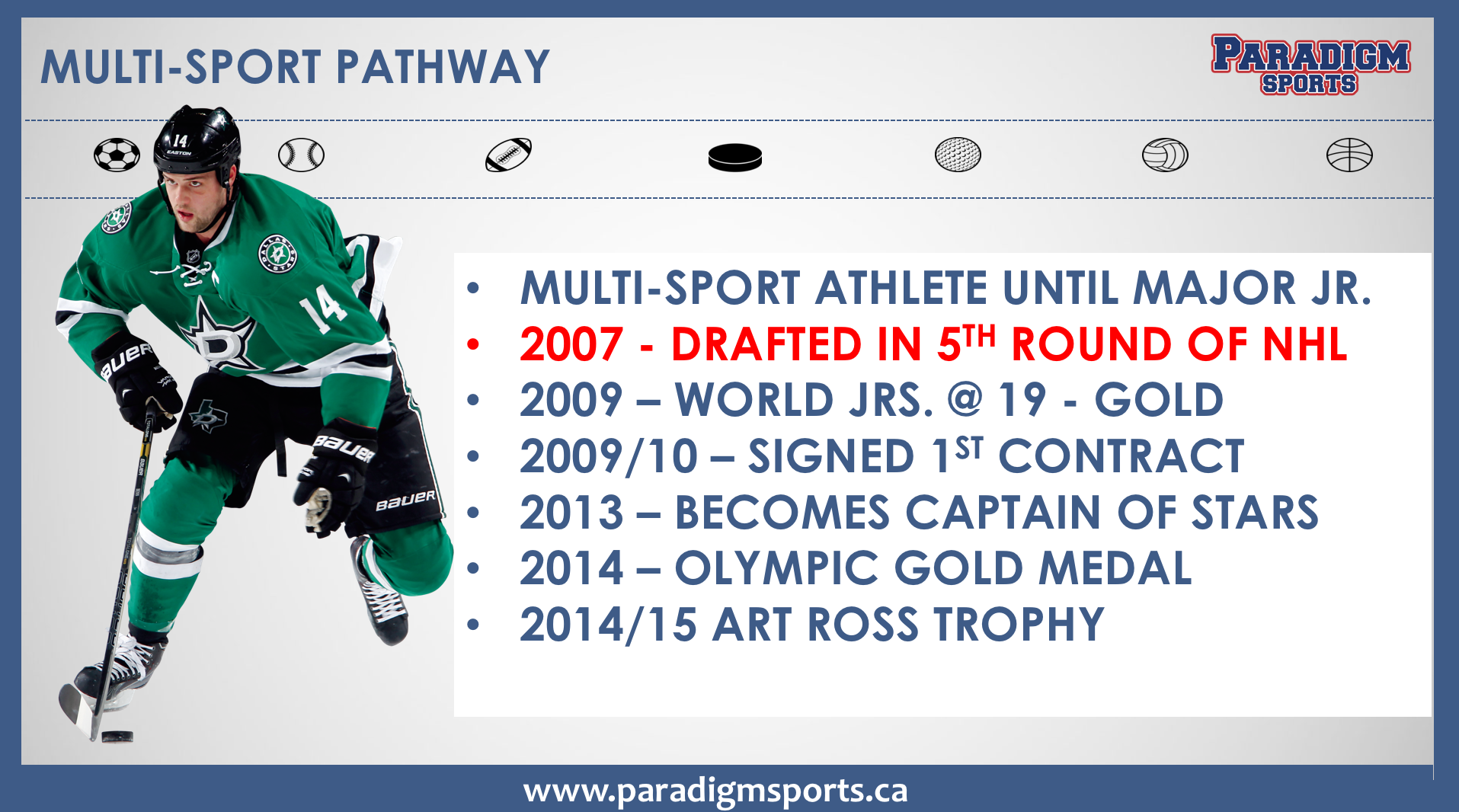
 

Jamie and his brother Jordie grew up on Vancouver Island and played a number of sports growing up, both played hockey in the winter and baseball in the spring as well as tried several other sports until they both found the one they loved the most – Hockey.

Note on the slide some of Jamie’s accolades – Gold in the World Juniors, Gold in the Olympics, Art Ross Trophy and now he is going to the Stanley Cup Final.

Did you know that he did not decide to focus on hockey until he was 19?

This is why Hockey Canada did not even identify him for any of the U16, U18 or U20 Junior Camps until he was 19 as his path was junior B, then Junior A, then WHL and was drafted in the 5th round to then become the captain of the stars in 2013 when he was 24 years old.

His path the NHL, much like the majority of players, was playing multiple sports until his later teens. When I interviewed Ken Martel for one of our summits last year, he shared with me that over 90% of NHL players were multi-sport athletes until at least 14.

“Just a game boys, there’s always next time” Tyler Sequin

Now at 31 he is considered the old guard with the NHL youth movement, but as much as I would love to see a Canadian team be in and ultimately win the final since the Habs won their last one (and last one for a Canadian team) in 1993 27 years ago, I will be pulling for the stars to align for Rick, Jamie to hoist their first and ultimately drink from the Stanley Cup.


How BC is returning to Sport – Phase III

Posted Posted in Athlete, Coach, COVID-19, Officials, Organization Executive, Parents

Since we entered the COVID-19 Era, I have had a number of conversations with various youth sports groups regarding the confusion regarding all of the return to play protocols as various provinces go thru their various stages of returning to play.

Our home province, British Columbia, has recently announced that we are now in Phase III thanks to the amazing work that our PHO and Dr. Bonnie Henry have done since COVID-19 lead to shutting down Sports and numerous other sectors.

Although I am excited that we will see sports ramping up this fall, based on recent conversations since I have had with a few user groups I felt best to share what the phase means in terms of returning back to Sport as some are inferring that it literally is GAME ON, meaning, we are good to return back to pre-COVID era and we are still a ways from that being the case.

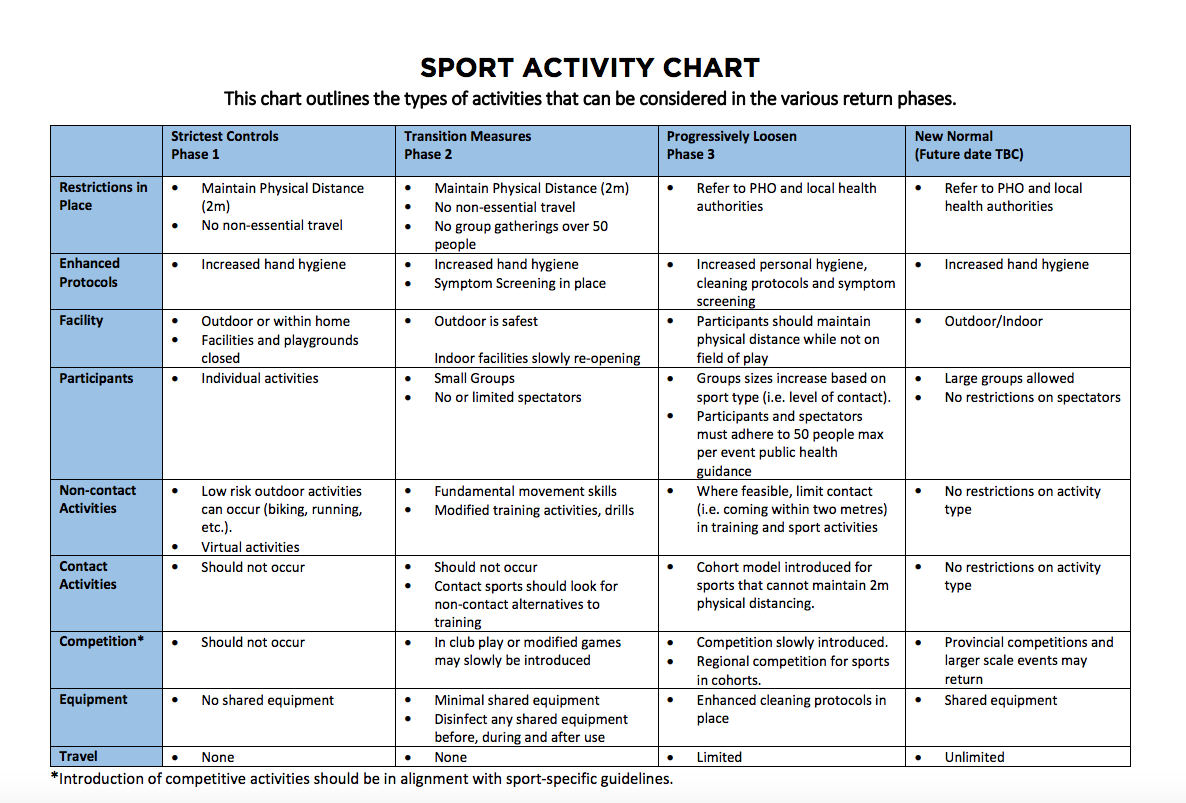
Below is a summary of all phases of the proposed return to sport plan as a summary for user groups to reference;

What has not changed from prior phases is;


  1. Personal Hygiene – washing hands regularly and using disinfectant
  2. Social Distancing required in common areas like benches, dugouts, dressing rooms, lobbies and entrances (masks in those areas is also recommended)
  3. Maximum gatherings of 50 to include spectators
  4. Symptom Screening before every activity
  5. Contact/Participant tracking

What has been eased up in terms of restrictions;

  1. Cohort groups identified by risk of sports can be anywhere from 10-100
  2. Contact within those cohort groups is now permitted
  3. Competition or games can now be played (adhering to revised protocols)
  4. High Performance training with limited travel

In terms of the actual sizes of cohort groups, as this will vary across a myriad of over 70 sports in BC alone, confirm with your PSO and refer to updated return to play quidelines, a recent example included Basketball BC’s HERE


  1. Lowest risk of Contact – i.e. Archery, Tennis, skiing, golf – Up to 100
  2. Higher risk of contact – Baseball, Cricket, Soccer – Up to 50
  3. Frequent/Sustained Contact Sports – Football, Rugby, Hockey – Up to 50
  4. Combative Sports – Martial Arts, Boxing – Max 10 per cohort

NOTE: Cohort groups includes spectators which are immediate family members only to be considered part of the cohort. Coaches and officials can be counted outside the total cohort number IF they are able to maintain physical distancing at all times.

To determine where your sport falls in terms of the size of cohort groups permitted, reach out to your PSO/RSO for confirmation as it is not a one size fits all approach, each sport will have different guidelines based on their evolving return to play plan and facilities being used.

A couple of examples that I can share with you how user groups implemented to limit COVID-19 exposure and reduce risk to participants (players, coaches and others)

My niece recently flew to Montreal for her first year to play for McGill’s Women’s Varsity Hockey Team.  She will be staying in dorm rooms in a converted hotel that McGill purchased and renovated for dorm housing with her own bathroom and common areas for kitchen for cohorts to use only.  Similar to the NHL bubble, they will not interact with others out of their cohorts

Her season will start with skills development sessions only, and will find out this week as Quebec enters into their next phase and she shared the original plan for competitive games is for McGill to play Concordia and Ottawa’s USports teams to be within a short travel distance but no travel will be permitted to USA or other provinces until a later date.

Although she will be able to be part of the team for various activities, all of her courses, like all the other students will be done online until further notice, like most other universities at least for this fall.

The second would be easing of instructions for minor hockey associations, the first of which that re-opened its doors with strict COVID-19 protocols was Burnaby Winter Club BWC) in May which we shared Returning Back to Play – Phase II where they took the biggest risk as the first out of the gate but to date no positive COVID-19 cases have been reported months later.

Now all other minor hockey associations in the lower mainland are slowly but surely returning back to the ice with various camps, skills sessions with limited number of skaters and coaches on the ice and aspire to return back to 5 on 5 hockey this coming season.

Ironically in July I had a coach who attended many of the workshops that I ran last year for one of those associations reached out to me if I felt it would be safe for him and his son to return to play and I shared all the work that was being done to ensure that it would be safe, but it would be different at least in the immediate short term.

When ViaSport and our provincial health authority announced that we would be entering phase III, I was excited but at the same time a little weary due to the fact that I have also connected with colleagues in the US, Europe and Australia who have shared how far out they are from returning to sport.

One recent example was a conversation that I had with one of our speakers for our Summer Summit, Rosemary Morris, the first female official of men’s elite basketball in Australia and she stated that they were in full lock-down due to the explosion of COVID-19 cases in recent weeks.

This included;

  • Curfew where all residents had to be in their homes from 8PM to 7AM the following day
  • Only 1 hour of outside time for physical activity, exercises
  • No retail shopping except essential services (grocery, pharmacy and of course alcohol)
  • Full cancellation of all sports programming until further notice
  • Police and Militia enforcement to ensure people follow the lock-down requirements

This right around the time when the Big 10, Pac12, CFL and various other professional, collegiate, school and youth sports cancelled all fall sports programming in Canada, US and abroad to curve the spread of COVID-19.

This is not to say that I am beyond excited that kids in BC, in particular the Vancouver area where I reside, will have the opportunity to return back to playing the sports they love, being with the coaches, team mates and working up a sweat with huge smiles on their faces while they do so.

I just want to make sure that we don’t go to the other extreme as we have seen in many US states who recognized the importance of kids playing youth sports but did not do so in phases adhering to various return to play protocols.

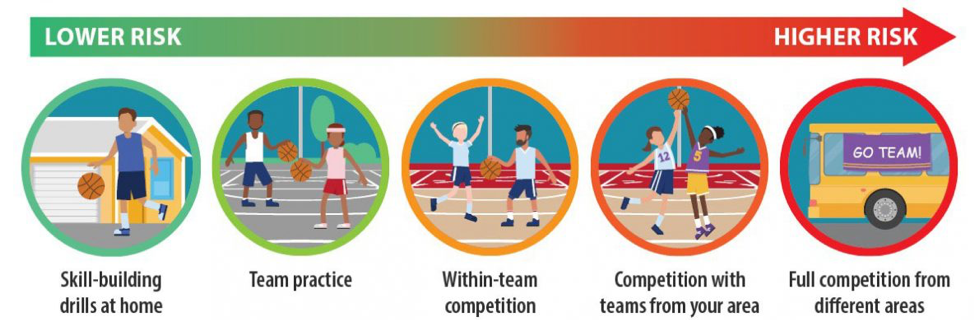
Recently the CDC, like ViaSport has identified various groupings of sport based on risk assessments per the image below


Phase III does permit cohort groups of competition within teams in your area but does not permit tournament play requiring travel to other areas.


Masks, sanitizer, and ultimately participating outdoors are the main recommendations to flatten the curve of COVID-19


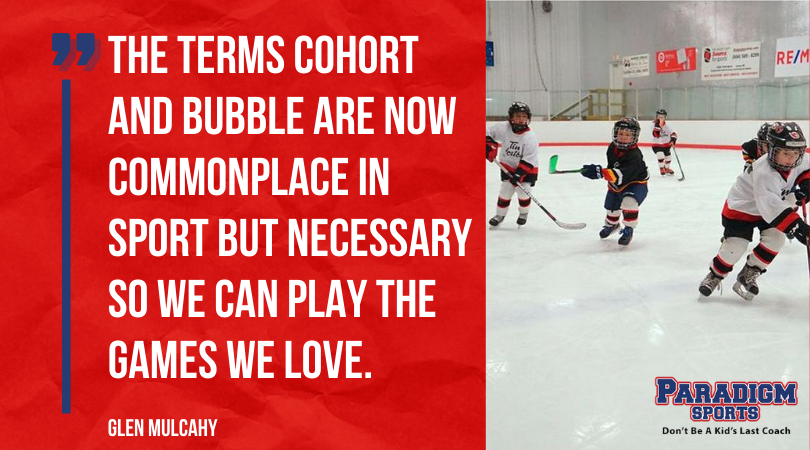
Sadly COVID-19 has forced our hand to go down the path of implementing cohorts or bubble environments to limit the interaction and potentially the spread of COVID-19 but as the NHL has shown, if bubble is maintained, it does permit sports to be played.

According to ViaSport, the term cohort is “a group of participants who primarily interact with each other within the sport environment over an extended period of time.”

Similar to the Bubble concept that has been implemented by professional sports like the NHL, NBA once kids are identified for their cohorts they are not permitted to interact with ones that are in other cohort groups and same holds true for coaches, officials if they become members of a cohort (exception being if they can maintain physical distancing then could coach other sports with other cohorts)

Sadly COVID-19 has forced our hand to go down the path of implementing cohorts or bubble environments to limit the interaction and potentially the spread of COVID-19 but as the NHL has shown, if bubble is maintained, it does permit sports to be played.

However, as the MLB who has not implemented a bubble model like the NHL/NBA/MLS have has shown, the chances of transmission of COVID-19 is much higher even though baseball is one of the sports identified by youth sports groups as being lower risk as by its natures participants are much farther apart then other team sports.

It also does not help when they had a couple of pitchers on one team that went partying in Chicago increasing their exposure, their team mates and potentially others teams they are playing against … but I digress.

The end result is for the foreseeable future, the cohort and or bubble model is necessary for us until such time that there is a vaccine or other treatment protocols for COVID-19 but by doing so, it will permit kids to play what they love, coaches do what they love to do and all other stakeholders return back to the fields, courts, fields and other playing surfaces so we can “Play for the love of the game”

In addition to the new Phase III guidelines, please ensure that you continue to follow health authority, organization and league safety protocols until such time that we do enter phase IV when large gatherings can take place as they had pre-Covid.

PS Tagline - Dont be a kids last coach