
Returning Back to Play – Phase II

Posted Posted in Athlete, Coach, Officials, Organization Executive, Parents

After a 2+ month quarantine period, many provinces, states and countries are starting to ease up on the physical distancing measures implemented to ensure that we flatten the curve of COVID19.

In phase I, we have seen restaurants, hair salons, non-essential retail, hotels and other services return with various safety guidelines to ensure that we continue to flatten the curve of COVID19 but slowly return to a sense of normalcy.

The sector that we are involved with is one that I am most excited in seeing work on return to play protocols, youth sports.

What I have found over the last couple of months during the hiatus, however, is the overall direction provided from national authorities and the trickle down effect from national, to provincial (or state), to municipal levels and literally every organization I have talked to saying they are waiting to see what their respective governing bodies provide in terms of guidelines so they can start the process of having their members return to play.

The first of the most anticipated documents that all sports groups in British Columbia (our home province in Canada) were waiting for was the guidelines for ViaSport, the provincial governing body under new leadership and legacy from the 2010 Winter Olympics held in Vancouver/Whistler.

The link to the guidelines has now been released, click on the image below to download a copy for reference.

The 35-page document outlines a generic return to play guidelines for all provincial sports organizations to then create their own guidelines to then in turn provide to their local organizations to the same.

Note that ViaSport is requiring that level has their own return to play guidelines, board members review/approve before are provided to their memberships.

I.e. First The National Sport Organization, then Provincial, then Regional (if applicable) and lastly local sports organizations.

The document was released June 1st, so it will take weeks for the various levels to prepare their own set of return to play guidelines to minimize the risk of the further spread of the COVID19 virus.

Yesterday I attended a webinar that was hosted one of my colleagues in Alberta, Lea Weins a Quality Sport Consultant in Alberta, outlining the project they undertook in various communities in Alberta identifying what quality sport would look like which now will look different as a result of the various health and governing guidelines

What I found interesting was a poll of the attendees from various sports organizations highlighted what I suspected, almost all (97%) stated that their were looking for clear guidelines and timelines to return back to activity.  Almost half were looking for assistance to mitigate risk as well as sanitization/cleaning support to ensure the safety of participants.
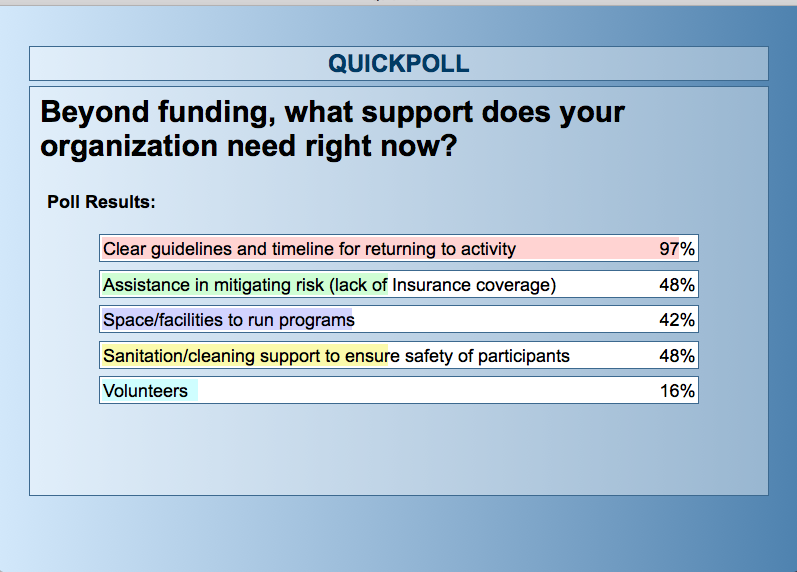
Source: Alberta Quality Sport Webinar June 2, 2020

This theme is consistent regardless of what sports organization I have talked to in recent weeks and I came across a survey that was done for Project Play By North Carolina and Utah universities of over 1000 youth sports parents in the USA
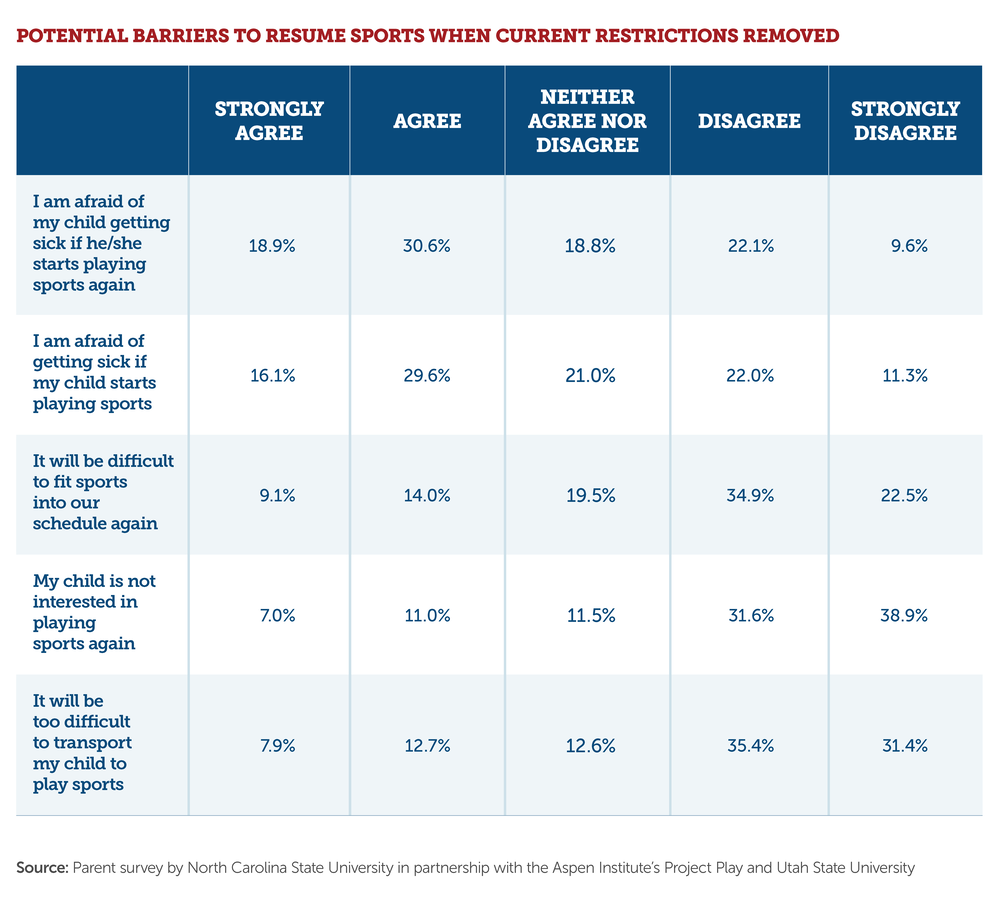
When asked how comfortable they were with their kids returning to sports 49.5% of parents are afraid of their kids getting sick if sport resumes and just shy of 46% stated they are afraid of getting sick if their child returns to sport!
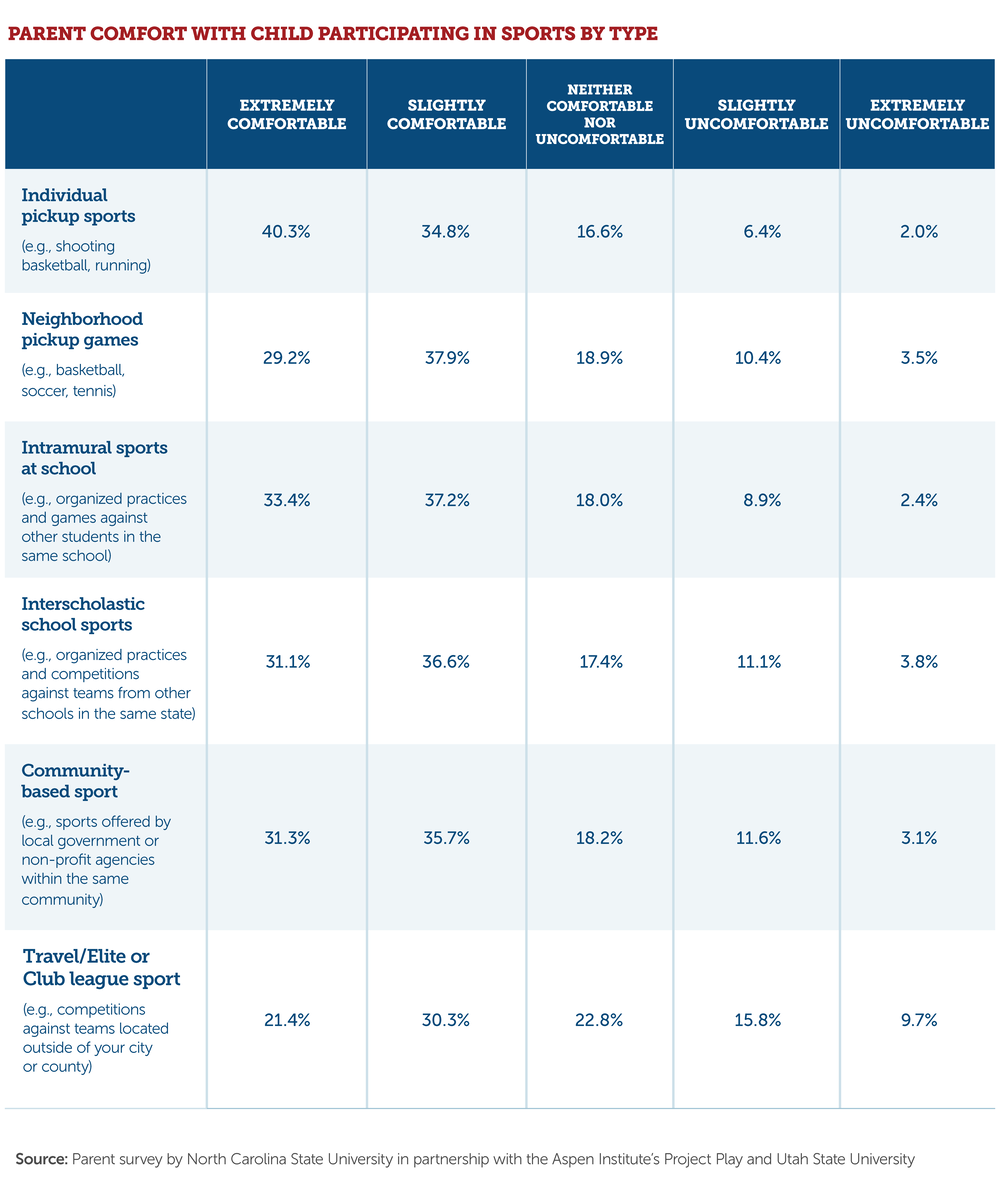
When parents were asked of their comfort level for their kids returning to various types of sport, over 70% were comfortable for their kids to return to pickup sports (AKA Free Play) and only 50% for what was the pay to play model pre-covid in terms of travel/elite club league sports.

In literally every webinar, Zoom or phone call I have had for over a month the one thing that was consistent was the LACK of consistency but it is due to the fact that every sport has their own challenges how they will return to play, some are low risk (i.e. archery) vs. higher risk team contact sports (rugby) how they can modify their practice sessions initially to adhere to physically distancing requirements.

Below is a chart prepared outlining the various phases for sport activity (also prepared by ViaSport)
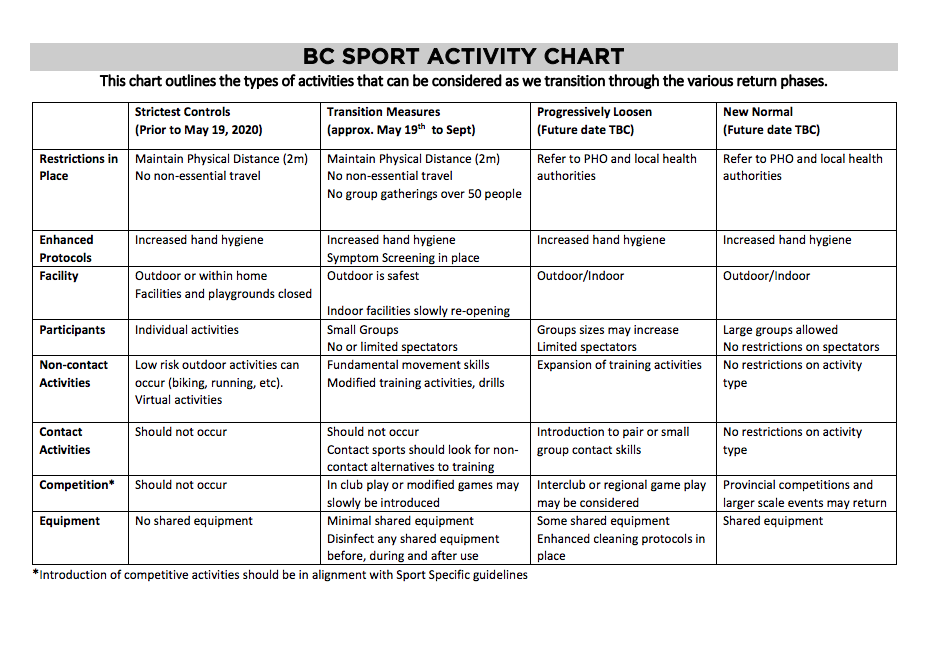
Phase I – State of Emergency Quarantine Period (March 13- May 18th)

Phase II – the phase we (and others are about to enter)

Notice the bare minimum requirements regardless of the sport

  1. Physical Distancing (6’/2m) must still be adhered to
  2. Increased Hand Hygiene (washing hands for 20 seconds regularly)
  3. Outdoor participation is safest … indoor facilities (gyms, pools, rinks) slowly reopening
  4. Small Groups, no or limited spectators, focus on fundamental movement skills
  5. NO Contact activities which will require contact sports like Rugby, Football, Hockey to revamp programming but also many others like basketball, soccer to ensure adhere to physical distancing
  6. Minimal shared equipment and must be disinfected frequently

Phase III/IV are still a ways away so in the short term (at least until September 1st projected for Phase III), any spring programs/summer camps will have to improvise, adapt and overcome to meet the COVID19 phase II guidelines.

Here are some of the challenges that are holding back sports organizations from shifting to phase II

  1. Insurance Requirements and if a pandemic/contagion exclusion is needed
  2. Updates to Player Participation/Waivers to include COVID19 disclaimer (i.e. that organizations are not to be found liable if participants test positive for COVID19)
  3. Facility Rental – Who is going to bear the costs (product and payroll) to ensure that common areas, equipment is sanitized and if masks will be needed
  4. Scheduling – to ensure minimize overlap of large groups for dropping off/pick up of participants
  5. Spectators – Yes or No … if so how many?
  6. Total Number of participants permitted (players, coaches, trainers, other)?
  7. Will lower numbers make the business model viable?

I even had some ask about what others were doing in terms of tryouts, coach and team selection which I shared that was not even being considered, the goal was merely to get kids back out to their sports in the safest way possible, there are not going to be any competitive games in phase II from the all the sanctioned sports organizations I have talked to.

**As far as non-sanctioned sports that is another thing it itself, only time will tell if they also practice the DO NO HARM philosophy vs. ramping up games and tournaments before health authorities deem it safe for us to do so **

Why is there so much ambiguity, confusion?

Because even the experts are no longer experts when it comes to dealing with a pandemic like the novel coronavirus, which is why over and over again we are hearing the term unprecedented.  Never in the course of human history has ALL sport been shut down, from professional to U-sport to high school and community sports.

The other challenge is there are many organizations leary of taking the risk of putting their toe in the water until someone else does so or they are given clear outlines from the higher-ups so to speak.

In sum, as health authorities have now deemed it safe for us to enter phase II, we shared in “What will the new Normal Be” how some organizations were returning to play starting with the infamous Mother’s Day Baseball tourney hosted in St. Louis that many felt was too much too soon.

I just checked my best friend Google to see if any other news had been shared since and to date there have been no reported cases of people that tested positive that participated in the event.

There have been a few others that have or are about to open their doors to return back to play implementing various safety measures to adhere to health authority guidelines.

 

Following the lead of Burnaby Winter Club who re-opened for bookings May 5th with rigid safety protocols, now my the multi-sheet facility that I coached at for many years has re-opened after their parking lot was turned into a Hyundai new vehicle parking lot
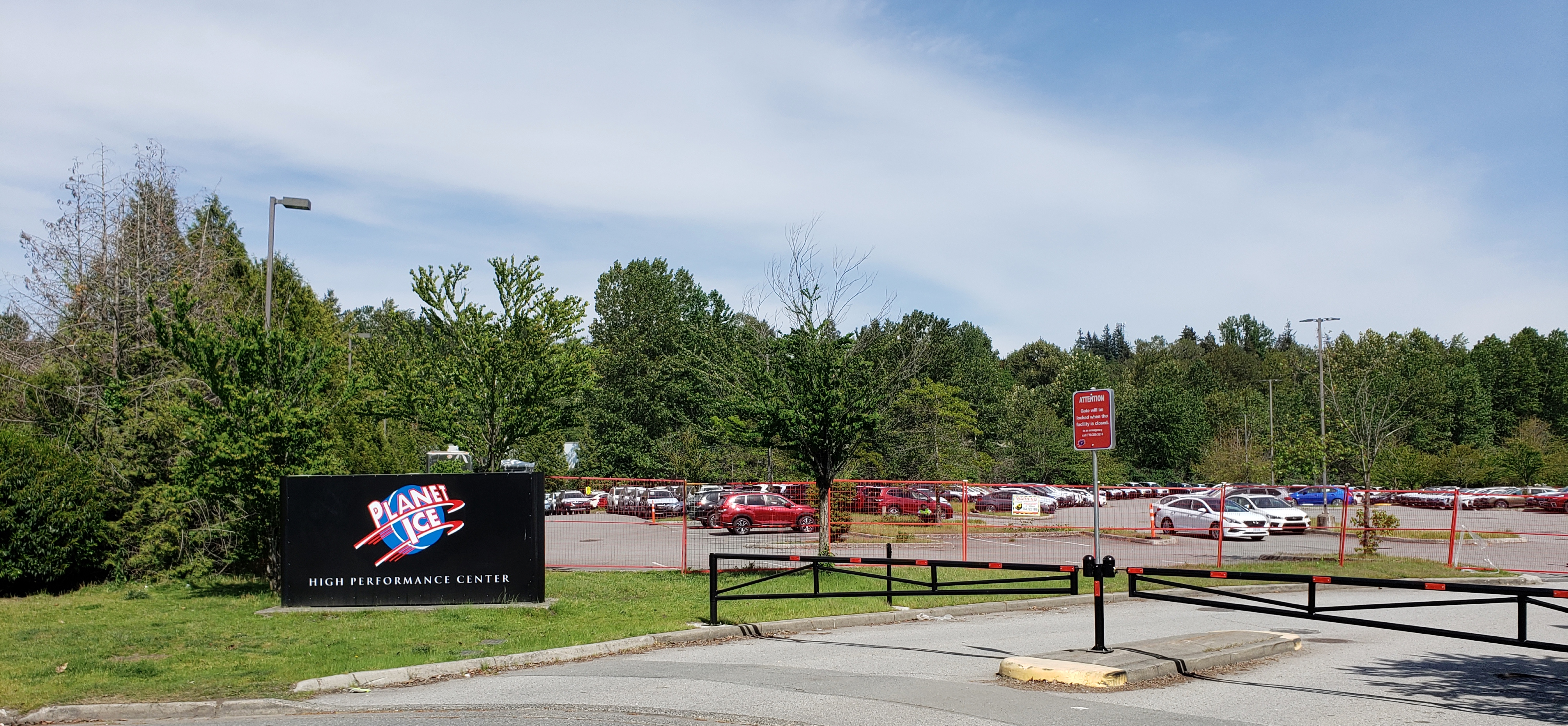


I started to see cars being parked early part of April as I drove past the rink which I can only assume was a means to generate some revenue as the private facility did close its doors to adhere to the quarantine period.

Fast Forward to May 19th, they also have opened up 2 of their 4 sheets of ice for skill development sessions like BWC according to Surrey Community staff member that shared during one of the many webinars I have done the last month.
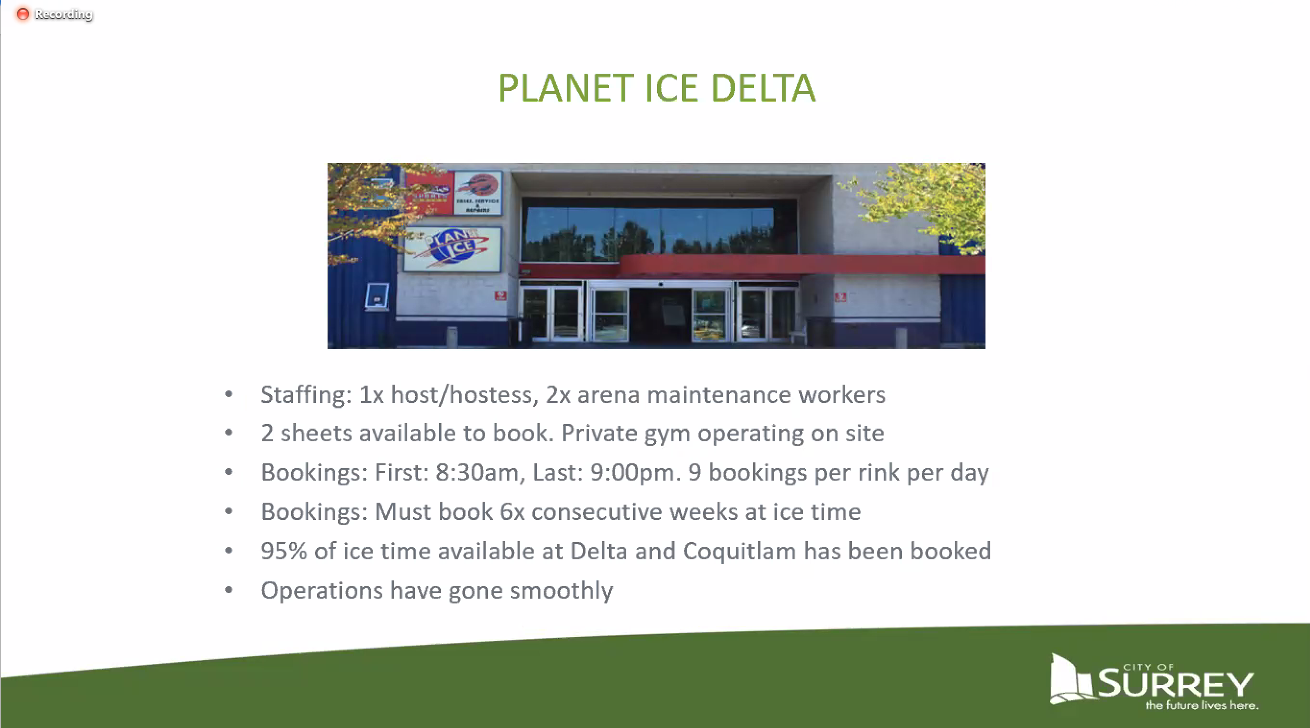
 

Note – just in a few days the facility manager confirmed that 95% of their ice was booked!

Only 6 skaters are permitted on the ice with a skills instructor, dressing rooms and concession are closed, and there is a one way flow inside the arena

They also have been creative in terms of signage for spectators (only one per player permitted and for markings on the ice to ensure that players adhere to physical distancing, including expanding the goalie crease by 6’!

 

Once Soccer Canada, ViaSport reviewed BC Soccer released their return to play guidelines on June 3rd.

Click on the image for the guidelines shared with their members



They outline 3 return to play phases only so their phase I is what ViaSport is calling phase II (after the quarantine period)

The documents include guidelines for local organizations, sample sessions and timelines

The sample sessions do outline how fields can be utilized (outdoors) to ensure that number of attendees on the field at any one time does not exceed 50
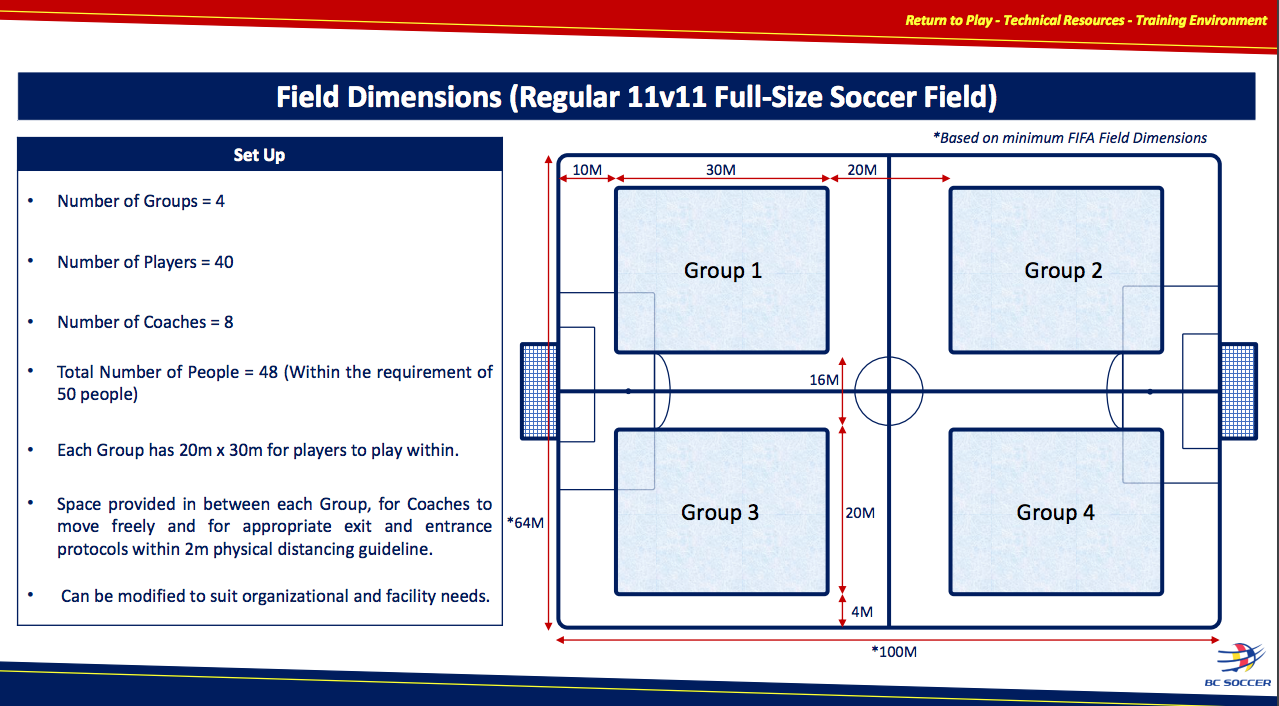
Session Example of 10 players in group 1 with 2 coaches working on various soccer skills
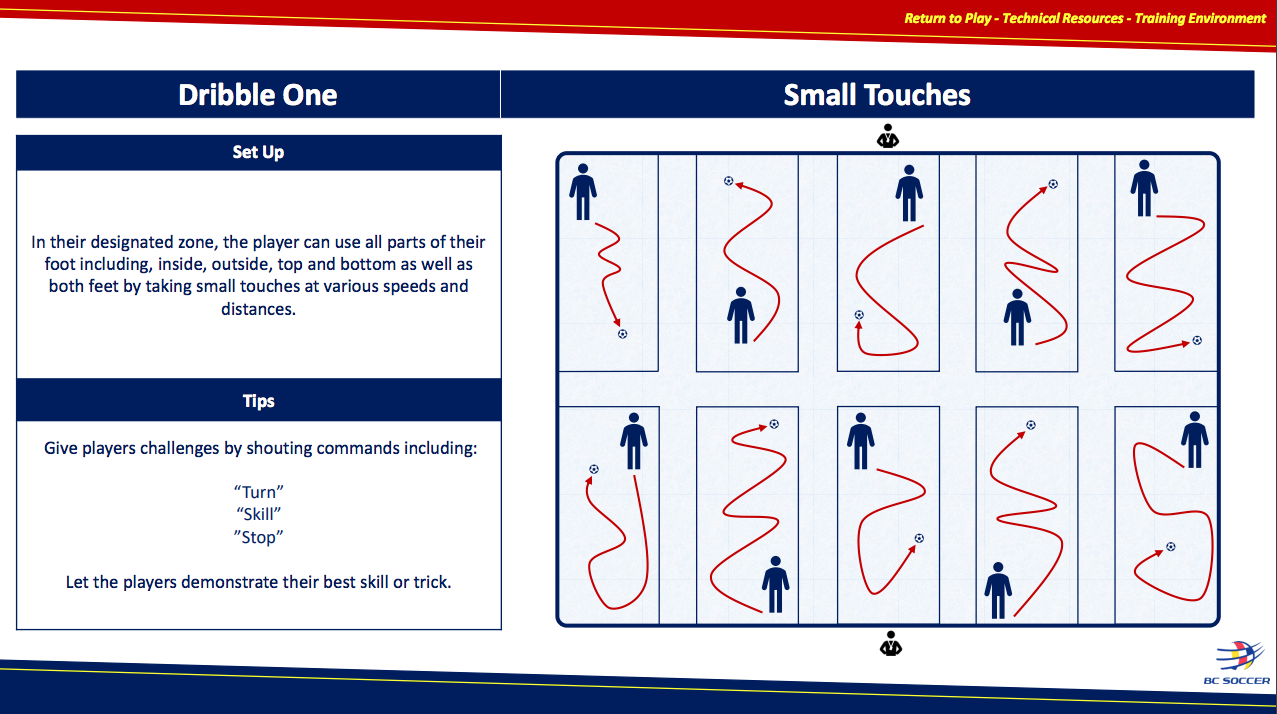
 

There is no reference to competitive game play, only skill sessions which adheres to ViaSports and BC Health Authority Guidelines.



Still working on their return to play guidelines for clubs but one of their directors shared in webinar how they envision their return to play will be in three components;

#1 – Only singles play, no doubles or mixed doubles play will be permitted

This will be mandatory for U11 and U9 age groups to start which they believe will be a good thing for their overall sport so coaches can focus less on tactics and more on skill development until the players mature and players have the skills to execute tactics

This also will permit coaches to do more one on one coaching vs. group sessions where coach to player ratio was a high as 1:8

HMMMMM … where I have I shared that before???

#2 – No Spectators initially, only players and coaches will be permitted

#3 – They had already started looking at piloting but are going to roll out AIR Badminton (AKA outside badminton like kids have done in their yards for 2 months during quarantine)

This was initiated pre-COVID lockdown to provide another playing experience than indoor, similar to the Beach Volleyball concept

More examples will follow in the coming weeks as more organizations release their return to play guidelines but as the cliché goes, good always comes out of bad and as more and more sports ramp up for Phase II the challenges we faced pre-covid in terms of adult behavior in the stands/sidelines, focusing on winning at all costs will not be an issue we deal with.

Perhaps this also will be the much-needed catalyst for sports in North America to consider other youth sports development models that we have shared in past like Norway, Sweden and Iceland who don’t even have competitive games until kids acquire the skills to from 6-12 years of age and as a result have had huge success at the Olympic and International Levels as a result.

Only time will tell.

Let’s all work together to bring the game back to the kids.
 

PS Tagline - Dont be a kids last coach


Shifting to a Virtual Environment

Posted Posted in Athlete, Coach, Early Sport Specialization, Organization Executive, Parents


In the last couple of weeks, the world as we know it has seen unprecedented closures of all sports, restaurants, schools, colleges, retail stores, and workplaces and so on so we do everything possible to contain the spread of COVID-19.

As we work with so many youth sports organizations with volunteer board members this week who had to suspend their winter seasons or postpone the launch of their spring seasons and many organizations (including ours) shifting to virtual work from home (WFH) I felt best to provide some tips how we can do the necessary work needed to ensure that we are prepared to ramp up once the medical community across the globe gives us the green light to do so.

In addition to youth sports organizations, we also have been a sponsor of co-op university students for several years who have helped us build out our platforms and know that colleges and universities also have shifted to virtual classrooms as well, and we, in turn, have shifted so they work from home to complete their co-op hours needed and aspire to sponsor more this summer.

As we have been building out our various digital resources the last few years thru our digital arm “For The Love Of The Game” to include digital summits, podcasts, webinars, online courses we have experimented with various software and hardware configurations and below is our list of recommendations how can set up a virtual board room/office if still scrambling to do so.

A computer – Either a laptop or desktop (PC or Mac).

A camera  – either built-in (laptops/tablets) or an add on webcam to their desktop computer.

Best bang for buck Webcam – Logitech C920 (> $100.00) – 1080P video with a decent built-in microphone

A microphone – many USB cameras will include an integrated microphone.  If you are using a laptop, it will also have a basic integrated microphone.

Better quality Microphones for buck include those with corded/Bluetooth headphones or Blue Snowball/Jedi are used by many people for video chats, interviews, podcasts

Collaboration software – there are many remote collaboration tools available on the market.  Our recommendation is Zoom, a free to use service for smaller groups for short meetings up to 40 minutes or for small monthly fee that can add additional users. Zoom uses the same hardware as Skype but in addition to meetings, can also be used for webinars and sharing screens

Conference Headset / Microphone– for those seeking a cleaner overall experience you may wish to consider a conference headset.  This will deliver high-quality sound and a high-quality microphone for work from home and can also be brought back to the office when given the green light to do so

Plantronics has a system that you can get very cost affective on eBay that allows users to connect to landline (if houses still have), Zoom/Skype via USB or Bluetooth (Cell Phones).  Model W740 and suggest getting the how to swap adapter for battery charging and an extra charger

Data /Software – Google Docs (free) for collaboration and sharing or Microsoft One Drive (subscription based on number of users but can get 1 Tb cloud storage with office 365 subscription)

Email – can setup work emails remotely as aliases with a Gmail account or webmail access. This can take a little finessing as we experienced for our interns to work remotely (ISP, Email hosting or browser conflicts/cookies), I suggest all sports orgs set up a Gmail account for interns so they use either in offices or WFH (work from home)

Team Connection – We suggest What’s App, it permits users to do group texting and accessible both by phone/tablet but also desktop/laptop with web-based apps. This also will not impact users data plans although many of the cellular providers are waiving data charges

Phone – Suggest call forwarding to a cell phone or remote log-in for voice mail

Not only can board members have their regular or emergency meetings weekly, but the Zoom Platform can also be scaled to host online training (vs. live workshops), webinars and suspect even AGM’s will be hosted as can have up to 100 participants for 20.00/month CDN with meeting duration up to 24 hours.  All can be recorded as well, but to do so the device hosting the Zoom Meeting must have available storage to do so (approx. 1GB/Hour of recording)

Our Online Option for Resources, Tips for all stakeholders in youth sports

In the summer of 2018, we hosted our first virtual summit to incorporate many of the technology platforms we recommend above thru a lot of trial and error (hardware and software) so stakeholders in youth sports could get insight from some of the top leaders in the space across the globe and we will be resharing our most recent summit with 18 speakers April 3-5th.  In addition to the insight all of the amazing speakers will share, we are also looking at sharing a live webinar on day one of this summit and encouraging all those that sign up to leave comments for all of the interviews to provide all youth sports stakeholders tips so they add to their tool baskets to implement when their upcoming seasons start up again.

The benefit, you can do so at home and access any device that is connected to the internet, phone, tablet, laptop, desktop, smart tvs or game consoles. The best part, it’s FREE to sign-up for vs. paying hundreds, if not thousands of dollars to attend live conferences (which have all be canceled for the foreseeable future also)


What: 2020 Youth Sports Digital Summit

When: We are going “live” with digital summit April 3-5th

Who: Interviews with 21 different speakers (key takeaways will be posted on the event page)

Why: We continue to host the online summits so all stakeholders of the grassroots sports community so they can learn tips from experts from across the globe as cost affectively as possible

Where: Accessible by any device that can access the internet (computer, laptop, smartphone, tablet, smart TV, game console)

How: Click HERE to go to the registration page with more info to sign up for FREE

Starting April 3rd, we will release 6 interviews per day that I will preface each interview with the key takeaways followed by 6 more on Saturday April 4th and Sunday April 5th.

The schedule for the interviews will be shared in advance so you can prepare for also.

In the event that you are unable to see/hear from all of the speakers you would like, we are offering cost-effective on-demand options for your to do so for this summit as well as all of our prior summits and online courses that we continue to build.  We now have over 70 hours of digital content that you can access with any digital device at your convenience.

Many other amazing guests who share insight on their amazing programs, coaching tips, developing cultures of excellence so anyone that signs up when their seasons start up again will hit the ground running!!!

We also provide links to resources, their websites you can reference going forward.

I know that all organizations across the globe are implementing contingency plans to ensure that we contain the virus and although it is a stressful time for all of us while we do so, we are all in this together.

One thing that I have been thinking as each day goes by is I hope when we are given the green light to return back to sports that hopefully it will allow us all to look at it from a different lens.

Perhaps the adults will take it less seriously and recognize that it is a game played by kids, officiated by kids, coached by volunteers (many of which are parents who stepped up) with volunteer board members to ensure programs run.

Perhaps those chasing the dream for their kids in the money sports (scholarships, professional contracts) will see that the return on investment they are aspiring for will be moreso in terms of their kids becoming great people, great athletes as they return and if they reach a level beyond high school, that is just gravy.

Perhaps after this time away, we will take a breath next time we are at youth sports game in lieu of screaming a kid for making a mistake, an official for missing or making a bad call, a coach for a mistake made due to learning HOW to coach (not what to coach).

Maybe, just maybe, there will be a PARADIGM shift that we have been aspiring for where adults Just Love Watching The Kids Play again.

At the end of the day, that’s why we do what we do, to help all stakeholders in the space create the highest quality youth sports experience possible so kids love the season more at the end of the season than they did at the beginning and they have active, healthy lifestyles well into their adulthood.

Our best wishes also go out to those that have tested positive for the virus so they can fight it with vigor and condolences to all those families who have lost a loved one.

We also encourage everyone to not panic during this time, just as we have thru other illnesses, economic times of instability, the world WILL get thru this, now more than ever we have to come together and follow all the recommendations from the health authorities so we are safe.

We can’t wait for the time when it is safe for kids to return back to PLAY, whether it be organized sports or free, unstructured play.

Hopefully, it is sooner rather than later.


Respect has to be a core value

Posted Posted in Athlete, Coach, Early Sport Specialization, Organization Executive, Parents


For years I have been advocating for the importance of bringing back respect to youth sports and although I have seen a shift, and many organizations have done public service announcements, campaigns or signage when I come across various posts in social media or in print it just leaves my head spinning how much more work we have to do.

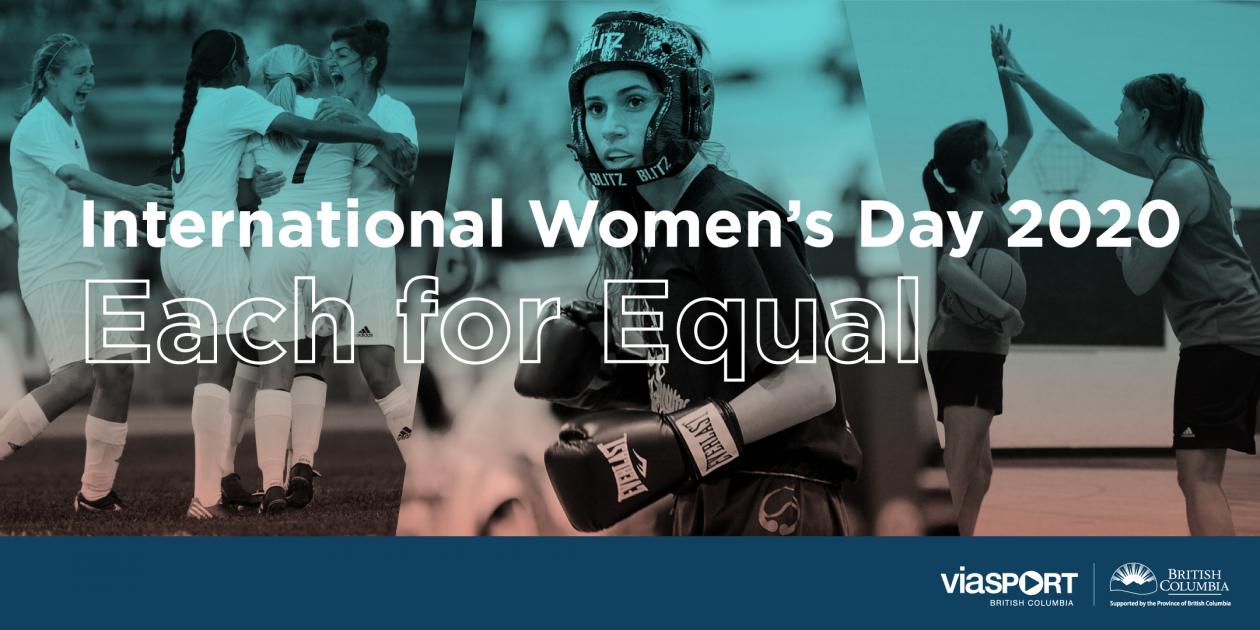
This past week we attended ViaSport’s International Women’s day event as we believe strongly in the importance of growing all levels of female participation of athletes, coaches, officials, board members, and various other leadership roles.


There were approximately 100 attendees for the event from various sports organizations in BC, which did include a small representation of he/him/his (including yours truly) and had a series of speakers reviewing the challenges to increase female and women’s (she/her/hers) participation within their various organizations.

In the afternoon, we went thru a Gender-Based Analysis Plus Workshop ran by Dr. Melanie Stewart from BC’s Provincial Gender Equity Office where she started off by highlighting some of the gender inequalities that still exist but the statistics that jumped out at me the most were gender-based Violence

  • In 2016/17 – 55% of sexual assault victims were females under 25 that were reported
  • More alarming, only 5% of sexual assaults are reported to police, and only 11% of those will lead to a conviction.

The reason these numbers jumped out at me to the extent they did was the fact that literally a year ago around the same time I attended another event sponsored by Via Sport, the BC Safe Sport Summit in response to the series of articles LY that Jamie Strashin and Lori Ward wrote for CBC that highlighted 222 coaches in Canada had been prosecuted sexually assaulting over 600 athletes from their late teens until mid ’20s.

If the 5% rule of thumb that are reported to police is, in fact, accurate, that means there could be over 10,000 athletes that were sexually assaulted the last 20 years in Canada!

As far as I am concerned, ONE is too many, we still have work to do to ensure sport is safe from all forms of harassment.

This just a week after I read an article highlighting the harassment towards a high school hockey player in Philadelphia, Alyssa Wruble, where a fan-created a sign challenging for her to declare her gender and number of the students from opposition school she was playing against chanting “she’s a dude”

In the morning address to all the attendees Mitzi Dean, the BC Parliamentary Secretary for Gender Equality shared a story about her 7-year-old daughter who played on a mixed hockey team with boys almost quit the game because the boys told her frequently that she did not belong on the team.

REALLY?  Both examples were just a painful reminder that we still have so much work to do to change the culture in youth sports for the better and I believe one of the reasons is due to the lack of respect we have, yes we talk about it, but do we truly walk the walk?

The very definition of respect is:

re·spect

/rəˈspekt/

noun

#1- a feeling of deep admiration for someone or something elicited by their abilities, qualities, or achievements.

“the director had a lot of respect for Douglas as an actor”

#2 due regard for the feelings, wishes, rights, or traditions of others.

“young people’s lack of respect for their parents”

verb

  1. admire (someone or something) deeply, as a result of their abilities, qualities, or achievements.

“she was respected by everyone she worked with”

With inclusivity being one of the hot topics and initiatives we discussed over the day as well as prior Women’s day and other events I have attended, one of the biggest issues that we still continue to face is the current culture of youth sports needs to change so youth sport is not only inclusive but the core value of respecting others so it becomes ingrained in all of our DNA’s.

Had it been a core value as part of the overall culture vs. highlighted on signage, public service announcements, or strategic initiatives still in the development phases Alyssa, Mitzi’s daughter all the other girls out there that aspire to play a game and may be forced to play with the boys as there are no programs in place for them for girls only teams would be respected and admired for their skills and abilities in lieu.

My niece is another one of those girls, who is a very skilled player and the only option was to play on boys teams who shared similar stories with me until she reached Bantam so had to move to play on and academy all-girls team (at a great expense to my in-laws for her to do so).

Fortunately, her love for the game never wavered like Hayley Wickenheiser and many other female trailblazers before her and she just received confirmation that she has been accepted to McGill and offered a spot on the Women’s Hockey Team starting next season.

Fortunately leaders in the space including Via Sport, Provincial and Federal Government, PSO NSO, and even professional sports are working towards programs to ensure we do keep moving the boulder up the mountain as the keynote speaker Charmaine Crooks (OLY, Order of Canada) used in her great keynote presentation so sport is inclusive, safe and sport can be a positive for all.

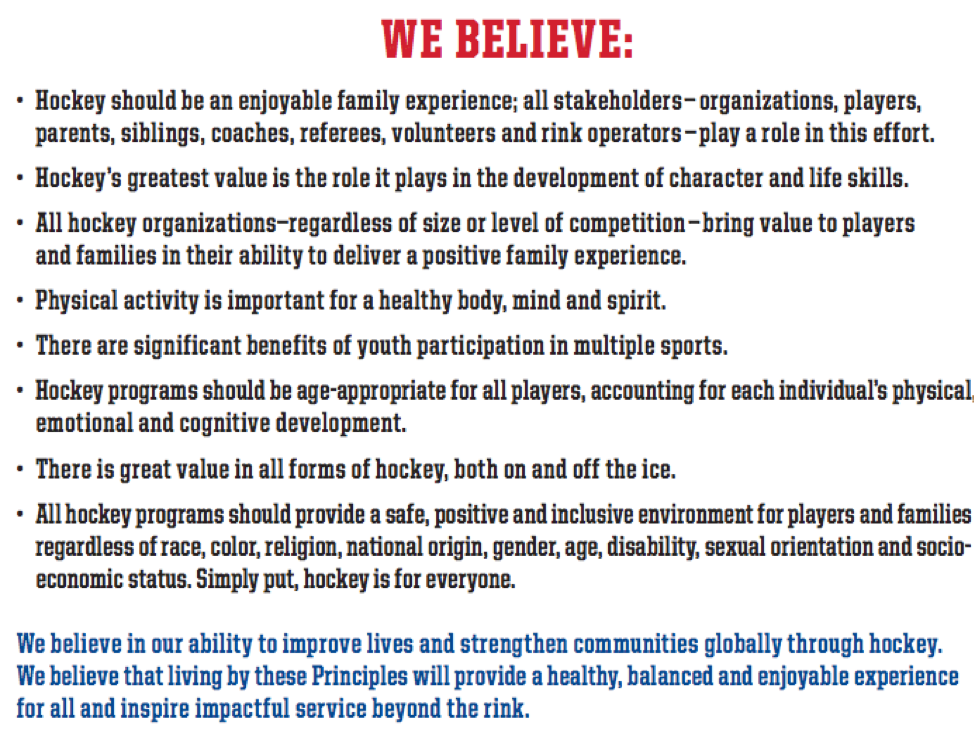
I can’t think of a better example of an initiative to ensure that respect does become part of our core values than the Hockey Declaration of Principles drafted by all the governing hockey associations worldwide in collaboration with the NHL released in Fall 2017.

We concur with the declaration of principals, not just for hockey, but sports are for everyone globally.

Sadly as each day passes while all sports are on hold to ensure the safety of all stakeholders as the world comes together to fight the spread of the Corona Virus I would be remiss not ending this post focusing on the importance of respect not acknowledging all the first responders and medical community who have come together as a global team to make the world safe again.

My utmost admiration to all of those that are doing so and let’s all work together to ensure that all those who love the game, whether it be young kids, teens or collegiate, professional athletes, and all the other stakeholders involved can return to the games they love when the medical community deems it safe to do so.