
How to develop creative players

Posted 1 CommentPosted in Uncategorized

BONUS – Download a Free Copy of this Blog in PDF Format HERE  

As the Hockey Clinic season has started I have reinforced the importance with new coaches the importance in developing creativity with their young athletes.

Below is a poster board of the 10 ways to develop creative youth players that we have posted to Facebook with examples outlining each.
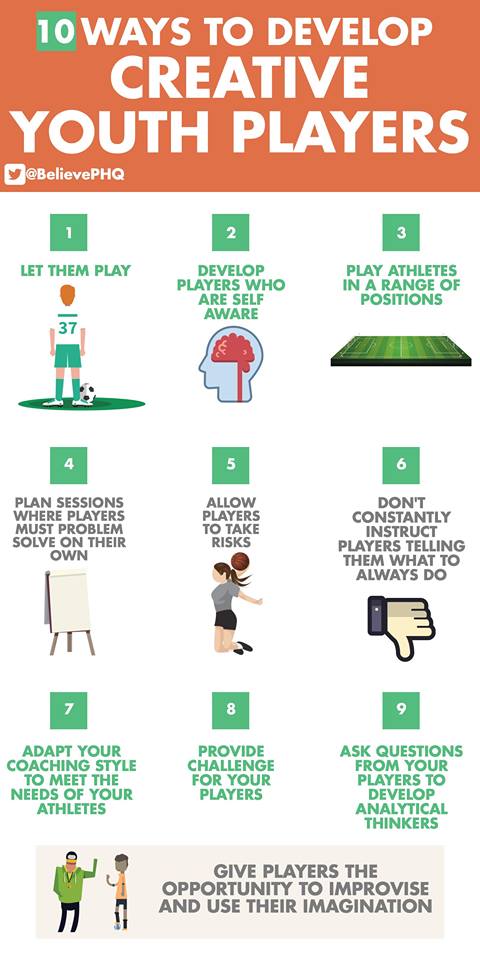
Our thoughts on the top 10 ways;
 

One of the biggest issues facing youth sports today is the focus on winning at all costs where “some” youth coaches will play their favorites or shorten their benches in games to win games, tournaments and banners.  One of the top 5 reasons identified by Amanda Visek in her groundbreaking study why kids play sports is when they get an opportunity to play.  90% of kids would rather play on a losing team in all situations than sit on a bench for a winning team.
In Hockey, much like many other sports, we need to teach players positional awareness so they know where to be without the puck as players will only have the puck for a very small portion of the game. For Peewee Recreational players, the average puck time is only 8 seconds in an average 50 minute game.
Players should not be pigeon holed in a specific position until they opt to specialize in their latter teens if they follow the LTPD model (don’t get me started on early specialization). In a recent clinic where we have a bantam A1 team come out for the coaches to run thru drills, one of the players had converted from being a A1 goalie to a player and was one of the top skaters on the ice. I have even been told that some MHA’s will only permit players to try out for defence or forward and that is the position they are to play all season long.

What happens if your team suffers injuries, a flu breakout then?

Coaches should be developing players by giving them the opportunity to play all positions in game play until their late teens or even later.

Would Dustin Byfuglien or Brent Burns have been able to make the transition from D-F and vice versa when in the NHL if they had played one position only in their youth?
 

In lieu of planning out every single drill in a practice to limit players having the opportunity to be creative in game play scenarios, ensure that you incorporate small area games with limited instruction to permit players to work on their skills. This will permit them to be creative in 1 on 1 battles, 2 on 1 and so forth that they could then transfer to game play.

This is probably one of top challenges for youth sport coaches today, it is important that you create a safe to fail environment not only in practices and encourage players to make mistakes, the uglier the better, but also have their backs in games so they don’t play in fear.

When I have talked to WHL coaches and scouts over the years, they have identified many of the deficiencies of Bantam Draft players that affects their draft position or being drafted at all including;

  1. Lack of creativity
  2. Not being able to shoot or receive a pass on a backhand
  3. Not making backhand passes
  4. Lack of checking skills
  5. Not “competing” for pucks along the boards or in front of the net

These are all areas that coaches should be working on developing not just in practices, but also in game play in lieu of screaming at a player when they try to do so and worse yet is not executed perfectly and leads to a turnover and a scoring opportunity by the opposing teams.

Was the first goal that Free Agent Louie Erickson scored a highlight reel on TSN ? Yes, but not because he went in on a breakaway but he tried to pass the puck back on a delayed penalty and it ended up going the length of the ice and into the Canucks net.

When Brent Sutter was interviewed after the 2014 World Juniors and Team Canada did not medal, he stated one of the reasons was that we lacked skill and creativity vs. other nations.  This is due largely in part to the fact that minor hockey coaches are spending too much time telling players what to do, vs. encouraging them to try the skills that they worked on in practices.
We also need to give players the opportunity to play without coaching whatsoever, Bobby Orr attributes he development and creativity to all the repetitions he had playing on the pond in Parry Sound.  When a goal was scored, all the players would do is pull the puck out of the net and start again.  There were not coaches, parents of officials telling the players what to do.

We will never get back to that time due to the digital era we now live in, but we must find a happy medium where players are safe to fail and have the freedom to try different things in practices and games so it will make them more creative when they get to higher levels of play.

The perfect example of this transformation is John Tortorella, who for many years was known for his tirades screaming at players and officials and not connecting to his players.  Last season, he was hired to coach the Columbus Blue Jackets much to many experts surprise due to the poor outing the World Championship Team had he coached in Fall 2016 but the management of Columbus told him he would need to change and adapt in order for his contract to be renewed.

He did so and guided Columbus to a record winning streak and into the playoffs and was acknowledged as Coach of the Year in the NHL receiving the Jack Adams award.

The best coaches that I ever had in my youth challenged me every practice to become the best player I could be, and they did so without being demeaning. That is the fine line we all have to walk, but in order to get the best out of our players individually and teams collectively is to push our players to become better each and every practice.

Reinforcing the importance of effort, praising when they make mistakes so they get up and try again.  As I have told every player over the years, if you aren’t pushing yourself, you are never going to get better.

If we continue to let them do it the same way over and over again and expect different results, that is insanity – Albert Einstein

In every practice and games I ask players what do they need to do, or we as a team need to do to improve?  Then I wait for the answers.

I have done this with Novice all the way to Midget and all age groups in between in both the competitive (rep) and recreational (rec) streams.

What I have also learned is the importance of P&R (Patience and repetitions from Terry Crisp), as yout sport coaches we have to be patient first and foremost and we have to provide opportunities for players to work on their skills thru numerous repetitions, adding to the difficulty (progression) thru the season.

The funniest anecdote I have shared in many clinics is a player that I had on my Bantam A2 team, at intermission breaks I would ask the players what we needed to do in the next period and he was infamous for one word answers like

Pass

Shoot

Score

His nickname became “Cone head” from the movie miracle for Herb Brooks Line “Cone Heads” when they came into his office and said coach we pass, we shoot and we score.

This is probably the biggest challenges for coaches, many want to develop set systems, tactics and strategies and many will scream at their players if they deviate from in game play.

I will never forget talking to a defencemen on a Bantam A1 team who shared the analogy with me that the coach only had one set play for power play where the team would cycle the puck to set up the weak side D to come in the back door and shoot on goal.  The problem was every team clued into the set play at the first powerplay each game and would position a player in the gap to prevent that setup pass or prevent the defensemen from shooting.  He (13 years old at the time) stated as he was not given any options, would try to slap the shot thru that player but would have to shoot wide as did not want to hurt him.

I heard similar stories from many other players over the years as coaches were not giving them the opportunity to “adapt, overcome and improvise” in game play.

Coaches, practices you can control, but games you can not as there are too many variables (other teams, coaches, the officiating) so it this last point is the key takeaway, you MUST support your players to improvise in all game situations, if you have a set play, provide players option B, C, D etc. so they can still follow in part but use their imagination in doing so.

Let’s work together to bring the game back to the kids.

 

PS Tagline - Dont be a kids last coach

Lack of Fair Play – The Other Reasons Why Kids Quit Sports

Posted 2 CommentsPosted in Coach

Lack of Fair Play –  The Other Reasons Why Kids Quit Sports


Playing just your starting lineup isn’t only hurting your kids, but your team as a whole!

Part II


Glen Mulcahy

May 18, 2017

BONUS – Download a Free Copy of this Blog in PDF Format HERE  

This blog post is a continuation of last week’s Part I post Poor Sportsmanship – The Other Reasons Why Kids Are Quitting Sports


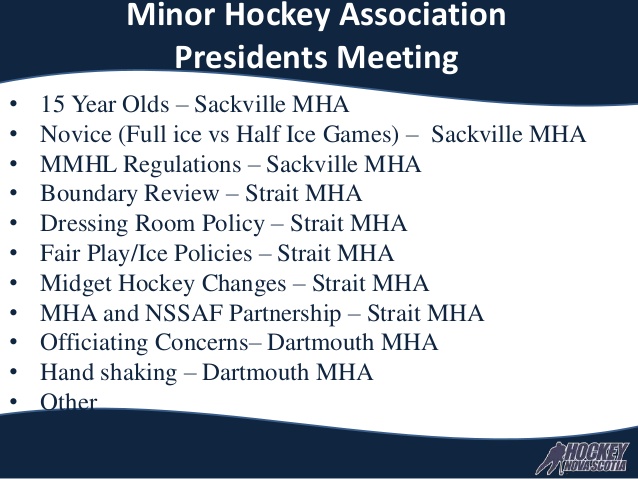
When I first began researching fair ice policies a few years back, there were only a couple that came up when I used my good friend Google. One I found was Hockey Nova Scotia which had fair play in addition to their policies for all levels including house, female and even competitive rep.


Nova Scotia Hockey AGM Agenda


Above is an image from last year’s Hockey Nova Scotia AGM. If you happen to follow the NHL at all, there are a couple of pretty good players that came from there. One happens to be the captain of the defending Stanley Cup Champions, Sidney Crosby; the other is Nathan McKinnon who many feel is the fastest player in the NHL with the puck.

I just did the same search I did four years ago in 2013 and the good news is, there is change coming. Currently the entire first page of Google outlines the fair ice policies that various hockey and ringette associations have adapted. As far as I am concerned as a coach and educator, the sooner that all major Hockey and Ringette associations implement these policies the better.

One of the top 5 reasons why players quit any sport is due to the fact that coaches play their favorites more than they do other players. In doing so, they are sending the message to those that sit that they are not good enough. As my son so eloquently shared with me after he sat on the bench for the better part of a game for non-disciplined reasons as a result of coaches’ strategy backfiring on him, he was “deprived of the opportunity to contribute to the outcome of the game.”

90% of kids would rather play on a losing team – emphasis on the word “play” in all situations – than sit on a bench for a winning team.

The only reason why players should be sitting on the bench when it comes to their turn to get out on the court, field or ice is for discipline. This could be anything from not being penalized when they should’ve been, to using bad language, to demonstrating poor sportsmanship and more. Aside from behaviour correcting actions, coaches need to take on their inherent responsibility of developing ALL of the players they’ve chosen to be part of their club, and not to rely on who they feel are their top players.

When I reached out to Cory McNabb (senior manager of player development for Hockey Canada) if he agreed with the short bench tactics that coaches in minor hockey are using, his reply was simply “Nope, if you pick ’em, you play them.”

Translation – regardless if the team in question is a house (rec) or competitive (rep) level, coaches choose the players for their team whether through tryouts, evaluations or drafts. To rely on a few players who in their subjective view are the cream of the crop,  coaches are not investing in developing all their players; something that should unquestionably be a priority above a win in the short term.

Just for a second, think back to the last 5 or more Stanley Cup Championships where commentators and coaches alike are saying they need to have all 4 lines contributing in order to win the Cup. This principle is not one that remains at the elite of the elite level. It is relevant all the way back to when kids are just beginning to develop their athletic careers at six or seven years old.

This year during my experience coaching high school rugby, the athletic director shared with me that there is no fair play code in high school sports other than grade 8 (13 year olds). The remainder of coaches for teams grade 9 and up are both allowed and encouraged to only play their top players in every game.

I had to deal with this experience first hand with my developing Rugby team this past year, which struggled to get a full field (15 players) out to any game on a good day. One match that’s been unfortunately etched into mine and my players brains was against a highly competitive school who brought out almost 30 players. Before the first half was over the ref came to me and asked what I wanted to do as we were already down 48-0.  We spoke to the athletic director of the other team and asked if they could sub in their second line players and, unfortunately, it went on deaf ears… the head coach continued to run the score up as he was focused on winning the provincials.

This I know now is the reason my son was deeply discouraged about playing different sports. A couple years ago he quit playing hockey, in large part to experience other sports and teams. When he signed up for grade 10 high school volleyball, just a few practices in, he was told point blank by the parent coach that he was only going to play his top players in games (one of whom was, of course, the coaches son).

Until the NSO/PSO/RSO and secondary school sporting bodies recognize that one of the top 5 reasons why kids are quitting any sport (just as in the case that ALA found in their survey) is because of a lack of fair play policies, attrition rates in youth sports are going to continue to grow!

Even if they implement fair play policies alone, I truly believe it will lessen that insanity in the stands which every parent knows all too well when it is time for their son or daughter to play. When the kids sit on the bench for non-disciplined reasons they get frustrated and after a season of it, it is no wonder why both player and parent opt to go down a different path (not that it is any greener on the other side of the fence).

It also will bring the love of the game back to the kids vs. the adults competing against each other through their kids.

Just because many kids may not have reached their potential at a young age doesn’t mean that they won’t be able to with future opportunities. If they are deprived of the chance to contribute it’s likely that they will quit.

Imagine if these “pretty good athletes” that went on to have insanely successful careers like Sydney Crosby and Nathan McKinnon were not given the opportunity to “play” early on in their development and were one of the 70% that quit by the age of 13 as a result.

Let’s work together to bring the game back to the Kids … where it belongs.


Glen Mulcahy


PS Tagline - Dont be a kids last coach

Poor Sportsmanship – The Other Reasons Why Kids Are Quitting Sports

Posted 2 CommentsPosted in Athlete, Coach

Poor Sportsmanship – The Other Reasons Why Kids Quit Sports

Lack of respect in youth sports today is killing our athlete’s motivation!
Part I

Glen Mulcahy

May 10, 2017


other reasons kids quit part 1


BONUS – Download a Free Copy of this Blog in PDF Format HERE  

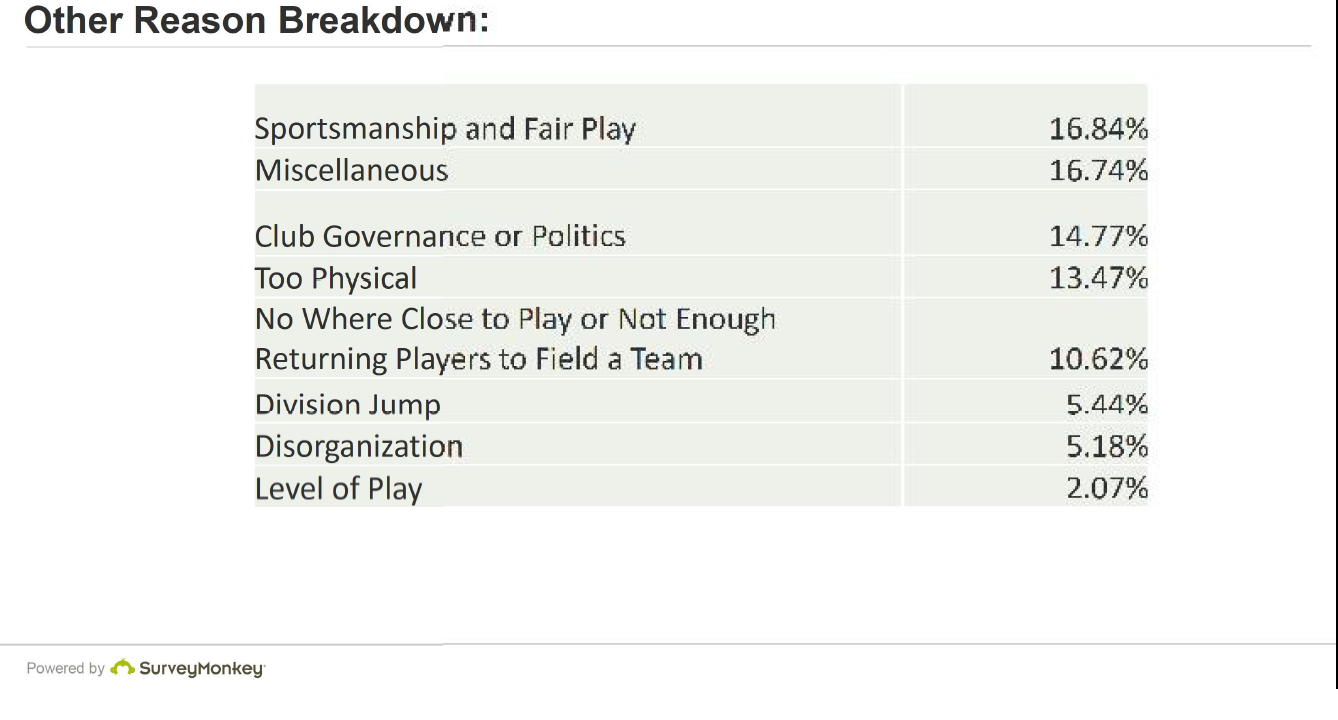
Lack of sportsmanship is a large part of the reasons our young athlete’s are becoming discouraged so early in their athletic careers. Although the second reason kids are leaving lacrosse is to specialize in other sports as I outlined in prior article Why Kids Quit Lacrosse, the primary reason why kids are leaving lacrosse are a myriad of combined problems within the sport (20.6% of the responses of the 1100 families surveyed by Alberta Lacrosse Association) that are outlined in the table below:


poor sportsmanship reason breakdown

Source: 2014-16 Retention Report – Alberta Lacrosse Association


Of these, the most significant reason was (poor) Sportsmanship and (lack of) Fair Play, the later of which we will talk about in Part II later this week.

Although the retention report was specific to lacrosse, I would argue based on my involvement in various other youth teams with coaches, parents, officials and athletes that the same would hold true in almost all other youth sports today.


Poor Sportsmanship

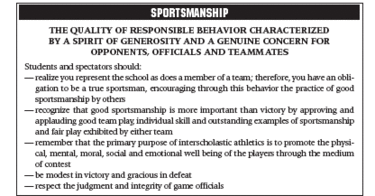
Have you come across a sign like this at your local arena, soccer field, lacrosse box etc? 


poor sportsmanship signboard


How many times have you been to a youth sports game in recent years and seen either players or coaches demonstrating poor sportsmanship? This could include any of the following, all of which that I’ve experienced firsthand;

  • Throwing or breaking their sticks because they missed a shot on goal
  • Screaming at a young official as they missed a call
  • Playing with the intent to injure – knee on knees, elbows to the head, helmet to helmet contact, cross checks or hitting players in the numbers (in the back)
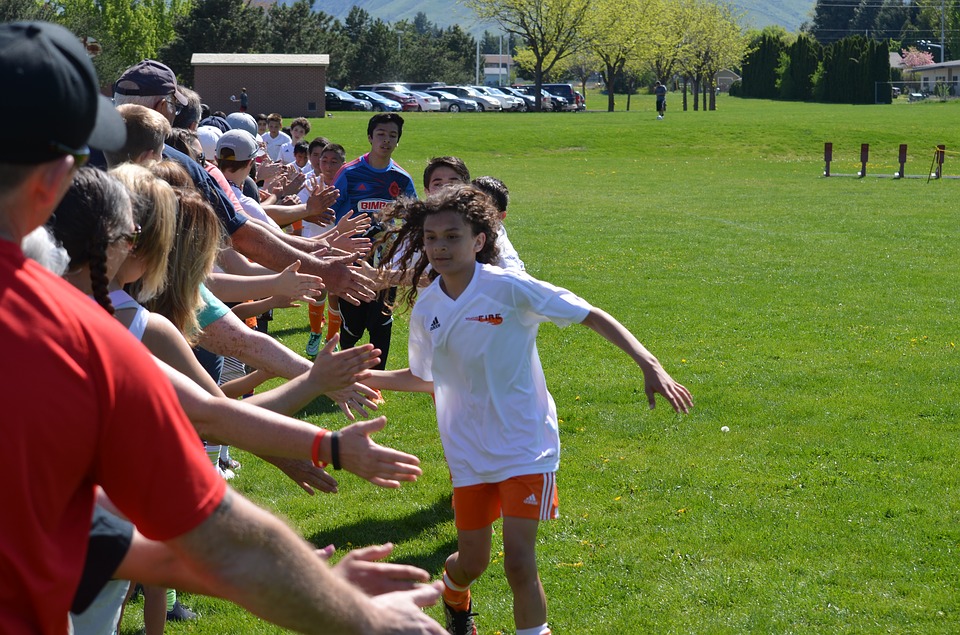
  • Disrespectful when shaking hands after a game, or worst case coaches slew footing (tripping) a player or vice versa. (At one of the games I coached a player on opposing team tried to trip me as a prank while shaking hands and was suspended for 5 games as a result!)
  • Entering the penalty box throwing helmets, gloves, sticks and using language that is not appropriate even for adults in ANY environment
  • Players excessively celebrating goals even when their team is up on the other team by a significant margin (AKA rubbing salt into the wound)

The list goes on and on for the escalating lack of sportsmanship I have seen over the years. I strongly believe this is due largely in part to the fact that many coaches and parents have not been reinforcing the importance of respect; whether for themselves, team mates, coaches, other teams, officials, parents, or others in their community. This includes the apparent lack of understanding that you should win with humility and lose with dignity.

I am coaching High School Rugby this year and our number one agreed upon core value is respect. Even when the going gets tough (which believe me, it has) I’ve taught my athletes to still call the ref sir, and that even though some feel it is a Hooligan’s game … it is played by gentlemen.

Our rugby team’s first game of the season we got, for lack of a better word, thumped. But as I knew going into this season we would be in for some tough games I did two things to kick off the season;

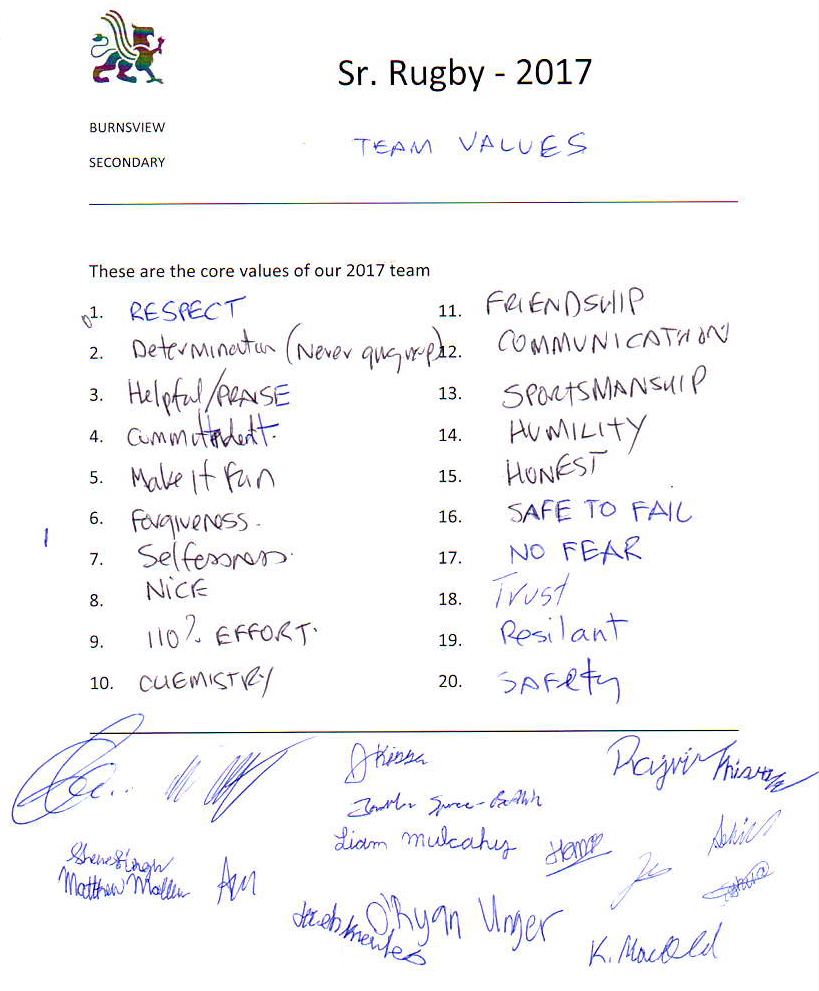
First – I asked every player to write down the top 3 characteristics they wanted to see from their team mates.

Below is the team values summary in no particular order where every player contributed. As you can see, one of our team values is sportsmanship, along with other core values like effort, chemistry, resilience and so on.


Team Values


Second – We have a circle of trust where the players form a circle, lock arms, and at each practice or game a different player leads the circle strongly stating the following:

“I have your back”

“I will respect you”

“I will be fearless”

“I will not criticize you”

“We will win with humility and lose with dignity”


The sayings for our circle of trust came from the subsequent question in which I asked all of my players what they did not like about youth sports. The top three answers were:

  1. When their team mates were not committed
  2. When the coach or team mates do not respect me
  3. When coaches played their favourites


The repetition of “We will win with humility and lose with dignity” is to reinforce the importance of good sportsmanship, regardless of the outcome of a game. When players leave the dressing room or field those that see them should not know whether they won or lost and as the old cliché goes, how you played the game is what matters. Having a focus on this is what breeds a healthy and positive relationship with the sport they love and is what will encourage young athletes to continue to love it long after they’ve stopped playing youth sports.

Probably the one of the greatest examples of sportsmanship I have ever come across was W. Oregon’s Sara Tucholsky who hit her first ever home run and the other team showed what playing for the love of the game truly means.


Let’s work together to bring the game back to the Kids … where it belongs.


Glen Mulcahy


Don`t be a kids last coach