

Make it fun.
This Saturday I missed the Seahawks Wildcard Playoff Game vs. Dallas as was the lucky recipient of a couple of tickets to the World Junior Gold Game I wrote about last week.
For many years I used to go on road trips with a number of my former team mates and co-workers to Seattle to watch them play live pre Pete Caroll Era, but as we all got older, married, and parents the weekend road trips weaned to overnight to day of to not at all.
In lieu, have defaulted to watching either at home or Pubs and was disappointed that their season had come to an end due to the fact that Pete has done an amazing job getting Seattle back into the playoffs as they rebuild from former glory days with the Legion of Doom, The Beast (Marshawn Lynch) and evolution of Russell Wilson as rookie to tenured QB.
Pete recently had his contract extended and Russell Wilson shared he was excited because Pete “truly cared about his players”
This continues to be the top characteristic of great coaches whomever I talk to, whether it be grass roots coaches when I survey them or top experts in the field I have had the opportunity to talk to during our online events hosted thru our digital arm “For the Love of The Game”
Pete is currently the oldest head coach in the NFL, but probably one of the most joyful on the sidelines and lead Seattle to the Superbowl, winning in 2013, losing in the last play in 2014 (where many questioned THE CALL that lead to the interception at the 2 yard line that would have lead to back to back wins) and has continued as the Seahawks started to see many of those players retire or get traded.
So other than caring about his players, what makes Pete Carrol a GREAT COACH?
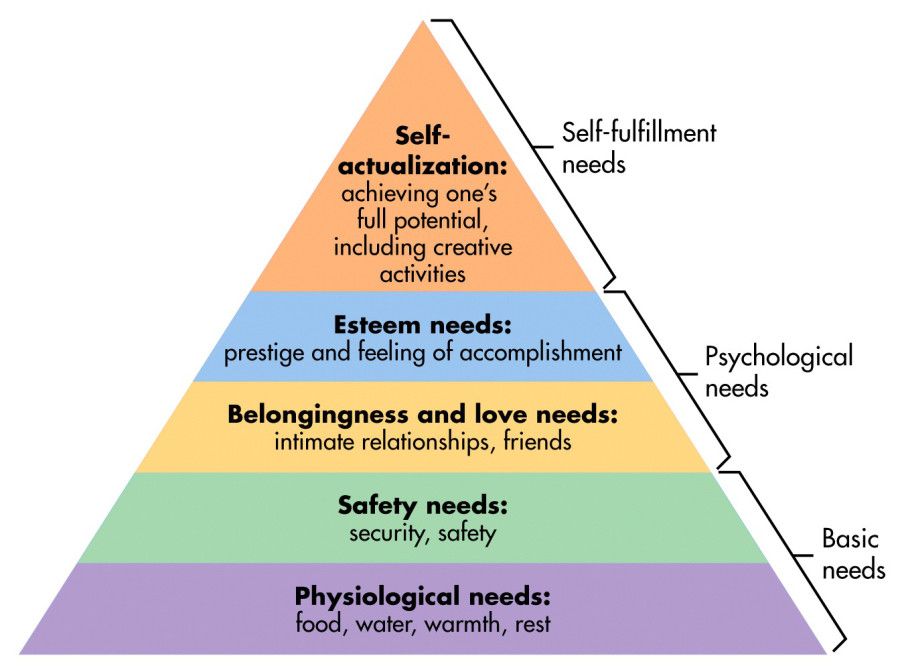
I. Going back to his early days as an assistant coach in the NFL, Pete immersed himself in sport psychology and became a huge fan of Dr. Abraham Maslow’s Hierarchy of Needs, a multi-layered approach for human motivation starting with basic human needs evolving achieving one’s true potential (self-actualization) at the top. The pyramid idea has evolved to many other theories like John Wooden’s pyramid of Success, Hockey Canada Skill’s Pyramid and so on where you can not reach the top unless you have strong foundation. In Maslow’s theory, people were unable to become the best they could be unless their basic and psychological needs were met first.
Maslow introduced the theory in 1943 but was one of many that I also came across in my studies at UBC around the same time that Pete got hooked on.
II. His ongoing research in other areas of Sport Psychology, looking at coaching practices of great coaches including John Wooden, Pete developed his new coaching philosophy which rolled out when became the head coach of USC in 2000
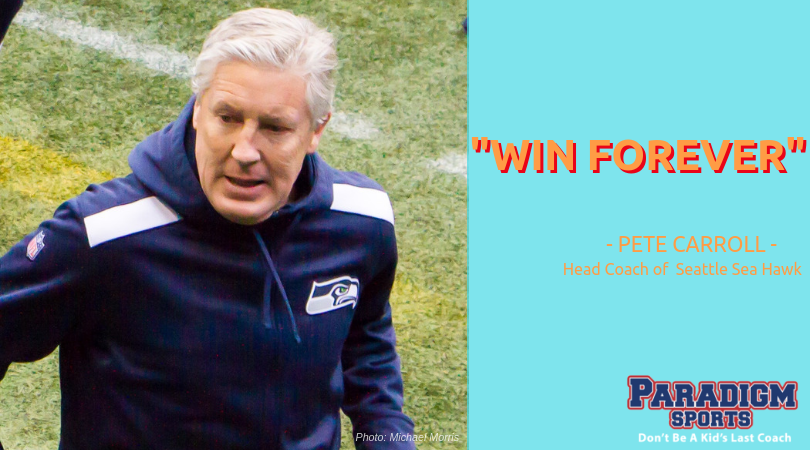
The basis for the philosophy is to maximize not only team but individual performances.
In sum, by developing each individual player on your team, collectively as a team you will see the results as a byproduct.
Nothing frustrates me more than when coaches rely on their top players, run short benches (AKA play their favorites) game after game in lieu of focusing on every player and given them all opportunities to contribute to the outcome of games.
Any coach can coach great players and win games.
Great coaches, like Pete Carroll, make all players great and winning becomes a byproduct.
It amazes me in this era with the access we all have to information how many grass roots coaches don’t have coaching philosophies and if they do, they don’t have them in writing.
This is one of the top three things that parents want to know and as one of the other asks I get all the time is Coach How do I Deal with parents … come up with a philosophy and put it in writing and live it like Pete and other great coaches.
- Another thing that Pete is infamous for is his belief that coaches should “Make it Fun”

This is also one of our key takeaways on every presentation we make, kids play sports because they are fun, they quit when they are not. It’s not rocket science.
In my travels and thru our online events I have had an opportunity to interact with top experts in youth sports, coaches, technical directors and every single one of them have shared the importance that we must make youth sports fun again.
Until then, we are going to see more and more kids quit the game they once loved.
As a result of his research on John Wooden who had three rules, Pete came up with 3 of his own;
- Always protect the team
- No whining, No complaining, No excuses
- Be Early
John Wooden’s 3 simple rules
- No tardiness (don’t be late)
- No profanity
- No criticizing your teammates
Ironically my 3 rules are;
- If you’re not early you’re late
- No swearing
- Respect (the game and everyone including yourself)
When I came up with my 3 rules, I had NO Idea they were very similar to John’s, and Pete’s rules are variations of John’s when he did all his research prior to going to USC on what made John such a great coach.
I also would NEVER put myself in the same conversation as John or Pete for everything they have accomplished at the NCAA and Professional levels of sports having been in the grass roots level for decades and now doing what I can to mentor those very same coaches.
- Pete also has become a big fan of mindfulness, being in the present vs. focusing on the past or worrying about the future.
Same holds true when you or your team make a big play or interception, recovering a fumble that leads to points for your teams favour.
Coming back to the present, in that moment, not focused on the past or future.
Like Russell Wilson, I was really happy to see that the Seahawks extended his contract for another 3 seasons, I suspect Paul Allen (majority owner who recently passed away) would have been his biggest advocate for it to happen.
Coaches – regardless if you are fan of Pete, John or other great coaches, remember one thing, the greatest coaches of all time cared passionately, they make it fun, they make it safe (to fail and from all forms of harassment) and they teach skills (of the game and life)
Don’t be a Kid’s Last Coach
Ensure that your legacy is a positive one like John’s, Pete’s and all the other great coaches and remember that your purpose is not to make a living, but to make a difference by developing youth into adults.
Let’s all work together to bring the game back to the kids …. where it belongs.