Why do Officials “Officiate” (2020)

Posted Posted in COVID-19, Officials

Why Officials Officiate – (2020)

A few years back I shared data in original post Why do Officials “Officiate” from what was the largest survey at the time of officials, one done by the national association of sports officials (NASA) where they received responses from 17,487 officials across the USA.

Fast forward to May 2020, I connected with Brenda Hilton, the founder of Officially Human whom I interviewed for our upcoming Youth Sports Virtual Summit along with several others and she shared with me that they had done a followup survey in partnership with IUPUI Sports Information Institute, School of Health and Human Sciences in Illinois.

The survey was done in the Fall of 2019 and just shy of 19,000 officials responded from 15 states in the USA and they prepared an infographic in PDF format that you can download HERE.

Below are highlights from the survey where I have compared results below each image from the one done in 2017
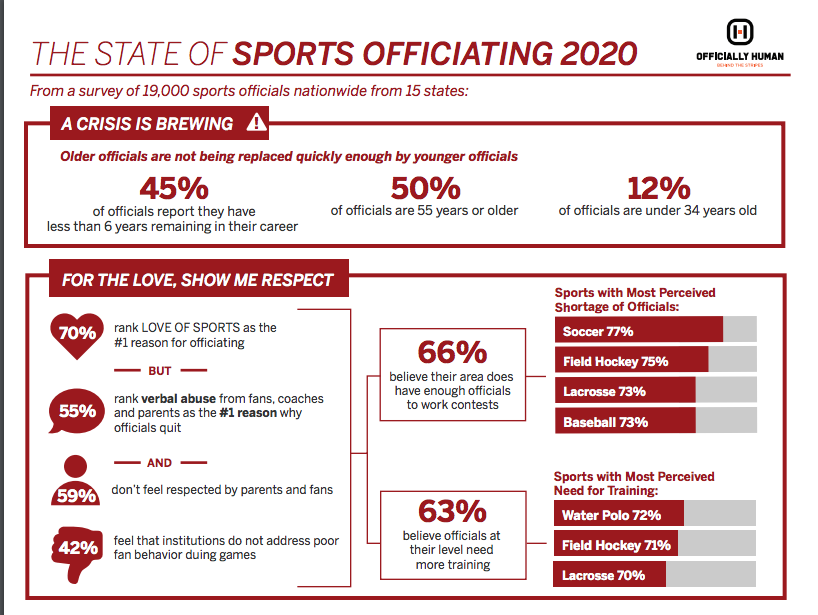
 

One of the issues in recent years that was identified by the NASO survey and also in recent SII survey is that officials involved in sports are getting older and as a result of COVID-19 there may be a real as youth sports start to ramp up again where many may be leery of returning due to safety concerns, in lieu of verbal abuse, however, from exposure to COVID-19 virus until a vaccine is developed in 2021

The #1 reason they become officials is the same, For The Love of The Game, as is the number 1 reason for quitting, verbal abuse, and almost 60% don’t feel respected by parents and fans.

The sports that have the largest % of shortages are Soccer, Field Hockey, Lacrosse, and Baseball.
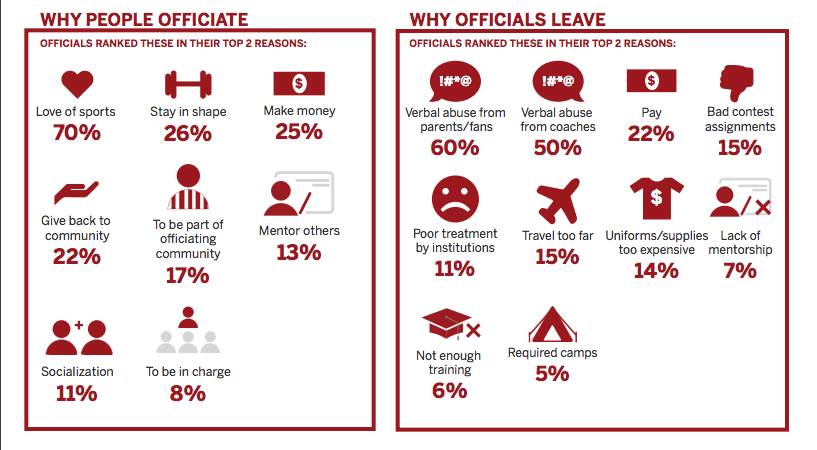
Officials also do so to stay in shape and make money (the majority of which is a small honorarium but some do make a living as officials at the higher levels)

The Second reason that officials quit is the verbal abuse from coaches, it is not just the parents and fans in the stands and sidelines that can be abusive, I have seen more than my fair share of coaches screaming at refs because they felt they missed or made a bad call which is something I remind all of during workshops and clinics.
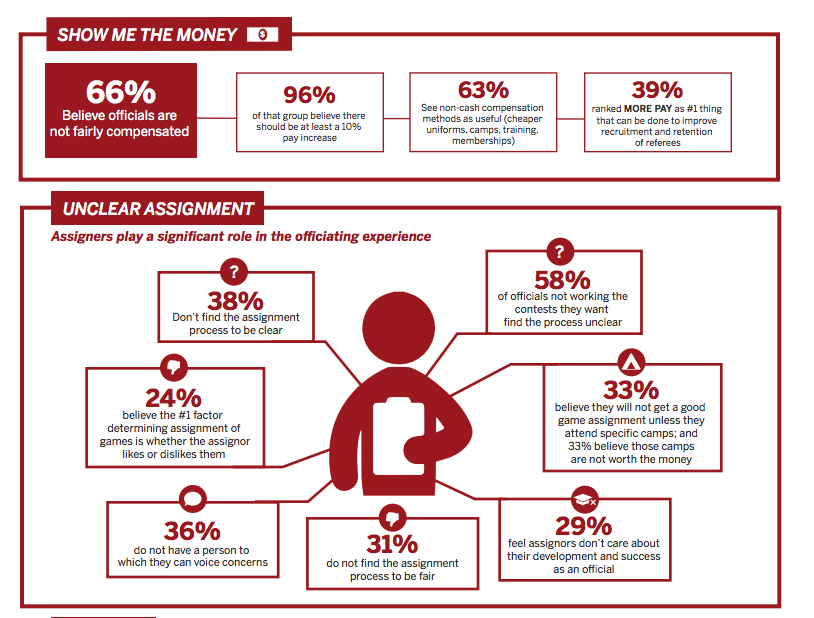


Almost all of those that responded (96%) felt that they should see an increase in pay of at least 10%!

58% of the officials stated they are getting to work the games they want to find the process of how they are assigned to games unclear, and 1/3 stated the reason they don’t get assigned the games they want is they have to attend camps to do so but are not worth the financial outlay to attend.

Key takeaways for organizations that are looking at attracting, retaining, and growing their number of officials as youth sports slowly return back to play post-COVID-19:

#1 – Parent and Coach Education reinforcing the importance of respecting the officials including codes of conduct for appropriate behavior and positive messaging in all common areas

#2 – Reduce costs for camps/clinics so officials see the value to them

In the 2017 NASO study, much of what officials earn in their seasons is taken up in terms their out of pocket costs for necessary equipment, potentially travel expenses, meals while at tournaments, attending clinics, camps etc.

#3 – Develop Rules Education programs for coaches, parents and fans so they are aware of the respective playing “rules of the game”.

#4 – Raise their pay by 10% (or more)

Minimum wage continues to increase year over year, in my home province has increased 25% the last 3 years so youth sport organizations need to recognize that their staff including paid officials should be compensated relative to costs of living

#5 – Implement mentoring programs for youth officials to be paired with tenured officials before they age out.  As the stats showed over half of the officials are over 55 years of age and the level of experience of 45% of officials is less than 6 years!!

This is largely due to the fact that rates of attrition that many sports groups face is as high as 50% of their first year officials and 30% each year thereafter

#6 – Make if Fun for ALL stakeholders, much like players, coaches, officials will only return each year if they enjoy the experience and will quit when it no longer is.

#7 – Implement policies to address poor fan or coach behavior during games so that they are removed from the facilities vs. putting the onus on the officials to say “you’re outta here” only.  Many will be reluctant, as well as unqualified to do so, in their first few years to tell parents to leave so they will need support from other adults

I worked for BC Place Stadium in Security for years, and when fans became unruly, it was really simple .. we escorted them out of the facility.  Why we have condoned inappropriate behavior in youth sports for years now makes no sense, kids quit, officials quit, coaches quit as a result.

#8 – Reward positive behavior by fans, coaches who demonstrate good sportsmanship in the stands towards officials, the game, players etc.

It could be as simple as coaches sharing with other coaches that their parent groups were awesome, please share our thanks to them for making this such a great experience and game to play.

As the cliche goes, you get much farther with honey than vinegar

#9 – Those that are in sports with shortages, start recruiting, training, mentorships programs NOW before games and tournaments are permitted in phase III/IV Post COVID-19.

#10 – Appreciate that the #1 reason why officials officiate is For The Love of The Game and focus on making the game GREAT for all stakeholders.  This not only will help retain officials but players, coaches, board members, and all others in your organizations so you can GROW your memberships … something that is going to be a challenge as sports return back to play.

Don`t be a kids last coach


Playing For the Love of the Game

Posted Leave a commentPosted in Athlete, Coach, Organization Executive, Parents


This coming Monday I will be returning back to Nanaimo to speak on behalf of Changing the Game Project hosted by Nanaimo Minor Hockey who is working with various other sports groups to develop an amazing sports experience for the kids in their community.

As I was when I made the ferry trip in October, I am truly honored to be invited to share nuggets but also interact with so many amazing people who are passionate about quality sport.

I came across some great nuggets the last few weeks that I will be sharing in the presentation that thought would be great to share on this week’s newsletter as well.

Why do Kids play Sports?

Simple, they play because they’re fun, they quit when they’re not.  It’s NOT Rocket science.

This is the quote that I have shared for years and it really comes down to just that.   What our role as parents, coaches should be, however, is not just making sure that youth sports are fun, but they should also ensure that kids love the sports they are playing more at the end of a SEASON than they did at the beginning.

Due to the growth of early sports specialization, however, there are no more seasons to youth sports, and in lieu of PLAYING sports, kids WORK sports for over 10 months of the year

As Wade Gilbert, the Coaches Doc, shares in many of his talks … do kids ask you Mom, Dad can I WORK Hockey? WORK Soccer?  No, they ask you if they can PLAY baseball, PLAY football and so on.

The more I thought about the reason why kids played a sport for more than one season is this held true, I Loved the Sport more at the end of a season that I could hardly wait to return to play again.  This was because when the season ended in March, I hung up my skates to play baseball, golf, go to the beach, ride bikes, hike, swim, tennis and so many other activities so when the season started again in Sept I missed the rink, my buddies, coaches and was eager to start another season.

Thank you for being a sport that helps me with other sports.


Why then do Officials (refs, umpires) start or continue to officiate?

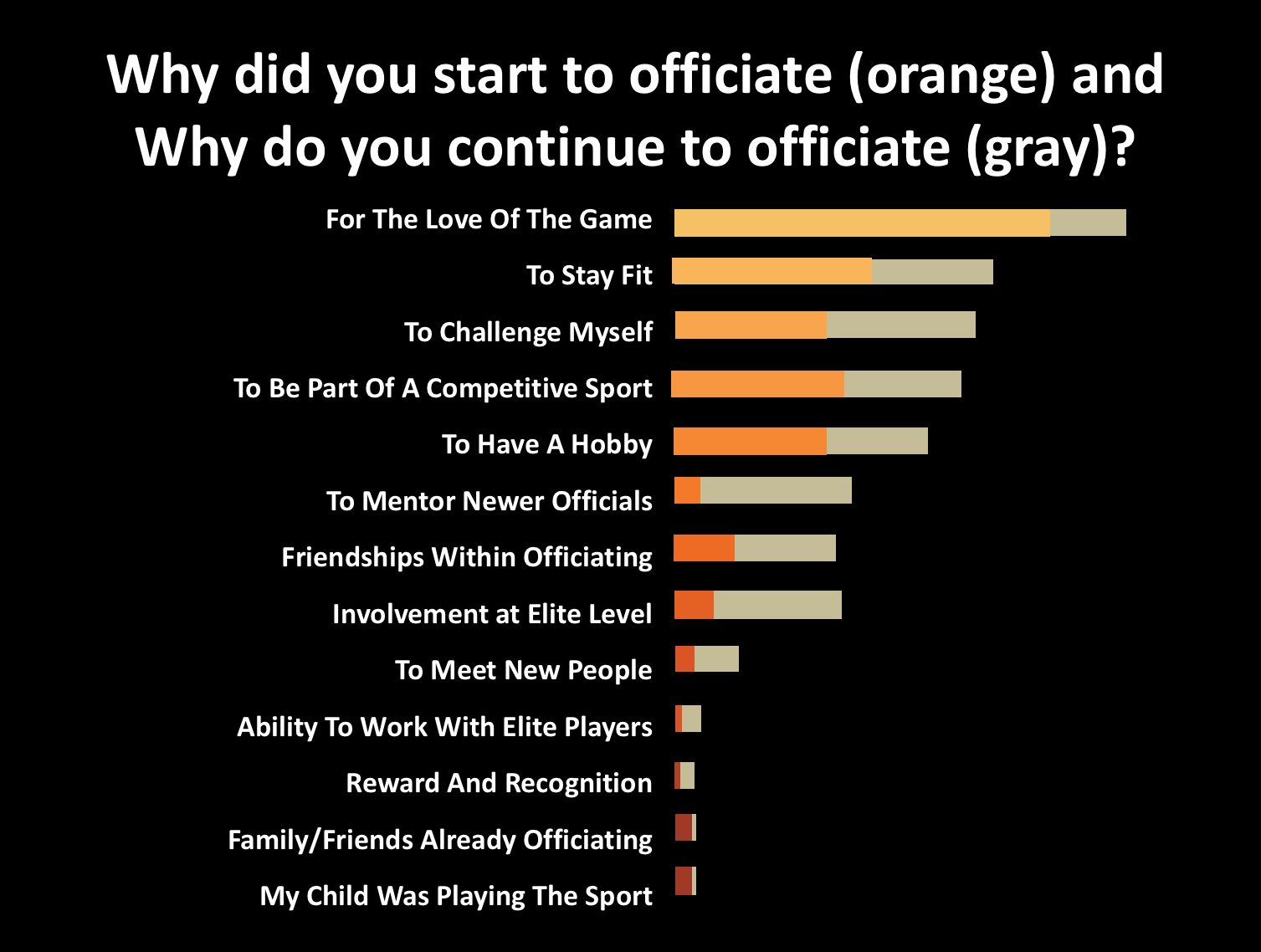
According to the largest survey I have come across today over 17,000 officials were asked why and the #1 Answer was “For the Love of the Game”.

See below for the other top 10 reasons why they started and continue to be officials.


Other reasons included staying fit, challenge self, be part of the competitive sport, have a hobby and near the bottom was reward/recognition and lowest motivator was the fact that they had a child playing the sport.  This is probably due to the fact that a lot of officials start before they are parents, and ironically one of the motivators that organizations do is provide stipends for refs to do so so if get enough games, they can have a decent part-time income of the course of those seasons.

Why do Coaches Coach?

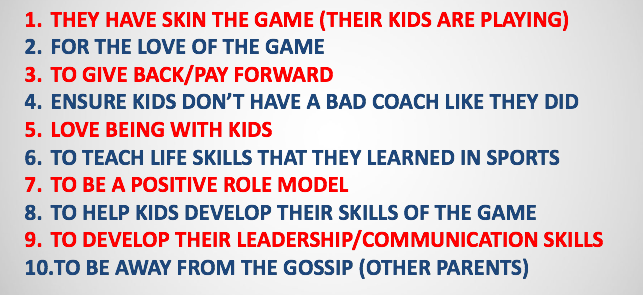
Ironically, when I have surveyed grassroots coaches over the years in clinics or talks and asked them why they coached, the #1 answer is because they had skin in the game, they stepped up to coach because their kids were playing and either asked them to coach OR a board member runs around the field, rinks at the beginning of the season asking for help.

I was one of those “suckers” initially putting my hand up to help on ice when board members came calling when my son was 5 starting hockey or my 7-year-old daughter in softball and 15 years and hundreds of kids later, I still put my hand up, now is to mentor the coaches of kids so they can help them become the best people they can become.

See below for the other reasons why Coaches Coach that I hear over and over again when I prompt coaches why they are coaching;

The second reason, whether they are a parent or not, is coaches step up to coach For the Love of the Game, they love the game and everything that it did for them, that they want to give back/pay it forward to help others reap the same benefits.

Many of which shared they are coaching so kids don’t have a BAD coach like they did when they grew up (which sadly there are still coaches even with all the certification coaches have today that coach the way they had been coached)

One reason that parents may not be aware of, coaches have also shared with me and I can relate, they are at the games anyway, drive to the practices and no point going home, so they put their hand up to help coach.  They also do so, as I did, to be away from the gossip that parents at times will share amongst themselves or worse yet those would be too vocal and scream coaching instructions at their kids or critique them/coaches or officials.

Another interesting stat came out of official vs. coach surveys, although officials receive fees and some coaches get honorariums for coaching now, neither officials or coaches stated when surveyed they started or continued to do so for the $$ in their top 10 reasons for doing so.

They do so not only because they love the game, and a few weeks into a season realize they also love being with kids as they have adopted large families when they start coaching.

Now let’s talk about why these three key stakeholders QUIT the Sports they once loved

Why do kids Quit Sports?

They not only quit because they are no longer fun, but they quit because the lost the passion, love for the game they once had and for various reasons lost their way in a sense.

More often than not, they no longer love for the game as they have been deprived of the opportunity to play in all key situations in games, have had adults screaming at them when made mistakes or have been on teams where harassment has taken place to some extent.

They quit because the games are no longer about what snacks they get after the games and being with their buds in the dressing room, hanging out in dugouts or sidelines it is about the results of the game that takes the focus due to winning at all costs.

They also quit because they can’t afford it any longer due to travel, equipment, spiraling fees and all the other costs now associated with youth sports unlike the “good old days” where you community sports were just that, played in the community or at high schools with low, no fees and even could use the same pair of cleats for 3 different sports as I did (baseball, rugby and football)

Why Do Officials Quit?

#1 Reason Poor Sportsmanship

As I shared in a prior post “Why do officials officiate” the #1 reason why officials quit is due to poor sportsmanship.

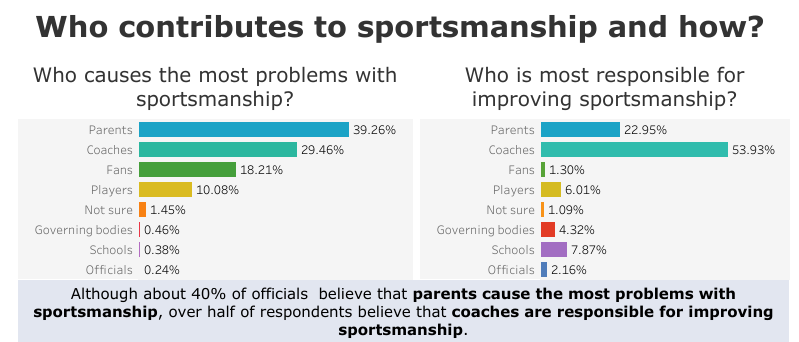
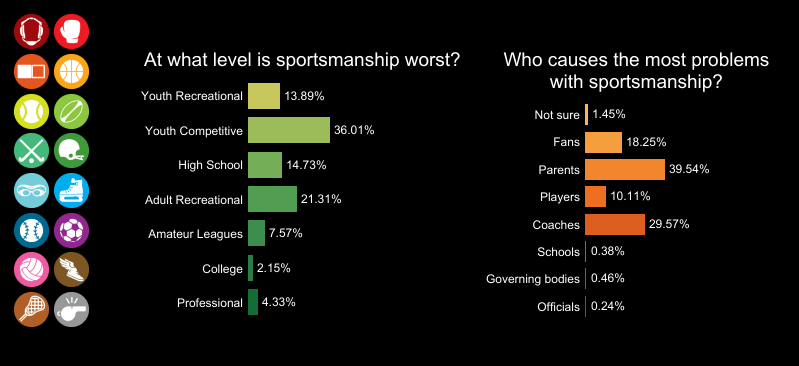
In the NASO study of over 17,000 officials, almost 40% of the respondents stated that parents caused the most problems with sportsmanship, followed by just shy of 30% of coaches.

When asked who is responsible for improving sportsmanship, over half stated coaches were.

Why?

Because they are the catalysts for change.

They interact with their players, assistant coaches, officials, board members and parents but also coaches and players of other teams, perhaps even their parent groups.

If coaches do not talk the talk but also walk the walk and demonstrate and expect good sportsmanship then whom is going to improve it?

They also quit because they are concerned about their safety, over 40% of male and female officials are due to administrator, parent, coach or player behavior

Even worse, they are intimidated by their fellow officials who will criticize them during games?

I just came across this extreme video where one parent kept telling the refs after a call he did not agree with “would see them after the game” (meaning we will duke it out in the parking lot – really?), but the entire group of parents and fans were ejected from a youth soccer game due to their behavior and threats towards young officials (about the same age of the players they were officiating)

This after each day I came across similar parental behavior, coach abuse towards players or officials, series of articles about sexual abuse, or various issues at minor hockey associations I shared in last week’s post “When will the culture of Youth Sports change for the better?”

Why do Coaches Quit?

Coaches, like players and officials, are either not putting their hand up, to begin with due to lack of willingness to “deal with” parents OR are quitting due to frustrations of the problems they had “dealt” with over their coaching careers.  This is why the most common ask I receive is “who do I deal with parents” to which I counter, it is not about dealing with parents, it is all about how you engage them as allies.

Over 80% of coaches surveyed by Syracuse.com stated that parent issues had gotten worse over their careers, the #1 problem they dealt with by over 80% of the respondents was parents complaining about their kids playing time.

IF a coach is playing everyone equally so they all have an opportunity to contribute to the outcome of the game in ALL situations this would be a non-issue (the exception being when kids need to be disciplined for behavioral issues).

I argue that coaches in a sense are a victim of their own demise, due to our winning at all costs culture, many coaches who may have had the best of intentions when they started coaching fall into the trap of running short benches starting from the beginning of the game and parents are merely venting their frustration as they ALL PAY THE SAME $ so expect all kids to PLAY THE SAME amount of time.

Again it comes down to pointing fingers at one of the key stakeholders that impacts what should be a quality and positive sports experience and the majority of the issues could be avoided from the GET GO.

In lieu, the officials blame the parents, the coaches blame the officials, players or parents, the parents blame the coaches, officials or board members blame the parents and goes round and round in circles like the merry go round at schools I loved when I was a kid (which kids can’t ride anymore as they may get hurt?)

When then are we going to stop pointing fingers at each other and understand the motivation for the players, officials, coaches to begin with?

They started because wanted to try a sport For the Love of the Game, they continue to do so for the same reason, and they quit because they lost that Love and passion they had to start with due the various issues that have taken the Play out of Play Ball.

In lieu of pointing fingers, what I suggest to all parties concerned is bury the axe, work on collaborating so it is a quality sports experience for ALL stakeholders so they all can do so For the Love of the Game.

Let’s all work together to bring the game back to the kids ….. where it belongs.


Why Officials Quit (2019)

Posted Leave a commentPosted in Athlete, Coach, Organization Executive, Parents

A couple of years back I posted Why Officials Quit and have continued to do a lot of research on the subject due to the fact that every sport organization that I work with is not only having challenges with player attrition, they also are losing officials to the point where many say they have to scale back on number of teams or games as a result, and in some states in the USA they have declared many of their sports programs are in jeopardy due to lack of officials.

This weekend I will be doing a talk on that very subject for Softball BC, titled “How to attract, retain and increase the number of officials in your organization”

It is based in part on the post I followed up with last year called “Why do Officials Officiate” but for purposes of this post wanted to share why we are losing so many officials year after year.

Top Reasons why officials are quitting are;

  1. It is not safe to fail:

Having talked to many officials and those responsible in various sports organizations, the trends are consistent, as I shared prior Hockey Canada loses 30% of their officials every year, as does every sport that I have talked to as we started to partner with various other sports organizations.

Why?  Because the officials who take a lot of pride in not make mistakes, are quitting because of the abuse that they are taking from adults (parents, coaches or fans) when they do make a mistake OR when they believe they made a mistake.

This is one of the videos I came across that shows very clearly that the umpire made the right call, but received 17 different abusive phrases from parents who were seated in the visitor section (along the 1st base line) who did not have the same perspective as the umpire.

He clearly made the right call as did have the right perspective, but all the parents on the visiting team thought nothing of screaming out their perspective which was wrong.


  1. Poor Sportsmanship: 

Above are the results for the largest study I have come across where over 17,000 officials replied to a survey from multiple sports done in 2017.  Almost 40% stated it was the parents that were causing the problems, followed by almost 30% of coaches, combining for approx. 70%.

Poor Sportsmanship was also one of the top 3 reasons that were the reasons why 11,000 players quit playing lacrosse in the retention report Alberta Lacrosse shared with me.

No matter what organization that I reach out to potentially partner with across Canada regardless of the hat I am wearing, even though 70% of the issues leading to officials quitting which goes hand in hand with the players is poor sportsmanship, when I ask what they are doing to curve the problem, they say they don’t have budgets for coach or parental education.


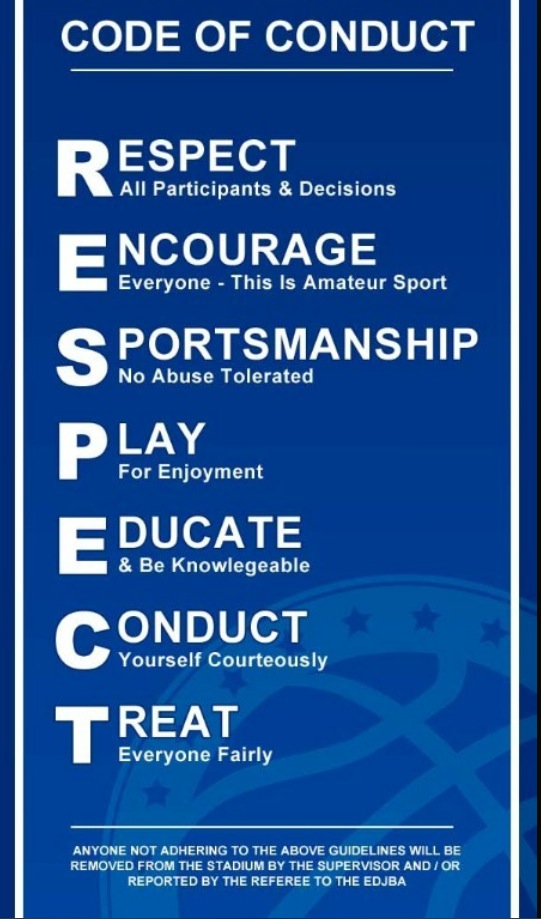
Translation: They keep doing the same thing over and over again expecting different results (Insanity), posting signs at rinks or fields like the ones above, making it mandatory for parents and coaches to take respect in sport online course for approximately 3 hours but don’t rigidly enforce policies for a zero tolerance for ANY forms of harassment.


When asked at what level is sportsmanship the worst, 36% of the officials stated it was the youth competitive level, followed by 21.3% adult recreational level.

These results did not surprise me at all.

Youth Competitive due to high expectations from parents due for a return on investment for the tens of thousands of dollars they invest in their child’s completive youth sports experience to get an NCAA scholarship or play professionally is what is translating to the vocal minority of parents screaming and umpires when they perceive they made a bad call.

Parents – the majority of these officials are just a level above your son or daughter, and many officials start at the age of 12 years old, and within 3 years associations are starting all over again to recruit officials as most have quit.

The second highest level, adult recreational, having played adult rec hockey, as well as slo-pitch for many years, I saw it firsthand how many who were playing adult rec thought they were living the dream playing professionally and took it a wee bit too far and would go at refs or umpires like they lost a Stanley Cup or World Series Game.

Every time I would approach them and say, relax, it’s just a game (yet another PSA campaign by Hockey Canada in 2004 when things really started to ramp up in terms of parental behavior in the stands).

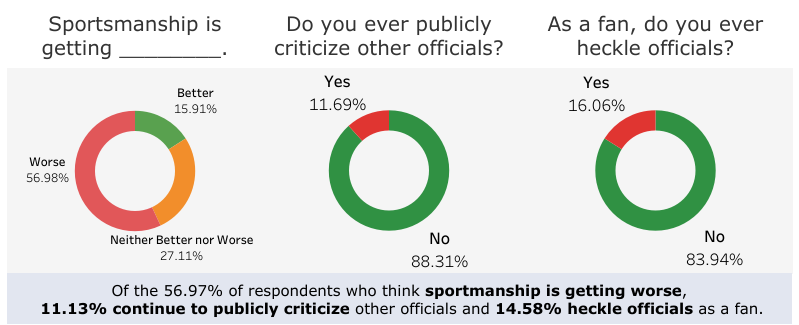
When officials were then asked if Sportsmanship is getting _______, almost 57% said it was getting worse, 27% neither better or worse but thankfully the remainder, close to 16%, stated that sportsmanship was getting better.

This I believe is due to all the organizations and awareness campaigns that have come to fruition in the last decade (including our own) to combat the impact of poor sportsmanship that is impacting the quality of the youth sports experience for kids.

What I was truly surprised with, however, was the fact that some officials responded (11.69%) publicly criticized other officials and when a fan at games, just over 16% confess they heckle their own fraternity.  If truly are going to change the way officials are treated, they must adhere to the very same Respect rule I have for all my teams and NEVER criticize your teammates.


  1. Fear for their Safety

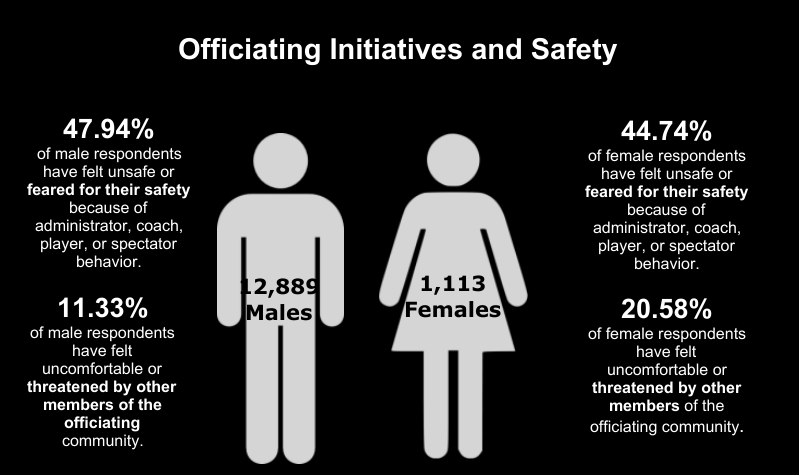
I shared this in the prior post that Almost 48% of the male respondents, and 45% of the female respondents shared they feared for their safety because of administrator, coach, player of spectator behavior?

What I did not highlight is just over 11% of male and 20% of female official felt uncomfortable or threatened by members of their very own officiating community.

Really?

What happened to all being it in together as a team?  Again, officials have to respect all others and avoid threats towards others in their community if we are going to reverse their fear for their own safety.

How then do organizations reverse these trends by ensuring that officials have a safe to fail environment, take pride in becoming the best they can be, are not in fear, that sportsmanship includes respecting ALL calls made by officials?

Organizations have to stop putting up signs, sending out public service announcements and as a means “to deal with parents”.  Most people don’t read signs anyway (thanks to my past experience working in the hospitality industry) and the time for PSA’s/Whitepapers is OVER.  It has come time to activate strategies so that sports organizations are accountable for everyone’s safety and creating a quality sporting experience.

In lieu, invest in parent education and teaching their coaches how to engage parents in lieu.

The vast majority of parents are AMAZING people who are doing everything they can to support their kids navigate what has become professional youth sports in lieu of kids playing kids like it was when I grew up.

They also have to recognize that officials are key stakeholders to ensure that today’s youth have a positive sporting experience, without them, kids will merely be having practices.

I worked at BC Place Stadium in security for many years and worked many BC Lions games as well as concerts and if fans became unruly (more often than not due to drinking too much) it was really simple, they were removed from the facility.

If they got into a fist of cuffs with fellow fans, we escorted them to the Police Wagon where they were brought to the station and potentially charged.

If we did so at professional sports events, why then do we not do it at youth sports events?

In lieu of having security surveying the stands, coaches and parents should be doing the same just as they did a generation removed.  If someone was acting up, a coach, parent or board member would approach them and eject them from the facility.

If a parent, coach or fan becomes unruly, too emotional, abusive, they should be removed so they can calm down and not permitted to return no differently when coaches are ejected.  The vocal minority of parents that do so be held accountable to the point where future incidents are treated with longer suspensions and using the same 3 strike rule, if a repeat offender;

Sorry we will miss you.

Meaning, we will not permit you to be a member of our organization.  Just like playing youth sports is a privilege (now more than ever due to pay to play model), so is that of being a member of the organization as parent, official, board member.

As far as I am concerned, no one, whether it be player, coach, official or board member should be in fear or a victim of verbal, worse yet potentially physical abusive threats and we need to bring the game back to the kids.

It’s time to stop doing the same things over and over again and expecting different results (Insanity)

Just like we should see the smiles on players when they are at games, the same should hold true for officials of any sport, they too should have a quality sport experience, otherwise the trends where 30% quit every year will just get worse.


Let’s all work together to bring the game back to the kids … where it belongs.


Don`t be a kids last coach