
Why Kids (May) Quit Soccer
Why Kids (May) Quit Soccer
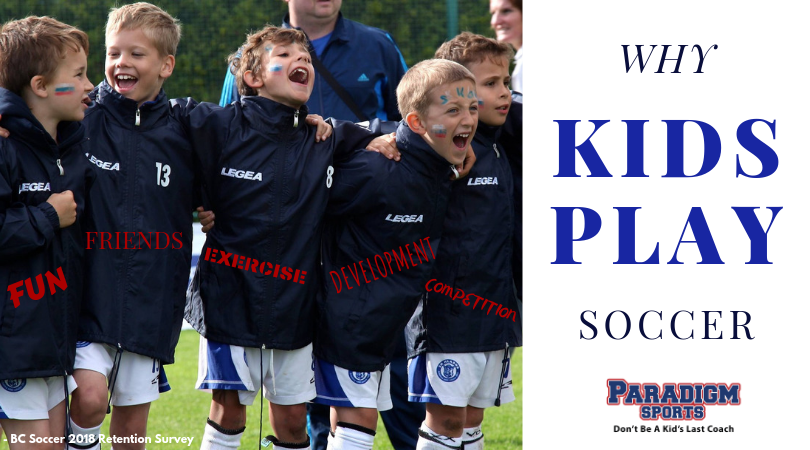
Last post we shared the reasons why Kids play Soccer based on responses from the BC Soccer 2018 Retention Survey, in this post will highlight the responses to the two other areas BC Soccer was looking for insight from their players;
#1 – The Likelihood of playing Next Year (Why Kids (May) Quit Soccer)
And
# 2 – What was not so good about their program this year (what areas received fair or poor rankings but the players)
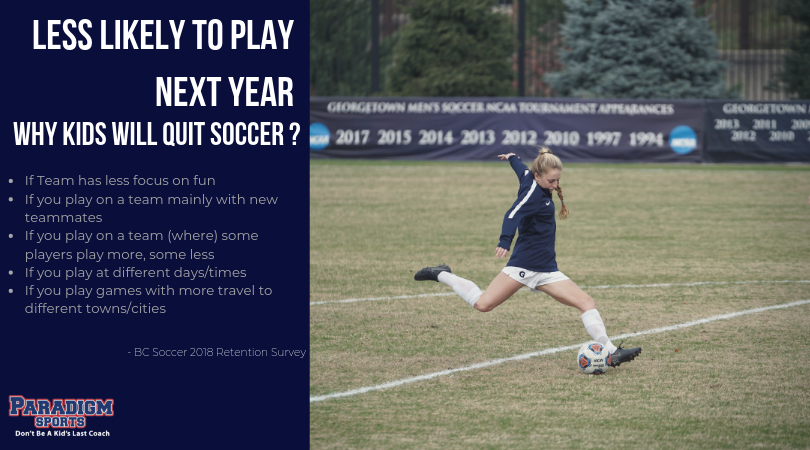
LESS LIKELY TO PLAY NEXT YEAR
When asked “Will you come back next season”.. the top 5 reasons kids would be less likely to do so (high probability they will NOT come back to play soccer)
SURVEY SAYS…
#1 – If your team has less focus on fun
#2 reason they would return back if their team focused on fun, second only to focusing on skills.
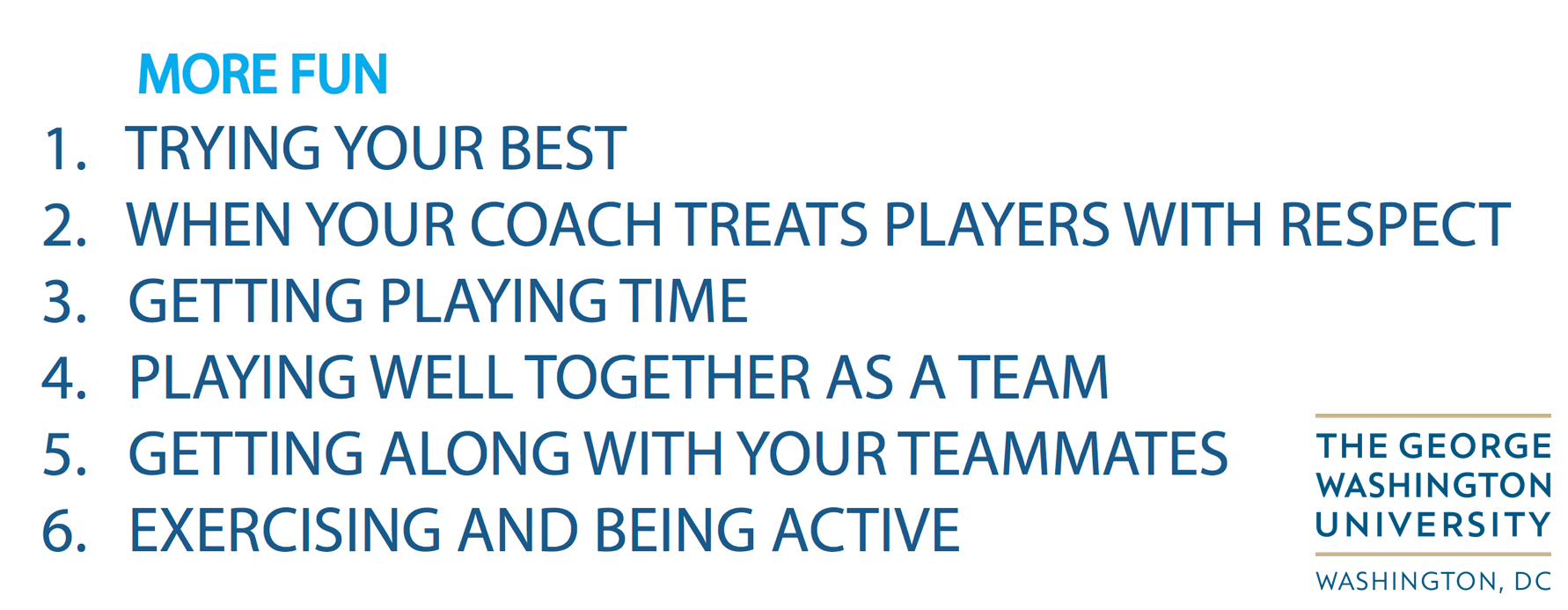
HMMMM … Similar to Amanda Viseks top reasons why sports were fun, #1 reason is when kids had the opportunity to try their best (focus on skills)
#2 – If you play on a team mostly with new teammates (not with their friends)
Two things that kids ask after games (sometimes during the games)
What is the snack? As Steve Simmons shared in an article he wrote many years back he continues to share every year Attention Coaches, parents: Minor Hockey is for the Children where he shares the anecdote of a novice player who stated:
“I Hope they don’t bring apple juice, I don’t like Apple Juice”
And the last question as they leave the field/rink/court…
When do we play again? (emphasis on PLAY not work as is now the case with early sport specialization)
If you loved sports as a kid and continue to play adult rec team sports ….
First question you ask after a game – Who has/how much is the beer?
AKA – THE SNACK
Last question you ask after a game – When do we play again?
Hmmm … if we love sports in our youth, we love them as adults because they are fun, we get to play with our buddies and we play for the love of the game.
#3 – If you play on a team (where) some players play more, some (play) less.
Translation: Coaches running short benches where their weaker players sit on the bench so they can win at all costs.
90% of kids would rather play on a losing team, in ALL situations, than sit on a bench for a winning team.
As my son shared after he had the misfortune sitting on the bench with some of his teammates for the better part of a game as coach was infamous for playing his favorites and shared how he felt after the game,
“I am pissed because I was deprived of the opportunity to contribute to the outcome”.
He was only 14 at the time, and I will never forget it because it was a month after he lost his Nanny (my mother) to a 2 year battle with cancer prior to that tournament game that the coach shared with me prior to the game he dedicated the game to her in her memory. Had she still be alive and attended that game, I can tell you she would have had some not so nice words to share with that same coach as she, like I, just loved watching my son and all of his teammate’s PLAY.
As far as I am concerned, the only reason why kids should be sitting on a bench is discipline (they took a bad penalty, acted inappropriately, hit an opposing player that could lead to injury etc.), other than that kids should PLAY. Coaches that rely on short bench tactics to win games is a short-sighted tactic/strategy that more often than not will backfire. If you focus on the process of developing all players on your teams, care about them, believe in them, connect with them, and develop their competence and character over time collectively as a team will improve and winning will be a byproduct NOT the focus.
There is a real simple fix to address this, incorporate fair play policies so coaches are only given a get out of jail free card for the last few minutes of a game only IF it is close and it should be the players that have BROUGHT IT that game (even if they are not the coaches “favorites” that get rewarded to be out there in latter part of the game.
This also will address the parental issues we see on social media every day, parents just want their kids to PLAY, coaches that run short benches as a far as I am concerned are a victim of their own demise.
#4 – If you play at different days/times
With every family in the lower mainland of Vancouver and many cities across Canada forced to have dual incomes now to pay mortgages and all other household expense PLUS rising costs for kids to play youth sports, scheduling consistency is critical for sports organizations so families know when/where they have to be over the course of the season, not just 4 weeks at a time.
#5 – If you play games with more travel to different towns/cities.
As soccer is now the #1 team sport in Canada, where provinces have organizations with thousands of players, why would kids even have to travel to begin with? Community sport should be just that, community sport (the exception being smaller rural communities that do require travel to play)
The evolution of the travel teams and prospect tournaments that are driving the $17 Billion industry in the USA is based on the premise that scouts, coaches will be at these events to see “prospects” for NCAA scholarships or be drafted to Professional sports.
News flash – with the evolution of the digital era, almost any of these prospect tournaments have all of their games streamed, scouts don’t even have to leave their houses to see kids play against others on “elite” teams. As every scout or high-level/collegiate/professional coach has shared with me, if they are good, they will be found regardless if they attend these prospect tournaments.
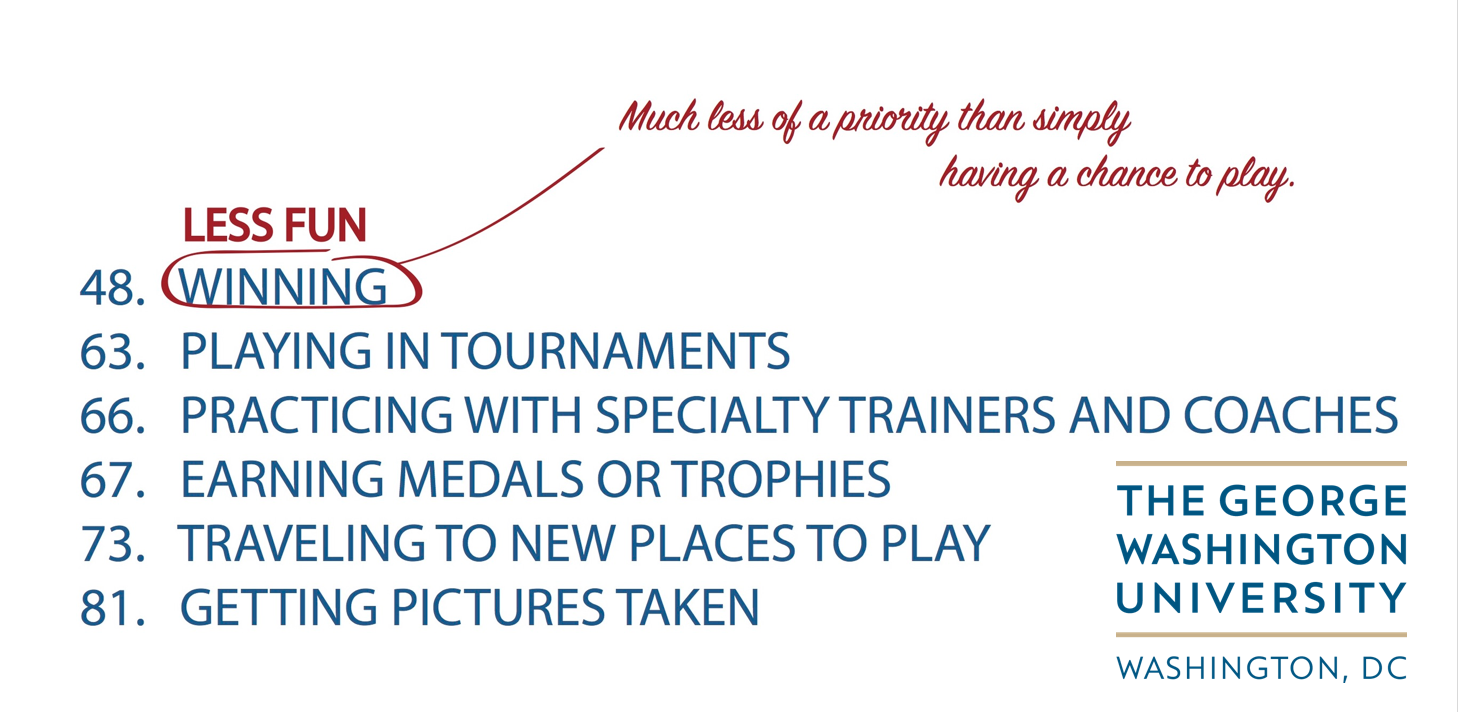
Note also in Amanda’s study, of 81 characteristics what is fun about youth sports, traveling to new places to play ranked right near the bottom of least fun reasons, 73rd out of 81.
It is not the kids that want to travel, it is the adultification of youth sports that has forced many families to spend their holiday time at ball fields, ice rinks, soccer pitches when they should be lying on a beach, taking a hike, swimming in a lake, going to amusement park of other TRUE forms of holidays.
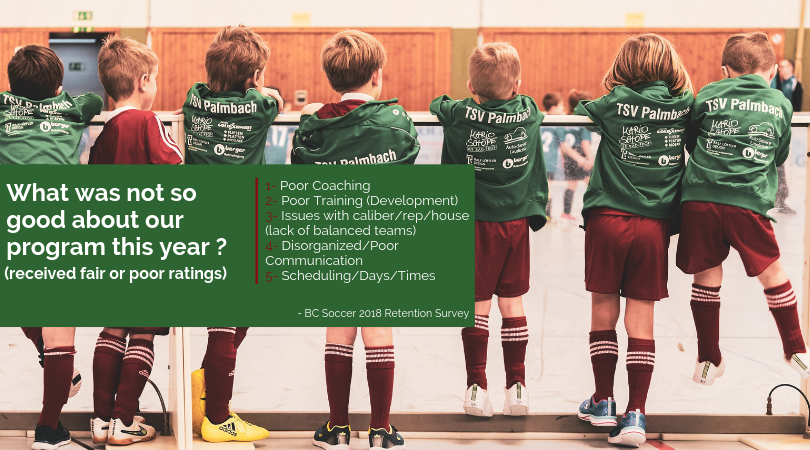
What was not so good about our program this year? (received fair or poor rankings)
SURVEY SAYS….
#1 – Poor Coaching
With the roll-out of NCCP program for all levels of coaching in soccer this will help address the what of coaching relative to the age groups to adhere to LTAD, small area games, age-appropriate drills, focusing on skill development vs. tactics and strategy and so forth.
It also will take several years to see the cause and effect as many other nations have experienced like Iceland who made the same commitment to coaching in 2000 and started to see the results once they qualified for the 2016 Euro Cup and 2018 World Cups of Soccer.
It also won’t address HOW to coach, How not be a kid’s last coach, coach beyond the game, how to connect with your players, how to engage parents, how to coach generation Z, LTAD vs. Early Sport Specialization, How to coach girls vs. boys, Grow your Mindset, Make it Safe to fail and from all levels of harassment, How to develop your philosophy and culture of excellent on teams etc.
Hmmm … this is why we have coaching modules to address all of the above, not WHAT to coach, but HOW to coach.
#2 – Poor Training
Goes hand in hand with #1, poor coaches are poor teachers and vice versa
This is not the fault of coaches that have the best of intentions to coach, is due to lack of experience and training at the grassroots level and like players, it takes YEARS to develop all the skills to become a great coach to teach the skills of the game, but also the skills of life.
#3 – Issues with caliber/rep/house/unequal skill on the teams
This comes down to player evaluations to form balanced teams, in lieu of subject measurement (which has led to a lot of politics associated with team selections), organizations should be using quantitative means to evaluate players and have baselines beginning of the season, mid and end of season skill evaluations to track development.
The only one that we recommend to all organizations is the personal sport record as many sports orgs across the globe are looking at or have already adapted for quantitative measurement including Norway Sport Federation who know “just a tad about being successful at the international level being the all-time winningest country in the winter Olympics in terms of medals”, Sport New Zealand, US Olympic Committee, BC Rugby, GTHL and many others.
Click on the logo to go the website for more information:

In lieu, the current model used by orgs is how many wins did the teams have?
How many banners did we win? Who scored all the goals and assists?
Focusing on outcomes, not the process.
For more insight the impact of the shift to winning at all costs has had on youth sports, reach out to us to schedule a FREE screening of The Cost of Winning followed by a Q&A session where sports leaders from across the globe provide their insights on the state of play in youth sports and the importance of bringing the game back to the kids.

#4 Disorganized/Poor Communication
From a coaching standpoint, one of the biggest asks I get all the time is how do I “deal with parents” to which I respond you should engage parents, not deal with them.
Engagement includes ongoing communication starting with a culture of excellence, a well-run parent meeting, team meetings, mid and end of season meetings as well as regular communication to all stakeholders (players, parents, fellow coaches) to ensure the ship (team) moves in the right direction.
#5 – (Poor) Schedule/Days/Times
This should be a focus for all local sports organizations to ensure consistency.
I suspect, like Amanda Visek’s Study, many other sports organizations not only across Canada but globally will be referring to BC Soccer’s Retention Survey for their current and seasons to come IF they truly aspire to buck the trends and attract, retain and grow their membership.
Kudo’s to all the board members at BC Soccer for taking this on, and now that have the answers “out of the mouth of babes” and better understanding of the motivations for their key stakeholders (players and parents) so their regional and local organizations can implement the changes to also buck the trends seen across Canada with declining numbers.
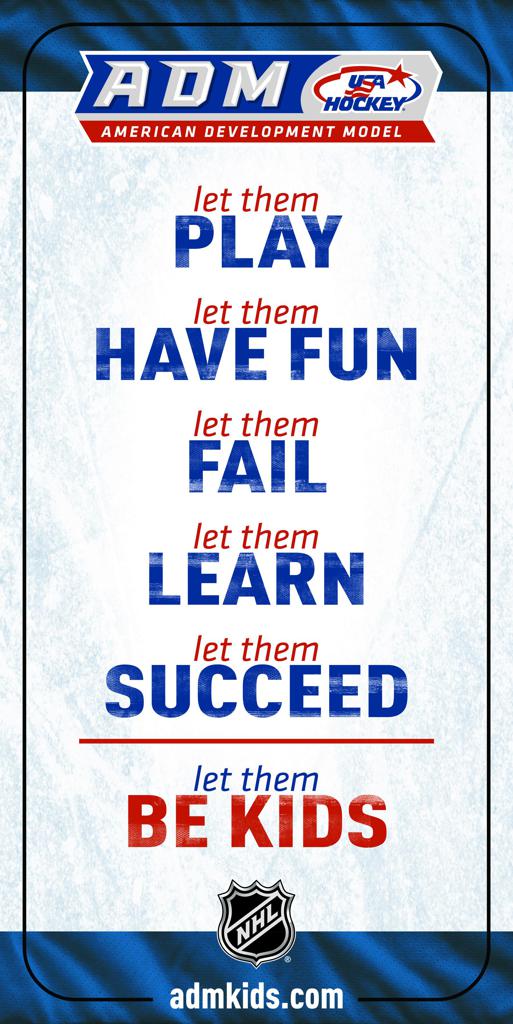
One sports org that did so that has shown it is possible, is USA Hockey who is setting the bar for all other sports organizations globally for all the great work they are doing to grow the game.
Several years back they were losing 60% of their kids by peewee (11-12 yrs. old)
They did three things to reverse the trends

- Rolled out their version of LTAD, the American Development Model, ADM, that focused on age appropriate training and coaching certification
- Emphasized fun for all age groups (regardless if rec or competitive streams)
- Cancelled their U12 national Championship that put too much pressure on parents and players who aspired to play in that championship
The result?
In lieu of 60% attrition, they retained 92% of their kids, only a 8% decrease.
For the naysayers that say it can’t be done or those that keep doing the same things over and over again expecting different results (insanity)…..
….. It CAN be done, as USA Hockey showed it takes a village to raise a child and requires collaboration by all parties concerned to focus on the things that matter most to the kids, Fun, Friends, Quality Coaching and having the opportunity to PLAY and contribute For the Love of the Game.