Why do Officials “Officiate” (2020)

Posted Posted in COVID-19, Officials

Why Officials Officiate – (2020)

A few years back I shared data in original post Why do Officials “Officiate” from what was the largest survey at the time of officials, one done by the national association of sports officials (NASA) where they received responses from 17,487 officials across the USA.

Fast forward to May 2020, I connected with Brenda Hilton, the founder of Officially Human whom I interviewed for our upcoming Youth Sports Virtual Summit along with several others and she shared with me that they had done a followup survey in partnership with IUPUI Sports Information Institute, School of Health and Human Sciences in Illinois.

The survey was done in the Fall of 2019 and just shy of 19,000 officials responded from 15 states in the USA and they prepared an infographic in PDF format that you can download HERE.

Below are highlights from the survey where I have compared results below each image from the one done in 2017
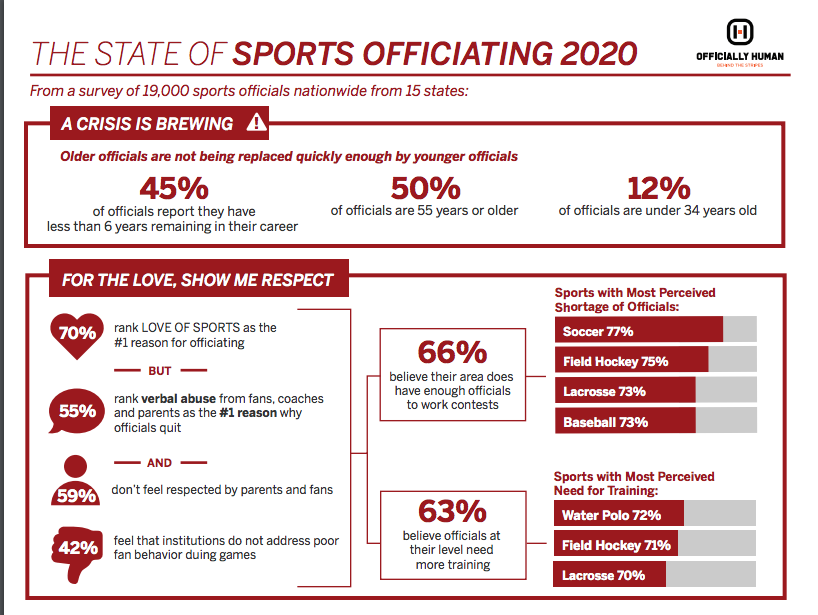
 

One of the issues in recent years that was identified by the NASO survey and also in recent SII survey is that officials involved in sports are getting older and as a result of COVID-19 there may be a real as youth sports start to ramp up again where many may be leery of returning due to safety concerns, in lieu of verbal abuse, however, from exposure to COVID-19 virus until a vaccine is developed in 2021

The #1 reason they become officials is the same, For The Love of The Game, as is the number 1 reason for quitting, verbal abuse, and almost 60% don’t feel respected by parents and fans.

The sports that have the largest % of shortages are Soccer, Field Hockey, Lacrosse, and Baseball.
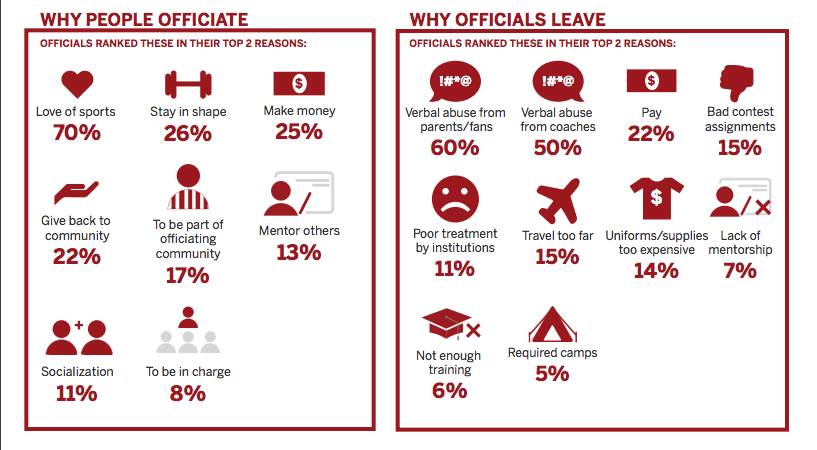
Officials also do so to stay in shape and make money (the majority of which is a small honorarium but some do make a living as officials at the higher levels)

The Second reason that officials quit is the verbal abuse from coaches, it is not just the parents and fans in the stands and sidelines that can be abusive, I have seen more than my fair share of coaches screaming at refs because they felt they missed or made a bad call which is something I remind all of during workshops and clinics.
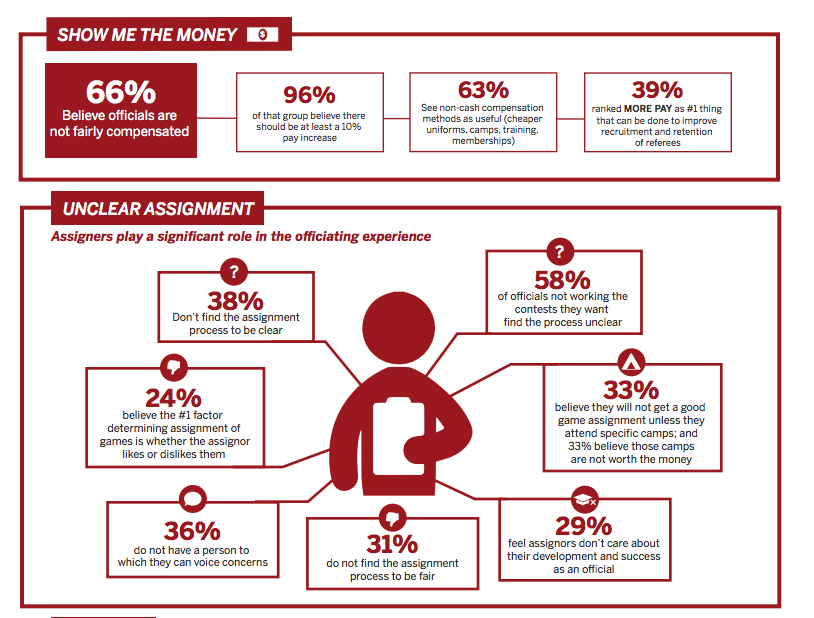


Almost all of those that responded (96%) felt that they should see an increase in pay of at least 10%!

58% of the officials stated they are getting to work the games they want to find the process of how they are assigned to games unclear, and 1/3 stated the reason they don’t get assigned the games they want is they have to attend camps to do so but are not worth the financial outlay to attend.

Key takeaways for organizations that are looking at attracting, retaining, and growing their number of officials as youth sports slowly return back to play post-COVID-19:

#1 – Parent and Coach Education reinforcing the importance of respecting the officials including codes of conduct for appropriate behavior and positive messaging in all common areas

#2 – Reduce costs for camps/clinics so officials see the value to them

In the 2017 NASO study, much of what officials earn in their seasons is taken up in terms their out of pocket costs for necessary equipment, potentially travel expenses, meals while at tournaments, attending clinics, camps etc.

#3 – Develop Rules Education programs for coaches, parents and fans so they are aware of the respective playing “rules of the game”.

#4 – Raise their pay by 10% (or more)

Minimum wage continues to increase year over year, in my home province has increased 25% the last 3 years so youth sport organizations need to recognize that their staff including paid officials should be compensated relative to costs of living

#5 – Implement mentoring programs for youth officials to be paired with tenured officials before they age out.  As the stats showed over half of the officials are over 55 years of age and the level of experience of 45% of officials is less than 6 years!!

This is largely due to the fact that rates of attrition that many sports groups face is as high as 50% of their first year officials and 30% each year thereafter

#6 – Make if Fun for ALL stakeholders, much like players, coaches, officials will only return each year if they enjoy the experience and will quit when it no longer is.

#7 – Implement policies to address poor fan or coach behavior during games so that they are removed from the facilities vs. putting the onus on the officials to say “you’re outta here” only.  Many will be reluctant, as well as unqualified to do so, in their first few years to tell parents to leave so they will need support from other adults

I worked for BC Place Stadium in Security for years, and when fans became unruly, it was really simple .. we escorted them out of the facility.  Why we have condoned inappropriate behavior in youth sports for years now makes no sense, kids quit, officials quit, coaches quit as a result.

#8 – Reward positive behavior by fans, coaches who demonstrate good sportsmanship in the stands towards officials, the game, players etc.

It could be as simple as coaches sharing with other coaches that their parent groups were awesome, please share our thanks to them for making this such a great experience and game to play.

As the cliche goes, you get much farther with honey than vinegar

#9 – Those that are in sports with shortages, start recruiting, training, mentorships programs NOW before games and tournaments are permitted in phase III/IV Post COVID-19.

#10 – Appreciate that the #1 reason why officials officiate is For The Love of The Game and focus on making the game GREAT for all stakeholders.  This not only will help retain officials but players, coaches, board members, and all others in your organizations so you can GROW your memberships … something that is going to be a challenge as sports return back to play.
Don`t be a kids last coach


What Parents Expect When Youth Sports Return Post COVID-19

Posted Posted in Coach, COVID-19, Early Sport Specialization, Officials, Organization Executive, Parents

I recently connected with a new officials organization in Illinois called Officially Human and the founder, Brenda Hilton, shared with me a recent survey was done that was circulated to 40 organizations across the US and received over 10,000 responses representing 13 different sports, 91% of those were parents who wore various hats in youth sports as coaches, administrators, officials, facility operators etc.

The survey was conducted by the Sports Innovation Institute based out of the University of Indiana and there were several interesting results that I believe sports organizations in Canada would find of interest as they continue to plan for or start rolling out their return to play guidelines in Phase II.

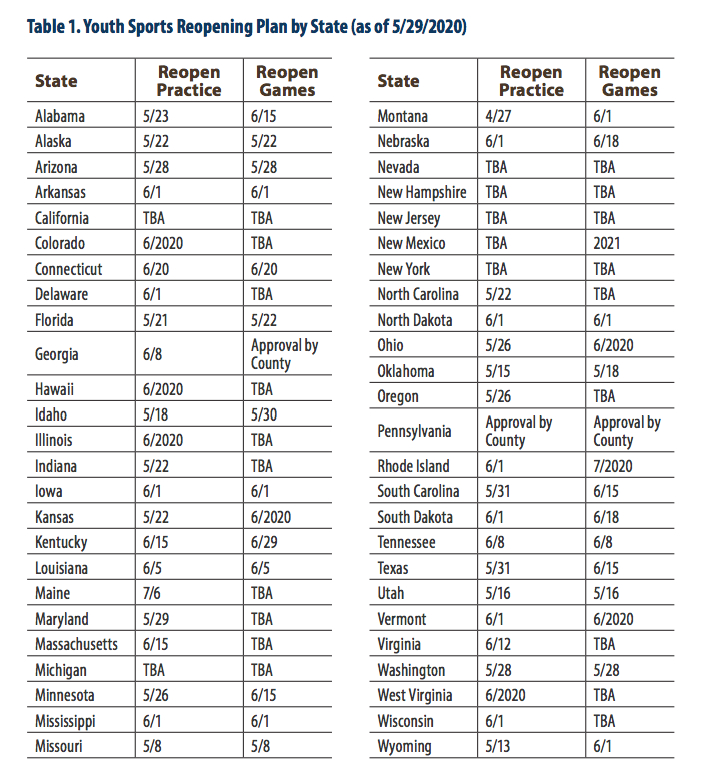
Below is the table outlining when youth sports can start practicing and play games


  • 86% of the 50 states will be permitting youth sports to start practicing as of May/June
  • 60% have confirmed that youth sports organizations will be able to start playing games


Compare this to Canadian Youth Sports that we have shared guidelines of returning to play today, many sports will be permitted to start returning to play for skills development sessions only and no confirmed dates when competitive games/tournaments will be permitted

The specific survey focused on the top 12 most common concerns identified from looking at various documents from governing bodies, trade associations and media articles

  1. Arrival and Departure Times: Changing arrival and departure times to limit time at the venue (I.e. waiting in the car before practice/game begins, coming to the facility fully dresses, leaving immediately once the game is over)


  1. No Spectators: Limiting youth sports competitions to players, coaches, and game officials.


  1. Spectators under 65 with No CDC-Indicated Underlying Medical Conditions: Limiting spectators at youth sports competitions to immediate family or maximum of two people who are under the age of 65 and have no pre-existing CDC identified conditions


  1. Health Screening: Answering a questionnaire that asks for contact information, travel itinerary, lodging, and health (status) i.e. fevers, COVID-19 symptoms to gain venue admission


  1. Social Distancing: Sitting or standing at least 6’ (2M) apart from others in spectating areas (i.e. blocking access to bleachers, sitting every third seat or row, standing in designated locations)


  1. Social Distancing with Respect: Treating even staff with respect if they approach you to strictly enforce social distancing guidelines


  1. Facemasks: Being required to wear a facemask while spectating


  1. Increased Sanitization: Facilities increasing the efforts before, during, and after events (i.e. frequent and visible cleaning, hand sanitizer available throughout the venue especially in high touch areas)


  1. Playing Areas and Equipment: Playing areas and equipment being sanitized after each competition


  1. Amenities: Amenities being closed at sports venues (i.e. concessions, drinking fountains, lobbies, playgrounds, entertainment centres)


  1. Bench and Dugouts: Minimizing the capacity of bench and dugout areas for athletes


  1. Personal Contact: Limiting personal contact between players (i.e. handshakes, high fives, hugs)


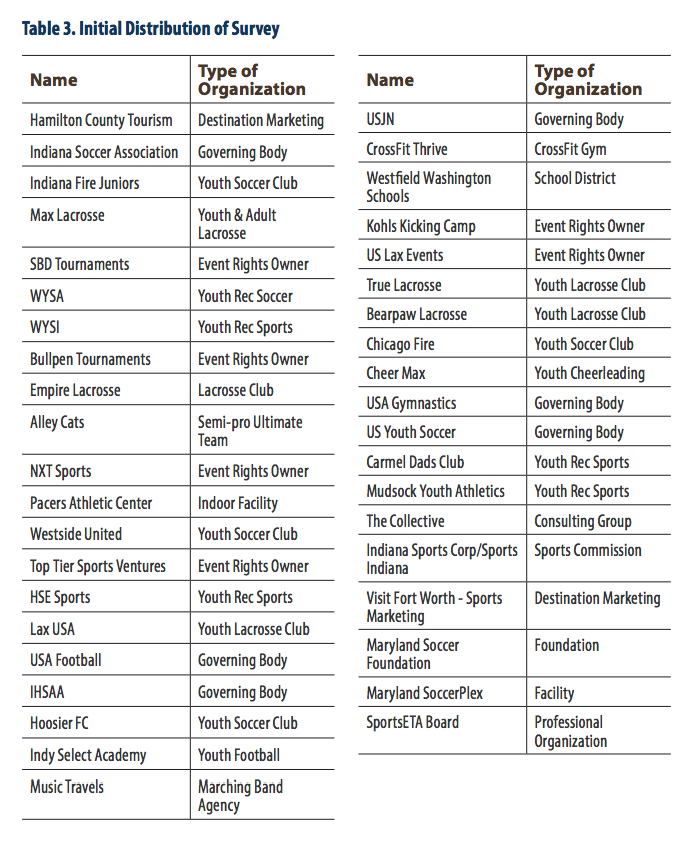
Below is the list of organizations who provided responses from private/local sports orgs all the way to NGB’s


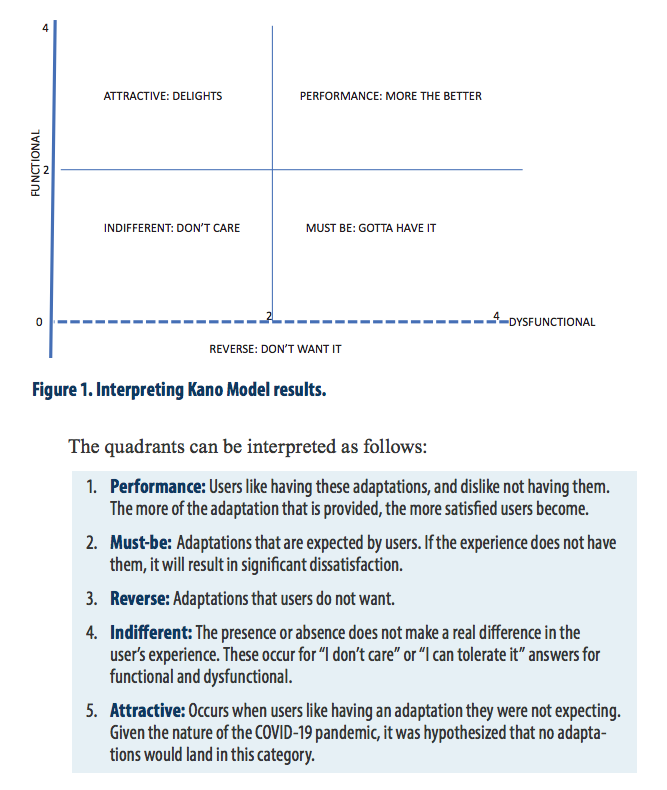
The survey results utilized the Kano Model, below is the legend to interpret


Survey Says….

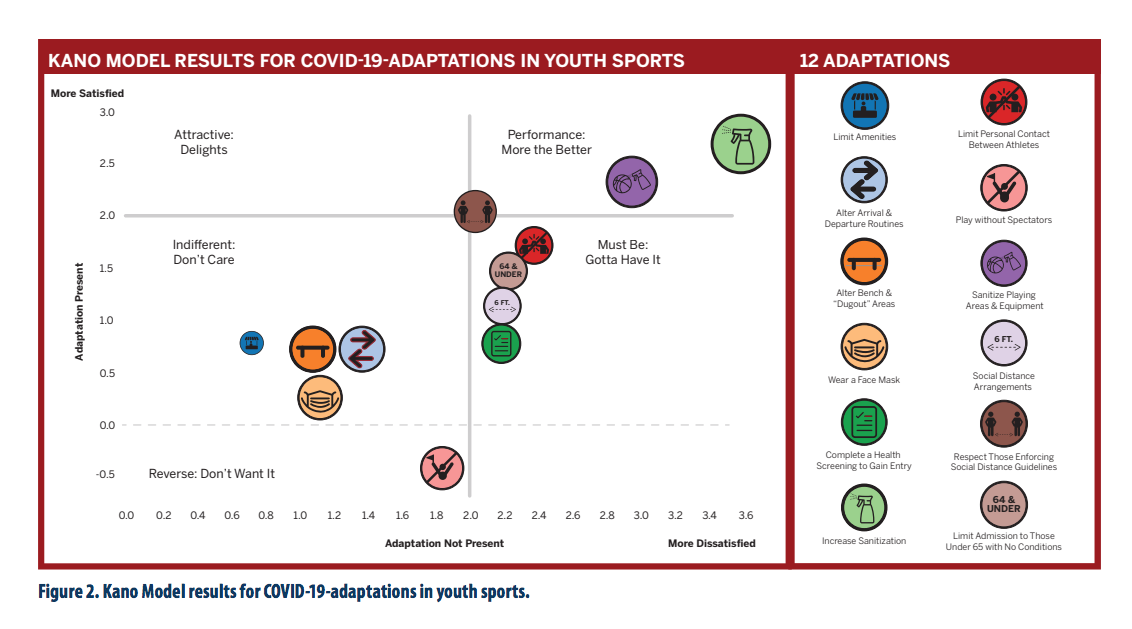
Amenities – Over 60% of parents were indifferent did not want additional amenities offered pre COVID (i.e. concession stands)

Arrival Times – Almost ¼ of those surveyed stated arrival/departure times must be varied

Benches/Dugouts – Over 30% were indifferent meaning did not require

Increased Sanitization – The NUMBER one expectation by the vast majority of respondents (over 87%) and #2 was sanitization of playing surfaces and equipment so if you or your facility provider has not got their order in for sanitizer stations, cleaning supplies etc it should be part of your return to play guidelines as there is a shortage of supply due to main ingredient ethynol on long backorders with long lead times that may impact your anticipated start dates

No Spectators – Over 50% were supportive of spectators being permitted vs. 30% against

Personal Contact – Over 50% stated contact amongst players must be limited as

Social Distancing with Respect – Over 60% supported that we should respect venue staff enforcing and over 50% expected social distancing by participants

Summary Graph of Results

A few of the results surprised me

The fact over 50% of respondents were against no spectators meaning it would just create more social distancing challenges for sports organizers especially as they had their hands full pre-COVID with spectator behavior at times.

Another was how many States in the USA are opening up facilities to permit not only practices but games by the end of June.

I have already shared prior examples of the Mother’s Day Baseball Tournament, Softball tournaments to be held in Texas in June and AAU’s 15,000 participant Volleyball tournament delayed until July (originally scheduled for June) and now over 60% of the US States will be permitting competitive game play en masse.

Then there was the tournament stat coming out of this survey, Travel Sports Parents (Pay to Play competitive teams) stated their comfort level to travel to tournaments increased from 42% in May to 76% in August when all sports organizers in Canada have been saying tournaments will be a no go until Phase IV and vaccine is developed.

Although COVID-19 has had a devastating impact on the global economy due to layoffs, business closures, and now more and more are filing bankruptcy 59% of those very same Travel Sports parents that the pandemic will not negatively impact their budgets for travel sports.

Only 23% will experience a decrease of greater than 25%

What does this mean?

Although many of the sports leaders I have interacted with not only in Canada the US and other parts of the world feel that there is a huge opportunity before us to bring the game back to the kids, the majority of parents that bought into the pay to play, travel ball, showcase tournament, early specialization and winning at all costs so my Johnny will be scouted and drafted as early as 9 years old are still drinking the same Koolaid.

What does that mean for organizations like ours?

That we and all of our partners across the globe will have even more work to do as organizations continue to return back to play safely to educate parents why kids play, why they were quitting, why we need to focus on what they want, not want the adults to believe they want.

Ironically the approach being taking by the Canadian Sports organizations I have connected with from Coast to Coast has been a wait and see, walk before we run approach even though Canada had evolved to the highest cost per capita country in the World for Youth Sports participation ($9 Billion in 2020 vs. $19 Billion in the USA).

I only hope that we continue to move slowly to ensure that we have who matters most at the top of the priority list, the kids.

Noting would please me more when kids get to play the games they love again, but to do so without going through the phases to ensure COVID-19 outbreak comes back in the fall is not worth rushing into it as far as I am concerned.

I also hope that this time of hiatus that we have had the last couple of months that all the adults in the space will see youth sports not as a business, a Multi-Billion Industry as it evolved to the last decade, but for what it truly is.

Kids playing Kids For The Love of the Game and Parents Just Loving their kids play when they do so.

PS Tagline - Dont be a kids last coach


Returning Back to Play – Phase II

Posted Posted in Athlete, Coach, Officials, Organization Executive, Parents

After a 2+ month quarantine period, many provinces, states and countries are starting to ease up on the physical distancing measures implemented to ensure that we flatten the curve of COVID19.

In phase I, we have seen restaurants, hair salons, non-essential retail, hotels and other services return with various safety guidelines to ensure that we continue to flatten the curve of COVID19 but slowly return to a sense of normalcy.

The sector that we are involved with is one that I am most excited in seeing work on return to play protocols, youth sports.

What I have found over the last couple of months during the hiatus, however, is the overall direction provided from national authorities and the trickle down effect from national, to provincial (or state), to municipal levels and literally every organization I have talked to saying they are waiting to see what their respective governing bodies provide in terms of guidelines so they can start the process of having their members return to play.

The first of the most anticipated documents that all sports groups in British Columbia (our home province in Canada) were waiting for was the guidelines for ViaSport, the provincial governing body under new leadership and legacy from the 2010 Winter Olympics held in Vancouver/Whistler.

The link to the guidelines has now been released, click on the image below to download a copy for reference.

The 35-page document outlines a generic return to play guidelines for all provincial sports organizations to then create their own guidelines to then in turn provide to their local organizations to the same.

Note that ViaSport is requiring that level has their own return to play guidelines, board members review/approve before are provided to their memberships.

I.e. First The National Sport Organization, then Provincial, then Regional (if applicable) and lastly local sports organizations.

The document was released June 1st, so it will take weeks for the various levels to prepare their own set of return to play guidelines to minimize the risk of the further spread of the COVID19 virus.

Yesterday I attended a webinar that was hosted one of my colleagues in Alberta, Lea Weins a Quality Sport Consultant in Alberta, outlining the project they undertook in various communities in Alberta identifying what quality sport would look like which now will look different as a result of the various health and governing guidelines

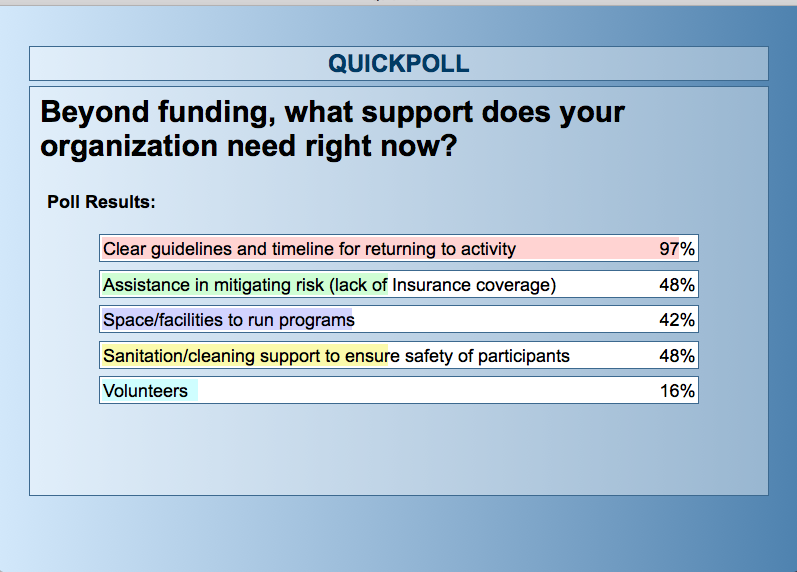
What I found interesting was a poll of the attendees from various sports organizations highlighted what I suspected, almost all (97%) stated that their were looking for clear guidelines and timelines to return back to activity.  Almost half were looking for assistance to mitigate risk as well as sanitization/cleaning support to ensure the safety of participants.

Source: Alberta Quality Sport Webinar June 2, 2020

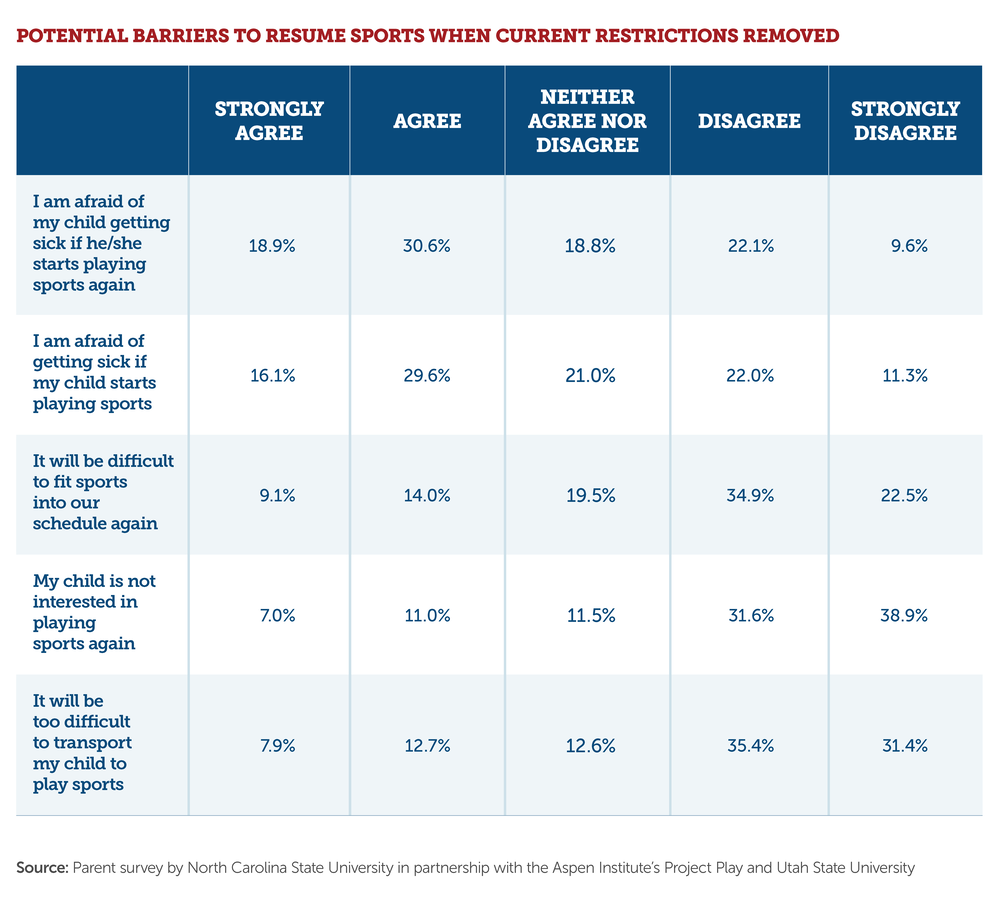
This theme is consistent regardless of what sports organization I have talked to in recent weeks and I came across a survey that was done for Project Play By North Carolina and Utah universities of over 1000 youth sports parents in the USA

When asked how comfortable they were with their kids returning to sports 49.5% of parents are afraid of their kids getting sick if sport resumes and just shy of 46% stated they are afraid of getting sick if their child returns to sport!

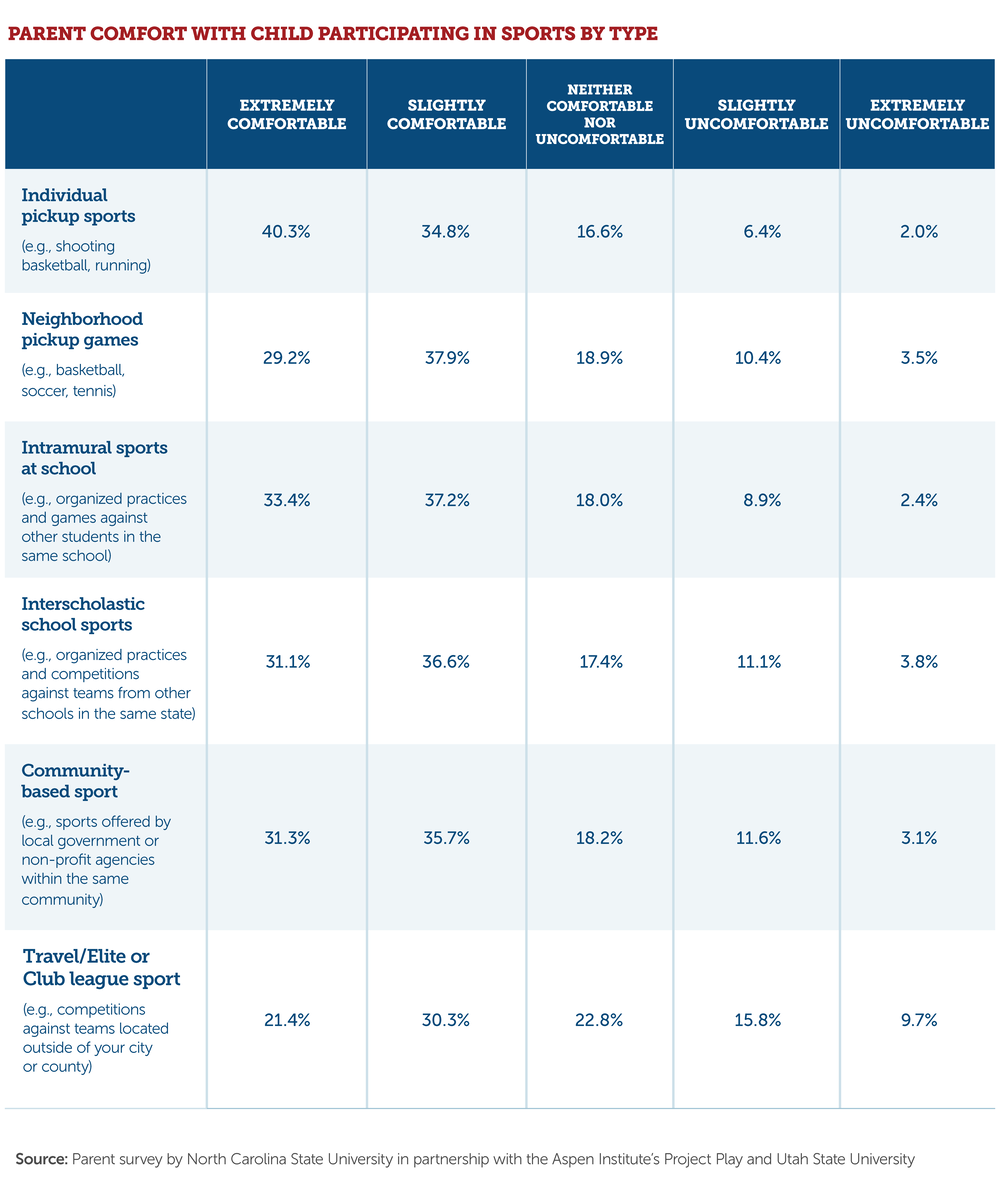
When parents were asked of their comfort level for their kids returning to various types of sport, over 70% were comfortable for their kids to return to pickup sports (AKA Free Play) and only 50% for what was the pay to play model pre-covid in terms of travel/elite club league sports.

In literally every webinar, Zoom or phone call I have had for over a month the one thing that was consistent was the LACK of consistency but it is due to the fact that every sport has their own challenges how they will return to play, some are low risk (i.e. archery) vs. higher risk team contact sports (rugby) how they can modify their practice sessions initially to adhere to physically distancing requirements.

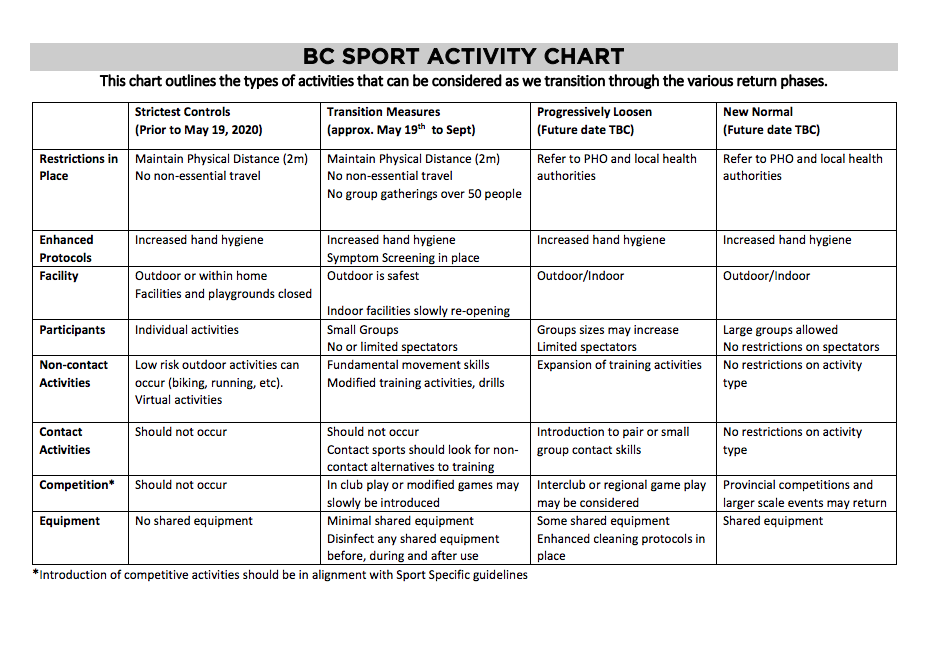
Below is a chart prepared outlining the various phases for sport activity (also prepared by ViaSport)

Phase I – State of Emergency Quarantine Period (March 13- May 18th)

Phase II – the phase we (and others are about to enter)

Notice the bare minimum requirements regardless of the sport

  1. Physical Distancing (6’/2m) must still be adhered to
  2. Increased Hand Hygiene (washing hands for 20 seconds regularly)
  3. Outdoor participation is safest … indoor facilities (gyms, pools, rinks) slowly reopening
  4. Small Groups, no or limited spectators, focus on fundamental movement skills
  5. NO Contact activities which will require contact sports like Rugby, Football, Hockey to revamp programming but also many others like basketball, soccer to ensure adhere to physical distancing
  6. Minimal shared equipment and must be disinfected frequently

Phase III/IV are still a ways away so in the short term (at least until September 1st projected for Phase III), any spring programs/summer camps will have to improvise, adapt and overcome to meet the COVID19 phase II guidelines.

Here are some of the challenges that are holding back sports organizations from shifting to phase II

  1. Insurance Requirements and if a pandemic/contagion exclusion is needed
  2. Updates to Player Participation/Waivers to include COVID19 disclaimer (i.e. that organizations are not to be found liable if participants test positive for COVID19)
  3. Facility Rental – Who is going to bear the costs (product and payroll) to ensure that common areas, equipment is sanitized and if masks will be needed
  4. Scheduling – to ensure minimize overlap of large groups for dropping off/pick up of participants
  5. Spectators – Yes or No … if so how many?
  6. Total Number of participants permitted (players, coaches, trainers, other)?
  7. Will lower numbers make the business model viable?

I even had some ask about what others were doing in terms of tryouts, coach and team selection which I shared that was not even being considered, the goal was merely to get kids back out to their sports in the safest way possible, there are not going to be any competitive games in phase II from the all the sanctioned sports organizations I have talked to.

**As far as non-sanctioned sports that is another thing it itself, only time will tell if they also practice the DO NO HARM philosophy vs. ramping up games and tournaments before health authorities deem it safe for us to do so **

Why is there so much ambiguity, confusion?

Because even the experts are no longer experts when it comes to dealing with a pandemic like the novel coronavirus, which is why over and over again we are hearing the term unprecedented.  Never in the course of human history has ALL sport been shut down, from professional to U-sport to high school and community sports.

The other challenge is there are many organizations leary of taking the risk of putting their toe in the water until someone else does so or they are given clear outlines from the higher-ups so to speak.

In sum, as health authorities have now deemed it safe for us to enter phase II, we shared in “What will the new Normal Be” how some organizations were returning to play starting with the infamous Mother’s Day Baseball tourney hosted in St. Louis that many felt was too much too soon.

I just checked my best friend Google to see if any other news had been shared since and to date there have been no reported cases of people that tested positive that participated in the event.

There have been a few others that have or are about to open their doors to return back to play implementing various safety measures to adhere to health authority guidelines.


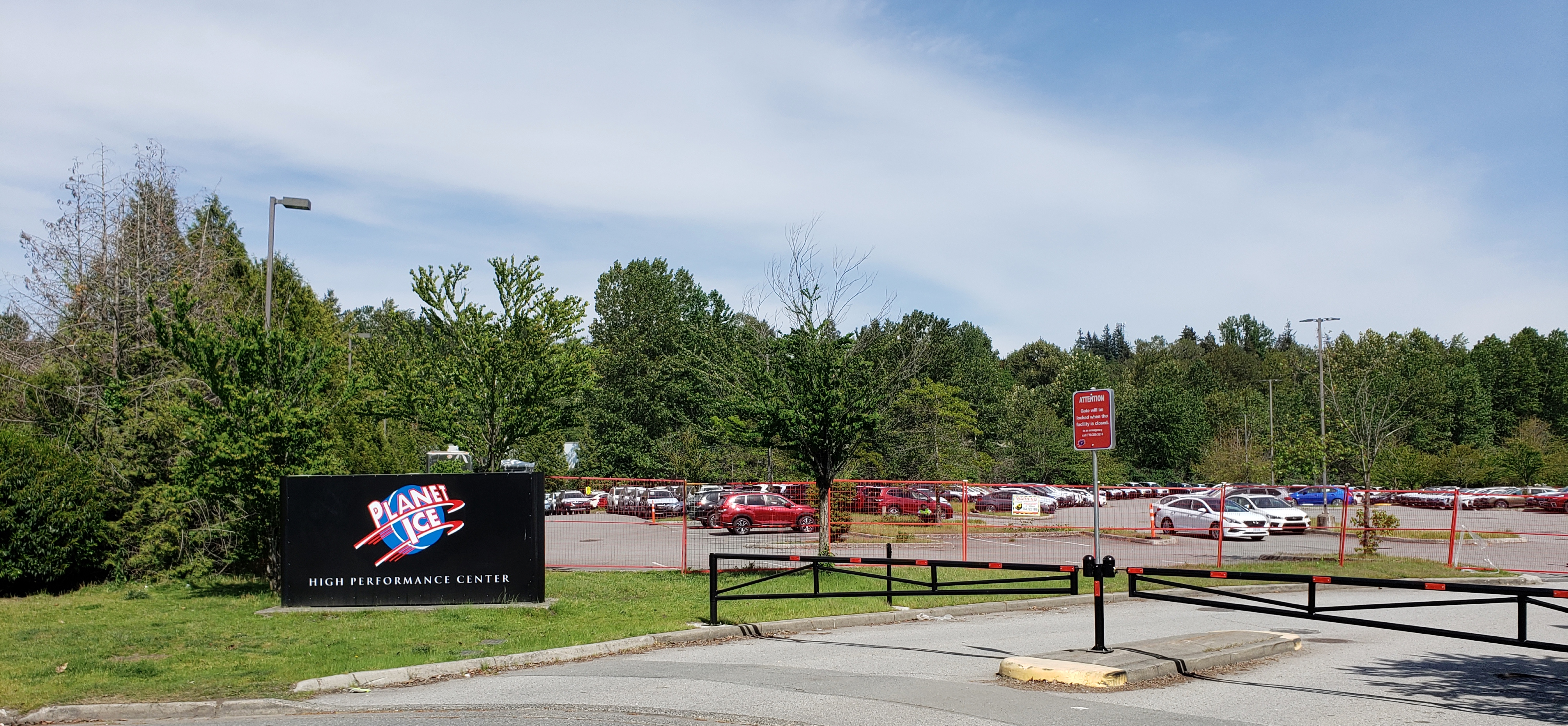
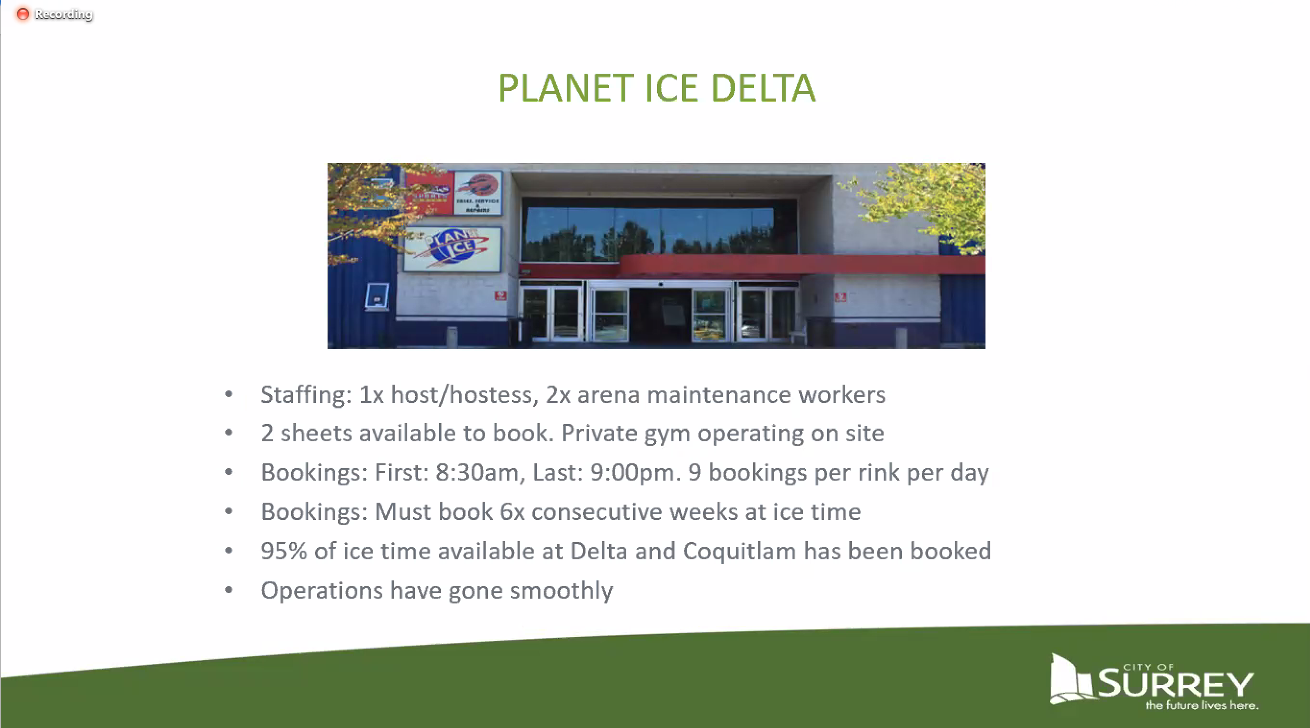
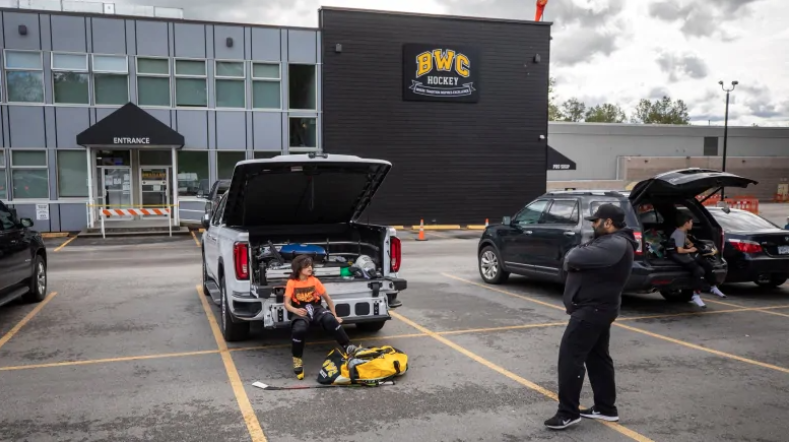
Following the lead of Burnaby Winter Club who re-opened for bookings May 5th with rigid safety protocols, now my the multi-sheet facility that I coached at for many years has re-opened after their parking lot was turned into a Hyundai new vehicle parking lot


I started to see cars being parked early part of April as I drove past the rink which I can only assume was a means to generate some revenue as the private facility did close its doors to adhere to the quarantine period.

Fast Forward to May 19th, they also have opened up 2 of their 4 sheets of ice for skill development sessions like BWC according to Surrey Community staff member that shared during one of the many webinars I have done the last month.


Note – just in a few days the facility manager confirmed that 95% of their ice was booked!

Only 6 skaters are permitted on the ice with a skills instructor, dressing rooms and concession are closed, and there is a one way flow inside the arena

They also have been creative in terms of signage for spectators (only one per player permitted and for markings on the ice to ensure that players adhere to physical distancing, including expanding the goalie crease by 6’!


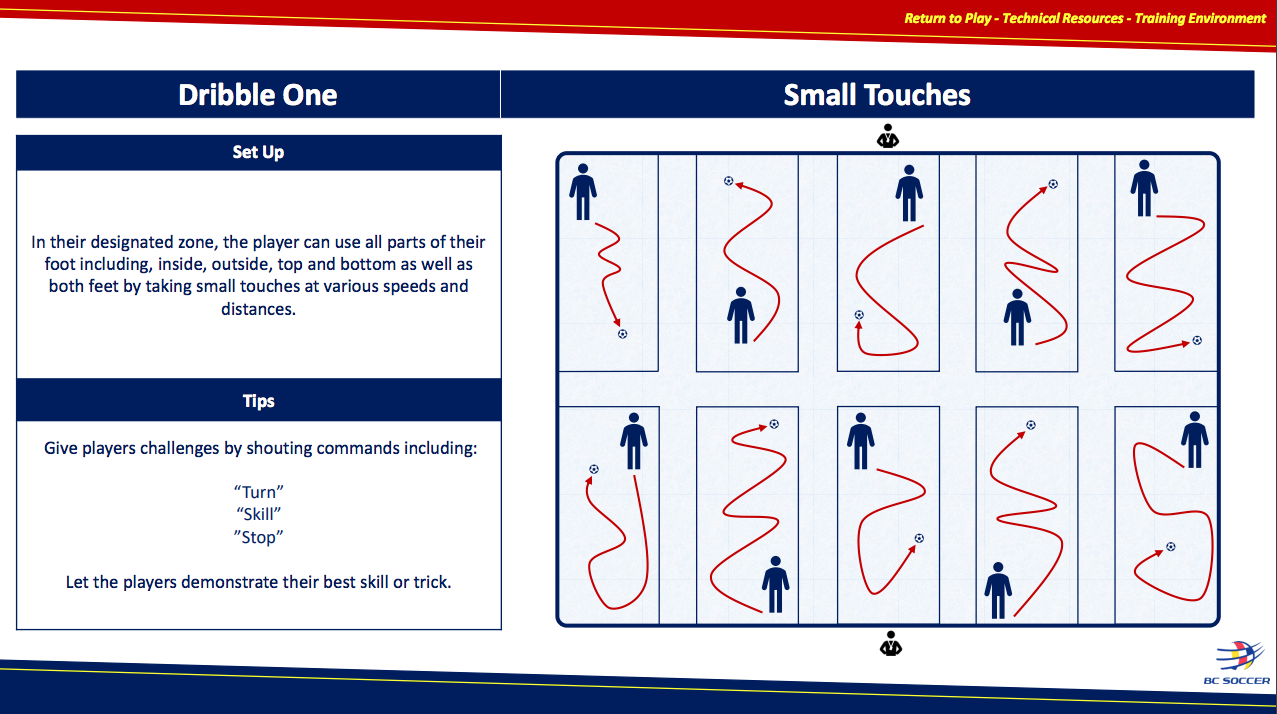
Once Soccer Canada, ViaSport reviewed BC Soccer released their return to play guidelines on June 3rd.

Click on the image for the guidelines shared with their members


They outline 3 return to play phases only so their phase I is what ViaSport is calling phase II (after the quarantine period)

The documents include guidelines for local organizations, sample sessions and timelines

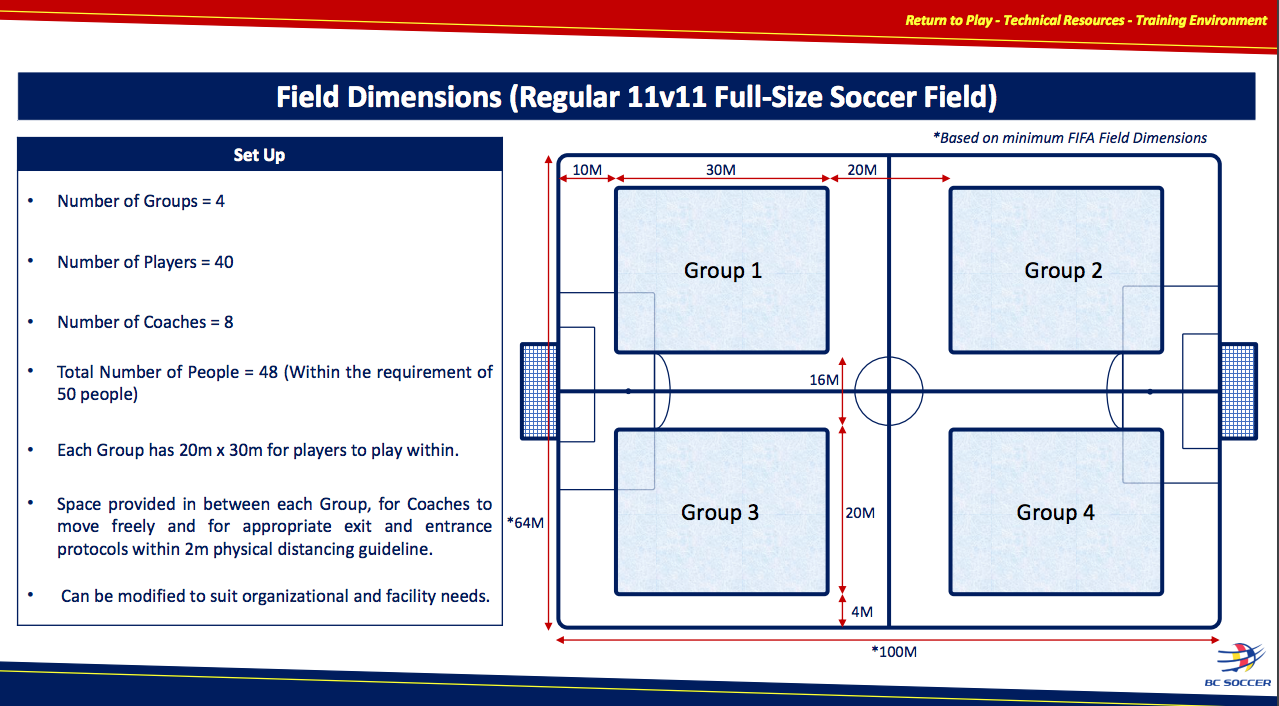
The sample sessions do outline how fields can be utilized (outdoors) to ensure that number of attendees on the field at any one time does not exceed 50

Session Example of 10 players in group 1 with 2 coaches working on various soccer skills


There is no reference to competitive game play, only skill sessions which adheres to ViaSports and BC Health Authority Guidelines.


Still working on their return to play guidelines for clubs but one of their directors shared in webinar how they envision their return to play will be in three components;

#1 – Only singles play, no doubles or mixed doubles play will be permitted

This will be mandatory for U11 and U9 age groups to start which they believe will be a good thing for their overall sport so coaches can focus less on tactics and more on skill development until the players mature and players have the skills to execute tactics

This also will permit coaches to do more one on one coaching vs. group sessions where coach to player ratio was a high as 1:8

HMMMMM … where I have I shared that before???

#2 – No Spectators initially, only players and coaches will be permitted

#3 – They had already started looking at piloting but are going to roll out AIR Badminton (AKA outside badminton like kids have done in their yards for 2 months during quarantine)

This was initiated pre-COVID lockdown to provide another playing experience than indoor, similar to the Beach Volleyball concept

More examples will follow in the coming weeks as more organizations release their return to play guidelines but as the cliché goes, good always comes out of bad and as more and more sports ramp up for Phase II the challenges we faced pre-covid in terms of adult behavior in the stands/sidelines, focusing on winning at all costs will not be an issue we deal with.

Perhaps this also will be the much-needed catalyst for sports in North America to consider other youth sports development models that we have shared in past like Norway, Sweden and Iceland who don’t even have competitive games until kids acquire the skills to from 6-12 years of age and as a result have had huge success at the Olympic and International Levels as a result.

Only time will tell.

Let’s all work together to bring the game back to the kids.


PS Tagline - Dont be a kids last coach


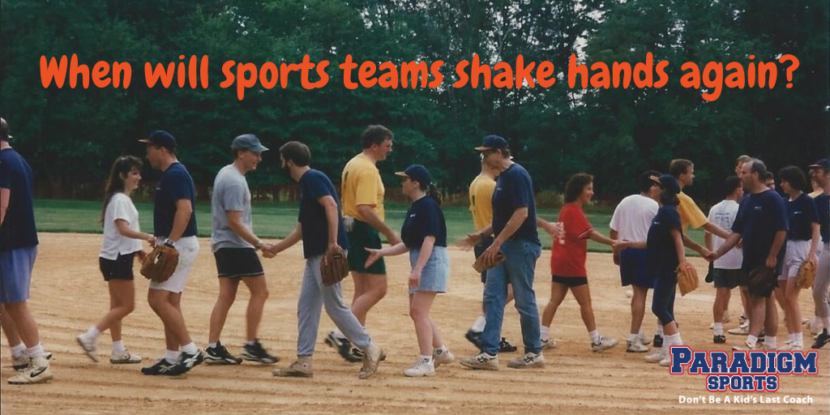
When will sports teams shake hands again?

Posted Posted in Athlete, Coach, Organization Executive, Parents

In the last couple of weeks, I have been thinking about the challenges that student-athletes are having as their spring seasons were put on hold and plans for this coming fall are in limbo due to the novel coronavirus pandemic canceling commencement ceremonies.

Two of which are my niece and nephew and I reflected back on my graduation ceremony from high school with over 600 of us wearing our gowns and gaps and the parties that took place in May and June as we ramped up for our official graduation ceremony.

The one thing that I keep being reminded of is one of the turning points that made me whom I am today, when one of my greatest teachers reminded me of the importance of never giving up in my last year of high school.

In my last year of high school, I played community football in the fall where I team went to the provincial championships (equivalent to state) only to lose in the last game which was a major disappointment but like many of my teammates we all aspired to go on and play collegiately or Junior and during that fall I also worked approximately 30 hours a week as a pizza driver and was in the honours program in my school.

After one of many crazy weekends where I played a game on the Sunday early afternoon then headed to the restaurant for my evening shift and got home around 11AM I woke up at 7 AM the following morning and went to my French 12 honours class and soon after I sat down my French Teacher, Mrs. Statz announced to the class we would be having a surprise quiz to help us prepare the provincial exam we would be taking in the spring.

To which I said … F>>> That, I am not taking a quiz in my groggy state

To which Mrs. Statz said “Mr. Mulcahy, get your ass out of my class”

I groggily picked up my textbook and binder and headed out of the class and heard the door slam behind me and as I turned to head to my locker I was shocked to see her standing in the hallway and she started to go up one side of me then down the other reminding me that I had so much potential and what I had done was not only disrespectful to her, my classmates but I was letting myself down.

It was reminiscent of that talks I had with many of coaches over the years that helped steer me in the right direction, having lost my father at 8 years old, then throwing (literally) my step-father out of our house for abusing my mother at 16 my teen years were full of anger and resentment and I had no aspirations other than getting my dogwood.

After all, I had a job, a car, a place to live and the idea of going to college or university was not even a inkling in my mind, moreso playing football, rugby that was an outlet for my anger issues but at the moment when Mrs. Statz asked reminded me of my potential to do so much more I said silently to myself that she was right … so the first thing I did was apologize to her, then went back in the class and did the same to my classmates and then set the wheels in motion what I would be doing after high school.

My grades were not quite good enough to go to University (as I worked, partied, and played sports) but was able to get into a junior college where I could still play Junior Football and Rugby in the Spring for the collegiate team so my path to higher education began.

I share all of this with you as I can relate all too well to the difficulties that my niece, nephew and all other student-athletes are having right now as they have been distanced from their teammates and classmates, they have had to improvise, adapt and overcome to complete their diplomas but unlike me and hundreds in my school will not be permitted to walk across the stage “live” to receive their diplomas, shake hands with their teachers in acknowledgment of their accomplishments nor having the opportunity to compete for what may be their last spring teams in Rugby, baseball, lacrosse or various other spring sports.


In lieu, their schools are working on creative ways to create a “virtual” graduation, where they still can put on a gown and cap, perhaps go to the stages they would have and being recorded walking across it, with representatives from the school and community than sharing via Zoom their “virtual handshake”

However these commencement ceremonies take place this May/June timeframe I believe there will be many “virtual commencement” speeches shared which cannot be done live, but below is one from Prince EA that I believe should be as regardless of the fact no ceremonies can take place this year, there is no reason why all the high school seniors should not celebrate in their own way and ensure that they do in fact “Live their dreams”

Dr. Anthony Fauci, The US Director of the National Institute of Allergy and Infectious Diseases has shared during the COVID19 quarantine period in April “we’ll never shake hands again” which had my head spinning when I came across the quote.

“WE’LL NEVER SHAKE HANDS AGAIN”

The reason?

Having played and coached sports my entire life, one of the core things that we do after games is do just that, shake hands after a competition in the spirit of sportsmanship and respect towards our opponents.

I did so for decades as I have all others involved in sports.

Can you imagine the Stanley Cup Playoffs and when teams are eliminated in a series not shaking hands after a game as one team moves on and the others head to the links?

The NBA, MLS, MLB, or any other sports when their playoff runs end not shaking hands in the spirit of competition, respect for their opponents for providing the opportunity to do just that, compete?

Any other sports competition at the professional, collegiate, high school, or community level not shaking hands after games, long playoff runs in the spirit of sportsmanship?

It all starts early on at the grassroots level where we as coaches remind our players the importance of respect, of themselves, their teammates, the officials, the opposing team and coaches, and shaking hands with respect.

Is that never going to happen in the New Post COVID19 Era of sports?

I hope not, I hope that when we do get thru this troubling time as entering into Phase I, II, III and beyond where large formal gatherings are permitted that the handshake is part of our tradition just as others like singing Take Me Out to the Ball Game in the 7th inning, singing anthems before games, raising retired jersey numbers to the rafters of great players, community celebrations to celebrate championships and so on have been for decades.

I also can say as a longtime coach, that one of the biggest rewards I have received as a coach over the years is when my players come to me at the end of a practice, a game, or season and extend their hand and say THANKS COACH.

I still remember to this day when a 6-year-old player did so on my hockey team and when he extended his tiny hand to do so made me realize just what coaching is all about, it is not about making a living, it is about making a difference developing youth into adults.

Until we can, in fact, practice the tradition of shaking hands again in the spirit of respect, sportsmanship, winning with humility and losing with dignity … stay the course … stay safe as we transition to phase II and I am crossing my fingers that Dr. Fauci was incorrect and we will be shaking hands sooner than later.


PS Tagline - Dont be a kids last coach


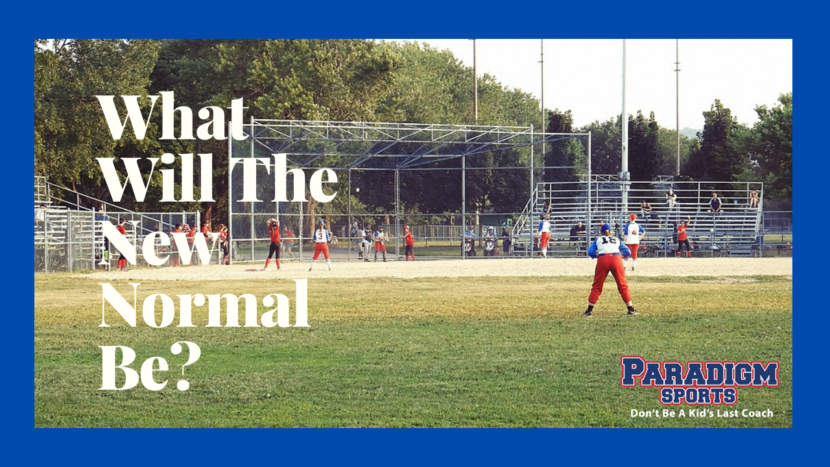
What will the “New” Normal Be?

Posted Posted in Athlete, Coach, Organization Executive, Parents

With the state of uncertainty that has evolved the last couple of months as countries locked down to flatten the curve and now many looking at easing up physical distancing to shift to phase II of the COVID19 era, I for one can say I am crossing my fingers that we do so in a manner that will ensure that we all continue to stay safe.

In the last few weeks, I have had conversations with various sports leaders, coaches, parents, players as well as various small business owners who are looking forward to returning but the big question we all keep asking ourselves is what will that in fact be?

If the recent outbreak that happened in South Korea where a man who was positive for COVID19 has any indication of a worst-case scenario leading to infecting 40 others while going to night clubs is potentially going to happen, I continue to caution everyone to adhere to all of the recommendations from health authorities to ensure that EVERYONE is safe when we start returning back to sporting activities.

I also must confess, I came across an article that shared the anecdote it is going to be like the Wild West when we do so, as so many people have been cooped up at home for many weeks that ANY opportunity will one people will be chasing.

This is what I do know .. as I have shared with students who we have sponsored for years, Haste Makes Waste.

In lieu of diving into the pool, we need to all tip our toes to test the waters so to speak before entering phase II, IV and beyond.

Here are just a few of the examples who have returned to play and safety measures they have implemented;

#1 – Mother’s Day St. Louis Tournament for 54 Youth Baseball teams May 8-10th, 2020

COVID19 Safety Measures per the Tournament Coordinator Rob Worstenholm

  • Players and Coaches to adhere to physical distancing by only having 3 people in the dugout
  • Umpire standing 6’ behind the pitcher
  • High-Fives, Fist Pumps, Hand-Shaking Banned (in lieu tipping their hats)
  • Balls were cleaned every half-inning
  • Dugouts cleaned after every game
  • Spectators had to sit in the outfield (bring their own chairs)

This was against recommendations of Missouri Health Official, Lynelle Phillips who shared “To hold a huge baseball tournament, even the most optimistic of us have to cringe at that” and Morstenholm said 50% of parents were for hosting the tournament vs. other thought it was too risky to do so.  Only time will tell if any COVID cases came out of the 1000+ players, parents, coaches, officials that participated.  If none, then it sets the bar for others to follow, if any, it could push youth sports back for quite sometime to ensure we flatten the curve.


  1. Burnaby Winter Club Renting Ice for small groups – May 5th

Within minutes of announcing they would be re-opening over a hundred parents reached out to BWC’s registrar but shared that the ice rentals that had traditionally been for spring hockey teams, games and potentially tournaments would be different than Pre Covid era

This means no team practices, only private lessons for skills development with 4 players on the ice and a skills instructor

Other safety measures to include;

  • Players must arrive at the rink in full gear (even when they were in full operation I know first hand this may be more beneficial due to the smaller size of the dressing rooms vs. newer facilities) as dressing rooms would be closed
  • Arrive no earlier than 15 minutes prior to ice time (no warming up in the parking lot permitted)
  • One way traffic flow both entering and out of the building

#3 – MLS (Soccer) / European Premiere (Football) Teams commence practicing in anticipation of playing games

Safety measures include;

  • Adhering to Physical Distancing (minimum 6′ / 2 metres)
  • All Players, coaches and support staff are wearing masks
  • Regular Handwashing for 20 seconds
  • All equipment and practice areas will be sanitized on a regular basis
  • Players are also  taking pay cuts in anticipation of shortened seasons
  • League games will be played in empty stadiums live-streamed by sports media
  • MLS league games will be on a neutral site, Disney World, where all players/coaches will be isolated in hotels

Other professional sports are also ramping up in anticipation of seasons continuing (NHL/NBA) or starting up (MLB)

  • NBA teams have been given the green light to practice but continuing to adhere to safety measures
  • Hosting games in a neutral site where all players/coaches would be quarantined in hotels and playing games in empty arena’s
  • MLB continues to look at a shortened season when they are able to Play Ball based on what the required safety measures will be
  • NFL – already hosted their virtual draft and anticipating starting league play as normal after labor day (albeit may be empty stadiums)

All of which so they can at least start providing live games on TV, one their top revenue generators but by no means will that offset loss in merchandise, concession, and ticket revenue

What then is going to happen with other community youth sports organizations either trying to salvage some semblance of a spring season or those with traditional fall sports programming (Ice Hockey, Field Lacrosse, Volleyball, Football, Basketball, and Soccer in certain provinces as well as others)

Each one I have talked they all say the same thing, they are waiting for direction from health authorities and their governing bodies to advise what the next phase will be.

All, including yours truly, are anxious to return back to play, but until a vaccine is developed and the majority of the population has been exposed to, tested positive and recovered from the novel coronavirus we are still going to be in this for the long term.

Just as I have been saying when it comes to athletic development, it’s a marathon, not a sprint, before we take the deep plunge to return to play I truly hope that we slowly tip our toe in the water and ease back into it. The other upside to the Global Sports Time Out is it has given us all time to reflect what truly is important and many kids have had the opportunity to sample various other athletic skills they may not have had based on crazy organized sports schedules they had.  The other big positive, they have experienced what “free play” is again, no coaches or officials telling them what to do, they just played for the sake of playing.

The last thing we need is to regress backward like South Korea is doing now as a result of easing up their physical distancing requirements way too early.

Nothing would please me more when we do see teams competing For The of The Game again but until we do, let’s do everything, and then some that medical practitioners advise to do to ensure that not only participants but all other stakeholders stay safe.