
Long Term Player Development.
I just came back from Whitehorse, Yukon to run three Hockey Canada NCCP Clinics for BC Hockey who also is the Provincial Governing Body for the Yukon Territory. This is now the second time in as many years that I have had the opportunity to work with passionate coaches is a small town where hockey is one of the main sports, the first time was when I was asked to run clinics for another small group of passionate coaches in Fort Nelson, BC. Both trips I had the opportunity to fly via Air North, a small airline whose lanes take passengers to various stops in the Yukon, mainly from BC and Alberta, but as far from Ottawa, Ontario. My favorite part of the trip, the warm chocolate chip cookie with Milk, one of Air Norths claims to fame. Over the last 10 years I have had the opportunity to interact and learn from thousands of coaches across Canada, and anytime I get asked to work with coaches in smaller towns I jump at the opportunity. Why? Because they are very passionate about sport, over the course of this past weekend, the coaches shared with me how their kids are bucking the trends where kids today spend on average of 7.5 hours a day on screens. In Whitehorse many of the kids play hockey and swim thanks to the legacy left behind at the Canada Games in 2007 for an amazing facility with 2 rinks, pool, gym and even a physical literacy education area. They also ski thanks to very affordable passes at their local hill of $200.00 for a season for kids up to 18 yrs. old, cross country ski, ice fishing, play soccer in spring (vs. fall in BC due to climate) and many will play indoor soccer in fall, basketball, volleyball and numerous other activities. We could all learn a little from the parents in those small towns who are encouraging their kids to participate in as many activities as possible until their latter teens when they choose a sport they are the most passionate about. We shared a quote on this weeks newsletter that I came across last week by Muffet McGraw, Head coach of the Women’s Basketball Team who has over 800 wins at the University of Notre Dame whose 2018 team is ranked Number 1 in the NCAA and reigning NCAA champions last year.
“Do I think we’re specializing at too young an age? Absolutely. I hate it. You don’t have to pick one sport when you are 10 or 12 years of age”
Sadly as I have shared in numerous articles, many parents are feeling the pressure to sign their kids up in one sport year round as early as 6-7-8 years of age which is due largely to the fact they are not aware of the benefits of multi-sport participation and the initiatives from all the NSO’s (National Sporting Organizations) in Canada, USA and many other countries worldwide for long term development to become the best athlete, not hockey player you can be (or any other sport) Hockey Canada is one of the NSO’s that have rolled out their version of LTAD developed many years back by Sport for Life, theirs as well as some other NSO’s like Soccer Canada, Softball Canada have called it LTPD. LTPD = Long Term Player Development. This past weekend, just as I have in any presentation or clinic I have ran going back many years, when I asked the question “What is LTPD?”, only a few hands go up. The ones whose hands go up have been coaching other sports but none of the first time coaches (many of which are parents) who are just starting out are aware of LTPD or the various versions. I then ask what about Physical Literacy or Fundamental Movement Skills? Same thing, only a few hands go up, in this instance however, many hands when up in the Coach 1 age groups (5-6) because Whitehorse has a Sport for Life Physical Literacy Centre and education thru their elementary school.Houston we have a problem.
One of the issues that has been identified by every NSO that I have spoken for is that our best coaches are coaching at the highest levels in their respective sports, Provincial, National Teams but for our youth to develop the core skills needed to reach that level we should have our best coaches working with the kids in the earlier age groups to develop those core motor skills. For purposes of this post, for those unfamiliar with what is LTPD, I asked of my co-op students to tweak the Hockey Canada LTPD image that outlines all the stages and applicable age groups so it was easier to read in presentations.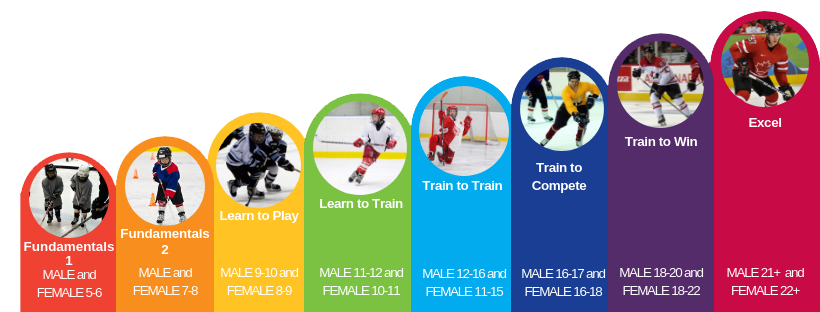
Fundamentals 1
Initiation Boys and Girls – 5-6 Yrs Old
Hockey Canada’s first stage for the initiation age group, boys and girls 5-6 years of age. In this weekend’s clinic, we asked for kids to come out from 7-9 for the coaches to run thru drills and one of the younger brothers who was just starting came out and was priceless. He could stand and skate forwards largely with help of his stick as a crutch, and went thru the various stations with all his older counterparts with a HUGE smile on his face. This age group should be all about core skills, mainly balance and agility, falling, getting up, learning basic V-Stop, holding stick, hockey stance (for balance). Ideally, they should do all drills starting with no stick so they learn to skate without the crutch many rely on NOT playing full ice games as I have learned is happening in BC, Ontario with leagues that have 6-year-old kids playing as many as 70 full ice games a year. This is totally contrary to the Cross-Ice model that Hockey Canada rolled out with resistance from these very same leagues last year for the Initiation Age group.Fundamentals 2
Novice: Boys and Girls – 7-8 Yrs. Old
The second stage for the Novice age group (boys and girls 7-8 years of age), that is going to be cross Ice Nationally next season as Hockey Canada opted to roll out in stages vs. some provinces like BC who opted to roll out for Initiation and Novice. The focus in this age group should continue to be core skills of hockey, balance, agility, skating, passing, shooting. NOT playing full ice games where the score board shows a score of 6-0 but the actual score as reported by various news outlets across Canada in a Novice age group was 41-0
Learn to Play
Atom – Boys 9-10, Girls 8-9 Yrs. Old
This is the first stage that girls age groups differ from boys because they mature sooner than boys in terms of their physical and mental growth For me, this is the age group I enjoyed the most as they truly learn to play, they make the transition to full ice hockey now (vs. at 7 years old when I coached and was a beehive of the weaker kids chasing the early bloomers and never touching the puck) It is also the first year that Rep Hockey is introduced, but still emphasis on development, no power play, penalty kill units or any other systems. Merely core skills and individual tactics. Unfortunately, as I have seen all too often, once the word rep or in other areas of BC “development” gets association with a team vs. recreation, many coaches jump the gun and start introducing systems, strategies when should continue working on core skillsLearn to Train – Peewee
Boys 11-12, Girls 10-11
This is the stage that coaches are required to take their Development 1 coaching certification as the rep stream is now deemed “competitive” and is a 2-day clinic, followed by a post task, MED online, practice evaluation and same CATT, RIS that all coaches have to take regardless of the age group or stage in LTPD. Only a small % of time should be on group tactics, systems and strategies still focusing on core skills (80%) but like I see in Atom, once the word competitive gets added, “some” coaches take it to the extreme. This is also the age group where spring programs really ramp up competition by going to travel tournaments all over North America, even some going to Europe that takes the current 1:1 practice to game ratio to even lower.Kids develop in practices, not games.
In BC, the current rep model is 2 games, 2 practices and a dryland a week. I always tell coaches to get their dryland to run pre-post one of their practices to limit the time commitment to allow kids to do other sports and activities. Easy fix to increase our practice to game ratio to 3:1 (Europe is 5:1) to focus on development not competition to a practice slot. VOILA – 3:1 practice to game ratio. Better Yet – Eliminate the Scoreboard and score sheets so sports are fun, the #1 reason why kids play per all the research and studies done, including my informal surveys of all the teams I coached in multiple sports. Per Amanda Visek great research, the top 3 reasons why sports are fun are 1 – Trying my best (skills), 2. When a coach treats me with respect and 3. Playing time. Way too many Peewee coaches, regardless if it is rep or rec (AKA house) run short benches, have power play and penalty kill units that deprive all the kids the opportunity play and contribute to the outcome of games. Why? Because the parents want to see more games so their kids can be scouted to be drafted and make the NHL or get a NCAA scholarship. REALITY CHECK – 0.03% of kids that play hockey “may” it to the NHL and less than 1% of kids will play in the NCAA with only partial scholarships (approx. $8K is the average vs. $30-40K for tuition, room and board, insurance etc still leaving parents on the hook for $80K or more) It is no wonder why 70% of kids quit hockey by the age of 13 as a result.Train to Train
Bantam Boys – 13-14, Girls 12-13 yrs. old
Coaches should continue to focus on skills, individual tactics and this is the age group that I believe we turn the scoreboard on, keep track of the results, not before. Yes – No scoreboards or scoresheets until Bantam. Norway, Sweden who have both implemented LTAD for many years do the same, kids do not compete until they are 13, until then, they play for the LOVE OF THE GAME, developing friendships, developing various skills across a myriad of sports. Some pretty good hockey players have come from Sweden no? One being the current Calder Trophy Candidate for the Vancouver Canucks, Elias Petterson. Norway knows a little about reaching the podium also, 39 medals in this year’s Winter Olympic Games. Train to Compete Midget – Boys 16-17, Girls 16-18 This is where group tactics, positions, tactics in competitive situations but also focus on conditioning, strength and power. Coaches should still continue to work on skill development (60-70%)Train to Win
Male – 18-20, Female – 18-22 INTERNATIONAL
Notice how LTPD does not reference the word winning until kids are this age? These are the players have bee identified by Hockey Canada to represent their provinces or the country but even when I have talked to these coaches they still continue to work on skill development. Brent Sutter, after they World Junior team he coached in 2014 that did not win a medal, shared that the reason we did not do so was we lacked skill, creativity that other nations had due to our system being too structured. This is a result of our focus on competition too early and not emphasizing the importance of free play, small area games and skill development. As we shared in a prior newsletter from one of the top 10 winningest coaches in NCAA Div 1 Men’s Hockey History;