Wear your parent hat at home, coach hat at the rink/field.

Posted Posted in Coach, Organization Executive, Parents

Years back I started a tradition with my family as I was traveling extensively for my day job then and when traveling in lieu of buying various touristy items for my kids I opted to buying the latest movie that we would watch when I returned home.

Although my kids have now become adults, as they are still going to college/university, they still reside at home (much like every other 20 something in the lower mainland of Vancouver due to the high costs of housing) and last night we decided to watch “Antwone Fisher” based on a young man who lost his father when he was 2 months old and was given up for adoption by his mother and had an abusive foster family environment until he entered the Navy.

Due to various emotional issues, particularly anger the led to him getting into numerous fights, he was ordered to see the Navy Psychiatrist brilliantly portrayed by Denzel Washington who helped Antwone overcome the various emotional struggles he experienced from losing both his father, turned over to what was an abusive foster care environment by his birth mother and then he lost his best friend in his late teens.

You’re probably wondering why I am sharing this, but the reason I am doing so is that I can relate to Antwone’s journey on a few fronts which is why I get very emotional when I watch the movie.

#1 – Like Antwone, I lost my father when I was very young, at 8 years old and as a result of his work we had had moved 8 times already to be close to the buildings he managed (so can relate to all the military brats out there), but also how disappointed I was that he was unable to honour his promise to coach my baseball team as he died half way thru the season.
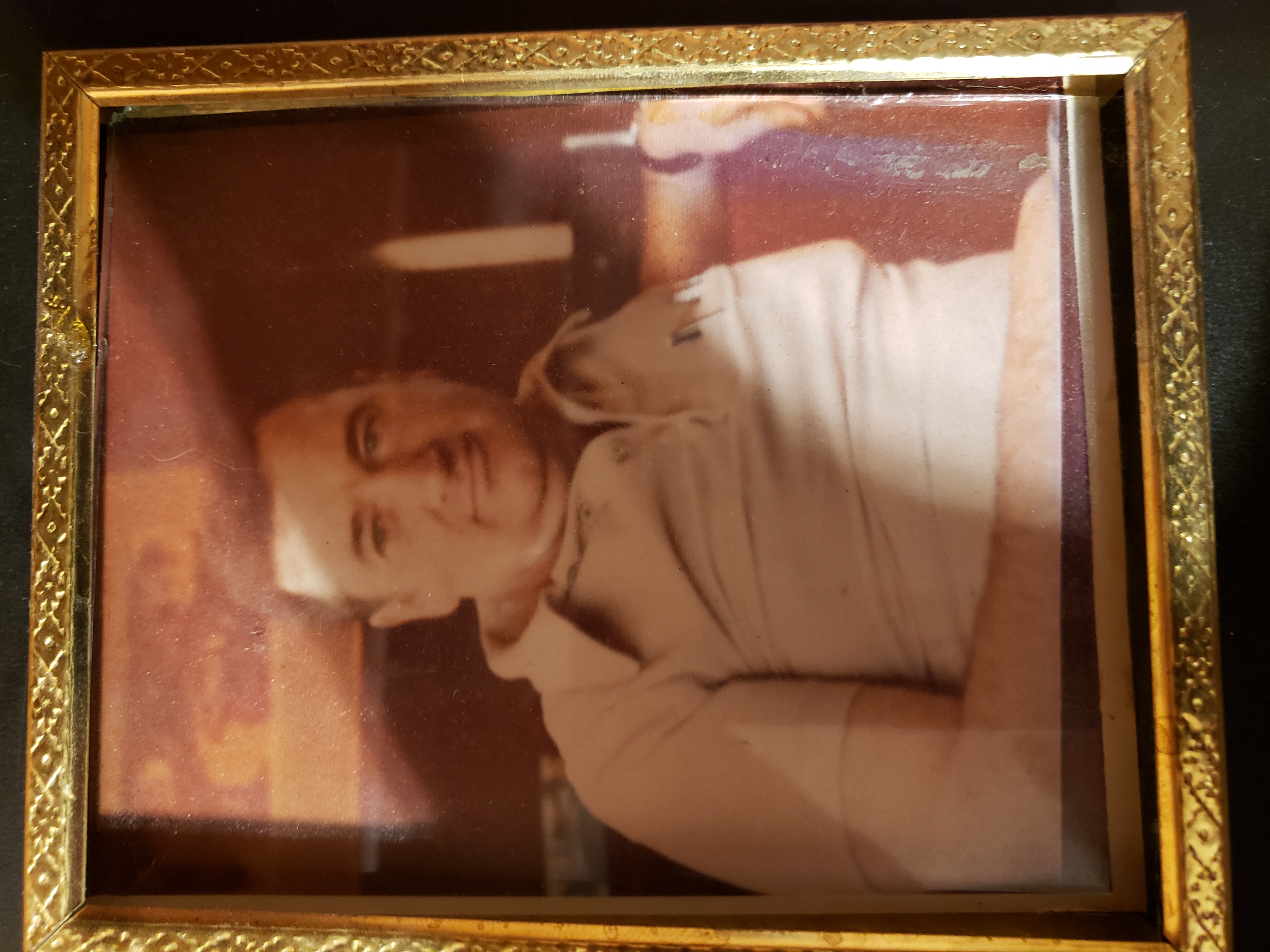
My favorite picture of my Dad that I actually took when we were on the train heading from Montreal to our new home in Vancouver when I was 7 years old

#2 – Like many youth without a father, I ended up hanging out with a group of misfits, my non-sport “friends” in my teen years but also continued to play various sports, in particular contact sports hockey, football and rugby as I too had issues with my temper from not having a Dad to turn to but the team mates in sports and coaches I had help me keep it in check, would say to me all the time to use my temper in a positive fashion by being tough to play against.

One of the main reasons that I am so passionate about sports and kids is all the amazing coaches that I had and team mates who helped steer me down the right path vs. “my friends” that went down the wrong path (many of which did not graduate high school, were imprisoned for various reasons so who knows where I would have ended up)

#3 – Although playing contact sports did keep my temper in check at times, one that I did not try and several said should have was boxing as I did in more than my fair share of bar brawls over the years into my mid  20’s until I lost my “first and last fight” (to that point I had lost a fight in any of the brawls I had been in) and was beaten up so bad that I made the original Rocky pic of Sly look like like he only had a couple of love taps that lead to me recovering from a concussion for several months and ended my collegiate rugby career and chance to represent Canada Nationally as I had been invited to attend the national camp later that year.

All of that is water under the bridge now, as I transitioned to working a day job to coach after I completed my post secondary education at night/weekends  and when I became a parent I made a promise to myself having lost my father so early that I would be there for my kids, be their coach like he couldn’t and support them to the best of my ability.

This Saturday I did a presentation of my core talk “Don’t be a Kid’s Last Coach” for Ontario Lacrosse virtual 4 day conference and shared a couple of tips for the coaches as majority of youth sports are parent coaches;

Tip #1 – When you are a parent coach, ensure you wear your parent hat at home/in the car and when get to the rink/field/court put your coach hat on and vice versa

When I shared that analogy to coincide with a video on the ride home that I have shared for a hockey clinic, one of the coaches came up to me during the break and was in tears and I asked him if he was ok and he said he never thought about it, but his 10 year old son shared with him that he was going to quit hockey as was not having fun that he was wearing his coach hat all the time.

He coached him at home, at the dinner, breakfast tables, in the car to and from the practices and games and shared with me that he will take my advice and only coach at the rink.

The clinic was in November, in March I received an email from the coach later that season sharing how appreciative he was of the advice and the relationship between him and his son was so much stronger and happier,  and his son was looking forward to playing soccer in the off season and told his dad thanks for being his coach and was looking forward to next season in hockey.

Tip #2 – Treat your son or daughter the same as all the other players and ensure they call you Coach when you have your coach hat on and Mom/Dad when you have your parent hat on.

Two things can happen when coaching your kids, you can either make them one of your favorites and give them more playing time, top lines, positions (which is the big reason why competitive hockey now has tried to go the non parent route but at huge cost for honorariums for coaches) OR you can be too hard on them.

The latter is one that I saw in my third year coaching minor hockey,, one of the coaches of the U8 team that shared ice with for practices would constantly scream at his son for making mistakes, although he was an early bloomer and one of the top players in our age group, I could tell every time his Dad did so he lost a little more of the joy he had for the game.  Although I would talk to his Dad numerous times when he beraded his son reminding him he was just a kid, game should be fun, treat him the same as others it went on deaf ears.

I heard the following year that his son had quit hockey and all other sports, his Dad also was not invited to come back to coach again as a result.

I know all too well how hard it can be as a parent coach to ensure you are not biased either way,  I also know how big of a time commitment it can be for all of us that juggle many things including work, perhaps other children, perhaps coaching multiple teams and sports as a result.

Although I know I made my mistakes as well, probably the greatest reward I received was when my son was 19 and was asked to play on a Junior Ball Hockey Team that several of his team mates and he had talked and asked if I would help coach the team as the head coach merely put up his hand as they were having a tough time finding coaches.

To which I humbly said, yes, I would be glad to help out and had a blast coaching my son and many of his friends who he grew up with playing a myriad of sports.

Sadly I don’t get to watch him or my daughter play youth sports any more, but I can look back with a big smile on my face how much I loved watching them and all their friends (part of my extended family) play the sports they loved and continue to be active in their adulthood.

At the end of the day, that is all we can ask for as parents and as coaches, if they play at a high level beyond their high school years that is just cherry on the cake.


PS Tagline - Dont be a kids last coach


The Life Lessons I learned through Sports – Part I

Posted Posted in Athlete, Coach, Parents

This coming week I will be doing a talk on how sport teaches life lessons.

The majority of kids who play sports when I grew up played multiple sports and many went on to play beyond high school, but unlike the craziness we have seen in the adultification and professionalization of youth sports I am many of my colleagues have highlighted in recent years, we continue to play sports because we loved the game, had met and met great friends, wanted to continue being active and so on.

The first slide that I will be sharing for the talk this week revolves around the various life lessons that I learned both as a player and now as a coach for decades and thought I would share the #1 life lesson I learned early on…Commitment … and will share others in a subsequent post.

Commitment: As a Player

Probably the greatest life lesson I learned from sports was the importance of commitment which was a result of losing my father when I was 8 years old to a tragic accident mid way thru the baseball season that he had stepped up to coach my team.  My father had played baseball all the way up to AA level and I remember how excited I was when he said he was going to coach my team.

Due to the nature of his job, this was the first, and sadly the last time he was able to do so which is one of the driving reasons why I committed to coach as a many of my kids teams as possible, but one of the things he use to share with me over and over again was the importance of honouring your commitment.

When he died it was half way thru our baseball season and at the service I remember telling my mother and Nanny (grandmother) that I was going to quit baseball because I lost Dad and could not finish the season as a result.

To which both said, No, your Dad would not want you to and you will finish the season.

I was able to as one of the assistant coaches took over as the head coach of the team and remember how he pulled me aside when came back for the first practice after my Dad died and he spent what seemed like an eternity with me in the dugout talking to me about how he would do what he could to help me, offered to be a sounding board whenever I wanted to talk and even offered to drive me with his son and wife to all practices and games as my Mother did not drive.

As a result of the support that he provided me I finished the season and continued to play many more years, including the competitive level and then played and then played both hardball and Competitive Slo-pitch as an adult for many years.


Commitment: As a Coach

Fast Forward to when I was coaching a minor hockey team of the same age (they would now be U9, then was Major Novice) and my life came around full circle.

Just as the season was starting up, one of my players lost his dad in a very similar tragedy as I did and I am unsure who was more messed up, he and his family or I.  It brought back a flood of memories when I was the same age as well as all the emotions I dealt with over they years and thanks to great coaches they kept me on track to stay the course or I could have gone in a completely different direction.

For the better part of the season I would call his mother, go visit him at home, chat with him when he did come to practices and games (I told him to take whatever time he needed when he was dealing with emotions) but much like I did finishing my baseball season, I made sure that he finished the hockey season including an end of season tournament where one of my favorite memories was him playing game boy on a bench with a huge smile on his face with my son beside him eating a hotdog and another player.

That summer he reached out to me with his Mom and said he needed to take the year off, he missed his Dad so much and the rink just brought to many memories.

I made a deal with him he could take the year off provided that he made a commitment to return the following season as that is what his father would aspire for him to do and he agreed.

I went to his house several times that season and even took him to a Canucks game thank to comp tickets I received from the association, and when registration time period came up in May/June the following year I went to see him and his Mother and he agreed to sign up for the following year.

The only stipulation?

That I had to be his coach.

I said to him … without hesitation although I did not know at the time what I had in fact committed to.

Later that summer my son tried out for and made the AAA team which I was asked to co-coach but I still honoured my promise to coach 80CC (my nickname for the player as he also loved Motor bikes) and reached out to the division manager that I would protect him in the draft as we were able do for our sons.

He said – no brainer, great that you are doing what you’re a doing but are you sure you can handle two teams?

Fortunately at the time I had a lot of flexibility as was self-employed and told him yes and was able to make it work even though there were weeks where I was on the ice 6 times or more plus I was also in the early years of facilitating Hockey Canada NCCP clinics for BC Hockey.

Several times that year the parents on the AAA team would applaud me for stepping up to coach him as well as the rest of the kids and we brought my team on the ice a few times to scrimmage and even affiliated him to come to practices when he was up to it.

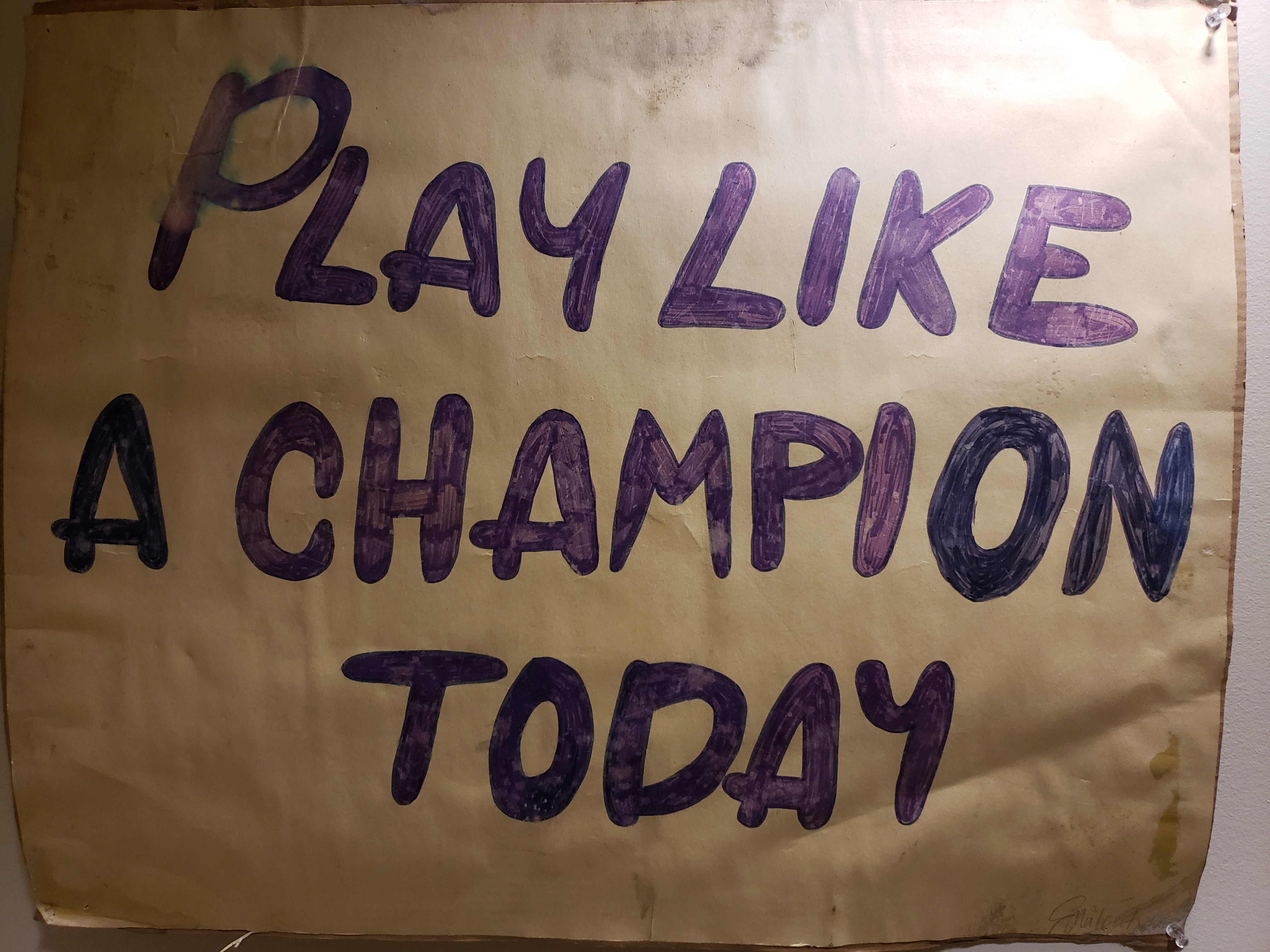
On our other team I asked my daughter to create the sign “Play Like a Champion Today” (which is now at the top of the stairs in my office) that I would bring to every game and before the game in lieu of talking about systems, tactics we would talk about core values like sportsmanship, communication, selflessness and many other life lessons that I wanted to instill in the players as my coaches had done for me.

He made it to literally every practice, game and tournaments we entered that season and at the end he walked up to me and extended his small 10 year old hand and said “Thanks Coach”

There are some memories that you have as a coach, and that was one of them, to be able to help a kid who lost his father much like I had reminded me that everything happens for a reason, and it also reminded me of the biggest life lesson I could have learned, the importance of commitment.

Although my son and my paths went in the AAA path, 80CC continued to play every year at the recreational level and was one of the top players and could have played competitively but opted not so he could snowboard, bike, water ski and various other activities.

His mother would share with me over the years had it not been for my commitment to him to ensure he stayed on track, she really was not sure where he would have ended up.

The same held true for me, had it not been for the great coaches and teachers I had growing up, who knows where I would have ended up.

Fortunately for me, the importance of commitment and numerous other life lessons I learned helped steer me down the right path which is all I have aspired for all the players I coached and now remind coaches to do the same.

Remember, your calling as a coach is not to make a living, it is to make a difference developing youth into adults.

Please ensure that your legacy is a positive one and you are not a kids last coach

The Costs of Going ALL IN

Posted Posted in Athlete, Coach, Early Sport Specialization, Organization Executive, Parents

The Costs of Going ALL IN


This week we came across an article and W5 Episode that aired last spring highlighting two families where they have gone all in to support their kids in chasing their dreams of playing NCAA on full-ride scholarships, national teams or professionally.

In the first of three-part series, they focused mainly on young hockey players and ended with an interview with the chief executive officer of a marketing research company based in the US that focused on the costs of youth sport participation not only in the US but internationally.

Their findings had my head spinning and although I have always encouraged players to chase their dream whatever they aspire to (regardless if it is sport, music, drama, academics) but what this 3 part series showed is a reflection how so many families are chasing the dream it has lead to youth sports exploding into multi-billion dollar industries primarily in Canada and the USA with no signs that it will slow down anytime soon.

A couple of years back Time Magazine’s front page highlighted that the US Youth Sports industry had then exceeded $15 Billion USD (approx. $20B CDN based on current foreign exchange).  The highlight of the article was a young baseball phenom appropriate nicknamed Joey Baseball

The article and spin-off videos highlighted how Joey Erace, then 10 years old, and his family were chasing the dream for him to play MLB.  He was playing on multiple travel teams, getting private one on one instruction for pitching ($100/hr), one on one fielding sessions ($100.00/Hr), had his own home batting cage, was getting sponsorship offers, over 24K followers on Instagram and even being asked for autographs from fellow aspiring young kids who were following him.

His life had evolved to baseball, baseball, baseball.

All this at 10 Yrs. Old?

Fast forward to 2019 and the US Youth Sports Industry had grown to over $17 Billion as a result of more and more players and their parents continuing to chase the dream to reach those lofty goals of representing their countries on national teams, getting NCAA scholarships, what is now multi-million salaries in various professional sports and possibly the Olympics.

Coming back to the W5 episodes shared last Spring, the marketing research firm WinterGreen whose chief executive Susan Eustis was interviewed at the tail end of episode one shared that the Canadian Youth Sports Industry in 2010 was $1.2 Billion, had grown to 5.2 Billion mid-way point of the 2000’s but in 2017 had climbed to $7.6B and last reported number for 2018 was a staggering ….


$8.7 BILLION DOLLARS!!! 

THAT’S OVER A 400% INCREASE SINCE 2010


Based on the current exchange this is approx. $6.5 B USD.

Compare that to the USA with 9X the population of Canada (327 M vs. 37M) whose last reported number is $17 Billion USD

As a result, Canada’s youth sport participation costs are the HIGHEST cost per capita than any other country in the world.

Highlighted in the episodes were two youth sports players and their families who were all in as either a hockey or soccer family;

Ethan Mcfarland – 14 years old at the time the episodes aired who aspires to get a full-ride Michigan State Scholarship to play NCAA Div 1 hockey and be drafted and play in the NHL.

No different than many kids have growing up in prior generations, playing shinny with their buds on frozen lakes, outdoor ice rinks, stick and puck for hours on end BUT the sad reality is 0.3% of those will reach that level as I have shared out in talks across Canada.


The cost for him to reach that goal is he has abandoned what all the powers that be and sports medicine research has shown is multi-sport participation so he becomes the best athlete he can be.

He also has a modified school course load geared specifically for “elite” athletes as a hybrid to homeschooling so he can make it to all of his shooting, skating, puck control sessions both on and off-ice in addition to sessions with Psychologists, nutritionists, custom skate, stick equipment manufacturers

All the while his parents seem to be nonchalant about the fact to support doing all of this is costing them tens of thousands of dollars a year much like thousands of other kids across Canada that are doing the same to chase the dream.

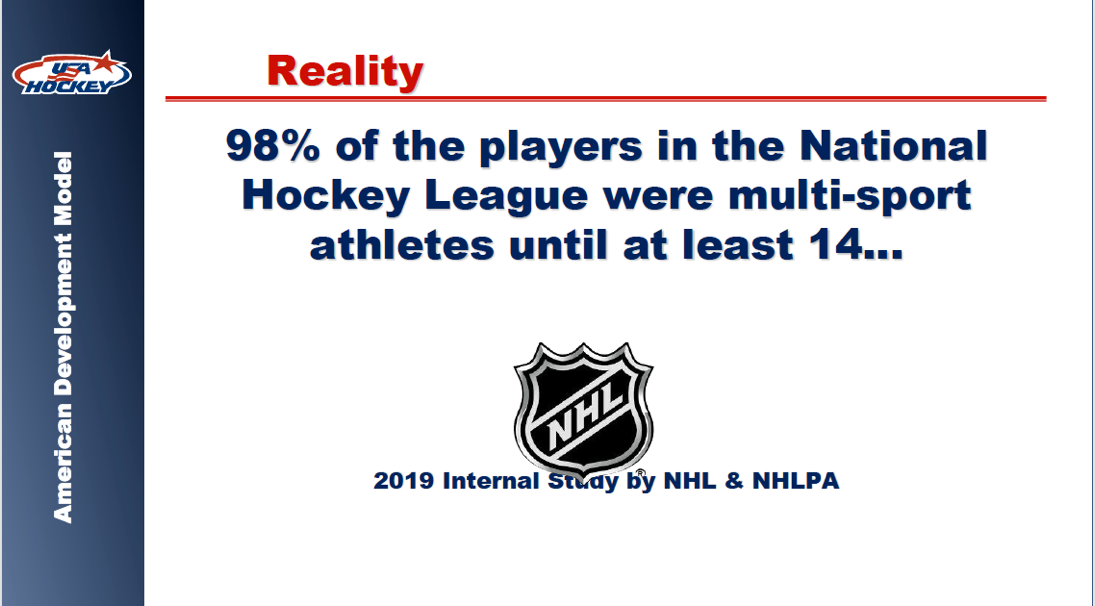
Probably one of the best data sets that I can provide to hockey parents to reinforce the importance for their kids to avoid this excessive time and financial commitment to focus on hockey, hockey, hockey is the NHL players association was surveyed last year and as Ken Martel (technical director for USA Hockey) shared with me and has now shared with other sports orgs, below is a slide from presentation he did for New Zealand Hockey (yes they play hockey in New Zealand)


Another statistic – Since 2010, there has been a 63% decrease in full-ride scholarships offered to Canadian born players to play in the NCAA which is a direct correlation with the ADM model in the USA, more and more US-born players are being recruited for those scholarships vs. past years seeking Canadian born players.

The other family highlighted was the Nicolazzo family whose three children, Xavier (7 at the time), sister Kiarra (10), and older brother Romero (13).  Their Dad Frank coaches both boys teams.

Year-Round Soccer, Soccer, Soccer, every day all year long including indoor session when Canada’s winter kicks in including playing on numerous travel teams costing tens of thousands of dollars every year.

REALITY CHECK – a colleague of mine shared me the soccer statistics which I reciprocated with hockey a few years back regarding NCAA/Professional path of US Soccer Players


As admirable as it is for all three of their children to chase the dream, like Hockey, the reality that they will reach that level is a longshot at best and depends on so many factors for all the stars to align.

The sad reality for both families and their kids who are rolling the dice and going all-in with one sport year-round as early as 7 years old is there is a very strong possibility that one or all of the issues below may happen;

  1. Kids are suffering pressure as early as 9-10 years old W5 highlighted in their episode.

Shouldn’t 9 -10-year-olds be playing a game for the sake of it, not feeling the pressure to reach a lofty goal 10 years or more down the road?


  1. All the research and data shows that these young players may quit (62% in the US are quitting by age 11, 70% by age 13 with similar trends in Canada and many other nations) due to pressure, burnout, not having fun as a result of focusing on winning at all costs chasing the dream because they are not having fun


  1. They may suffer a season-ending, worse yet a potentially career-ending injury like multiple concussions, tears of ulnar, medial, anterior cruciate ligaments


  1. May suffer depression, anxiety IF they make it to the NCAA, pro-level as they were deprived of a normal childhood which has been identified by many NCAA athletic directors is a major issue of new players coming into their programs now vs. a decade ago


  1. Worse case –  may consider, or actually do commit suicide as there has been a 56% increase in the suicide rate the last 10 years from 10-24 years of age. If you don’t think this is a reality, I personally know of 3 kids who committed suicide, the third happened to be the brother of one and cousin of two other players I coached so really hit me hard.  This stat was shared by Corey Hirsch, advocate for mental health and the Hockey Talks program the day that Tyler Motte shared he is dealing with depression and anxiety issues with amazing support by the Vancouver Canucks.  Why?  Because 7 years ago Rick Rypien committed suicide as a result of similar mental health issues stemming from the pressure to perform.

All of the above aside, many of the single-sport players I have interacted with as they got to older levels (15+) stopped smiling, stopped laughing, appeared methodical, robotic when they came to training sessions, games, other activities.

Why?

Because they lost that original love for the game they had which many parents argue with me is the reason when they support their kids to play year long, pay for all kinds of development the grind of playing one sport all year long starting as early as many kids do today became a job.

When they originally started down the path did they ask if they could WORK hockey, soccer etc?

No – they asked if they could PLAY hockey, soccer etc.

Last but not least, in the event that you have not been following business news of late, many countries are looming towards another recessionary period so the tens of thousands of dollars that parents are spending each year, much of which via credit facilities including second mortgages, credit cards, lines of credit will put the entire family in harm’s way if one of the dual incomes is lost to downsizing.

Is it really worth taking that risk going all in with one sport?

In lieu of looking at youth sports as a return on investment, we should be looking at all the other benefits it provides, developing character, valuable life lessons, healthy (both physical and mental) lifestyles, friendships, social skills being part of teams, being well rounded and becoming the best ATHLETE they can be.

If at the end of the day they are one of the select few to reach the level of NCAA, National or professional level then that is just icing on the cake.

Let’s all work together to bring the game back to the kids ….. where it belongs.


What do parents expect for their kids in youth sports?

Posted Posted in Athlete, Coach, Organization Executive, Parents

As we head into another fall season of a myriad of youth sports, thought this would be a good time to share with coaches the importance of having answers to the top 3 questions that parents will be asking in their upcoming parent meetings.

#1 – What is your background as a coach?

This is particularly top of mind for parents in the competitive streams, many of which will make decisions whether they will support their son or daughter trying out for competitive teams based on the coaches that have been selected by organizations.

When it comes to the recreational stream, particularly the earlier age groups, parents more often than not are happy that someone put their hand up to coach the 5-8 year old age groups and are more concerned when/where they should drop their kids off for various team events than whether their kids are in qualified hands.

Whether it be recreational grassroots level or higher level older age group teams, however, this is an answer that all coaches should have the answer to before they meet the parets for the first time.

Things like;

  1. Playing experience in the respective sport they are coaching
  2. Certification they have completed
  3. If they have children themselves (more often than not parents are those that start coaching the youngest age groups)
  4. How many years they have coached
  5. How committed they will be (dedication is key, coaches should be there for the kids)

#2 – Why do you Coach?

It amazes me when I speak and ask coaches the questions to provide answers to that very question how few hands go up to begin with but am thankful for those that to stand up and share all kinds of reasons why they coach like;

  1. They love the game and want to give back
  2. They want to help kids learn the skills of the game, but also skills of life
  3. They Love Kids and watching them grow
  4. They want to help kids have a positive experience
  5. They don’t want kids to have a bad coach like they did

It is at this point where I also hear coaches shared their core values like respect, sportsmanship, winning with humility, losing with dignity, developing leaders and teaching various other life skills that the kids will need beyond the sport.

Then the one that gets me the most, when they share how passionate they are about the game and kids to love it as much as they do.

One of the things I share all the time is kids should love the game more at the end of the season than they did at the beginning of the season.

Ironically, as we shared in last weeks post, the #1 thing that parents are looking for in terms of their kid’s sports experience is that they develop character, which is followed by them having fun and making friends.

Great Coaches, as we have shared in past, are ones that truly care about the kids the coach, and those that are passionate about the game, as a parent, they had me at HI.

#3 – What is your coaching philosophy?

This again is one that I find we really need to work on with grassroots coaches, when I prompt coaches to share their philosophies either en masse or in small groups, only a small % are able to do so.  In part because they are still developing their philosophies of coaching, in part because they have never put it in writing.

Once they do so, it makes them accountable so if they talk the talk, they must walk the walk not just for the players but also for the parents, board members, officials etc.

I remember last year when I put forth the query in a clinic I was running, one of the coaches stood up and shared a very detailed coaching philosophy, so much to the point, that I then worked with him after the fact to tweak it so it was not more than a couple of sentences.

Think about it being your mission statement for WHY you coach, what your raison d’ê·tre (reason for being) which goes hand in hand with your core values that you have learned from parents, family, education, work etc.

Like that coach, I had a very lengthy coaching philosophy that was several paragraphs long until I reviewed it with one of my mentors and he told me that it had to be no more than two sentences … there was no way I would be able to share my philosophy with board members when I was interviewing for coaching positions or parents after the fact when met them for the first of several meetings over the season.

My philosophy evolved over the next couple of years to one statement:

FUNdamentals, not winning, at all Costs.

Why is Fun in Caps?


I believe strongly in developing kids skills of the game in part, but more so the skills of life to make a difference by developing youth into adults.

AND

I Have learned there is a fine line between winning and winning at all costs.

Without going into a deep dive on the article itself, just wanted to touch on a recent article co-authored by two faculty members at the University of Waterloo posted in the conversation which was reshared by the Vancouver Sun under permission.

The Conversation Title:

“Making Youth Soccer less Competitive: Better Skills or sign or coddling kids”

In the paper edition of the Vancouver Sun the article was titled:

Removing Competition: Good or Bad for Kids?


In the Vancouver Sun Digital Edition the article was titled:

Ryan Snelgrove and Daniel Wigfield: Is less-competitive youth soccer a sign of coddled kids?

My comments to the digital edition version:


Below is a image we shared out in the fall where the GTHL had a novice hockey game (8 yr olds) still playing full ice hockey where the final score was 41-0 although they only showed 6-0 on the scoreboard so as to “not hurt the kids feelings” that was referenced in the article why Ontario Soccer has shifted to the model of not keeping track of scores U12.


Like the Ontario Soccer article, there were two sides that came forward, those supporting the move to push competitive play to later age groups, and those arguing that competition introduced at earlier age groups teaches kids life lessons.

Below are just a number of other articles on page one of google pertaining to the pros and cons of competition with several other articles on subsequent pages with those for and those against having scoreboards, scoresheets for the younger age groups


I know that there is always two sides to every story, but if we let the adults who are pushing the pay to play winning at all costs model becomes the norm, not the exception, the kids LOSE regardless of the age group.

What coaches must be cognizant about as they head into the upcoming seasons is what both parents and the kid’s expectations are.

The top three Parents expectations they share with me when doing presentations are for their kids to build character, have fun and make friends.

The top three kids share why sports are fun (the reason they play) per Amanda Viseks research and my surveys of kids in numerous sports is when they get to try their best (work on their skills), when coaches treat them with respect (by treating them with fairness, teaching them the skills of the game and of life) AND when they get playing time (kids just want to PLAY).

And if you are the naysayer or sarcastic adult think that removing the scoreboard is for the kid’s sake, not hurt their feelings, coddle them no, it could not be farther from the truth.  Kids keep track of all the goals, assists, who the top players are, who the players are that need to develop and so on.  Before youth sports became adultified as it is now, kids formed their own teams, made and enforced their own rules, rebalanced as needed so games were competitive NOT blowouts or having coaches run short benches to win games to pad their resumes, not to develop all kids on their teams.

The reason why there is no scoreboard in the earlier age groups already in Soccer, Hockey, Baseball and many other sports to follow is so that the parents and coaches don’t take the game too seriously which has led to bench-clearing brawls involving the most infamous one to date of parents fighting at 7-year-old baseball game because a 13-year-old official made a call the spectators did not agree with.


Really?  Is winning or losing at that age group really matter? Should it not be about developing the kid’s love for the game, working on the core skills, and all the other benefits kids can reap from playing sports?

Having worked with many parents I can tell you first hand none went to this game expecting to get into a brawl, they had hoped to just go watch their kids play but as winning has become the epicenter of youth sports, anything impacting a win or loss (in this case the call by a KID) set fuel to a fire.

We (as in all the adults) must remember that youth sports are games played by KIDS, with many of the official’s kids themselves, and too many are quitting before they should and once they do, many don’t return to the game they once loved.

Let’s all work together to bring the game back to the kids … where it belongs.

Don`t be a kids last coach


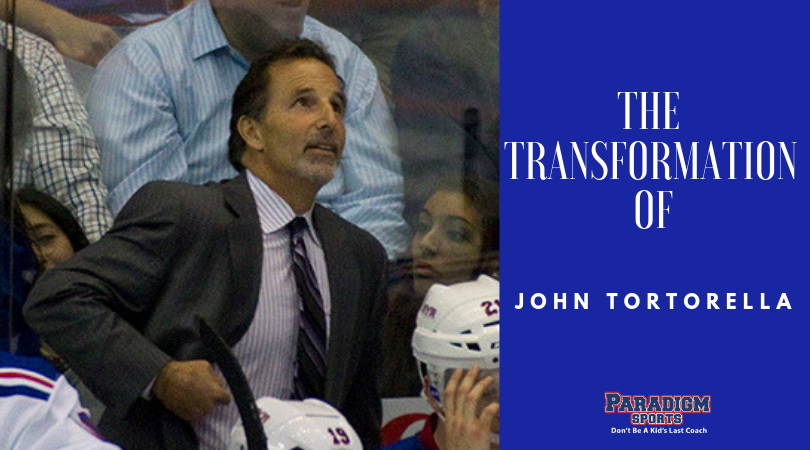
The Transformation of John Tortorella

Posted Posted in Athlete, Coach, Organization Executive, Parents

I am writing this as the Columbus Blue Jackets are going to start the second round of the NHL playoffs against the Boston Bruins but won’t be posting for another week so won’t reflect the first 4+ games played in the second round.

I would be remiss not doing a post during the Stanley Cup Playoffs not referencing the amazing accomplishment of the Columbus Blue Jackets led by the “new” John Tortorella.

Everyone knows John for his antics in past exploding towards players, coaches, and officials when he lost his temper.

But what people don’t know is he is no longer the John Tortorella of old, people say you can’t teach an old dog new tricks but John is the epitome of how this is not this case.

In 2004 John led the Tampa Bay Lighting to their first (and only to date) Stanley Cup captained by Dave Andreychuk with fellow Canadian counterparts Vinny Lecavalier, Martin St. Louis, Brad Richards and 13 others who won against the Calgary Flames in 7 games. The following season the Carolina Hurricanes won the Stanley Cup against the last Canadian Team to reach the finals, the Edmonton Oilers and another Stanley Cup Final will be US teams as all three Canadian teams that made the playoffs this season were knocked out in the first round.

Fast Forward to this season, Columbus Manager rolled the dice before the trade deadline to acquire several rental players to reach their goal to win their first playoff round EVER acquiring Adam McQuaid, Keith Kinkaid, Ryan Dzingel, Matt Duchene and Julius Bergmen.

Although it took several weeks for the new players to buy-in to John’s systems the results paid off, and John led the Blue Jackets to their first ever playoff win against his former Tampa Bay Lighting team he led to the Stanley Cup 15 years prior.

I remember watching game 4 and was blown away how Columbus outplayed this season’s President Cup Winners as the top team, tying the NHL record for points and wins (62) in one season only to be swept by Columbus in the first round. Others followed Calgary (top team in the west) and recently the Washington Capitals who were defeated by Carolina who advanced to the second round for the first time since 2010.

The buzz amongst all those in the Hockey world is WOW, Tampa, Washington, Pittsburgh, Leafs, Jets, and Calgary who were all picked as favorites at the beginning of the season to potentially go deep in the playoffs have been eliminated in the first round.

This has Boston licking their chops now as the top seed remaining of the 8 teams

GO BLUE JACKETS!!! (never been a fan of Boston as long-time Habs fan)

Often when teams load up on rental players with the aspirations of going deep into the playoffs don’t make the playoffs or sputter out early so how did John Tortorella lead the Columbus Blue Jackets to take out the best team in the league in the first round?

Because he transformed.

John Tortorella is no longer the John of old that was infamous for his rants, systems, and strategies that many know him for.

Think back when he was hired by the Vancouver Canucks, in the only season he coached the team as they did not make the playoffs for the first time in 7 years, which included multiple 100+ point seasons and advancing to the Stanley Cup Final in 2010-11.

I will never forget when John lost it when Calgary started their 4th line in January game in 2014 where he did the same and ensuing line brawl that occurred and then Torts chased down Calgary Coach at the time Bob Hartley in the dressing room hallway.

Suspect not his proudest moment, nor was it a great moment for the NHL with a full 5 on 5 brawl to start a game reminiscent of what the Hansens in Slapshot.

That season he coached the Canucks he overplayed many of his top players, opted to play his top two lines for the majority of the ice time where the third and 4th lines saw limited ice time.

The Sedins had their WORST seasons ever in terms of points, suffered injuries, as did Edler who was -37 that season and many of the other players also had poor seasons.

At the end of the season, John was fired by Mike Gillis and in his end of the season media conference, John shared that the Canucks needed to get younger to return back to the playoffs.

Ironically the Canucks hired Willie Desjardins the following season and he opted to roll 4 lines, connected with all of his players and lead them to the playoffs although they lost in the first round. As the Canucks were getting older and needed to go thru a “rebuild” Willy only lasted 2 seasons behind the bench and was let go but has returned to coach Team Canada in 2018 Olympics and interim head coach for the LA Kings this season.

John was the head coach of the USA World Championship Team in 2016 that received a lot of criticism as they did not medal and finished 7th overall and many in the hockey space felt that John would not behind the bench again as a result.

This after Columbus had hired John to be their head coach in 2015 and one of the conditions that they made when they did so is that he would have to change his coaching style to be less confrontational (Old School) and more transformational (New School)

The season that was prefaced by the World Cup of Hockey in 2016, John continued to change his coaching style so that he could be more of a player’s coach and less abrasive when dealing with media, he committed to developing all of his players in lieu of “playing his favorites” and rolled 4 lines and VOILA at the end of the 2016-17 season he was voted Coach of the Year.

In that season he led Columbus to a 16 game winning streak, one game short of NHL record held by the 1992-93 Pittsburgh Penguins (Mario Lemieux and Jaromir Jagr were “pretty good” that year)

Columbus finished 3rd overall that season with 50 wins, 108 points, with the Capitals and Penguins (who won the cup that year) finishing 1st and second in the East.

Unlike this season, however, when they knocked Tampa out in the first round, they faced the Pittsburgh Penguins who knocked Columbus out in the first round and went on to win the Stanley Cup in back to back seasons.

A few other things that commentators shared during one of the Columbus playoff games;

John and his wife founded the John and Christine Tortorella Family Foundations for Giving Back.

The foundation focusing on providing funding to those that protect children, animals, and environment from harm. Prior he provided funding to charities in Tampa and New York where he previously coached.

When John moved to Columbus he opted to buy a horse farm as he LOVES animals, particularly dogs.

“If it isn’t Hockey, its Dogs”

People want to keep their dogs but can’t afford to do it, have a program in the foundation, try to facilitate helping people keep their dogs that require expensive vet care.

Although John and Christine have never had experience raising horses, they recently adopted two Bella Run Fosters who were going to be slaughtered.

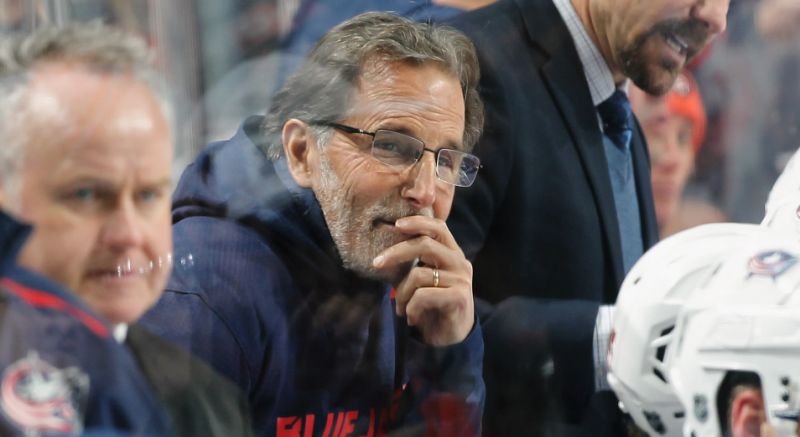
John has always been one of the most knowledgeable coaches in the NHL, but now that he has modified his coaching style to focus on the players, has a softer demeanor where he even wears hoodies on the bench, it is another example of how winning just becomes a byproduct if you are transformational coach focusing more on the person than the outcomes of games.

If John can transform his leadership style if you are not drinking the kool-aid yet in terms of transformational leadership, shouldn’t you?

The Greatest Coaches EVER were/are transformational leaders including John Wooden, Clare Drake, Phil Jackson, Pete Carroll, Sean McVay amongst others.

Will you be next?

Let’s all work together to bring the game back to the kids …. Where it belongs.

Don`t be a kids last coach