Why Kids (May) Quit Soccer

Posted Leave a commentPosted in Athlete, Coach, Early Sport Specialization, Organization Executive, Parents

Why Kids (May) Quit Soccer

Last post we shared the reasons why Kids play Soccer based on responses from the BC Soccer 2018 Retention Survey, in this post will highlight the responses to the two other areas BC Soccer was looking for insight from their players;

#1 – The Likelihood of playing Next Year (Why Kids (May) Quit Soccer)

And

# 2 – What was not so good about their program this year (what areas received fair or poor rankings but the players)


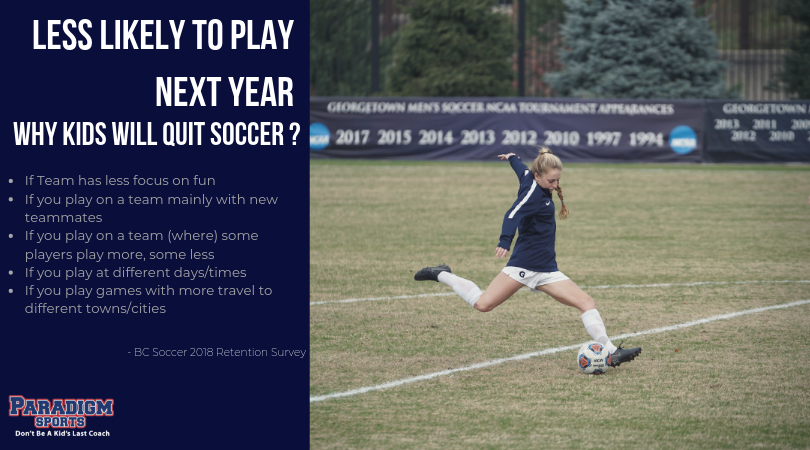
LESS LIKELY TO PLAY NEXT YEAR

When asked “Will you come back next season”.. the top 5 reasons kids would be less likely to do so (high probability they will NOT come back to play soccer) 
 

SURVEY SAYS…

#1 – If your team has less focus on fun

#2 reason they would return back if their team focused on fun, second only to focusing on skills.

HMMMM … Similar to Amanda Viseks top reasons why sports were fun, #1 reason is when kids had the opportunity to try their best (focus on skills)

#2 – If you play on a team mostly with new teammates (not with their friends)

Two things that kids ask after games (sometimes during the games)

What is the snack? As Steve Simmons shared in an article he wrote many years back he continues to share every year Attention Coaches, parents: Minor Hockey is for the Children where he shares the anecdote of a novice player who stated:

“I Hope they don’t bring apple juice, I don’t like Apple Juice”

And the last question as they leave the field/rink/court…

When do we play again? (emphasis on PLAY not work as is now the case with early sport specialization)

If you loved sports as a kid and continue to play adult rec team sports ….

First question you ask after a game – Who has/how much is the beer? 

AKA – THE SNACK

Last question you ask after a game – When do we play again?

Hmmm … if we love sports in our youth, we love them as adults because they are fun, we get to play with our buddies and we play for the love of the game.

#3 – If you play on a team (where) some players play more, some (play) less.

Translation: Coaches running short benches where their weaker players sit on the bench so they can win at all costs.

90% of kids would rather play on a losing team, in ALL situations, than sit on a bench for a winning team.

As my son shared after he had the misfortune sitting on the bench with some of his teammates for the better part of a game as coach was infamous for playing his favorites and shared how he felt after the game,

“I am pissed because I was deprived of the opportunity to contribute to the outcome”.

He was only 14 at the time, and I will never forget it because it was a month after he lost his Nanny (my mother) to a 2 year battle with cancer prior to that tournament game that the coach shared with me prior to the game he dedicated the game to her in her memory.  Had she still be alive and attended that game, I can tell you she would have had some not so nice words to share with that same coach as she, like I, just loved watching my son and all of his teammate’s PLAY.

As far as I am concerned, the only reason why kids should be sitting on a bench is discipline (they took a bad penalty, acted inappropriately, hit an opposing player that could lead to injury etc.), other than that kids should PLAY.  Coaches that rely on short bench tactics to win games is a short-sighted tactic/strategy that more often than not will backfire. If you focus on the process of developing all players on your teams, care about them, believe in them, connect with them,  and develop their competence and character over time collectively as a team will improve and winning will be a byproduct NOT the focus.

There is a real simple fix to address this, incorporate fair play policies so coaches are only given a get out of jail free card for the last few minutes of a game only IF it is close and it should be the players that have BROUGHT IT that game (even if they are not the coaches “favorites” that get rewarded to be out there in latter part of the game.

This also will address the parental issues we see on social media every day, parents just want their kids to PLAY, coaches that run short benches as a far as I am concerned are a victim of their own demise.

#4 – If you play at different days/times

With every family in the lower mainland of Vancouver and many cities across Canada forced to have dual incomes now to pay mortgages and all other household expense PLUS rising costs for kids to play youth sports, scheduling consistency is critical for sports organizations so families know when/where they have to be over the course of the season, not just 4 weeks at a time.

#5 – If you play games with more travel to different towns/cities.

As soccer is now the #1 team sport in Canada, where provinces have organizations with thousands of players, why would kids even have to travel to begin with?  Community sport should be just that, community sport (the exception being smaller rural communities that do require travel to play)

The evolution of the travel teams and prospect tournaments that are driving the $17 Billion industry in the USA is based on the premise that scouts, coaches will be at these events to see “prospects” for NCAA scholarships or be drafted to Professional sports.

News flash – with the evolution of the digital era, almost any of these prospect tournaments have all of their games streamed, scouts don’t even have to leave their houses to see kids play against others on “elite” teams.  As every scout or high-level/collegiate/professional coach has shared with me, if they are good, they will be found regardless if they attend these prospect tournaments.

Note also in Amanda’s study, of 81 characteristics what is fun about youth sports, traveling to new places to play ranked right near the bottom of least fun reasons, 73rd out of 81.

It is not the kids that want to travel, it is the adultification of youth sports that has forced many families to spend their holiday time at ball fields, ice rinks, soccer pitches when they should be lying on a beach, taking a hike, swimming in a lake, going to amusement park of other TRUE forms of holidays.

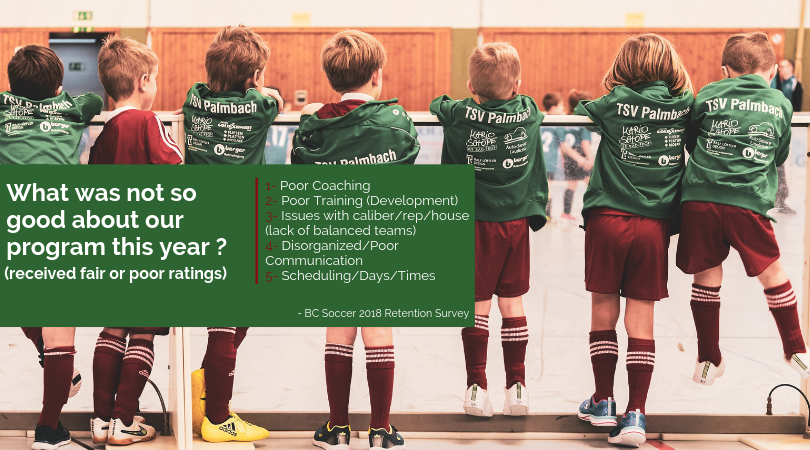
What was not so good about our program this year? (received fair or poor rankings)
SURVEY SAYS….

#1 – Poor Coaching

With the roll-out of NCCP program for all levels of coaching in soccer this will help address the what of coaching relative to the age groups to adhere to LTAD, small area games, age-appropriate drills, focusing on skill development vs. tactics and strategy and so forth.

It also will take several years to see the cause and effect as many other nations have experienced like Iceland who made the same commitment to coaching in 2000 and started to see the results once they qualified for the 2016 Euro Cup and 2018 World Cups of Soccer.

It also won’t address HOW to coach, How not be a kid’s last coach, coach beyond the game, how to connect with your players, how to engage parents, how to coach generation Z, LTAD vs. Early Sport Specialization, How to coach girls vs. boys, Grow your Mindset, Make it Safe to fail and from all levels of harassment, How to develop your philosophy and culture of excellent on teams etc.

Hmmm … this is why we have coaching modules to address all of the above, not WHAT to coach, but HOW to coach.

#2 – Poor Training

Goes hand in hand with #1, poor coaches are poor teachers and vice versa

This is not the fault of coaches that have the best of intentions to coach, is due to lack of experience and training at the grassroots level and like players, it takes YEARS to develop all the skills to become a great coach to teach the skills of the game, but also the skills of life.

#3 – Issues with caliber/rep/house/unequal skill on the teams

This comes down to player evaluations to form balanced teams, in lieu of subject measurement (which has led to a lot of politics associated with team selections), organizations should be using quantitative means to evaluate players and have baselines beginning of the season, mid and end of season skill evaluations to track development.

The only one that we recommend to all organizations is the personal sport record  as many sports orgs across the globe are looking at or have already adapted for quantitative measurement including Norway Sport Federation who know “just a tad about being successful at the international level being the all-time winningest country in the winter Olympics in terms of medals”, Sport New Zealand,  US Olympic Committee, BC Rugby, GTHL and many others.

Click on the logo to go the website for more information:

 

In lieu, the current model used by orgs is how many wins did the teams have?

How many banners did we win?  Who scored all the goals and assists?

Focusing on outcomes, not the process.

For more insight the impact of the shift to winning at all costs has had on youth sports, reach out to us to schedule a FREE screening of The Cost of Winning followed by a Q&A session where sports leaders from across the globe provide their insights on the state of play in youth sports and the importance of bringing the game back to the kids.

#4 Disorganized/Poor Communication

From a coaching standpoint, one of the biggest asks I get all the time is how do I “deal with parents” to which I respond you should engage parents, not deal with them.

Engagement includes ongoing communication starting with a culture of excellence, a well-run parent meeting, team meetings, mid and end of season meetings as well as regular communication to all stakeholders (players, parents, fellow coaches) to ensure the ship (team) moves in the right direction.

#5 – (Poor) Schedule/Days/Times

This should be a focus for all local sports organizations to ensure consistency.

I suspect, like Amanda Visek’s Study, many other sports organizations not only across Canada but globally will be referring to BC Soccer’s Retention Survey for their current and seasons to come IF they truly aspire to buck the trends and attract, retain and grow their membership.

Kudo’s to all the board members at BC Soccer for taking this on, and now that have the answers “out of the mouth of babes” and better understanding of the motivations for their key stakeholders (players and parents) so their regional and local organizations can implement the changes to also buck the trends seen across Canada with declining numbers.

One sports org that did so that has shown it is possible, is USA Hockey who is setting the bar for all other sports organizations globally for all the great work they are doing to grow the game.

Several years back they were losing 60% of their kids by peewee (11-12 yrs. old)

They did three things to reverse the trends
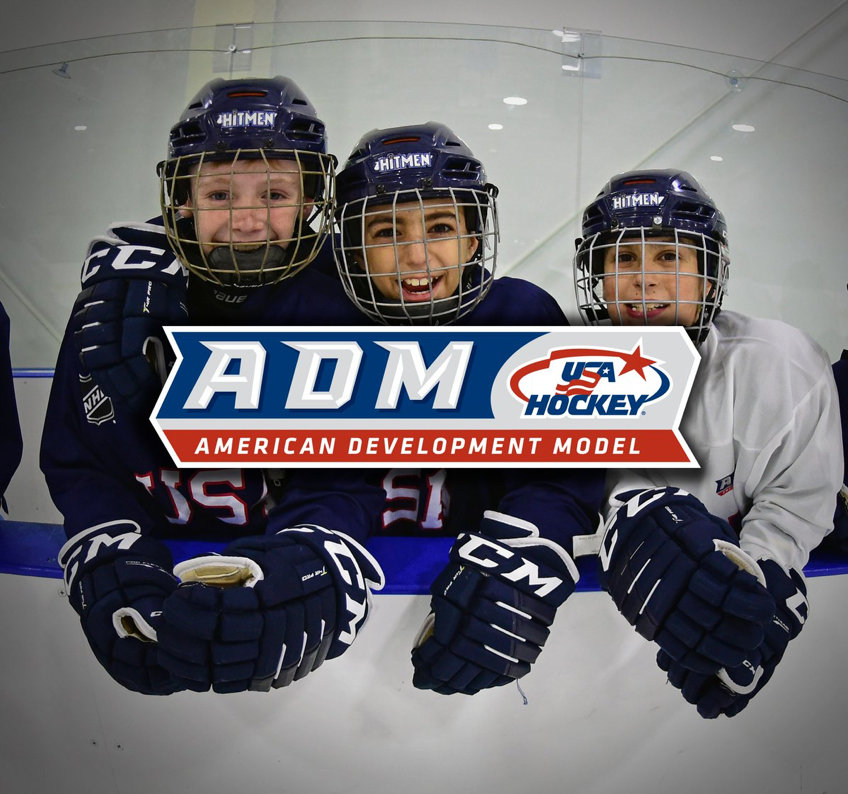
 

  1. Rolled out their version of LTAD, the American Development Model, ADM, that focused on age appropriate training and coaching certification
  2. Emphasized fun for all age groups (regardless if rec or competitive streams)
  3. Cancelled their U12 national Championship that put too much pressure on parents and players who aspired to play in that championship

The result?

In lieu of 60% attrition, they retained 92% of their kids, only a 8% decrease.

For the naysayers that say it can’t be done or those that keep doing the same things over and over again expecting different results (insanity)…..

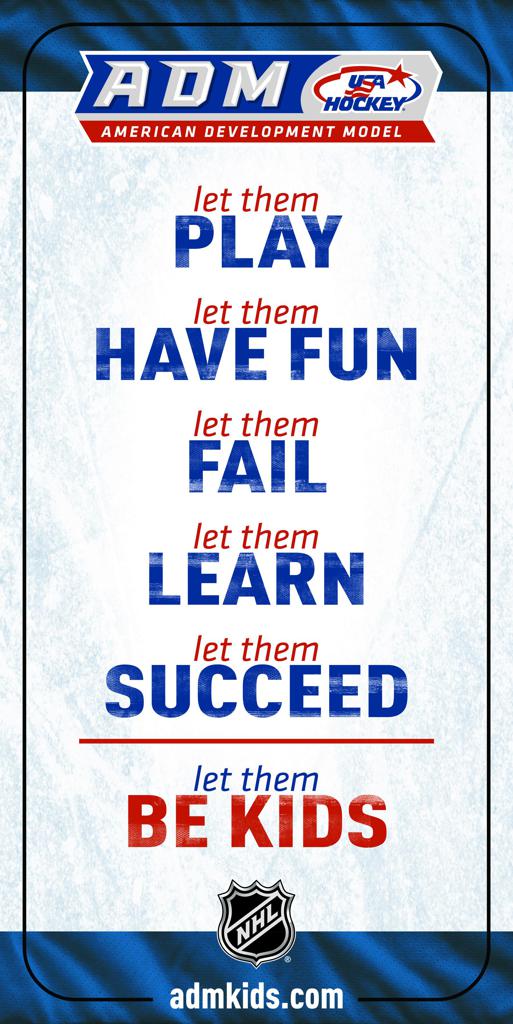
….. It CAN be done, as USA Hockey showed it takes a village to raise a child and requires collaboration by all parties concerned to focus on the things that matter most to the kids, Fun, Friends, Quality Coaching and having the opportunity to PLAY and contribute For the Love of the Game.



Don`t be a kids last coach


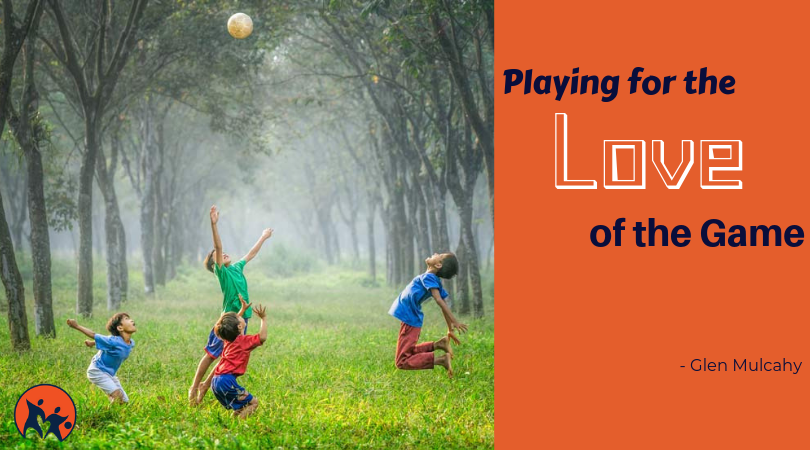
Playing For the Love of the Game

Posted Leave a commentPosted in Athlete, Coach, Organization Executive, Parents


This coming Monday I will be returning back to Nanaimo to speak on behalf of Changing the Game Project hosted by Nanaimo Minor Hockey who is working with various other sports groups to develop an amazing sports experience for the kids in their community.

As I was when I made the ferry trip in October, I am truly honored to be invited to share nuggets but also interact with so many amazing people who are passionate about quality sport.

I came across some great nuggets the last few weeks that I will be sharing in the presentation that thought would be great to share on this week’s newsletter as well.

Why do Kids play Sports?

Simple, they play because they’re fun, they quit when they’re not.  It’s NOT Rocket science.

This is the quote that I have shared for years and it really comes down to just that.   What our role as parents, coaches should be, however, is not just making sure that youth sports are fun, but they should also ensure that kids love the sports they are playing more at the end of a SEASON than they did at the beginning.

Due to the growth of early sports specialization, however, there are no more seasons to youth sports, and in lieu of PLAYING sports, kids WORK sports for over 10 months of the year

As Wade Gilbert, the Coaches Doc, shares in many of his talks … do kids ask you Mom, Dad can I WORK Hockey? WORK Soccer?  No, they ask you if they can PLAY baseball, PLAY football and so on.

The more I thought about the reason why kids played a sport for more than one season is this held true, I Loved the Sport more at the end of a season that I could hardly wait to return to play again.  This was because when the season ended in March, I hung up my skates to play baseball, golf, go to the beach, ride bikes, hike, swim, tennis and so many other activities so when the season started again in Sept I missed the rink, my buddies, coaches and was eager to start another season.

Thank you for being a sport that helps me with other sports.


Why then do Officials (refs, umpires) start or continue to officiate?

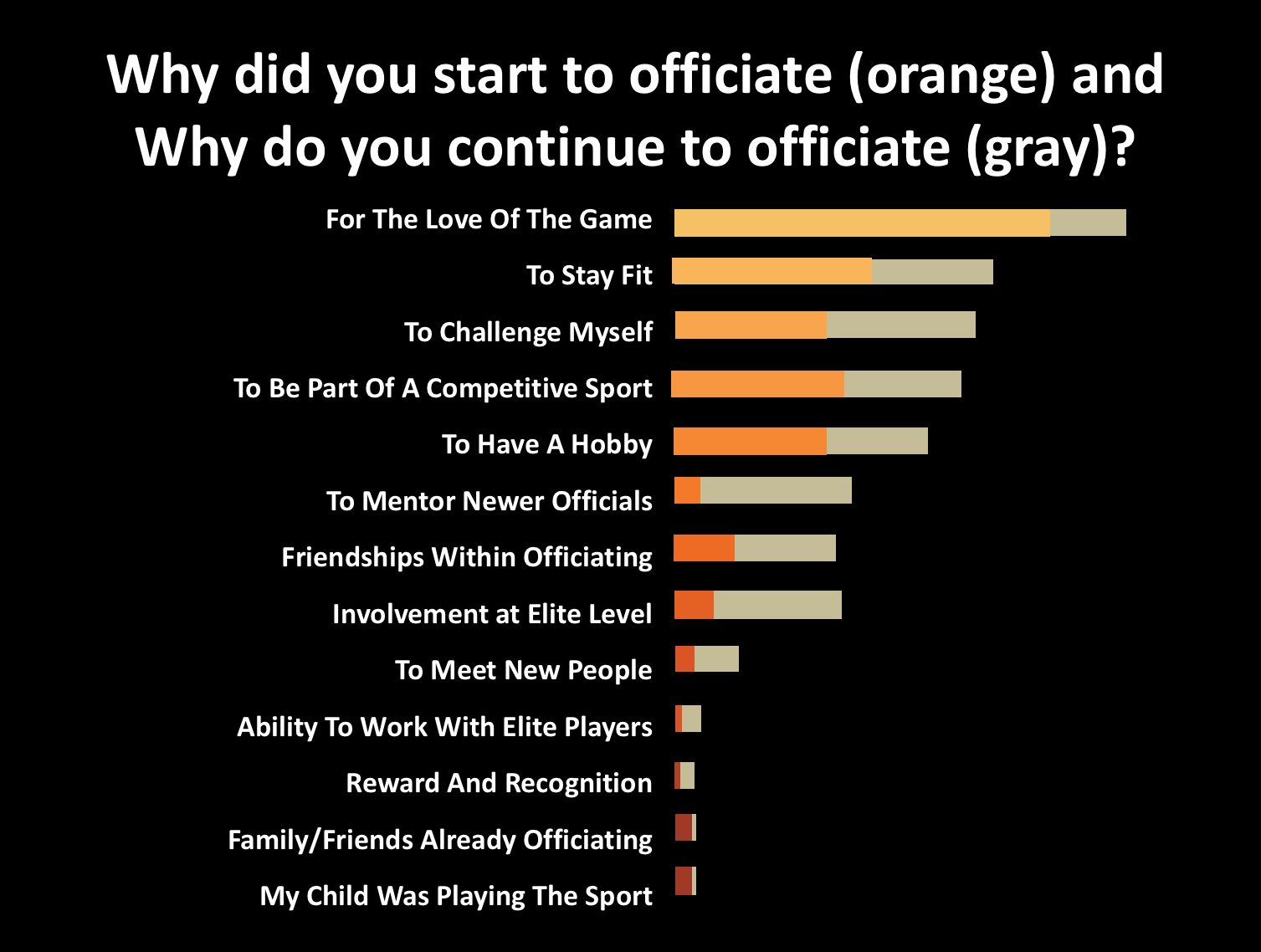
According to the largest survey I have come across today over 17,000 officials were asked why and the #1 Answer was “For the Love of the Game”.

See below for the other top 10 reasons why they started and continue to be officials.


Other reasons included staying fit, challenge self, be part of the competitive sport, have a hobby and near the bottom was reward/recognition and lowest motivator was the fact that they had a child playing the sport.  This is probably due to the fact that a lot of officials start before they are parents, and ironically one of the motivators that organizations do is provide stipends for refs to do so so if get enough games, they can have a decent part-time income of the course of those seasons.

Why do Coaches Coach?

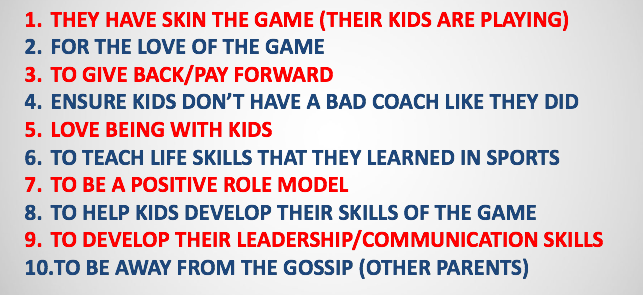
Ironically, when I have surveyed grassroots coaches over the years in clinics or talks and asked them why they coached, the #1 answer is because they had skin in the game, they stepped up to coach because their kids were playing and either asked them to coach OR a board member runs around the field, rinks at the beginning of the season asking for help.

I was one of those “suckers” initially putting my hand up to help on ice when board members came calling when my son was 5 starting hockey or my 7-year-old daughter in softball and 15 years and hundreds of kids later, I still put my hand up, now is to mentor the coaches of kids so they can help them become the best people they can become.

See below for the other reasons why Coaches Coach that I hear over and over again when I prompt coaches why they are coaching;

The second reason, whether they are a parent or not, is coaches step up to coach For the Love of the Game, they love the game and everything that it did for them, that they want to give back/pay it forward to help others reap the same benefits.

Many of which shared they are coaching so kids don’t have a BAD coach like they did when they grew up (which sadly there are still coaches even with all the certification coaches have today that coach the way they had been coached)

One reason that parents may not be aware of, coaches have also shared with me and I can relate, they are at the games anyway, drive to the practices and no point going home, so they put their hand up to help coach.  They also do so, as I did, to be away from the gossip that parents at times will share amongst themselves or worse yet those would be too vocal and scream coaching instructions at their kids or critique them/coaches or officials.

Another interesting stat came out of official vs. coach surveys, although officials receive fees and some coaches get honorariums for coaching now, neither officials or coaches stated when surveyed they started or continued to do so for the $$ in their top 10 reasons for doing so.

They do so not only because they love the game, and a few weeks into a season realize they also love being with kids as they have adopted large families when they start coaching.

Now let’s talk about why these three key stakeholders QUIT the Sports they once loved

Why do kids Quit Sports?

They not only quit because they are no longer fun, but they quit because the lost the passion, love for the game they once had and for various reasons lost their way in a sense.

More often than not, they no longer love for the game as they have been deprived of the opportunity to play in all key situations in games, have had adults screaming at them when made mistakes or have been on teams where harassment has taken place to some extent.

They quit because the games are no longer about what snacks they get after the games and being with their buds in the dressing room, hanging out in dugouts or sidelines it is about the results of the game that takes the focus due to winning at all costs.

They also quit because they can’t afford it any longer due to travel, equipment, spiraling fees and all the other costs now associated with youth sports unlike the “good old days” where you community sports were just that, played in the community or at high schools with low, no fees and even could use the same pair of cleats for 3 different sports as I did (baseball, rugby and football)

Why Do Officials Quit?

#1 Reason Poor Sportsmanship

As I shared in a prior post “Why do officials officiate” the #1 reason why officials quit is due to poor sportsmanship.

In the NASO study of over 17,000 officials, almost 40% of the respondents stated that parents caused the most problems with sportsmanship, followed by just shy of 30% of coaches.

When asked who is responsible for improving sportsmanship, over half stated coaches were.

Why?

Because they are the catalysts for change.

They interact with their players, assistant coaches, officials, board members and parents but also coaches and players of other teams, perhaps even their parent groups.

If coaches do not talk the talk but also walk the walk and demonstrate and expect good sportsmanship then whom is going to improve it?

They also quit because they are concerned about their safety, over 40% of male and female officials are due to administrator, parent, coach or player behavior

Even worse, they are intimidated by their fellow officials who will criticize them during games?

I just came across this extreme video where one parent kept telling the refs after a call he did not agree with “would see them after the game” (meaning we will duke it out in the parking lot – really?), but the entire group of parents and fans were ejected from a youth soccer game due to their behavior and threats towards young officials (about the same age of the players they were officiating)

This after each day I came across similar parental behavior, coach abuse towards players or officials, series of articles about sexual abuse, or various issues at minor hockey associations I shared in last week’s post “When will the culture of Youth Sports change for the better?”

Why do Coaches Quit?

Coaches, like players and officials, are either not putting their hand up, to begin with due to lack of willingness to “deal with” parents OR are quitting due to frustrations of the problems they had “dealt” with over their coaching careers.  This is why the most common ask I receive is “who do I deal with parents” to which I counter, it is not about dealing with parents, it is all about how you engage them as allies.

Over 80% of coaches surveyed by Syracuse.com stated that parent issues had gotten worse over their careers, the #1 problem they dealt with by over 80% of the respondents was parents complaining about their kids playing time.

IF a coach is playing everyone equally so they all have an opportunity to contribute to the outcome of the game in ALL situations this would be a non-issue (the exception being when kids need to be disciplined for behavioral issues).

I argue that coaches in a sense are a victim of their own demise, due to our winning at all costs culture, many coaches who may have had the best of intentions when they started coaching fall into the trap of running short benches starting from the beginning of the game and parents are merely venting their frustration as they ALL PAY THE SAME $ so expect all kids to PLAY THE SAME amount of time.

Again it comes down to pointing fingers at one of the key stakeholders that impacts what should be a quality and positive sports experience and the majority of the issues could be avoided from the GET GO.

In lieu, the officials blame the parents, the coaches blame the officials, players or parents, the parents blame the coaches, officials or board members blame the parents and goes round and round in circles like the merry go round at schools I loved when I was a kid (which kids can’t ride anymore as they may get hurt?)

When then are we going to stop pointing fingers at each other and understand the motivation for the players, officials, coaches to begin with?

They started because wanted to try a sport For the Love of the Game, they continue to do so for the same reason, and they quit because they lost that Love and passion they had to start with due the various issues that have taken the Play out of Play Ball.

In lieu of pointing fingers, what I suggest to all parties concerned is bury the axe, work on collaborating so it is a quality sports experience for ALL stakeholders so they all can do so For the Love of the Game.
Let’s all work together to bring the game back to the kids ….. where it belongs.


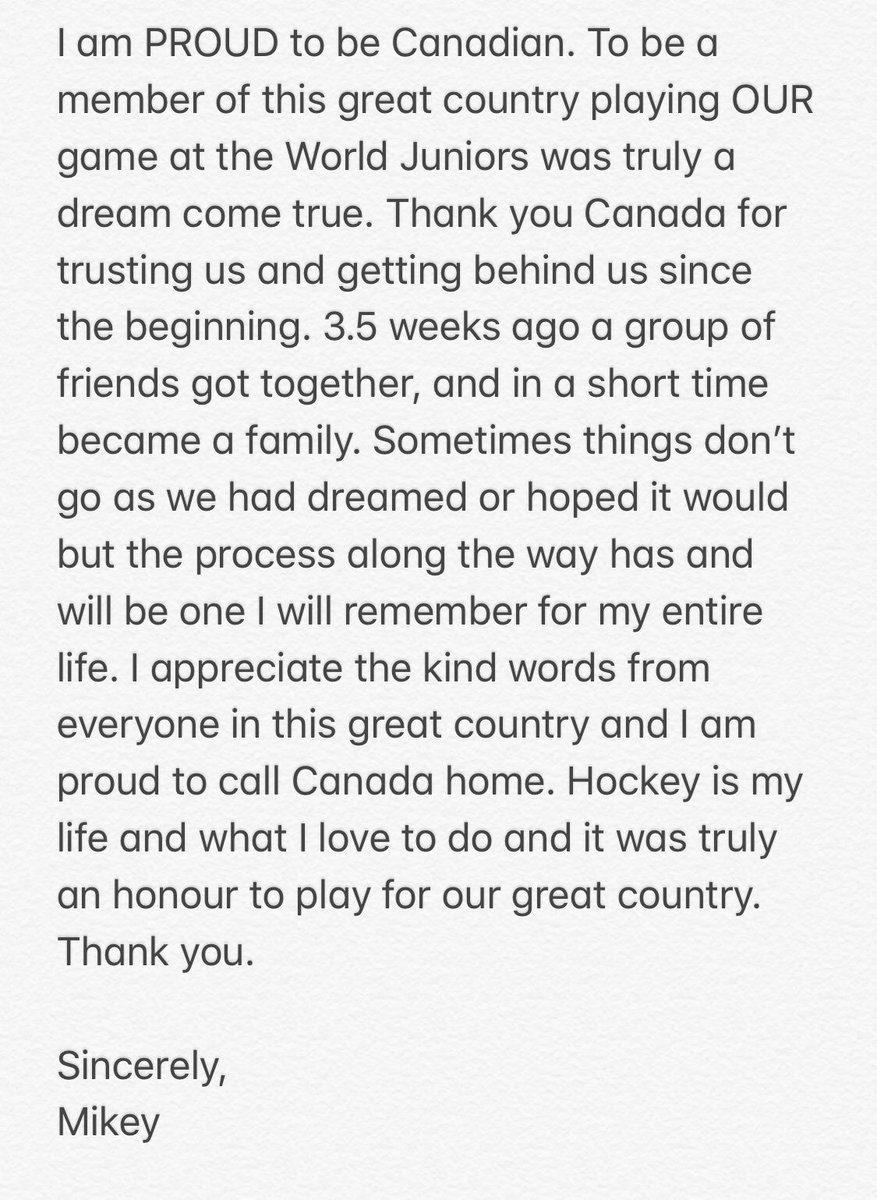
I am proud to be Canadian.

Posted Leave a commentPosted in Athlete, Coach, Organization Executive, Uncategorized

As today marks the official full week return to work, school after the holiday break I would be remiss in not talking about this year’s World Junior Tournament that was hosted in my hometown, Vancouver, BC and across the Pond (ferry ride) in Victoria. Like Mikey Dipietro who tweeted after Team Canada’s tough loss to Finland, I too am proud to be Canadian (albeit equally as proud of my Irish heritage) and like it was during the Winter Olympics in 2010, it was amazing to have the opportunity to see some amazing hockey being played by the future prospects of the NHL.

Although Vancouver has hosted the World Juniors in 2006 this was the first time that I was able to get tickets to see live games, starting with the cheap man’s version of pre-competition games where I got to see Jack and Quinn Hughes for the first time live and said to myself Vancouver Canucks FINALLY have a power play D-Man, prospect Quinn Hughes did not disappoint, and whoever wins the draft lottery this coming draft, which also is being hosted in Vancouver, will get another “pretty good player” as his younger brother Jack is pegged to be the #1 overall pick.

I was then offered free tickets to see Czech Republic vs. Swiss, Canada vs. Swiss and thanks to my wife’s cousin having purchased 4 corporate seats and two sons getting hit with the same flu that I was recovering from, the opportunity to see the Gold Game USA vs. Finland.

I also watched a few games on the tube as I do every year including the New Year’s Eve game Canada vs. Russia and the semi-final match vs. Finland.

Some of my key takeaways as a result of seeing both live and TV versions of this year’s World Juniors;

My whole life has revolved around Hockey and many other sports and nothing makes me prouder than when Canada wins gold in an international tournament like the World Juniors but as Hockey is now a global game, as this year’s world juniors and those over the last 10 years have shown, anyone can win on any given day (as not only Canada found out but so did Sweden who was 48-0 in round robin play and lost to Swiss in semi-final game).

Although Team Canada dominated Denmark (14-0), strong game vs. the Czech’s (5-1) they won by only one goal against the Swiss that I saw first hand, then lost to Russia by one goal, then lost to Finland also by one goal that knocked them out of the tournament.

Soon after the Finland game, team captain Max Comtois was berated on social media with various comments from “fans” who critiqued him for missing the penalty shot that would have tied the game BUT what none of these naysayers knew is Max played thru a separated shoulder he sustained in the tournament that will mean he will miss minimum 2 weeks from his Junior team Drummondville.

This when Telus shared their #endbullying commercial with Jordan Eberle for the second year in a row how over 1 Million kids are cyberbullied yearly?

As my Nanny (grandmother) told me all the time, if you don’t anything good to say, say nothing and ALWAYS treat others as you expect to be treated.

The lack of respect in hockey and other sports is one of my biggest pet peeves today and we must bring respect back into the game to eliminate harassment of ANY KIND.

TOUGH PUCK LUCK – What about the tough puck luck in the Finland semi-final?

With 46 seconds left to play and Canada up 1-0 (always scary in any game to not have an insurance goal) and Finland scores a pinball-type goal that would be worthy of the McDonalds commercials several years back with Michael Jordan and Larry Bird. Off the net, a shin pad, stick, then backhand off Dipietro to find the top shelf only for Mikey to look at his teammate in utter disbelief?

What about the wide open net that Noah Dobson missed because his %(^()$*^% composite stick broke in OT that lead to an odd-man rush by Finland that leads to the game-winning goal? If Gordie How could score as many goals as he did with a wooden stick, flat blade and have a wrist shot over 70 MPH, there is something to be said about being old school, I still don’t believe in composite sticks as they lead to too many missed scoring opportunities when they break like this time.

At the end of the day as the final game I witnessed proved, Finland was the better team in the tournament but had Canada gotten some better puck luck perhaps they would have least made it to the medal round.

Mike Dipietro, goalie for Team Canada who suffered that tough puck luck showed the epitome of class and the importance of losing with dignity when he shared his tweet;


One of the best moments in the world Juniors was when the fans chanted DI-PI-ETRO and he mother broke into tears, too often we forget about the support that all these players get from their families and friends.

What Team Canada’s early exit showed is that Canada still has their work to do to repeat and setting our high expectations what they did 5 years in row 1993-1997 and then again 2005-2009 winning gold so it has set our expectations high every year Canada suits up for the World Juniors.

Since 2010, however, Canada won gold in 2015 (Connor McDavid one of the co-captains) and 2018 and the only returning player from LY was the very same Max Comtois, team captain, who was a victim of the ridiculous and cowardly social media rants for not scoring on the penalty shot (with a separated shoulder).

We have our work to do in Canada to reach that same level and a few other countries have shown they have moved in the right direction to give Canada a run for the money at their own game.


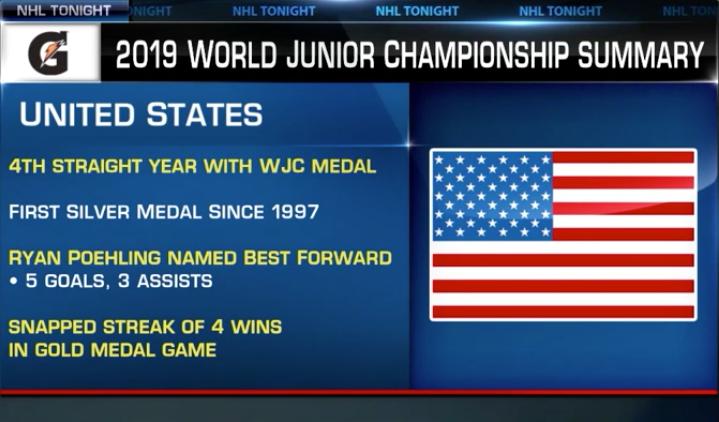
They too suffered some bad puck luck, having the first goal they scored called back as one of their players was in the crease violating a IIHF rule?  We were seated right behind the Finnish net at the time and the US player was mauled by the two Finnish D-Men leaving the other US player to jump on the loose puck and bury it in the net.

Had that goal counted, perhaps it would have been the US anthem played at the end of the game as all games had been won by teams that scored the first goal in the games.

It did not help that USA could not score on any of their 5 power plays although there were flashes of brilliance and posts hits on some shots, the puck did not cross the line when it needed to.

USA Hockey has been setting the bar for LTAD for years now, with their adaption called the American Development Model (ADM) which includes several years head start for cross ice hockey for the younger players, small area games for all age groups, smaller nets, lighter pucks, coaching certification relative to age groups to adhere to the levels.

Ken Martel, Technical Director, ADM for USA Hockey and many of his regional managers including Bob Mancini whom I had the opportunity to talk to for our winter summit which we will be replaying latter part of January, have done an amazing job with Team USA

Click on Video below for more insight;


2019 is the 4th consecutive year that the USA has medaled in the tournament, Ryan Poehling is named the top forward, the Hughes Brothers and many other prospects including Keith Primeaus son (goalie) will potentially have long NHL careers.

This is not just a result of the ADM model, but is also due their National Team Development Program starting with 16 and 17 year olds (the time when kids should look at specializing NOT before) and some other pretty good players have come out of the program including; Austin Matthews, Jake Eichel, Matthew and Brady Tkachuk and many others.

TEAM FINLAND


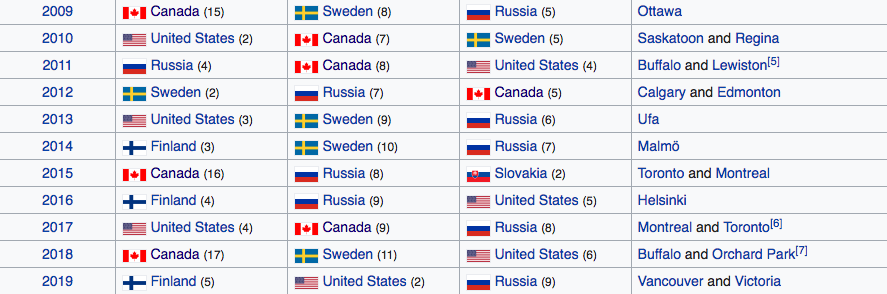
I have no idea why everyone had Finland a dark horse in the tournament, as Finland has now won 3 GOLD medals since 2014, all three of those same Major Junior Tournament years Canada did NOT MEDAL. (First Column = Gold, Second = Silver, Third = Bronze Medal)


This reflects Finland’s commitment also to LTAD, focusing on practice to game ratios much higher than Canada 3,4 or 5:1 relative to the stages that kids are at and like Sweden, and they have been focusing on the importance of coaching the person as we shared about Erkka Usterland who lead Finland to Olympic Silver in 2006.

They have been setting the bar for a good athlete focused coaching for years, and the results are showing on the worlds stage.

The gold game that I had the privilege to watch on Saturday night was the top two teams in world juniors since 2010 and although Canada is the all-time leader since the world juniors started decades back (17 Gold Medals, 10 of which due to 5 consecutive golds in the 90’s and early 2000’s pre 2010), if we don’t change our system NOW, we will continue to fall short at the Juniors and other international events.

Recommendations for change to our grass roots programs leading to high performance

  1. We need to focus on development, not competiton.

The easy fix in the rep stream – replace on of the game slots (currently in western Canada rep teams play 2 games, 2 practices and a dryland) with a practice slot and VOILA, we have a 3:1 Practice to game ratio and kids will develop vs. overly compete

DON’T sign up for Spring hockey unless it truly is a Spring Development, once, twice a week max working on skills, small area games, cross ice etc. but no games or tournaments as players develop in practices NOT games.

Play other sports in the Spring and Summer, Hockey is already the longest season of any sports and kids need to take a break from the ice so they can develop other motor skills that will translate to Hockey (i.e. Sidney Crosby batting pucks out of the air)

2.We need to have our best coaches in the trenches, grass roots when kids are developing their core motor skills between the ages of 9-12 to learn LTAD, Fundamental Movement Skills, Physical Literacy. I have had over 3000 coaches in clinics alone and when I ask the question how many coaches are familiar with these concepts, only a few hands go up so we have so much work to do to get our coaches on board.

  1. We need those coaches to recognize there is so much more to coaching that writing up drills on a white board and focus on the person, not the outcome as well as the importance for life-long learning.  The NCCP program ran by Coaching Association of Canada in conjunction with Hockey Canada is now requiring coaches to get a minimum number of professional development (PD) credits but it has been a long time coming


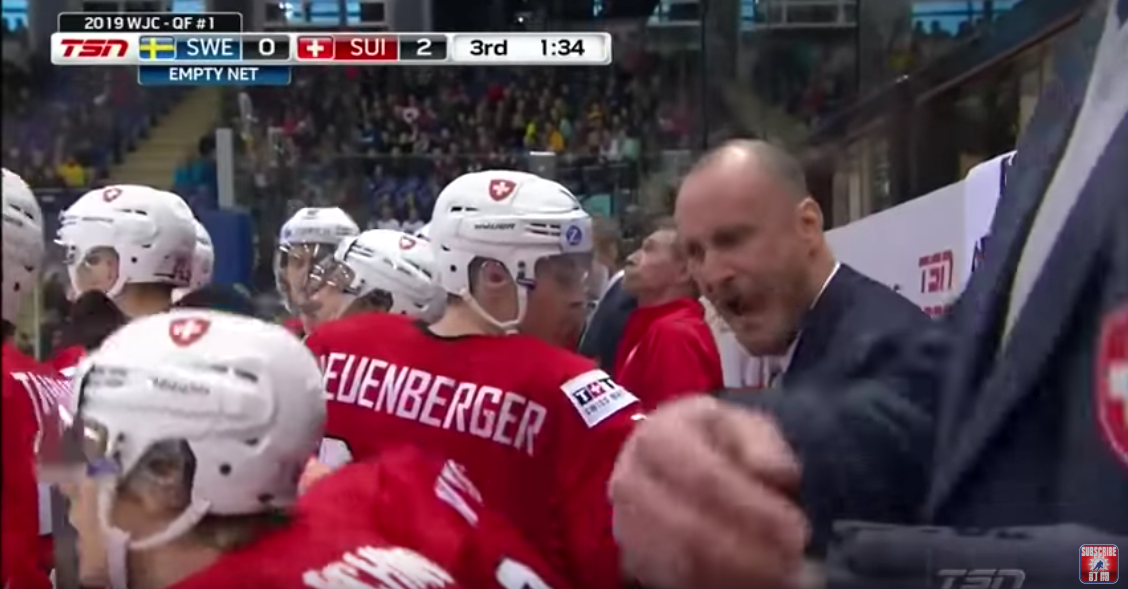
  1. We need to eliminate old school coaching practices at all levels that for some reason people did not think there was anything wrong with it when Swiss Coach berades players on their team for making mistakes as he did in the game vs. Sweden.


Swiss Head Coach Christian Wohlwend screaming at Sandro Schmid for mistake made touching puck causing it to go offside in last 2 minutes of game vs. Sweden.

Had Swiss lost the game, I suspect this video clip would have gone viral calling for him to be fired, but because they won and qualified to be in the final 4 (losing to Russia in the Bronze game) commentators merely shared that he was hot under the collar and smoke coming out his ears?

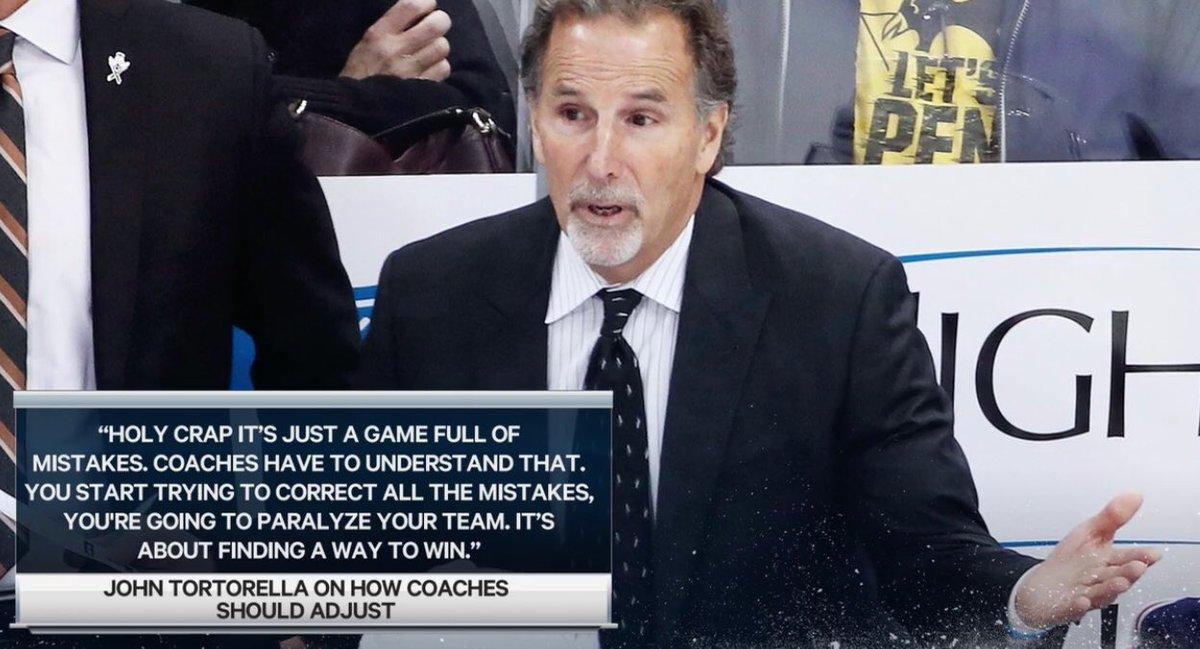
Ironically, one of those former old School Coaches, John Tortorella, who was infamous for his player rants on the bench and was advised by Columbus if he was going to continue coaching he would have to become more athlete focused recently shared this quote we posted to twitter;


Swiss Coach may have accomplished the win by putting fear into his players or as some of the players stated was being honest with them but using a totally different approach merely by pulling the player aside and showing him on a whiteboard what he should have done in lieu, as the old cliché goes, you get much father with honey than you do with vinegar.

The only way that any of this will happen, however, is if Parents who are paying the bills are educated why other nations have caught up to us in terms of their programs and coaching development and how they will continue to excel if we don’t change our culture and systems NOW.

Like Mike Dipietro, I also am proud to be Canadian, but we can no longer do the same things over and over again and expect different results (Einsteins definition of Insanity). We need to implement a significant PARADIGM shift in our development model so we don’t fall further behind other nations as we have this past decade.

Otherwise the worst 4 words anyone can say will be posted in one of our blogs years from now ….


I TOLD YOU SO.


Don`t be a kids last coach


The Reality vs. the Dream of NCAA Scholarships and Going to the Show

Posted 21 CommentsPosted in Athlete, Coach, Organization Executive, Parents

Every day I come across another study, article, or blog post about the dangers of early sport specialization and the driver for same is parents aspiring for their son or daughter to receive a NCAA scholarship for their chosen team sport to ultimately be drafted to play professionally.

Translation – Get a full ride to get an education and save Mom and Dad over $200K USD, get drafted and then you can take care of us with your Multi-Million Dollar Salary playing professional sports (ROI = Return on investment)

As I have shared with every coach, parent over the years, if that truly is your goal for your son or daughter, start a RESP (registered education savings plan in Canada) or the whatever the equivalent is in your nation when your son or daughter are born.

By the time they are ready to apply for post-secondary education, you will have their scholarship.

IF, you roll the dice and encourage them to specialize as early as 7 years old, these are the real statistics that you need to be aware of before you do so;

  1. Specialization will lead to burnout, even though they may love the sport you encouraged them to specialize in early, the trend where 70% of kids quitting that sport and all sports in general before they enter high school still continues in many developed nations across the globe.

Translation – the 10’s of thousands of dollars, thousands of hours you and your child invested chasing the scholarship or ultimately playing professionally will be for not

  1. They will potentially suffer one or more major injuries that could end their season, worst case, career ending due to overuse

Translation – Again the 10’s of thousands of dollars, thousands of hours you and your child invested chasing the scholarship and ultimately playing professionally will be for not

  1. Full Ride scholarships also are few and far between, most are partials, approx 8.7K – 10.6K USD. Majority of those are for Div 1 schools only (the most expensive tuition and hardest to get into), some in Div II and none in Div III schools.

Translation – Even IF your child gets thru 1 and 2 and is offered a scholarship, it will only partially offset the  actual out of pocket costs.  Compound that with tuition fees alone for international students to the very same schools that offer scholarships can exceed $40K per year it will still leave the family with huge financial outlays each year.

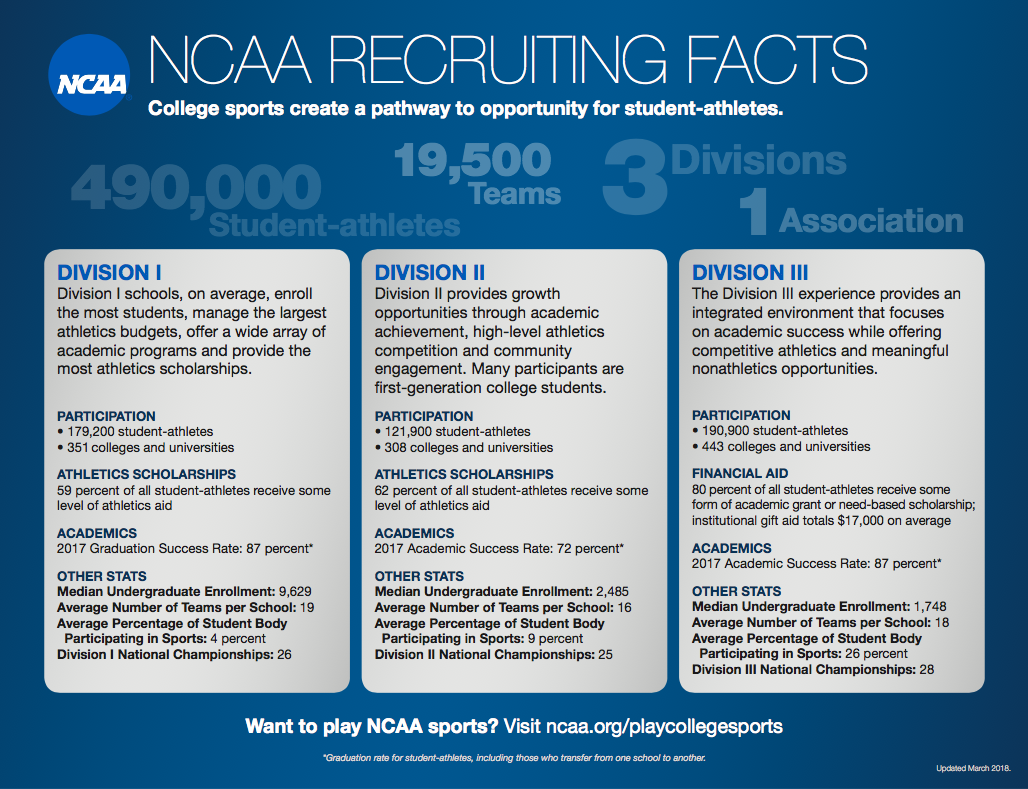
See below for the NCAA facts from March 2018


FACT – Only 2% of the NCAA athletes will be drafted to their major professional team sports but there is no guarantee they will actually PLAY even one game.

The two main NCAA team sports that are driving specialization are Baseball and Men’s Ice Hockey that have much higher % of players being drafted to their major professional levels (9.1%) and (5.6%) respectively vs. other team sports.  Being drafted is one thing, but being drafted, signing a contract, playing a game or a having a long career is another thing altogether.  One of the downsides of specialization is even those that do get to play if specialized starting in high school they will have shorter playing careers than those that continued to play multiple sports until or even in college/university as we shared in our January post

Early Sport Specialization does more harm than good

In the early 90’s, the OHL did a study based on the 1975 birth year of players, approx. 30,000 registered at the time in Ontario,  when they were eligible for the NHL draft and this is what they found;

  • 262 were drafted to the OHL (0.87%)
  • 113 drafted to the NHL (0.37%)
  • 38 Signed an actual contract (0.13%)
  • 22 Played only one game (0.07%)
  • Only 11 were active at 24 years old (0.04%)

I have yet to come across a similar study for MLB players drafted vs. those that will play for the major-league clubs they signed with, but like NHL, the majority come from the first round and after that will potentially have long careers for their minor-league affiliates.

Here is the math based on current trends of kids specializing at 7 years old and entering clubs/academies for 10 years before they even reach the collegiate level.

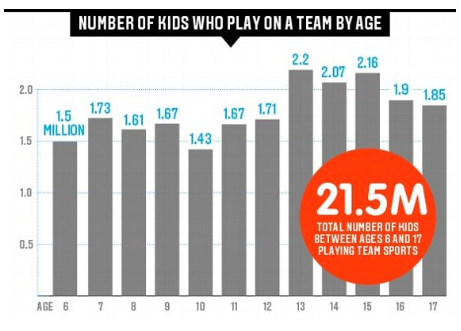
Most Current Data Set Available from 2013 for team sport participation

21.5M kids playing youth team sports in the USA;

  • Of those 7.3M will play team sports in high school (football being number one with over 1M) = 34%

Per March 2018 NCAA Facts (of those that played team sports in high school that went on to play in the NCAA)

  • 492K went on to play at the NCAA level = Only 2.3%
  • 59% of athletes at Div I schools offer a handful of full ride scholarships, majority are partials
  • 62% of athletes at Div II schools receive some level of financial aid/smaller scholarships
  • 80% of athletes of Div III school athletes receive some form of financial aid only, no scholarships

Student-athletes in Div II and III schools aid is more in student loans than actual bursaries or scholarships, subject to being repaid back (which puts further stress on the family to do so) vs. scholarships for Div I schools do not require repayment.

  • According to Mark Emmet, President of the NCAA, when players on NCAA men’s basketball teams were surveyed, 75% of Div I, 50% of Div II and 25% of Div III athletes believed they would play professionally when just over 1% were drafted to the NBA in 2017
  • Assuming 2% of NCAA Athletes go on to major professional levels, that is 9840 of the 492K student-athletes
  • Going back to the total 21.5M that played team sports from 6-17 years of age as the feeder group to those that went on to play at the NCAA level, those that were drafted to major professional sports (9840) only equates to  0.04% 

This is the same % that I have shared from numbers shared at the Hockey World Cup Summit in Toronto in 2016;

  • Approximately 2M kids playing hockey globally, Canada and USA accounting for 1.2M, the rest for other nations in Europe and did not even include the sleeping monster China
  • 700’sh roster spots in the NHL = 0.04%
  • The number of NCAA scholarships offered to Ontario born players has dropped 63% the last 10 years. Why? Because the USA has developed their ADM (American Development Model) over the same time period and is developing their own vs. those born elsewhere

Similar Stats in terms of soccer (MLS) based on registration numbers in the US in 2014;

  • Approx 5.7% of the 414K boys played soccer in high school
  • 7% (23,602) will go on to play soccer in college
  • About ½ of those (2.8% or 11.6K) will play Div 1 level (where athletic scholarships are available)
  • Average scholarship = $8.7 – 10.6K USD (gone are the days of full rides, now the average is approx 8.7K for all sports other than football and basketball that the average is 10.6K USD falling well short of that the actual annual costs will be)
  • Only 72 of those playing in college will go on to PLAY professionally = 0.02%
  • BUT 26% of parents think their kids will play professional soccer

I suspect the same % would hold true for English Premier League (European Football), NFL or other professional sports programs where players salaries have increased to the millions of dollars (not including the lucrative endorsement deals)

TD Ameritrade did a study with their clients in 2015 as they were concerned they were not investing enough for their retirement.

  • Many of those that replied stated a large portion of their disposable* income was being spent on youth sports.


  • 43% of those stated that youth sports were too expensive.


  • 67% aspired for their child to get an NCAA scholarship (only 2% potentially will)


  • 47% think their kids will play professionally ( reality = less than 0.5%)


  • 34% think their kids will become an Olympian (reality = less than 0.1% will)

* How many of us actually have disposable income anymore, with rising costs of housing, gas alone, more and more families are living paycheque to paycheque

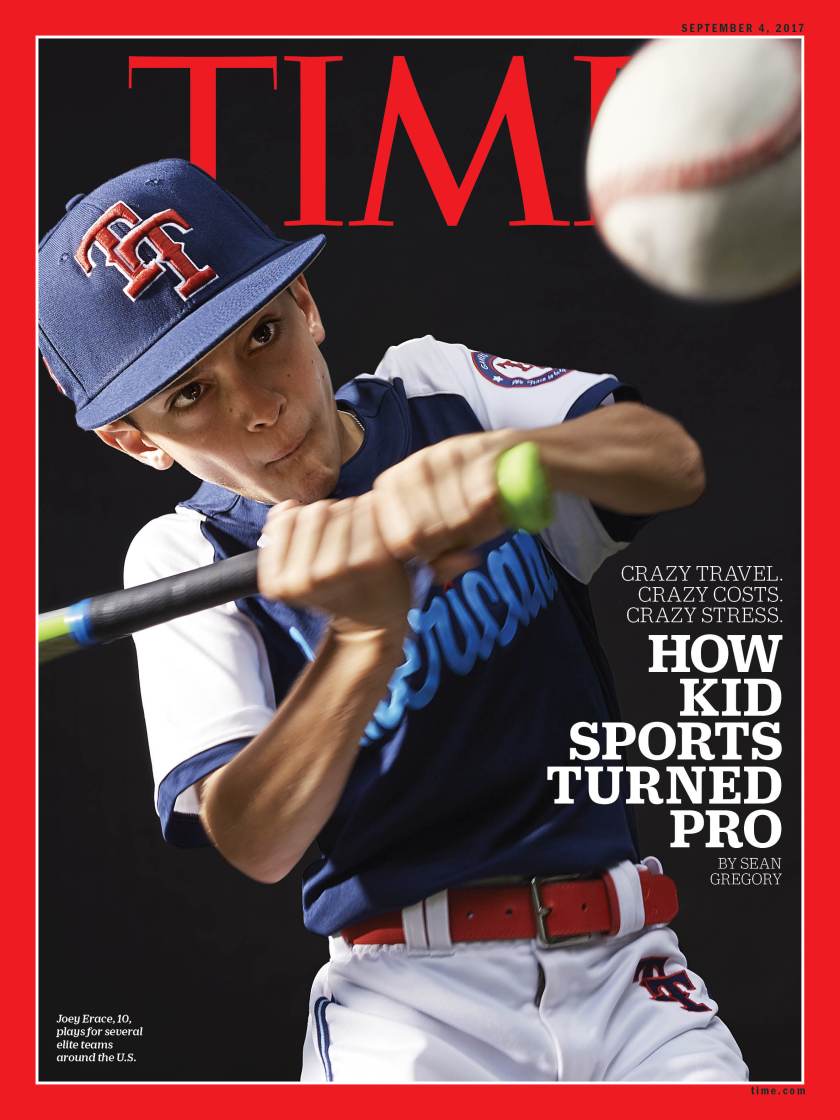
Two Years Later – Time Magazine shared that youth sports in the USA had evolved to a $15 Billion Industry due largely to specialization and the growth of private for-profit clubs and academies.  The industry has literally doubled in revenue in less than a decade!


These private programs are now costing anywhere from $15 to 50K per year (some include travel costs, some do not) so using an average of $25K per year (for travel, programs, gear, specialty trainers etc), and you signed up your “talented” child to year-round program starting at 7 will exceed $250K even before they get to college (AKA – NCAA PREP)

This does not include the opportunity loss of taking personal days, weeks off from your job to chauffeur or fly your child to all the prospect tournaments, games so a scout may “potentially” see them play (if they are good enough, they will be seen TRUST ME, you don’t need to spend all that extra money and time and if you truly aspire for that level, majority of college and professional coaches are recruiting multi-sport ATHLETES)

This is roughly the equivalent what it would work out to for a Div I school tuition for an international student which “may” only be offset by partial scholarships (literally covering meals) of 8K per year (full rides are about as rare as the Giant Panda).

This also does not include the equipment, apparel or other costs that I call “the fluff”

Drum roll …….

NET out of pocket for NCAA PREP (academies) and NCAA education WITH partial scholarship support can still cost …

ALMOST HALF A MILLION DOLLARS invested chasing the dream of playing professionally when the average is only 2% of NCAA athletes will get drafted and even if they do the majority will never play other than for their minor club affiliates and the actual number that may play in the Show works out to 0.02-0.04% in all the data referenced above).

Sadly, many parents are chasing THEIR dream, not their child’s dream, and when I have talked to parent’s almost all share they have not kept track of the math as either too scared to do so or they merely were trying to provide their child the same opportunity as others (AKA keeping up with the Jones).  Thanks to the traditional less costly community and high school sports programs competing with private clubs and academies they all get caught up in the same race only to find out at the end, the costs far outweigh the rewards.

One of the hardest things that I had to tell my son in his last year of minor hockey (when he was 17 years old) was I could not justify paying for AAA hockey thanks in part to mandatory travel tournaments that would push our out of pocket costs over $10,000 for the winter season.  This was MINOR HOCKEY, not an academy where the costs can push 20-50K.

Ironically it was the same conversation I had with my mother she shared that she could no longer support me playing hockey as my father’s life insurance ran out (well before specialization, spring, summer camps, $300 sticks, $1000 skates, Mandatory Travel tournaments)

What did I say to her?

It’s Ok Mom, I love hockey, but I would like to keep trying other sports, so I signed up for football in the fall ($125 reg fees that included all the equipment but cleats), rugby in the Spring (No reg fees, just $200 for jersey and cleats) and taught myself to play golf in the summer (junior fees were free or very low and I bought a used golf set for $100.00).  I had already won provincials (equivalent to a state title) in Hockey, and then went on to play for teams that won provincials in Football and Rugby.

What did my son say?

He understood and said he would rather play High School Volleyball ($125 athletic fees plus a pair court shoes) and Rugby  ($125 athletic fees plus a pair of cleats) and golf in the summertime so he could just go out there, work up a sweat, have fun and be with his friends.

At the end of the day, that truly is the reason why kids PLAY sports.

Sometimes we have to hear from the mouth of babes to bring us back to reality.

Let’s all work together to bring the game back to the kids … where it belongs


PS Tagline - Dont be a kids last coach


Poor Sportsmanship – The Other Reasons Why Kids Are Quitting Sports

Posted 2 CommentsPosted in Athlete, Coach

Poor Sportsmanship – The Other Reasons Why Kids Quit Sports

Lack of respect in youth sports today is killing our athlete’s motivation!
Part I

Glen Mulcahy

May 10, 2017


other reasons kids quit part 1


BONUS – Download a Free Copy of this Blog in PDF Format HERE  

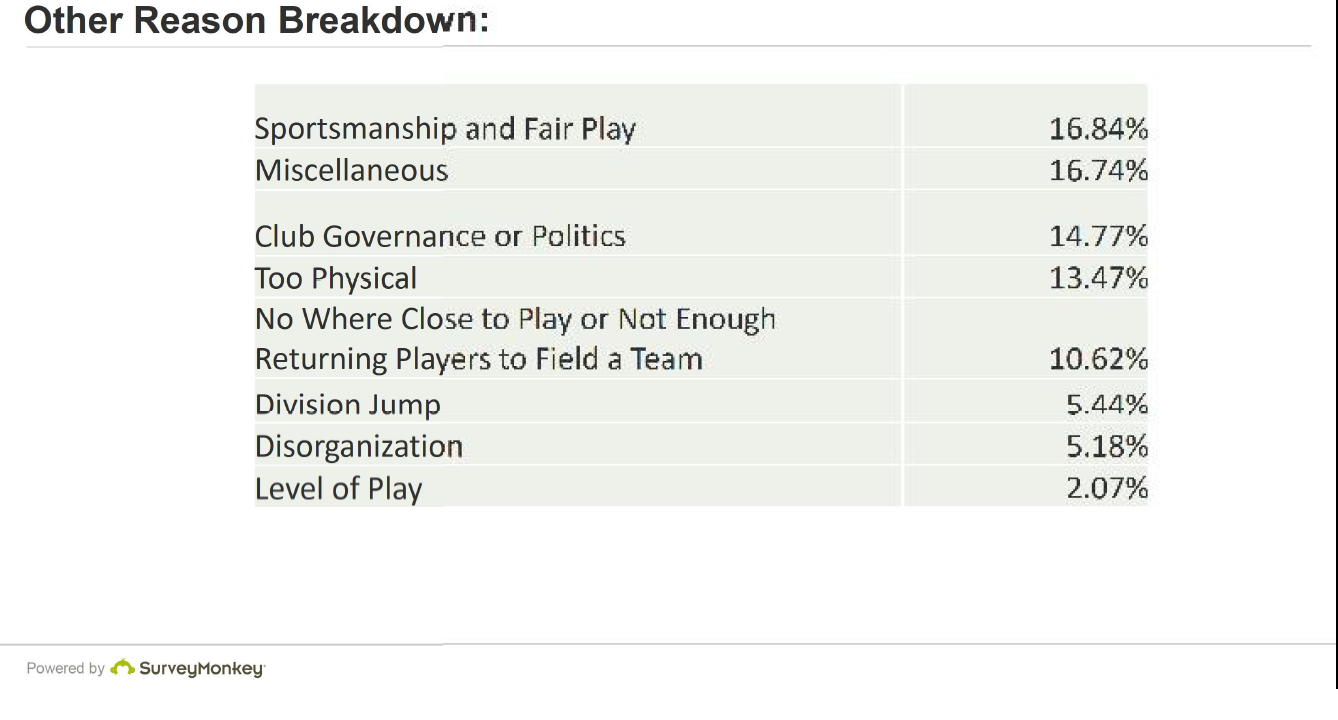
Lack of sportsmanship is a large part of the reasons our young athlete’s are becoming discouraged so early in their athletic careers. Although the second reason kids are leaving lacrosse is to specialize in other sports as I outlined in prior article Why Kids Quit Lacrosse, the primary reason why kids are leaving lacrosse are a myriad of combined problems within the sport (20.6% of the responses of the 1100 families surveyed by Alberta Lacrosse Association) that are outlined in the table below:


poor sportsmanship reason breakdown

Source: 2014-16 Retention Report – Alberta Lacrosse Association


Of these, the most significant reason was (poor) Sportsmanship and (lack of) Fair Play, the later of which we will talk about in Part II later this week.

Although the retention report was specific to lacrosse, I would argue based on my involvement in various other youth teams with coaches, parents, officials and athletes that the same would hold true in almost all other youth sports today.


Poor Sportsmanship

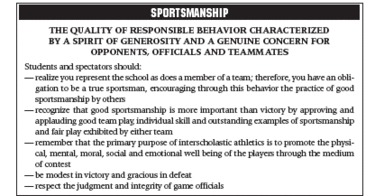
Have you come across a sign like this at your local arena, soccer field, lacrosse box etc? 


poor sportsmanship signboard


How many times have you been to a youth sports game in recent years and seen either players or coaches demonstrating poor sportsmanship? This could include any of the following, all of which that I’ve experienced firsthand;

  • Throwing or breaking their sticks because they missed a shot on goal
  • Screaming at a young official as they missed a call
  • Playing with the intent to injure – knee on knees, elbows to the head, helmet to helmet contact, cross checks or hitting players in the numbers (in the back)
  • Disrespectful when shaking hands after a game, or worst case coaches slew footing (tripping) a player or vice versa. (At one of the games I coached a player on opposing team tried to trip me as a prank while shaking hands and was suspended for 5 games as a result!)
  • Entering the penalty box throwing helmets, gloves, sticks and using language that is not appropriate even for adults in ANY environment
  • Players excessively celebrating goals even when their team is up on the other team by a significant margin (AKA rubbing salt into the wound)

The list goes on and on for the escalating lack of sportsmanship I have seen over the years. I strongly believe this is due largely in part to the fact that many coaches and parents have not been reinforcing the importance of respect; whether for themselves, team mates, coaches, other teams, officials, parents, or others in their community. This includes the apparent lack of understanding that you should win with humility and lose with dignity.

I am coaching High School Rugby this year and our number one agreed upon core value is respect. Even when the going gets tough (which believe me, it has) I’ve taught my athletes to still call the ref sir, and that even though some feel it is a Hooligan’s game … it is played by gentlemen.

Our rugby team’s first game of the season we got, for lack of a better word, thumped. But as I knew going into this season we would be in for some tough games I did two things to kick off the season;

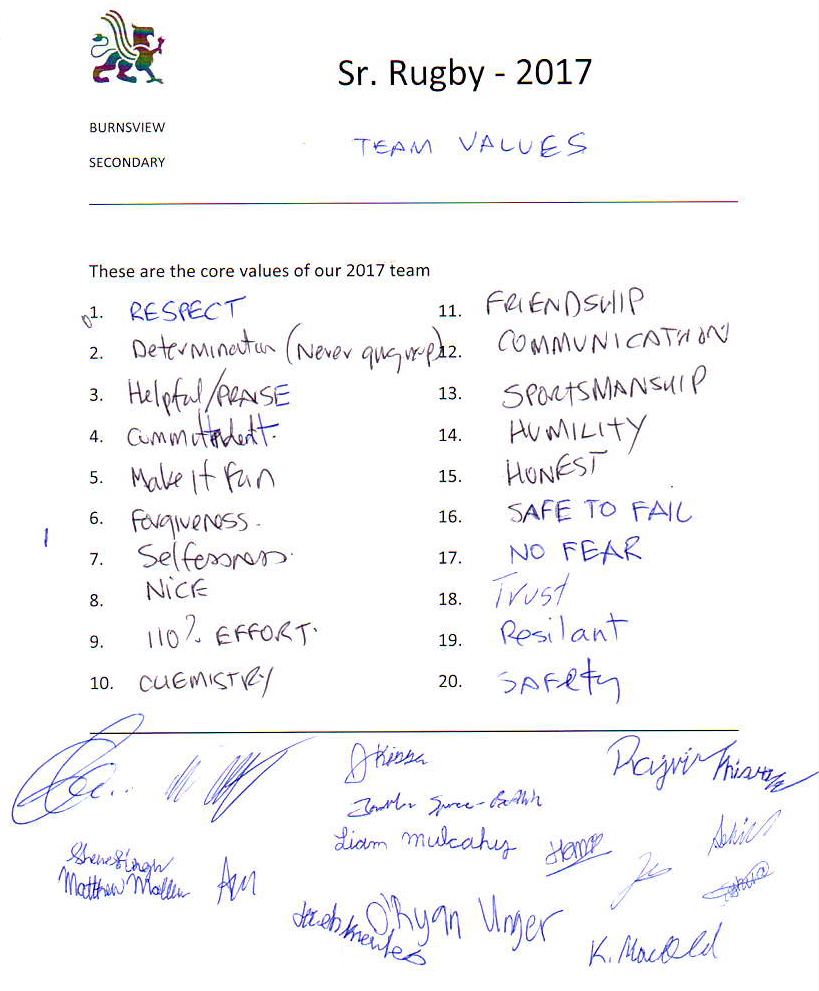
First – I asked every player to write down the top 3 characteristics they wanted to see from their team mates.

Below is the team values summary in no particular order where every player contributed. As you can see, one of our team values is sportsmanship, along with other core values like effort, chemistry, resilience and so on.


Team Values


Second – We have a circle of trust where the players form a circle, lock arms, and at each practice or game a different player leads the circle strongly stating the following:

“I have your back”

“I will respect you”

“I will be fearless”

“I will not criticize you”

“We will win with humility and lose with dignity”


The sayings for our circle of trust came from the subsequent question in which I asked all of my players what they did not like about youth sports. The top three answers were:

  1. When their team mates were not committed
  2. When the coach or team mates do not respect me
  3. When coaches played their favourites


The repetition of “We will win with humility and lose with dignity” is to reinforce the importance of good sportsmanship, regardless of the outcome of a game. When players leave the dressing room or field those that see them should not know whether they won or lost and as the old cliché goes, how you played the game is what matters. Having a focus on this is what breeds a healthy and positive relationship with the sport they love and is what will encourage young athletes to continue to love it long after they’ve stopped playing youth sports.

Probably the one of the greatest examples of sportsmanship I have ever come across was W. Oregon’s Sara Tucholsky who hit her first ever home run and the other team showed what playing for the love of the game truly means.


Let’s work together to bring the game back to the Kids … where it belongs.


Glen Mulcahy


Don`t be a kids last coach