In the last few weeks, there has been a lot of press that has had me shaking my head in utter disbelief regarding the current culture of youth sports. The very fact that harassment has come to light to this extent makes me ask the question over and over again, when will the culture of youth sports change for the better?
What should be a positive, amazing experience for today’s youth to not only learn the skills of the game, but the skills of life as it was when I grew up, has evolved to a culture of winning at all costs, a multi-billion industry where only the haves can afford to pay to play and yet no accountability for protection of the very same youth to have a safe to fail experience or safe from any forms of all harassment.
The first part of this post will highlight the issues regarding current youth sports culture, the second 1/2 will provide recommendations on what we can do to change the culture for the better.
THE ISSUES
A few of the incidents that made the headlines since the fall include;
St. Michaels College Sex assault scandal
Cost of Coaching Abuse – The Province
Hockey Players part of alleged bullying, assault at North Shore Winter Club
13 Year Old Pens resignation Letter from Abbotsford Hockey Team, alleging bullying
The latter three happened in Minor Hockey Associations in the lower mainland of Vancouver so it was very close to home and had my head spinning as a result.
This is my take on the ones that happened in the lower mainland;
- COACHING ABUSE:
Coaches are required to take a number of courses to ensure that they DO NO HARM, no different than that of teachers, social workers or other adults that work with those in the vulnerable sector. Most organizations now require all those that would be interacting with kids to do criminal record checks (CRC), respect in sport (for coaches or parents), concussion awareness, NCCP clinics that include making ethical decisions for the competitive stream.
Although I believe that CRC’s are needed and have had no issues when requested to do, there are few issues with them we still need to work out;
- Only if the coach had actually been prosecuted of assault will it show up even if there were legal proceedings pending (takes years for cases to get thru the system).
- It can be a lengthy process and many organizations have trouble enforcing as a result.
- I have also heard several coaches (which includes myself) asking for better ways to manage if you are involved in various roles with the vulnerable sector to do ONE CRC per year, one year I had to do four with overlapping sports and charities I was involved with.
Even with all of the certification requirements including CRC’s now mandatory for all hockey associations, the very fact that a young man could not cope with the abuse from a coach he had sustained while playing hockey that led to mental health issues, alcohol/drug abuse, dropping out of school when he had been a straight-A student and attempted suicide made me cringe. In lieu of developing life skills that include resiliency, this coach crossed the line with abusive old school coaching tactics and pushed this player beyond the tipping point regardless if he and the minor hockey association he still coaches for argued there was no cause and effect. Even the players Dad admitted regrets he should have done something at the time when his son was being berated over and over again by the coach.
What really was a tipping point for me is that the model for competitive hockey in the lower mainland had shifted in recent years, and many (not all) of the larger organizations are offering stipends from 1.5K to 10K to “recruit” non-parent head “quality” head coaches for their competitive rep teams. In this instance, the coach in question would have been one of those “paid” (aka professional) quality coaches, many of which are very young, inexperienced who were motivated to coach by the honorariums offered.
It takes YEARS of development and lifetime learning to become a great coach, plus it has increased team budgets so parents are on the hook for same, adding to the costs to the most expensive team sport in Canada for what should be a cost-effective option for players to play at a high level vs. the major midget/academy model that has evolved the last 10 years.
Had I been a parent of player on that team, or that of the player in question, as coaches are now paid by parents on the team (not by the associations directly), I would have been calling for the coaches immediate termination for the way he was treating players as the coach is under contract to DO NO HARM.
- NEVER CRITICIZE YOUR TEAMMATES (RESPECT)
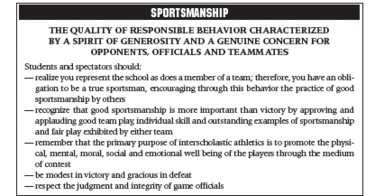
The fact that players in three of the above incidents are harassed their very own teammates in my day was totally unacceptable and is the way I have coached every team as a result. John Wooden, arguably the greatest coach of all time, had 3 rules, one Never criticizing your teammates – translation, respect your teammates, coaches, officials, other teams, classmates, teachers, parents, elders etc.
This is a direct reflection of the lack of respect now prevalent in youth sports in its current culture that some coaches are not enforcing the value of respect on their teams, worse yet the organizations or sports as a whole they are involved with.
Kudos to the young man of the Abbotsford Minor Hockey Team for taking the brave stance by standing up against the current culture and resigning from his team due to the harassment he received from a few of his teammates. This should have lead to an apology from the association, coaches but over a week later after it was released the association has merely issued a statement that they take harassment seriously and no communication to the parent or player.
- DO NO HARM – 2 DEEP RULE
Since the article was posted in the Province outlining the abuse players took at North Shore Winter Club, the head coach has received praise for stepping down due to the decision of the executive after review reinstating the offenders on his team in lieu of suspensions he and his assistant (now head coach) for the remainder of the season, there was a MAJOR error in omission in the article.
For as long as I can remember there has been a 2 Deep Rule in Hockey, evolving as a result of Graham James abuse of Sheldon Kennedy and Theo Fleury and other major junior players under his watch.
The rule means that there must be 2 adults in the dressing room at all times to ensure players are safe, there was no mention if the head and assistant coaches or any other adults were present in the dressing room when the incident occurred. This has been one of the main issues that I have seen with the “paid” non-parent competitive stream model, as they have no kids to bring to or after games, many will arrive well after the requested time to arrive at practices or games and leave soon after their post-game or practice debriefs leaving the dressing rooms abandoned
Had they enforced the 2 Deep rule, this NEVER would have happened in the first place.
In recent 3 part series released by CBC on sexual abuse that has taken place in youth sports, , the sport with the highest number of charges and convictions, twice that of the second amateur sport with high enrollment in Canada, Soccer (now the #1 youth sport in terms of registrants), was Hockey (approximately 50K less registrants than Soccer).
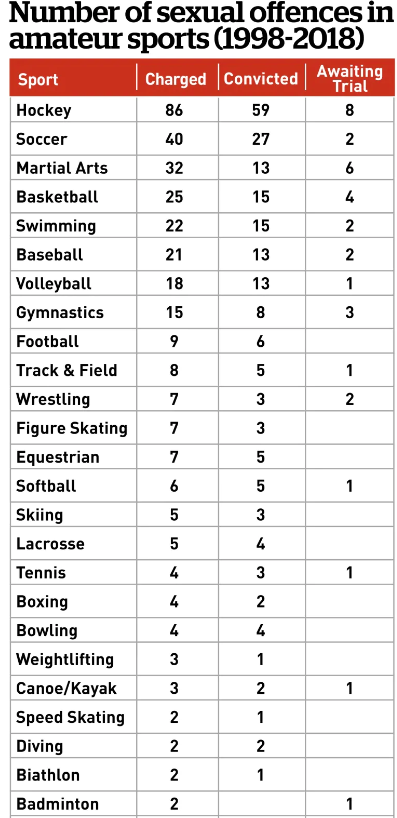
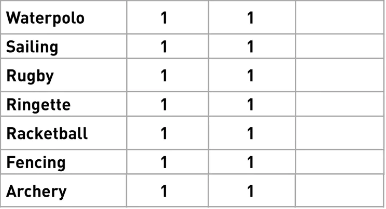
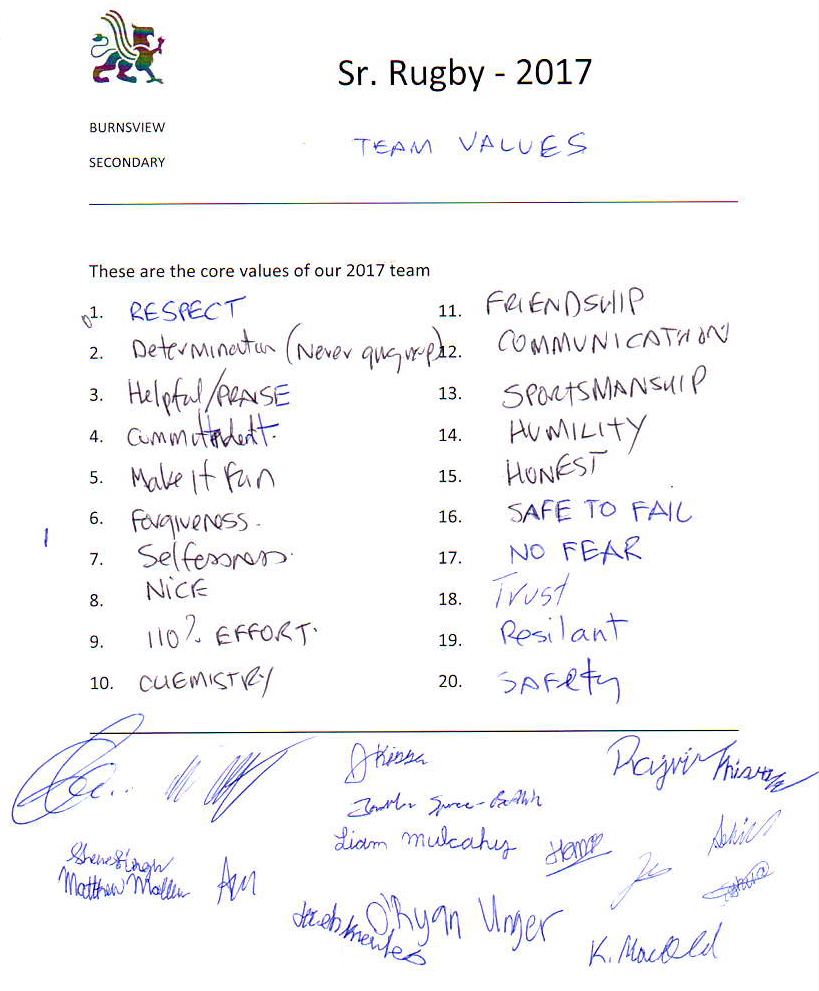
Ironically, my favorite sport as both a player and coach, Rugby, has had only one charge and conviction of sexual assault the last 20 years which one of the writers of the series attributed to the number of charges and convictions were proportional to the level of enrollment in particular sports.
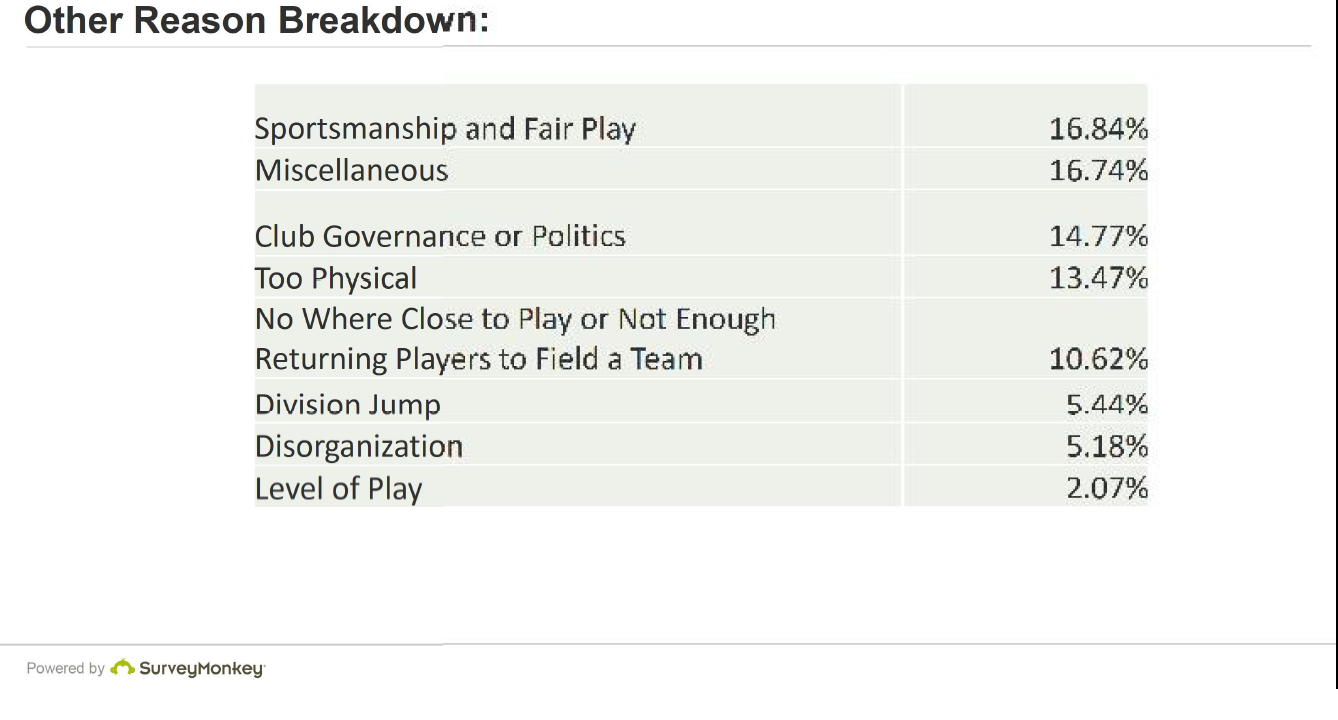
Having played and coached many sports, I would argue the contrary, it is due to the current culture of many sports, the one with the highest number of charges in convictions is Hockey, which is now the second largest team sport in Canada in terms of registrations (Soccer is number 1 by approx 50,000 registrants). The sport that I loved the most as a player and coach was Rugby, where officials are still called sir and although it is a hooligans game, it is played by gentlemen (and now ladies thanks to growth of female teams) whose registrations have grown significantly due to success of our 7’s teams but only have one charge and conviction the last 20 years.
I naively thought when Graham James incident came to the forefront it would have credited the awareness and shift in culture necessary to ensure did not happen again but sadly the last decade has seen other incidents across the globe come to light including;
2012 – Penn State Football – Jerry Sandusky
2016 – English Football – 839 alleged victims of 294 suspects
2017 – USA Gymnastics – over 350 girls abused by Larry Nasar
2018 – Canadian Gymnastics – Dave Brubaker
2018 – USA Swimming – Sean Hutchinson Cover Up
2018 – Canadian Alpine Skiing – Bertrand Charest
2019 – South Korea skating
2019 – Multiple Canadian Sports since 1998 – over 600 victims and 222 convictions
In the CBC 3 part series, Sandra Kirby, former Olympic Rower, and Professor Emerita at the University of Winnipeg was cited as sexual abuse is an underreported crime (as is many other forms of harassment), “this is just the tip of the iceberg” there could be thousands of cases where no one has come forward.
As far as I am concerned, ONE is too many, the current culture of youth sports MUST change for the better to ensure that no other child is a victim of any form of harassment.
- CURRENT SYSTEM: INTERNAL REPORTING AND REVIEWS
The very fact that abuse of any kind continues to run rampant across all sports is due to the fact that the majority of sports organizations have internal reporting mechanisms that lack anonymity for the victims of harassment and internal review boards more often than not will try to save face (cover it up) vs. doing the right thing (being accountable and owning up for the incident and implementing the necessary steps to ensure it never happens again). Perfect example, USA Gymnastics, even after the scandal came to light, the leadership group was still trying to cover up evidence and as a result the US Olympic Committee is in the process of removing their sanctions as a National Governing body.
The reviews at local organizations (if they take place) are done by board members (the majority of which have kids in the same organization) that are untrained volunteers with limited expertise (if ANY) in the subject matter.
- NO BOARD/COACH/PARENT OR PLAYER EDUCATION REGARDING SEXUAL ABUSE
There is currently not a universal system in place to educate the stakeholders on how to identify and prevent sexual abuse so that we can protect children BEFORE it happens.
Board members are left on their own accord to implement policies, procedures and continue building on so that all stakeholders understand the process.
SO … HOW DO WE ENSURE THAT WE DO CHANGE YOUTH SPORTS FOR THE BETTER?
- FINALLY – AN ACKNOWLEDGEMENT WE HAVE A PROBLEM WITH THE CULTURE OF AMATEUR SPORTS
Thanks to recent press bringing the issue of harassment to light on so many fronts and mediums (print, digital, radio, TV and podcasts) and subsequent response by the highest levels involved in sports acknowledging WE do have a problem, we can now check this box off (although I and many of my colleagues in the space have been saying the same for YEARS) and the time for much-needed activation of systematic change of the current culture is the next step.
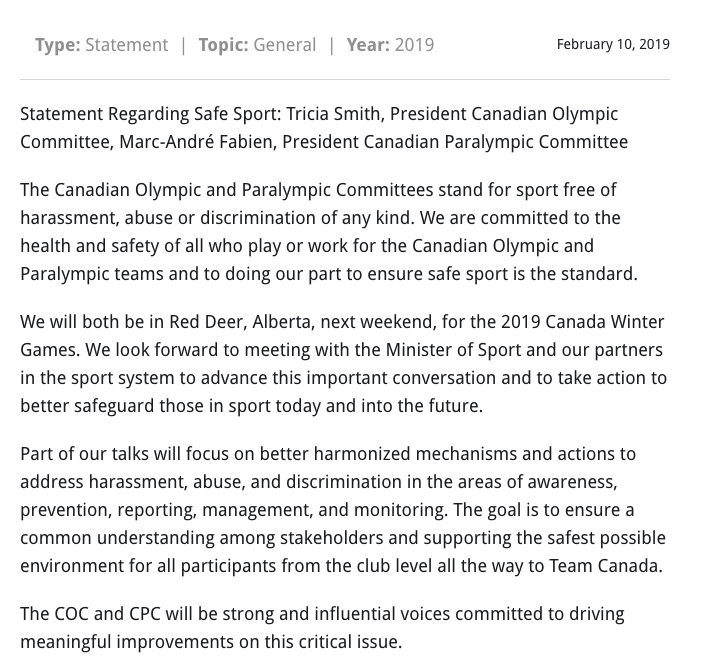
Joint Statement issued by the COC/CPC in response to the CBC 3 Part Series on Sexual Abuse in Amateur Sports
- IMPROVE COACHING EDUCATION/ENFORCE THE 2 DEEP RULE:
One of the biggest challenges I run up against is organizations feel that the initial certification coaches get is sufficient, which may varies by sport, some have extensive certification, others have none or very little. Every sanctioned National Sport should ensure their Provincial, regional and local organizations comply with the minimum coaching education requirements including ongoing professional development.
Had the 2 Deep Rule (2 adults in the dressing room or areas where players are in contact with coaches) been enforced leading to suspensions/termination of coaches if did not adhere to many of these kids would not have become victims.
Almost every board member I have talked to in recent years is they are getting push back from coaches due to the up-front time commitment to become certified, if it only requires a CRC and respect in sport as the bare minimum, being out of pocket for fees until they complete all the requirements, and push back against any other courses once they complete their initial certification. Many coaches are stating if they have to do any more they will quit as “they have all the certification they required”, they don’t have the time” or “I have been coaching for years” excuses.
Translation – the coaches got in it for the wrong reasons. Whatever has been asked of me by organizations if I had not done so already, I took the time and spent my own dime to do the education and certification without hesitation as it was all about the kids.
Initial certification and ongoing professional development is a requirement for teachers, social workers, physicians who interact with the vulnerable sector so the same should hold true for coaches, even volunteers. A perfect example is volunteer firemen, who do regular training to stay current as it is required, not optional.
- IMPROVE BOARD/EXECUTIVE MEMBER EDUCATION AND POLICY STATEMENTS:
Just as coaches need to take certification, courses, clinics, so should new board members in key roles like President, VP, Risk Managers for local organizations. More often than not, they put their hand up, get voted in as they either have no others vying for the same role OR they have support from membership aspiring for their political agenda’s.
In a study conducted with sports stakeholders across Canada where 27 sports were represented, administrators acknowledge they lacked the specialized resources in this area and was even greater in local clubs than in national federations. None of those surveyed stated they had received training on sexual abuse in particular. There is a need for training, information dissemination, awareness-raising, and clear rules and procedures.
Full accountability and transparency via policy statements and discipline for offenses should not be a wish, but an expectation from all key stakeholders of the membership to be met.
The time has come for no more cover-ups, not turn a blind eye, sweep under the rug, put up our hands in the air as don’t know how to deal with and so on. Per Albert Einstein, if we keep doing the same things over and over again and expecting different results is insanity.
- INDEPENDENT REPORTING/REVIEW BY 3rd PARTY ORGANIZATIONS
We need to ensure that all members in sports organizations have a safe reporting and review mechanism independent from that of sports organization from the grassroots all the way to national level to ensure that issues do not get covered up to the point where hundreds, potentially thousands of youth athletes become victims as have in past.
According to the Canadian Minister of Sport and Science, Kirsty Duncan, this is her top priority, “I have one goal, it’s close the gap, and do the hard systemic change and this right going forward, to do everything we can to protect our athletes and our kids.”
Kirsty acknowledged in the same press release that the federal government is working on a third party that would be independent of the sports organizations to ensure reporting and discipline mechanisms are put in place. She subsequently shared this tweet a few days later while meeting members of various sports bodies at the 2019 Winter Canada Games.
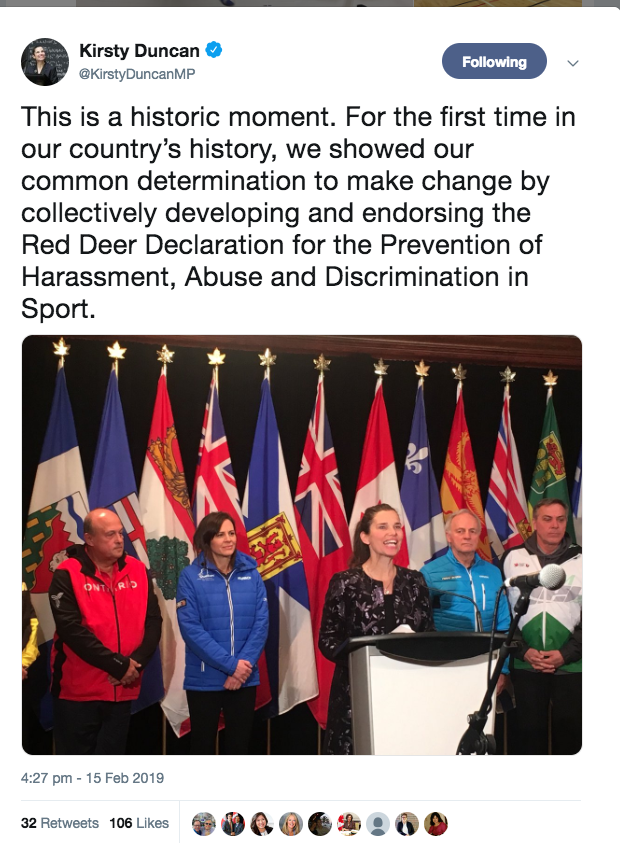
Now that the need for a change in current culture has not only been acknowledged, but those at the highest levels governing sport collaborating to develop the Red Deer Declaration to prevent harassment and discrimination of any kind will no longer be condoned in sport. The much needed PARADIGM Shift is FINALLY on the horizon.
- PARENT AND PLAYER EDUCATION:
We need to educate parents and players on the various forms of harassment that can take place in youth sports, prevention is 99% of the cure, let’s not wait until more kids are abused.
Majority of parents that I have talked to regarding harassment issues that impact their own or kids on their kids teams either were unaware it was, in fact, a form of harassment in the first place (either denial or ignorance), they remain silent due to fear of being ostracized by other parents, coaches or the organization OR fear that their child’s chances to continue playing on top level teams will be jeopardized (due to perceived meal ticket their kids will get a scholarship or play professionally).
Although there are education programs for kids in schools regarding various forms of harassment and how kids can safely report or ask questions, there currently is no mandate for youth athletes to learn what are the various forms of abuse in a safe way (i.e. going to someone to ask questions, advice without potential repercussions) and better yet, how to prevent it.
The buck stops here, in order for the much-needed change to the culture of youth sports, we all have to accept ownership to collaborate to make the changes necessary.
This is the responsibility that we all have in youth sports, whether it be adult leadership at the National, Provincial, local association or respective coaches, official, board member or parents is to develop youth into adults.
Per Kristy Duncan when she responded to the CBC 3 part series regarding sexual abuse in amateur sports in the last 20 years;
“One athlete, one child is too many”.
I could not agree more.
It is our responsibility as adults to provide kids with a safe environment for them to develop, without fear of verbal, physical or sexual abuse.
Let’s all work together to bring the game back to the kids … where it belongs.