
There are NO shortcuts

Posted Posted in Athlete, Coach, Parents

I am currently in the process of onboarding a couple of interns for this coming summer who will be working on our various digital platforms, image creation, video and audio editing and back end support for summits, webinars and live streams.

We have now sponsored over 20 university co-op students over the last few years as we have built out our websites to provide content for all youth sports stakeholders and as we onboard new students each time, one of the key teaching points I share with them is the importance of having a strong work ethic and have used a myriad of sports analogies over the 4 months they work with us to ensure they finish the term strong.

This comes from the many years of playing various sports where coaches would remind me and all of my team mates of the importance of work ethic, something that has been lost in part in recent years where many parents, kids have fallen into the early sport specialization trap but not recognizing the importance of practicing the way they will actually play in games.

What separates those that reach the highest levels they aspire vs. those that do not having coached hundreds of different players in different sports and now having interacted with thousands of coaches that have shared similar stories of players they coaches, is the fact that the ones that excel are the ones that have superior work ethics to do vs. those that have a tendency to not run through the finish line.

There are so many analogies I can share as examples of those that reached the elite level, below are three that come top of mind;

Sidney Crosby

When Sid (The Kid which is no longer the case) was coming up the pipeline many felt that he was the next Wayne Gretzky, much like people feel now of Connor McDavid.  What has separated Sid from the rest of the pack and what has made him the player he has become is not the fact that he focused on hockey from a young age like many kids do today, is his commitment to practice like he is going to play every practice.

He even will ask his team mates not to pass “tape to tape” so that he can retrieve pucks that are too far away or caught up in his feet to kick to his blade and doing so at full speed.

He is so committed to working on his skills even now at the age of 31 years old, that the Pittsburgh Penguins, according to a story shared with one of my colleagues who interviewed Mike Johnston, former head coach, built as second practice rink adjacent to their initial rink so that he and other players would not have to wait for the Zamboni to clean the ice for 15 minutes.

Per his current head coach Mike Sullivan

“The quality that allows Crosby to remain atop the league, coaches and teammates say, is his unique work ethic, an ability to specify subtle areas for improvement and work with meticulous precision until they match the other elite elements of his game. … “He’s a generational talent,”


Micheal Jordan

Many know the story that he was released from the first high school team that he tried out for, was totally distraught, cried as a result for quite some time after the fact but he made a commitment to be the best he could be, and ultimately became arguably one of the best ever to play in the NBA by working tirelessly to do so.

The same work ethic transferred to when he decided to retire from basketball when he lost his Dad, to pursue a career in professional baseball and although never made it to the MLB White Sox, he honed his craft over a few years in the minors by working tirelessly every day with hitting and other specialty coaches to improve his batting %, stealing bases and so forth.


Walter Payton (AKA Sweetness)


Hi workout routines to this day are still used as examples for those in the NFL to mirror and what many don’t know is he mentored a former high school player to work out with him which he did for years.  In the short clip below he shares the 5 years that he did so with Walter where they became good friends as a result and talks about the infamous hill (AKA Hell) they trained on.


There are many other examples that I can cite of professional players whose work ethic got them there like Kobe Bryant (sadly who we lost way too early last year), Tom Brady, Muhammad Ali, Pelé, all of which continued to work on their craft while even when they reached the levels they did professionally.

This is the big takeaway that youth coaches must remind their players regardless of the level to ensure that they don’t cheat themselves, and at the same time their team mates, of the importance of working hard during every game, practice … to reach the highest level possible, there are no shortcuts.  Too often over the many years of coaching I would see kids that had great skills but when push came to shove they did not put in the extra effort to hone their craft and as a result they got passed by many of their less “skilled” counterparts.

Those that reach the tip of the pyramid don’t make shortcuts along the way, they recognize that it take YEARS to reach that the highest level they aspire to and continue to work on their crafts even when they do.



PS Tagline - Dont be a kids last coach


Gone are the days of “Just getting your bell rung”

Posted Posted in Athlete, Coach, Early Sport Specialization, Organization Executive, Parents

This past week was absolutely crazy for me in terms of various webinars and zoom meetings as it was National Coaches Week in Canada.  I took advantage of the various webinars, virtual conferences, summits during the day, and at night was participating in Zoom meetings to prep for online delivery of Hockey Canada NCCP clinics for BC Hockey due to COVID-19.

A couple of the sessions I did was attend a presentation on concussion management and the following day had a great chat with the director of an organization based in Florida who is providing Hyperbaric O2 Therapy to help people recover from brain trauma that I will expand on below.

Both of which really resonated with me personally as I probably suffered a few minor concussions during my playing days of tackle football when was hit helmet to helmet or tackled really hard.  I recall a few times over the years when that would happen and I would be sitting or lying on the field woozy from the impact and trainers would run on the field to help me.

The first thing that they did was pull smelling salts out of their first aid kits and swipe under my nose where I would become more coherent and then they would say “Hey Bud, you’re good, you just got your bell rung” then help me back to the sidelines.

Then the head coach would come to me and ask me how I was doing and like players were doing for many years until recently where mandatory medical or return to play protocols were implemented and my response would be “I’m Good Coach” (but was I??)

To which they would say … Good to hear, Get back out there.

Fast forward many years later while running clinics, workshops or presentations across Canada interacting with coaches and other youth sports stakeholders may feel that the increasing concussion rates are attributed to the fact there is so much awareness now than it was in my playing days.

To which I say … I am glad that is the case because not only did I “probably” have a few minor concussions playing contact sports (none were diagnosed), I did have 2 Grade 3 concussions (most severe), the second ended my competitive playing career in contact sports in my 20’s.

Ironically it, like the first, were not from sports, rather were are result of bar brawls, the second I can only share what people told me after the fact as I lost approximately 2 weeks of memory leading up the incident and vague tidbits the days that followed.

In sum, I was doing a pub crawl with my buds for a stag and the one that was getting married was hit over the head with a beer mug and knocked out to which I came to his aid and I in turn was hit over the head and knocked the ground.

I literally had the S..T kicked out of me by three young men and I was taken to hospital, was in and out of consciousness per the doctors when I finally game to a couple of days later with what felt like a knife digging into my head …

The days, weeks and months that followed were extremely tough on me as doctors said I had to limit any activity, keep the lights off, rest while I recovered from the migraines, headaches, dizziness, nausea and other symptoms as a result of the concussion.

The incident happened in July and I was returning back to my second year of college and had to reach out to my advisor and instructors to advise that I could not return until I had the green light, that did not happen until early November.

I missed two month of my third term (of 4) in a really intense program but my instructors and fellow classmates were amazing helping me return and get back up to speed.

I share this as I know what it is like to deal with a major concussion, it is tough not only physically, but mentally as you are unable to do things I just took for granted, running, biking, hiking, playing sports, swimming, skiing, golf and so on.

So when coaches say to me the only reason so many more concussions are being diagnosed is due to awareness now vs in past I reply … I would rather doctor’s, coaches err on the side of caution.

I also have had players on teams I coached suffer concussions, one of the ones to this day I regret agreeing to let him return to play as soon as he did (even though he had doctor’s approval) was one that sustained a bad concussion in a game, came back a month later and sustained another concussion.

I received a call from his father later that night saying the doctor had advised that his son not play the remainder of the season and that he no longer play rep/competitive hockey with body checking as a result.

Although everyone said it was not my fault, I still feel some of the blame as I could have pushed back to his parents more and said give it more time but they insisted he was good to go.

This is why I was excited when I attended the webinar and talked with Hilary Loftus this week in terms of advances that the medical profession has made in terms of concussion management and recovery


Tina did a great presentation highlighting what concussions were, the ways that the can now be diagnosed by coaches and trainers utilizing concussion recognition tools like the one below

There have also been changes in terms how concussions are managed when diagnosed

  1. Complete rest for 48-72 hours is no longer advised in lieu early return to light activity that does not increase symptoms
  2. Slowly return to play/learn or work in terms of a graduated approach

Yikes … I potentially could have saved myself of 2+ months being in a dark room and literally doing nothing during that time?

She also shared following stats

  • Most people recover quickly and fully
  • 85-90% within 3 weeks
  • Children take a little longer 4 weeks

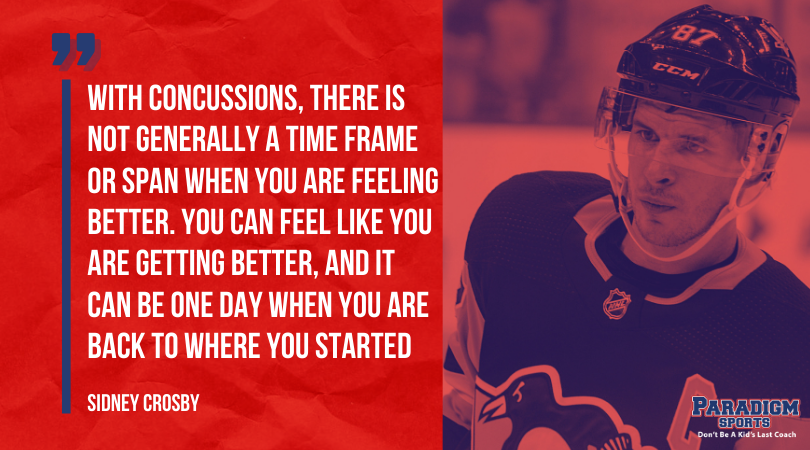
Only 10-15% may have persistent symptoms (months to years), which mine as well as Sidney Crosby’s example as well as many other professional athletes who took months to return or had to retire as a result of concussions (i.e. Eric Lindros, Paul Kariya)


The Key takeaways that Tina ended her presentation for Coaches


  • Know your athlete
  • Be Supportive
  • Community with the health care team managing the concussion if need quidance how to be supportive
  • Speak the same language as the health care team

The day following Tina’s webinar, I had an opportunity to chat with Hilary Loftus, the director for HOW (Helping Our Wounded) Foundation which was established initially to help US military and veterans recover from brain trauma and PTSD using Hyperbaric Oxygen Therapy (HBOT)

The sessions are either done in mono type chambers like the one above or they have larger ones that can accommodate groups of 4-8 or 12 at a time.

Pure O2 affects the body at a cellular level and by using pressured chambers it enhances and provides the tools for the body to naturally heal.  A session is 80 minutes and the technology has been around for decades used mainly in hospitals for severe injuries, burns etc but is now becoming more mainstream in conjunction with other injury therapy practices (i.e. physical, occupational therapy)

Hilary shared an amazing stat with me also, if athletes who are diagnosed with a concussion start HBOT sessions within a week of being diagnosed they only have to do 3 sessions to recover and return to normal activity.

All I could say to myself during our chat and prior conversation was “I wish this was around for me many years ago” but it is exciting to see the advances that we are seeing for concussion management both in terms of recovery but ultimately in terms of prevention as many sports have implemented training programs for coaches, players to reduce head contact and severity of concussions many suffered in past.

If you are a coach and suspect one of your players has had “their bell rung”, that should be a red flag for you to immediately pull them from the field, ice, court and reach out to their parents to get them checked out and follow return to play protocols accordingly.

As the cliché goes, it is better to be safe than to be sorry.


PS Tagline - Dont be a kids last coach


The Steelers Way

Posted Posted in Athlete, Coach, Organization Executive, Parents

October has evolved to be the business months of the year for us as various fall sports seasons ramp up and does not allow me to follow many professional sports including one of my favorite teams in the NFL, the Pittsburgh Steelers.

My interest in the Steelers goes back to my playing days in Tackle football, as the name for our youth football program teams once we got into the Bantam age group (13-14 years of age) was the Steelers and our uniforms were the same black and gold as Pittsburgh Steelers iconic franchise.  How can anyone argue that their 70’s dynasty team was not one of the best EVER as they won four Superbowls under the guidance of the Chuck Noll as head coach, Terry Bradshaw at QB, the iron curtain on defense (Mean Joe Green, LC Greenwood, Ernie Holmes and Dwight White), running back Franco Harris and the infamous Lynn Swan among other Hall of Famers.

This year the Steelers have been served a tough blow losing their QB Ben Roethesberger early in the season for the remainder of the year, and their backup Mason Rudolf who was concussed when he was sandwiched by two Baltimore Ravens players and has been the case with NFL officiating issues there was no penalty called on the play.

The result of the head contact that Mason sustained was something that you never want to see in the game and after the fact, Baltimore player was fined $21,000 for head contact which many argue was the NFL’s attempt to make amends for no penalty being called.

Having suffered 3 major concussions myself, the last I not only was knocked unconscious as Mason was but suffered a memory loss of approximately 2 weeks, I can relate all too well what it’s like to recover from this type of injury.

Although the NFL has made significant improvements in player safety, particularly for the quarterbacks, I don’t think anyone would disagree that they still have their work cut out for them.

As a result of Mason following return to play protocol (thankfully he should be able to return to play this season), the Steelers were forced to play their third-string QB Devlin Hodges,  nicknamed duck caller, who started his first game this weekend and lead the Steelers to their second victory of the season (now 2-4) over the LA Chargers (albeit Phillip Rivers et al did come back from 24-3 to almost tying the game in the 4th quarter for a final score of 24-17)

During the broadcast, Chris Collingsworth, colour commentator for Sunday Night Football, spoke about the fact that this was the Steelers Way, they have been known for their strong defense, gritty coaches (i.e. Bill Cower and his infamous scowl) and their tough defensive play since the inception of the franchise in the 60’s.

What many don’t know is that current Steelers coach Mike Tomlin is second in all-time winningest NFL coach who has coached for over 10 years only to Bill Bellichek, the long-time head coach of the New England Patriots dynasty team with Tom Brady at the helm.

Not only are they having to sustain the season-ending injury of Ben this year, they also had to deal with offseason theatrics from two of their former Killer B’s, Antonio Brown and Le’ Veon Bell.

Bell opted to sit out all of last season to hold out for a better contract (is now with the New York Jets), and the antics of AB became so ridiculous that I shook my head in disbelief from his demand for a trade, the LA (soon to be Las Vegas) Raiders taking a chance on him only for him to be let go and outright disappointment by head Coach John (Chucky) Gruden due in part to his whining about having to wear a new helmet, then the very same Patriots committing to a contract after he was released for AB only to reneg on it a few days later because of sexual abuse allegations that have come forth.

Good luck getting any of that $40 Million in guaranteed salary AB you are seeking, you demonstrated to the masses via your selfishness and lack of character why you do not deserve it.

Both players proved to be major distractions last and in the offseason but the Steelers found a way to overcome the adversity as they always have.

James Conner, the new tailback for the Steelers story has been well documented, growing up in Pittsburgh, playing for Pitt in college, suffering an MCL tear in his Junior season and then was diagnosed with Hodgkins in his 3rd year at Pitt.

He immediately underwent chemo with his coach and fellow teammates at his side while he fought his battle while he continued to work out with his team to stay in game shape.

Just 4 months after final chemo treatment he successfully fought cancer and returned to play for his team and was selected as one of the captains in his senior season.

Following that season, in 2017 his dream was realized and he was drafted by the Steelers in the third round and is now their starting running back, replacing Who?

The reason that I can relate to his story of the fight he went thru, I lost my mother to Cancer and remember all too well talking about winning the battles of the day to ultimately win the war, something I learned from my many years of playing and now coaching competitive sports.  Both my inlaws have dealt with Cancer and yet again we recently found out my mother in law has been diagnosed with breast cancer for the second time, in the very same month that the NFL and numerous other organizations are doing awareness campaigns for same.


Ironically I watched the Steelers game this past weekend when I was up in the interior to shut down my inlaws trailer and we spent a lot of time with them over the course of the weekend and I was reminded of the importance of fighting thru adversity yet once again by my mother in law.

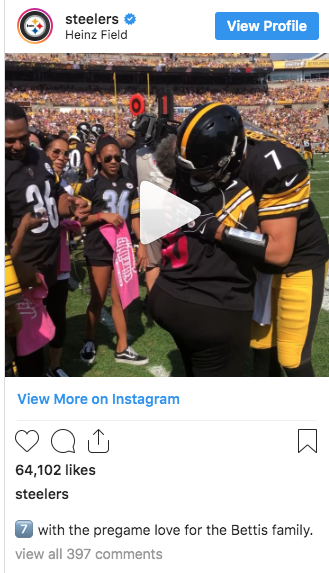
One of former Steelers player DeAngelo Williams lost his mother to breast cancer and recently committed to pay for 500 Mammograms. Jerome Bettis, AKA The Bus, also received tons of support from his Steelers organization when his mother fought and successfully won her battle with Breast Cancer including a huge hug from Ben last season prior to a home game.


Like James Conner, my mother, Jerome Bettis’s Mother, my mother in law refuses to go down without a fight and will be undergoing her second surgery and chemo to follow starting Oct. 23rd so like it was the first time the support people provide via fundraising activities for those impacted is really close to home for us.

Per the late great coach that Scott Stuart shares in the video we highlight in this weeks newsletter;

Don’t Give Up.

Don’t EVER give up.

Kudos to the Steelers, the leadership of Mike Tomlin, players like James and all the others that adhering to the Steelers way as a blue-collar team from Pittsburgh whose uniform colours highlight the steel industry in their town, Black and Gold.  The fact that they iconic helmet stickers are based on the original steel mark of the steel industry Pittsburgh is known for and are only placed on  the right side of the helmets as a result of the early success they had in the 60’s when they were testing how the stickers would look.  The Pittsburgh Steelers epitomize the very city they represent where many are employed by various US Steel manufacturers.

The same uniform colours hold true for The Pittsburgh Penguins (NHL) and Pirates (MLB) teams as tributes to their hard-working blue collar origins.

Ironically, Penguins former player, captain and now owner Mario Lemieux also dealt with Hodgkins and has been instrumental in rebuilding the Penguins to be one of the NHL’s top franchises thanks to drafting another pretty good player, Sidney Crosby among others.

Kudos to the Steelers for continuing to demonstrate their blue-collar routes, they nor the fans for never giving up and waving their terrible towels no matter what the circumstances of forms of adversity they face.

I suspect whatever other hurdles they face the remainder of this and seasons to come in future will continue to be dealt with “The Steelers Way”.

Don`t be a kids last coach


Lack of Fair Play – The Other Reasons Why Kids Quit Sports

Posted 2 CommentsPosted in Coach

Lack of Fair Play –  The Other Reasons Why Kids Quit Sports


Playing just your starting lineup isn’t only hurting your kids, but your team as a whole!

Part II


Glen Mulcahy

May 18, 2017

BONUS – Download a Free Copy of this Blog in PDF Format HERE  

This blog post is a continuation of last week’s Part I post Poor Sportsmanship – The Other Reasons Why Kids Are Quitting Sports


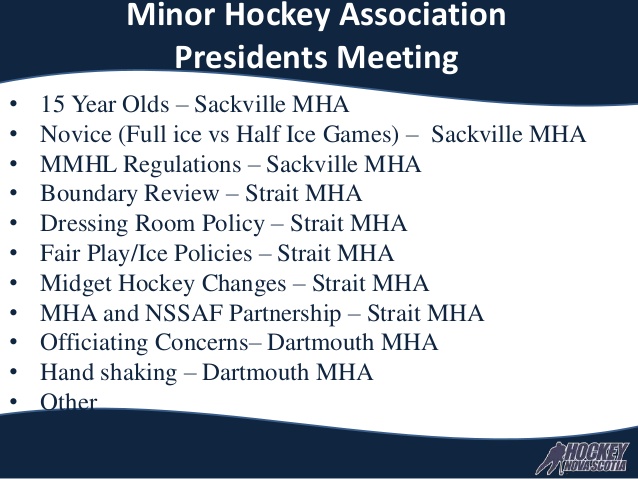
When I first began researching fair ice policies a few years back, there were only a couple that came up when I used my good friend Google. One I found was Hockey Nova Scotia which had fair play in addition to their policies for all levels including house, female and even competitive rep.


Nova Scotia Hockey AGM Agenda


Above is an image from last year’s Hockey Nova Scotia AGM. If you happen to follow the NHL at all, there are a couple of pretty good players that came from there. One happens to be the captain of the defending Stanley Cup Champions, Sidney Crosby; the other is Nathan McKinnon who many feel is the fastest player in the NHL with the puck.

I just did the same search I did four years ago in 2013 and the good news is, there is change coming. Currently the entire first page of Google outlines the fair ice policies that various hockey and ringette associations have adapted. As far as I am concerned as a coach and educator, the sooner that all major Hockey and Ringette associations implement these policies the better.

One of the top 5 reasons why players quit any sport is due to the fact that coaches play their favorites more than they do other players. In doing so, they are sending the message to those that sit that they are not good enough. As my son so eloquently shared with me after he sat on the bench for the better part of a game for non-disciplined reasons as a result of coaches’ strategy backfiring on him, he was “deprived of the opportunity to contribute to the outcome of the game.”

90% of kids would rather play on a losing team – emphasis on the word “play” in all situations – than sit on a bench for a winning team.

The only reason why players should be sitting on the bench when it comes to their turn to get out on the court, field or ice is for discipline. This could be anything from not being penalized when they should’ve been, to using bad language, to demonstrating poor sportsmanship and more. Aside from behaviour correcting actions, coaches need to take on their inherent responsibility of developing ALL of the players they’ve chosen to be part of their club, and not to rely on who they feel are their top players.

When I reached out to Cory McNabb (senior manager of player development for Hockey Canada) if he agreed with the short bench tactics that coaches in minor hockey are using, his reply was simply “Nope, if you pick ’em, you play them.”

Translation – regardless if the team in question is a house (rec) or competitive (rep) level, coaches choose the players for their team whether through tryouts, evaluations or drafts. To rely on a few players who in their subjective view are the cream of the crop,  coaches are not investing in developing all their players; something that should unquestionably be a priority above a win in the short term.

Just for a second, think back to the last 5 or more Stanley Cup Championships where commentators and coaches alike are saying they need to have all 4 lines contributing in order to win the Cup. This principle is not one that remains at the elite of the elite level. It is relevant all the way back to when kids are just beginning to develop their athletic careers at six or seven years old.

This year during my experience coaching high school rugby, the athletic director shared with me that there is no fair play code in high school sports other than grade 8 (13 year olds). The remainder of coaches for teams grade 9 and up are both allowed and encouraged to only play their top players in every game.

I had to deal with this experience first hand with my developing Rugby team this past year, which struggled to get a full field (15 players) out to any game on a good day. One match that’s been unfortunately etched into mine and my players brains was against a highly competitive school who brought out almost 30 players. Before the first half was over the ref came to me and asked what I wanted to do as we were already down 48-0.  We spoke to the athletic director of the other team and asked if they could sub in their second line players and, unfortunately, it went on deaf ears… the head coach continued to run the score up as he was focused on winning the provincials.

This I know now is the reason my son was deeply discouraged about playing different sports. A couple years ago he quit playing hockey, in large part to experience other sports and teams. When he signed up for grade 10 high school volleyball, just a few practices in, he was told point blank by the parent coach that he was only going to play his top players in games (one of whom was, of course, the coaches son).

Until the NSO/PSO/RSO and secondary school sporting bodies recognize that one of the top 5 reasons why kids are quitting any sport (just as in the case that ALA found in their survey) is because of a lack of fair play policies, attrition rates in youth sports are going to continue to grow!

Even if they implement fair play policies alone, I truly believe it will lessen that insanity in the stands which every parent knows all too well when it is time for their son or daughter to play. When the kids sit on the bench for non-disciplined reasons they get frustrated and after a season of it, it is no wonder why both player and parent opt to go down a different path (not that it is any greener on the other side of the fence).

It also will bring the love of the game back to the kids vs. the adults competing against each other through their kids.

Just because many kids may not have reached their potential at a young age doesn’t mean that they won’t be able to with future opportunities. If they are deprived of the chance to contribute it’s likely that they will quit.

Imagine if these “pretty good athletes” that went on to have insanely successful careers like Sydney Crosby and Nathan McKinnon were not given the opportunity to “play” early on in their development and were one of the 70% that quit by the age of 13 as a result.

Let’s work together to bring the game back to the Kids … where it belongs.


Glen Mulcahy


PS Tagline - Dont be a kids last coach