
Play Like A Champion Today

Posted Leave a commentPosted in Uncategorized


BONUS – Download a Free Copy of this Blog in PDF Format HERE  

I have been a fan of Notre Dame football since the glory days when they were coached by Lou Holtz and had many seasons of greatness and winning bowl games.  For many year’s thereafter they struggled to re-build their championship program since Lou Holtz retired with a record of 100-30-2 and a National Title (pre-BCS days) in 1988.

Lou Holtz’s overall winning percentage over 11 years was 0.765 and since that point Notre Dame has struggled to get back to championship form under a myriad of coaches since 1996 when Lou retired

1997 – 2001 – Bob Davie – 5 Seasons – 0.583

2001 – George O’Leary – 0 Seasons – 0.000 – although George was hired, he was let go soon after the board found out he misrepresented his academic credentials

2002-2004: Tyrone Willingham – 3 seasons – 0.583 winning % (same as Bob Davie)

2004 – Kent Baer – one game, served as interim head coach after Tyrone was fired

2005-2009: Charlie Weis – 5 seasons – 0.565 winning %

In 2010 they replaced Charlie who was a former offensive coordinator in the NFL, including the New England Patriots where they won three of their Superbowl’s with Brian Kelly.

Under Brian Kelly, the Fighting Irish have gotten back to their winning ways, Brian has lead them to a 66-33 record and 0.667 winning % and are now ranked #3 in the USA 7-1 behind #1 Alabama and #2 Georgia and are vying for a trip to the National Championship Game as a result.

Am I happy to see Norte Dame back to glory – You betcha – GO IRISH !

Several years back a work colleague of mine reached out to me and asked if I would like to see the Fighting Irish Live in North Bend and I jumped at the opportunity.  He was an alumnus of Boston College and each time BC played Norte Dame in North Bend he had access to 6 tickets (albeit they were far up in the stands as in the end zone as possible).

I will never forget that cold Day in November, when we arrived joining all the others that were tail gating pre-game (we must of all been nuts drinking beer when it was literally freezing out but thousands did the same) and then walking down the historic campus past the Golden Dome that all is emulated on the very same Norte Dame Helmets for their weekly Saturday games.

I got so distracted being in awe of the campus that I was separated from our group, but did find them later in the stadium where all seats are filled each and every Saturday.

 

Once in the stadium from our nose bleed seats, I was still like a kid opening a present I had been anxiously waiting for on Christmas day while I watched the game, the band during half time as they played the traditional fighting Irish song.  Below is a short video outlying the history and evolution of Notre Dame with the lyrics of the song that the fans and players sing after each and every game.


Not only has Norte Dame had some “pretty good” coaches, but they also have had some pretty good players over the years.  The reason I became hooked as a fan was watching Joe Montana before he went on to the NFL and lead the 49’s to 4 super bowl victories (thanks largely to have a pretty good wide receiver to throw to -Jerry Rice) and Hall of Fame inductee and I have followed the Fighting Irish with great interest on Saturdays in the fall every year.

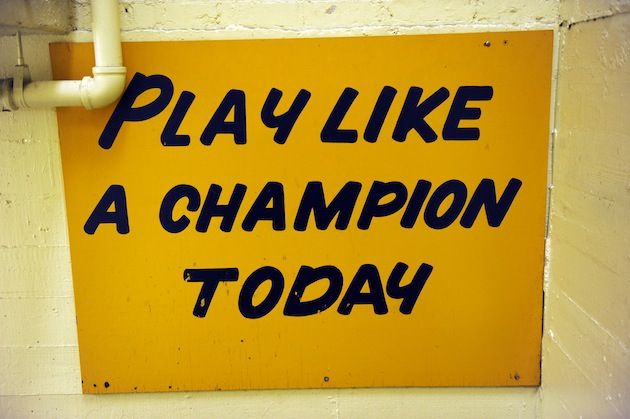
The video ends with the poster that is at the bottom of the stairs as the players head out to the field “Play like a Champion Today” and each player touches it as they go thru the tunnel onto the field.


It is also the reason why Rudy is one of my favorite sports movies of all time, the story of a Rudy Ruettiger (brilliantly acted by Sean Astin) what wants to play at the University of Norte Dame but does not have the money, the grades and many argued the physical characteristics and skills to play there.

Although he was small in stature, his heart was HUGE and was determined to play for ND and after he lost a close friend due to an accident at the steel mill he and many of his family worked at he quit his job and went to that same campus in Indianna to chase his dream.

He was advised that he had to get his grades up first and foremost, then if he did, perhaps he would be accepted but playing for the actual football team was another story in itself.

Rudy connected with a good friend at junior college across the lake a priest on the main campus helped him get into, worked thru dyslexia and got his grades up after 3 years to be accepted to Norte Dame in his last and final year as a senior.

He subsequently made the practice roster of the football team, and although was the smallest player on the field, and was thrown around like a tackling dummy by the starters, his heart transformed the team and coaches where they permitted him to dress in the last game of the season against Georgia.

Rudy was given an opportunity to play the last couple of downs of the game, got a sack in the waning seconds to fulfil his dream, not only of going to one of the top Ivy league schools in the USA, but suit up and played like a champion that day for the historic football team.

Although the movie scene was embellished, Rudy is only one of two players in Notre Dame history to be carried off the field on the shoulders of his team mates. It also happened to be the first season that Joe Montana was on the team as freshmen quarterback.

I don’t think any would argue that John Wooden was the greatest coach of all time.

I believe that Lou Holtz was another one of those great coaches.

Why?

Because like John who developed a winning tradition for UCLA, Lou was instrumental in doing the same for the Fighting Irish and his tenure began in 1986 by bringing back the “Play like a champion today” sign back to the bottom of the tunnel where it once was. He came across in a book before his coaching tenure started in 1986 and asked for it to be recreated and placed at the bottom of the stairs.

He relayed to the players he brought it back due to the storied tradition of Notre Dame, the great coaches and players before them and asked they tap the sign before each game as others had done before them.

Tap it for the sacrifices they had made, the ones their parents had made and the sacrifices and hard work they had made to play for such an iconic university.

He also reminded them that each time they tapped the sign the obligation they had to their team mates to truly play like a champion and not let their team mates down.

The third Rule that John Wooden had with his teams that I have expanded on in part for my teams was “never criticize your team mates” similar to Lou’s commitment to your team mates. My third rule (AKA standard) for my players is to respect all aspects of the game (yourselves, your team mates, coaches, officials, other teams, parents, class mates, teachers, elders and so on).

By respecting the tradition of the sign and reasons behind it, the players under Lou’s and coaches since he retired learned the tenured history of Notre Dame who played their inaugural game 130 years ago on Nov 23, 1887.

Below is a video where Lou talks about the history of the sign and the Fighting Irish including the statue that was created on campus as a tribute to him.


Lou felt he never coached football, he coached life and like John was there for his players for decades well beyond he coached them.

“Players are like your children, you love them for life.” Lou Holtz

Don`t be a kids last coach

Our role as coaches is not to make a living, but our calling/purpose is to develop youth into adults.

Please ensure that the legacy that you leave behind is a positive one like John Wooden’s, Lou Holtz and all the other great coaches out there whose athletes in turn have left positive legacies behind.

Let’s work together to bring the game back to the kids … where it belongs.

 

How to develop creative players

Posted 1 CommentPosted in Uncategorized

BONUS – Download a Free Copy of this Blog in PDF Format HERE  

As the Hockey Clinic season has started I have reinforced the importance with new coaches the importance in developing creativity with their young athletes.

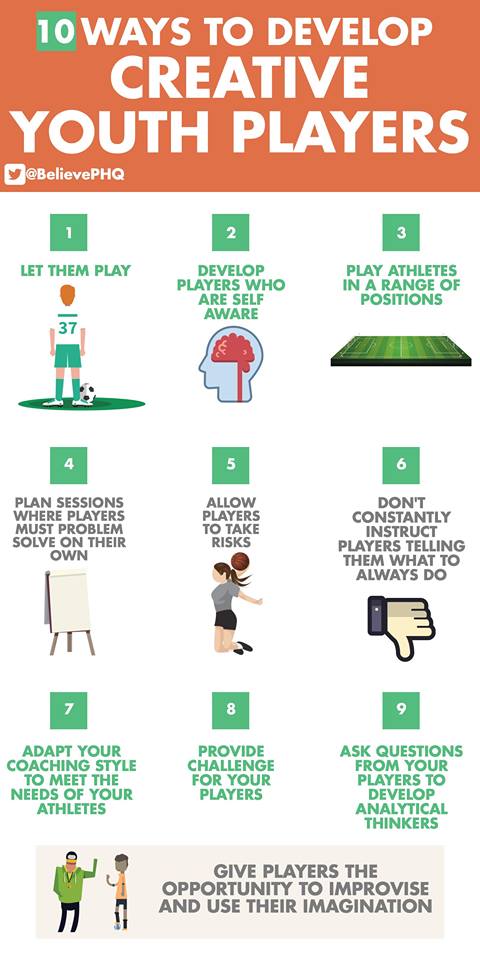
Below is a poster board of the 10 ways to develop creative youth players that we have posted to Facebook with examples outlining each.

Our thoughts on the top 10 ways;


One of the biggest issues facing youth sports today is the focus on winning at all costs where “some” youth coaches will play their favorites or shorten their benches in games to win games, tournaments and banners.  One of the top 5 reasons identified by Amanda Visek in her groundbreaking study why kids play sports is when they get an opportunity to play.  90% of kids would rather play on a losing team in all situations than sit on a bench for a winning team.

In Hockey, much like many other sports, we need to teach players positional awareness so they know where to be without the puck as players will only have the puck for a very small portion of the game. For Peewee Recreational players, the average puck time is only 8 seconds in an average 50 minute game.

Players should not be pigeon holed in a specific position until they opt to specialize in their latter teens if they follow the LTPD model (don’t get me started on early specialization). In a recent clinic where we have a bantam A1 team come out for the coaches to run thru drills, one of the players had converted from being a A1 goalie to a player and was one of the top skaters on the ice. I have even been told that some MHA’s will only permit players to try out for defence or forward and that is the position they are to play all season long.

What happens if your team suffers injuries, a flu breakout then?

Coaches should be developing players by giving them the opportunity to play all positions in game play until their late teens or even later.

Would Dustin Byfuglien or Brent Burns have been able to make the transition from D-F and vice versa when in the NHL if they had played one position only in their youth?


In lieu of planning out every single drill in a practice to limit players having the opportunity to be creative in game play scenarios, ensure that you incorporate small area games with limited instruction to permit players to work on their skills. This will permit them to be creative in 1 on 1 battles, 2 on 1 and so forth that they could then transfer to game play.

This is probably one of top challenges for youth sport coaches today, it is important that you create a safe to fail environment not only in practices and encourage players to make mistakes, the uglier the better, but also have their backs in games so they don’t play in fear.

When I have talked to WHL coaches and scouts over the years, they have identified many of the deficiencies of Bantam Draft players that affects their draft position or being drafted at all including;

  1. Lack of creativity
  2. Not being able to shoot or receive a pass on a backhand
  3. Not making backhand passes
  4. Lack of checking skills
  5. Not “competing” for pucks along the boards or in front of the net

These are all areas that coaches should be working on developing not just in practices, but also in game play in lieu of screaming at a player when they try to do so and worse yet is not executed perfectly and leads to a turnover and a scoring opportunity by the opposing teams.

Was the first goal that Free Agent Louie Erickson scored a highlight reel on TSN ? Yes, but not because he went in on a breakaway but he tried to pass the puck back on a delayed penalty and it ended up going the length of the ice and into the Canucks net.

When Brent Sutter was interviewed after the 2014 World Juniors and Team Canada did not medal, he stated one of the reasons was that we lacked skill and creativity vs. other nations.  This is due largely in part to the fact that minor hockey coaches are spending too much time telling players what to do, vs. encouraging them to try the skills that they worked on in practices.

We also need to give players the opportunity to play without coaching whatsoever, Bobby Orr attributes he development and creativity to all the repetitions he had playing on the pond in Parry Sound.  When a goal was scored, all the players would do is pull the puck out of the net and start again.  There were not coaches, parents of officials telling the players what to do.

We will never get back to that time due to the digital era we now live in, but we must find a happy medium where players are safe to fail and have the freedom to try different things in practices and games so it will make them more creative when they get to higher levels of play.

The perfect example of this transformation is John Tortorella, who for many years was known for his tirades screaming at players and officials and not connecting to his players.  Last season, he was hired to coach the Columbus Blue Jackets much to many experts surprise due to the poor outing the World Championship Team had he coached in Fall 2016 but the management of Columbus told him he would need to change and adapt in order for his contract to be renewed.

He did so and guided Columbus to a record winning streak and into the playoffs and was acknowledged as Coach of the Year in the NHL receiving the Jack Adams award.

The best coaches that I ever had in my youth challenged me every practice to become the best player I could be, and they did so without being demeaning. That is the fine line we all have to walk, but in order to get the best out of our players individually and teams collectively is to push our players to become better each and every practice.

Reinforcing the importance of effort, praising when they make mistakes so they get up and try again.  As I have told every player over the years, if you aren’t pushing yourself, you are never going to get better.

If we continue to let them do it the same way over and over again and expect different results, that is insanity – Albert Einstein

In every practice and games I ask players what do they need to do, or we as a team need to do to improve?  Then I wait for the answers.

I have done this with Novice all the way to Midget and all age groups in between in both the competitive (rep) and recreational (rec) streams.

What I have also learned is the importance of P&R (Patience and repetitions from Terry Crisp), as yout sport coaches we have to be patient first and foremost and we have to provide opportunities for players to work on their skills thru numerous repetitions, adding to the difficulty (progression) thru the season.

The funniest anecdote I have shared in many clinics is a player that I had on my Bantam A2 team, at intermission breaks I would ask the players what we needed to do in the next period and he was infamous for one word answers like

Pass

Shoot

Score

His nickname became “Cone head” from the movie miracle for Herb Brooks Line “Cone Heads” when they came into his office and said coach we pass, we shoot and we score.

This is probably the biggest challenges for coaches, many want to develop set systems, tactics and strategies and many will scream at their players if they deviate from in game play.

I will never forget talking to a defencemen on a Bantam A1 team who shared the analogy with me that the coach only had one set play for power play where the team would cycle the puck to set up the weak side D to come in the back door and shoot on goal.  The problem was every team clued into the set play at the first powerplay each game and would position a player in the gap to prevent that setup pass or prevent the defensemen from shooting.  He (13 years old at the time) stated as he was not given any options, would try to slap the shot thru that player but would have to shoot wide as did not want to hurt him.

I heard similar stories from many other players over the years as coaches were not giving them the opportunity to “adapt, overcome and improvise” in game play.

Coaches, practices you can control, but games you can not as there are too many variables (other teams, coaches, the officiating) so it this last point is the key takeaway, you MUST support your players to improvise in all game situations, if you have a set play, provide players option B, C, D etc. so they can still follow in part but use their imagination in doing so.

Let’s work together to bring the game back to the kids.


PS Tagline - Dont be a kids last coach

Why Kid’s Play Sports

Posted 1 CommentPosted in Athlete, Coach, Organization Executive, Parents, Uncategorized

Why Kids Play Sports2

BONUS – Download a Free Copy of this Blog in PDF Format HERE  


Quote for our upcoming newsletter is one that I share in every clinic or talk I do, “Kid’s play sports because it’s fun and quit when it no longer is … it’s not rocket science.”

It amazes me how few answers when I pose that question either in workshops or keynotes, of 30 people, a few say “fun” but then I hear a myriad of other answers including winning.  This week I will share why kids play sports to piggyback on recent back to back appreciation weeks, the first coaches week to thank all the volunteer youth sports coaches in Canada for everything they do, the second week for all the youth sports parents.

Too often traditional and social media have focused on the doom and gloom in youth sports, yes SOME coaches are abrasive focusing on winning above all else and SOME parents take it over the top on the sidelines, stands at youth sports games but the reality is many are GREAT and without their support kids would not have an opportunity to PLAY a game they love.

Early on in my youth sport coaching “career” as a volunteer, I started asking three questions of the players on my teams and I recommend all youth sports coaches do the same at the beginning of each season they coach

Question 1: Why are you playing X?

Answer? All of the players I asked would say Fun … from 7 year old recreational to 17-year-old AAA players and everything in between.

Question 2: What is fun about X?

Answers?

They varied from early on when the kids were Novice age groups focusing on things like the snacks, pool parties, windups then as kids got older things like working on their skills, making friends, staying in shape to learning life lessons like learning respect from coaches, leadership, communication, work ethic and so forth.  Older age groups I also asked them what was not fun and over and over again was the adult criticism (from parents and coaches) when coaches played their favorites (ran short benches) and ride home which I will defer to further post why kids quit sports.

I joke with coaches in clinics, workshops that the first question kids ask when they get in the dressing room is?

What is the snack?

The last question they ask when they leave is?

When do we play again?

Fast forward 25 years and think about the sports you play as adults like slo-pitch, adult rec hockey and what is the first question you ask as the game is over and go to bench or dressing room?

Coach — Who has and how much is the beer? (AKA Snack)

The last question you ask when you are leaving?

When do we play again?

IT DOESN’T CHANGE if we instill the love of the game when kids are young so they love a sport to play and be active for a very long time.

Sadly that love or passion for sport and activity is not there like it was in past due to all the issues that have evolved that has affected today’s generation of kids but we can change it if we let kids PLAY again without criticism, reduce the structure and bring back more free play.

If you don’t believe me and have not had a chance to listen to Amanda Viseks podcast with WOC then I will give you the anecdotal studies of thousands of kids based on her research at George Washington University.

Like I, Amanda asked kids why they played sports, and over 95% stated because it was fun.

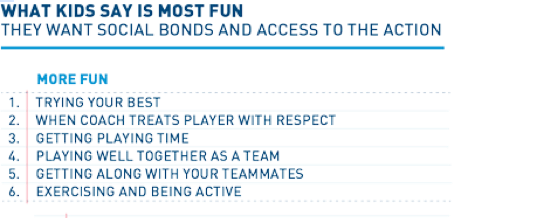
She then asked them to define what was fun, and she got many of the same answers I did as well as many others.  In fact, she identified 81 characteristics why sports was fun, below are the top 6 reasons;


Trying their best, respect from coaches, get playing time, exercise and being active were all answers I received every time I asked my teams and various of 4 and 5 were getting to meet new friends and having fun as a team so none of these answers surprised me.

At NO point in all the years and all the teams I asked the question what was fun, NO player answered winning.

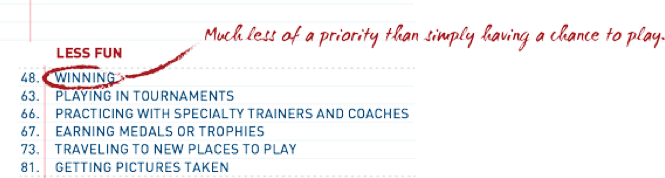
I know that is the adult’s motivation more than kids but Amanda confirmed it, below are the latter half of the 81 characteristics why sports were fun;

In the bottom ½ of the list (48 of 81) winning was mentioned, but there were 47 other reasons why sports were fun to play.

Few other ones Amanda highlighted also, earning medals/trophies ranked 67th on the list!

July 3rd, 2018 Update – I wrote this in October 2017 where we originally shared the quote why kids play sports.  In addition to trophies, note that other least fun activities are playing in tournaments, travel and working with specialty trainers which continues to feed the $15 Billion business model that youth sports have become vs. focusing on the top 5 reasons why sports are fun.  The reason I said it’s not rocket science, is one only has to ask kids why they play to get the answers, something I have been doing for many years as a means to connect with my players and also share with parents so all of our goals align vs. adults competing with other adults thru their kids.

Coincidentally, in my interview with Dr. Wade Gilbert (AKA the Coaches Doc) for our inaugural digital summit, his #1 tip what coaches can do so kids love the game at the end of the season is #3 of the reason why kids play sports, is let them PLAY.  Due to the winning at all costs focus of travel teams, even when you make the travel team, many kids are victims of a short bench and don’t get the opportunity to do so, no wonder why they are putting up the white flag and 70% are quitting before they enter high school. 

AGAIN, IT’S NOT ROCKET SCIENCE.

Please NO MORE participation trophies, if players on competitive sports teams are ranking trophies at the bottom 1/3 of why sports are fun, for recreational or participation only they have no value whatsoever and like my son’s participation trophy from t-ball merely get put in the Toy Story box to be recycled down the road.

The same is going to hold true for the other extreme I came across recently, Rawlings is sponsoring the National Championships of U6 T-Ball.


Has Rawlings lost their minds? Sponsoring a National Championship guaranteeing 4 competitive games for 4-5-year-old kids?  Worse yet, in November AFTER even the professional MLB players are DONE for several months.  Will coaches commit to becoming the FIRST ever (and hopefully last) World Champions of T-Ball be flying in ringers? Didn’t USA Baseball just roll-out their LTAD model and are they not supporters of Multi-Sport Participation when kids should be sampling as many sports as possible until they reach adolescence?

This only a few weeks after Aspen Institutes Project Play had their 2017 summit and talked about the importance of sampling, free play activities before kids became teenagers?  How are programs developing where kids organize their own sandlot games without any adults present? In my new post will share insight from their recent summit.

This has gone viral via social media (thankfully there are other sane adults thinking the same as I am).

4-5-year-old kids should merely be playing, focusing on developing all their fundamental movement skills throwing, catching, two and one handed striking, kicking, falling and getting up and so on NOT traveling to Houston to play 4 competitive games costing their families thousands of dollars.  That is one of the reasons why youth sports now a $15 Billion industry in the USA!

Baseball in the US has seen increases in total participation in recent years thanks to MLB’s Play Ball program, and although this may be argued is a means to plant the seed to get in the game early, but there is such a thing as too early and too much and this is over the top.

So if you don’t believe me, you don’t believe Amanda’s research, maybe you will believe the kids.  Below is a panel was done at the Aspen Institute Project Play – So when do kid’s get a vote?


Youth sport and free play will never get back to what it was for our generation due to the digital evolution but we MUST find a way to bring the game back to the kids … where it belongs.

Otherwise, the current trends where 70% of kids are quitting all sports by the age of 13 will just continue to get worse.

PS Tagline - Dont be a kids last coach


10 Coaching Commitments – USA Hockey

Posted Leave a commentPosted in Uncategorized

BONUS – Download a Free Copy of this Blog in PDF Format HERE  

10 Coaching Commitments

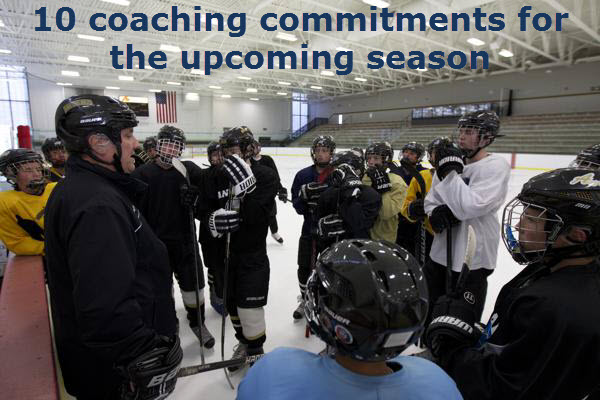
Earlier this month USA Hockey announced the 10 coaching commitments they are going to be asking from all their coaches for the upcoming season and beyond.

Why?

Because the want to not only help players become the best they can be but create a lifetime love for the game so they play well into their adulthood.

Below are the 10 commitments with our comments;

1. Commit to Age-Appropriate training

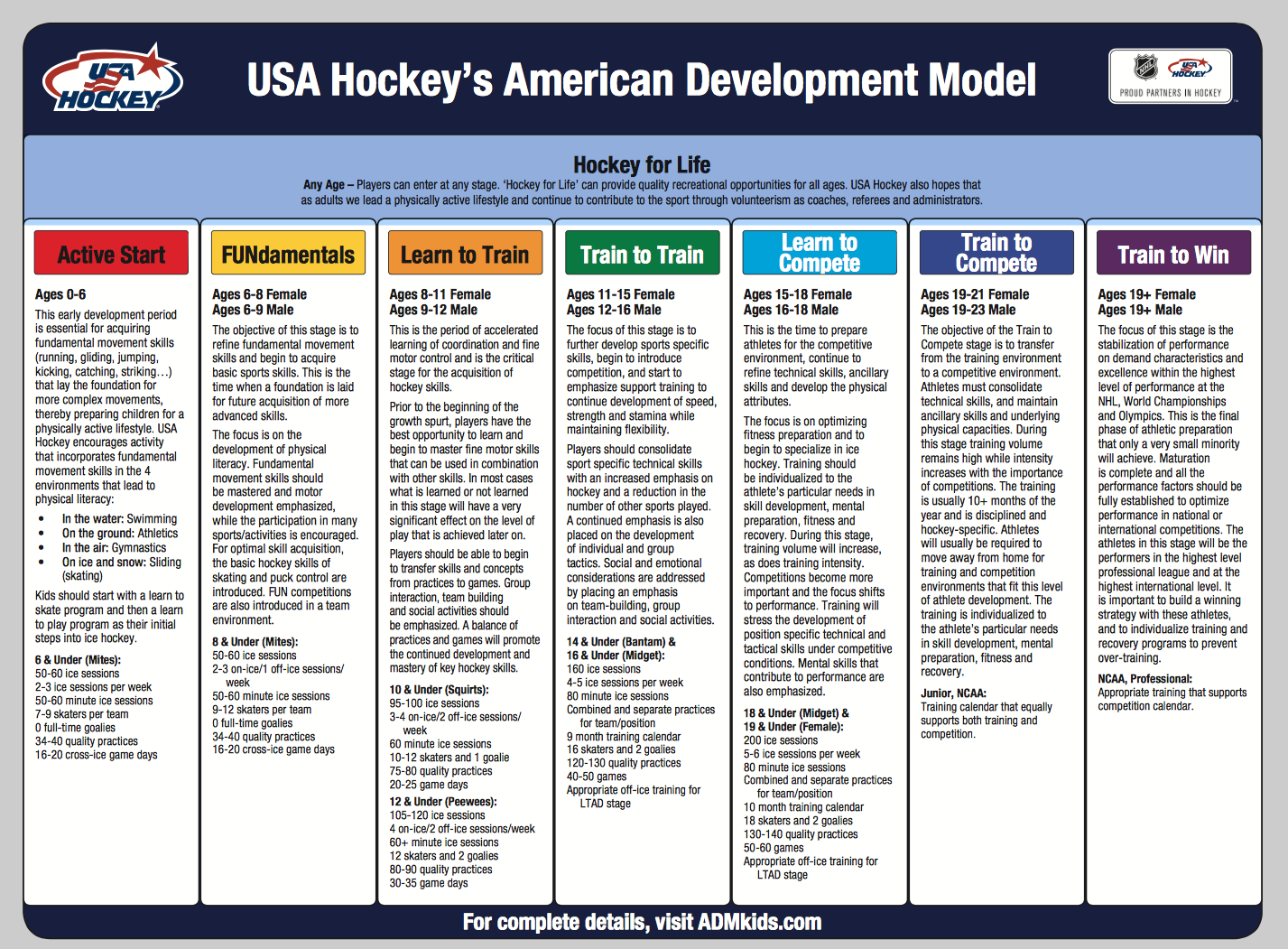
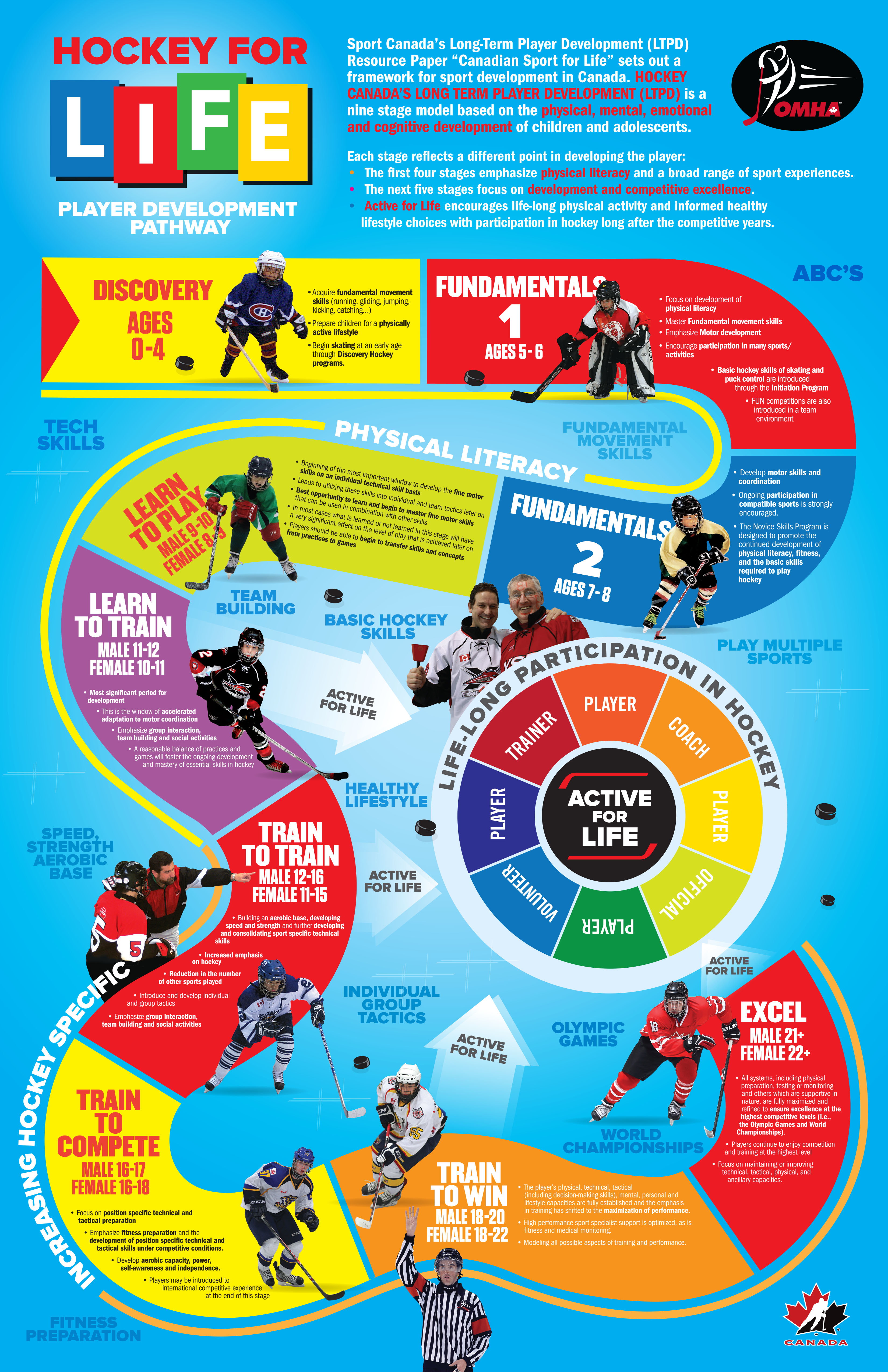
Follow the ADM (American development model) and they windows of trainability. This is the USA equivalent of the LTPD (Long term player development) model that Hockey Canada introduced several years ago so coaches focus on core skill development during the core motor skill development years and introduce systems and tactics afterwards.

Below is an outline of the ADM and LTPD summaries and their respective stages in the development pathways

USA Hockey – ADM


Hockey Canada – LTPD (Long term player development) Model


In order to ensure that coaches do follow LTPD, one of the steps that Hockey Canada is introducing this year is mandatory cross ice hockey for the initiation age group (5-6 years old) and then in 2019-20 season will make it also mandatory for 7-8 year old players to allow for a transition moving from full ice to cross ice hockey.

This should have happened LONG ago, and it is very apparent that parents don’t understand the science behind the two models as became evident when parents of “elite” 6 year old players on “select” teams threatened to move to other areas to play on a “varsity team”.

All the more reason why parents MUST be educated about the benefits of LTPD, and based on surveys I have done of parents in recent years (including parent coaches), we still have a lot of work to do to educate all parents in Canada regarding the science, once we do so it will alleviate a lot of the mayhem we are seeing in games.

2. Commit to Skills and station-based practices.

The director of USA Hockey Coaching Education program. Mark Tabrum, states that even U16 (top 15 year old players) practices should still include individual skill work for ALL age groups. The core age groups per LTPD (Hockey Canada) for motor skill development is between the ages of 6-12 (Initiation to Peewee Age Groups)

Literally every time I go to the rink I see coaches running practices focusing 2/3rd of their practice slot on breakouts, power play, penalty kill, neutral ice transition and so forth as early as Novice Age Groups. When I talk to them after a practice, they say it is due to the fact they were unable to score on power play, breakout of their own end, enter into the offensive zone or kill penalties.

I counter – the reason your players are not able to successfully run the systems, strategies is to the fact they lack the necessary core skills to do so. Regardless if Novice of Bantam AAA, players must work on core skills so they can execute systems, otherwise they will continue to struggle.

3. Commit to a Culture Change

In lieu of the traditional practice where players show up 20-30 minutes early, practice for one hour, then undress and out of the rink 15 minutes later plan for the same dynamic warm-up that you would do for games followed by a cool down routine after the practice.

Reason – because kids need 60 minutes of activity each day, and even the best run practices they will only be active for 40 minutes but it is also important to warm-up and cool down to avoid injuries like pulled groins, hip flexors that are very common in hockey.

4. Commit to Small Area Games

This holds true not just for the younger age groups (reason why Cross Ice Hockey is being rolled out), but also the older age groups. Hockey is all about time and space, and being able to go where the puck is GOING TO BE (not where it is) in order to move the puck out of your zone and enter opposing zones to create scoring opportunities.

Even coaches in the NHL incorporate small area games in their practices and they are coaching the most skilled players in the WORLD.

Click HERE to read our post on the benefits of Cross Ice Hockey


5. Commit to Off-Ice Training (AKA – multi-sport activities)

Tabrum also comments on the need to develop physical literacy in others areas than just core hockey skills … in the summer time throwing a football or baseball, kicking a soccer ball. “We want to get back to two- and three- sport athletes in high school and get away from specialization”

USA HOCKEY endorses multi-sport participation until high school, so why on earth are parents encouraging and worse yet paying for their kids to be involved in hockey year round starting at 6 years old?

I just came back from New Brunswick where I spoke at CoachNB Beyond Coaching conference and after my presentation several coaches queried how they can stop madness of early specialization. One coach who had been a gymnast, one of two sports identified as an early specialization sport came to me and stated she quit gymnastics at 13 years old as it was too much, 25+ hours a week of training plus competitions and she wanted to try other sports and other activities at school like drama, art, music.

I recently came across this video, one of the elite skills instructors in the world, Sean Skinner who has worked with literally everyone in the hockey world. He started a hockey academy and referenced the 10,000 hour rule originally proposed by Malcolm Gladwell in the 90’s that it takes 10,000 hours to develop elite skills.

This is one of the drivers why parents are putting their kids into skills academies as can’t get there if only practicing 2-3 times a week. In lieu, he uses the Olympian Gymnist analogy (which is an early specialization sport) could be practicing 5-6 hours a day and how his academy offers the same for hockey daily both on and off ice and then they go with their teams and play 3-4 times are week.

Although the 10K was a go to for several years, but recent research by Anders Erikkson in his book Peak released last year talks about Gladwells 10,000 hour rule and provides data and research it is not about the reps, it is about how deliberate the practice is that leads to elite level skill development.  One of my daughter’s coaches used the analogy, 10,000 reps makes permanent, but what happens if you do it wrong and don’t correct the mistakes?

Making kids practice 5 days a week, play 3-4 games a week is INSANE, and does not allow kids to be kids which is one of the driving reasons why 70% of kids are quitting by age 13 as they have already “worked” the sport year round racing to get in the 10K hours vs. following the long term development path as hockey players don’t peak in their skill development until their 20’s, goalies even later.

Thank you Mark and all others at USA Hockey for endorsing multi-sport participation for all the benefits vs. early sport specialization hockey academies like the one that Sean Skinner is running in Minnesota.

6. Commit to your goaltender

USA Hockey has introduced materials for coaches called Goalie Nation, much like Hockey Canada who has specialty clinics for coaches to better understand all the basics of the position.

It is the most skilled position on your teams, but unfortunately many coaches use the excuse “I did’t play goalie so don’t know how to coach them”

Visit www.usagoaltending.com for drills and resources to help develop your goalies.

Two recommendations we share with coaches in Hockey Canada clinics is to ensure they plan for goalie development in all drills, don’t just use your goalies as shooting tutors. If you are not comfortable coaching the goalies, one tip is to recruit goalies from older age groups in your association to come out to your practices to work with your goalies. Many schools require that student’s complete community service credits and this is a great means for them to do so and at the same time mentor younger goalies in their associations.

7. Commit to teaching body contact and body-checking

Mark shares that it’s it crucial doing things off ice to teach body contact and body checking confidence starting at the U12 level before body checking is permitted at the U14 competitive level and we could not agree more.


The reason that body checking is part of hockey is to separate the player from the puck, NOT separate the head from the body. Many players that have not developed the confidence for body checking will either raise their elbows to protect themselves or worse yet initiate contact with their elbows with is one of the biggest contributors to concussions.

Hockey is a contact sport even without body checking, and coaches should reinforce the proper checking techniques early on as it is one of the core skills of hockey.

Gone are the days where kids that will be entering levels with body checking only participate in a one hour clinic to prepare them for full contact, it must be a progression just like all the other core skills of hockey as it takes YEARS to develop the confidence for full contact play.

8. Commit to and download the USA Mobile Hockey APP

Here is the link to the USA Hockey Mobile Coach App that provides resources, drills and practice plans in the palm of your hand.

Click HERE to download the USA Hockey Mobile Coach App

The Hockey Canada equivalent is the Hockey Canada Network App,

Click HERE to download the Hockey Canada Network App

It has the entire Hockey Canada digital library of practice plans, videos and various other resources so coaches can plan their practices more efficiently and provide videos to all players and coaches in advance. Don’t make the mistake that many young coaches do and try to design practices on their own, the greatest minds in Canada have contributed to the resource library for decades for Hockey Canada, we highly recommend you use it and will save a lot of time each week.

9. Commit to equal playing time (AKA fair ice policy)

Per Mark Tabrum at USA Hockey  “if you choose them, they were selected (BY YOU) to play on your team – and should play like everyone else”

Per Corey McNab, director of player development for Hockey Canada that shared in a recent summit I attended “ If you pick ‘em, you play them”

Coaches need to recognize the importance of the process of player development, following the ADM/LTPD models vs. focusing on the scoreboard. Too many kids are quitting hockey in both countries as a result of winning at all costs philosophies.

The fact that a National Sporting Association is endorsing equal or fair playing time is something we have been pushing for many years. No kid should sit on a bench for undisciplined reasons to win a game or a tournament, as the old cliché goes … you win or lose as at TEAM.

When kids are victims of a short bench strategy, they will probably quit as a result, and our job as coaches is to instil the love of the game and passion so they come back each year.

Don’t be that coach that only plays his favorites and deprives other players on your team you selected to be deprived the opportunity to contribute to the outcome of the game.

Otherwise – you may end up being that kid’s last coach.

10. Commit to emphasizing fun

The number 1 reason why kids play any sport is that it is fun, and the #1 reason why they quit is it no longer is. This holds true for recreational level all the way to the high performance and everything in between.

Even professional athletes state over and over again, they opted not to retire as they were still having fun. Prior to the 2010 Gold game, Mike Babcock told the best players in Canada to “just go out there and have fun”.

Coaches that balance competitive play ensuring that it remains positive and an enjoyable experience at all team activities will realize the greatest reward a coach will receive, when every player returns to play the following season.

Kudo’s to Mark Tabrum and the rest of the USA Hockey Executive team for putting forth their 10 coaching commitments they would like to see from their coaches for this and upcoming seasons.

Let’s work together to bring the game back to the kids … where it belongs.
PS Tagline - Dont be a kids last coach

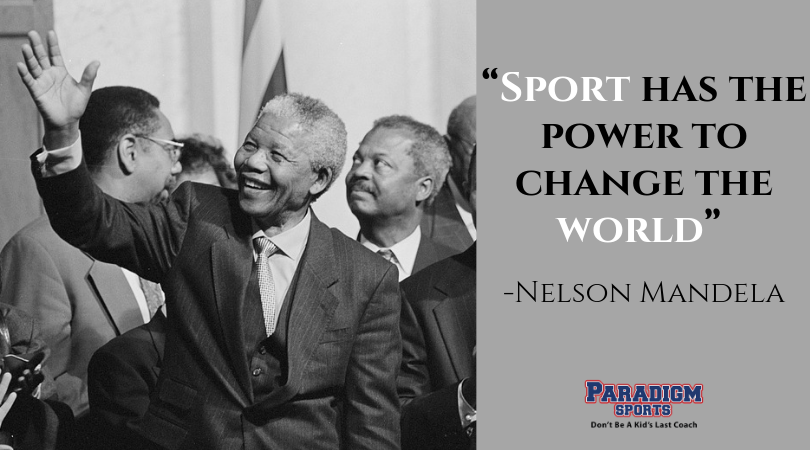
“Sport has the power to change the world” – Nelson Mandela

Posted 1 CommentPosted in Uncategorized

BONUS – Download a Free Copy of this Blog in PDF Format HERE  


“Sport has the power to change the world” – Nelson Mandela

In preparation for talks will be doing this coming weekend for Coach New Brunswick’s Coaching Beyond Conference to wrap up National Coaches Week in Canada, I plan to start my presentation how powerful sport can be and who better to reference that the great Nelson Mandela who transformed a nation.

Below is his speech that he did for the inaugural Laureus World Sports Lifetime achievement awards held in Monaco in 2000.

Here is the full transcript of his speech;

Thank you. Thank you. Thank you

I am happy to be with you tonight at the first Laureus World Sports Award. Sport has the power to change the world. It has the power to inspire, it has the power to unite people in a way that little else does. It speaks to youth in a language they understand. Sport can create hope, where once there was only despair. It is more powerful than governments in breaking down racial barriers. It laughs in the face of all types of discrimination.


The heroes standing with me are examples of this power. They are valiant not only in the playing field, but also in the community, both local and international. They are champions and they deserve the world’s recognition.

Together they represent an active, vigorous Hall of Fame. A Hall of Fame that goes out into the world, spreading help, inspiration and hope.

Their legacy will be an international community where the rules of the game are the same for everyone, and behaviour is guided by fair play and good sportsmanship. I ask you now to rise and join me in commending the original inductees into the World Sports Academy Hall of Fame.

It is now my great pleasure to present a very special laureus award – the Laureus Lifetime Achievement Award – given to a world athlete who exemplifies the highest virtue of sport, honour, courage, joy and perseverance. Our first honouree is a man who is both an athlete for the ages and a beacon of hope for the millions.

He began life in poverty and rose to the highest level of fame. To watch him play was to watch the delight of a child combined with the extraordinary grace of a man in full.

Ladies and gentlemen

It is my honour to present the inaugural Laureus Lifetime Achievement Award to Edson Arantes do Nascimento or as he is known to world – Pele.
Pele is in Rome tonight to join with other world soccer stars in an international football match for peace.

[PELE]
Thank you very much Mr Mandela. It is a big honour to me to receive this award. And I want to thank also to World Sports Academy for this. Everybody knows I am in Roma. We are here for the peace in the world. Beautiful event, beautiful game. One more time – thank you Mr Mandela , thank you every body for that.
[PELE ends]

Congratulations to the great Pele. You are an enduring model for all athletes. In fact, for all of us, to admire and emulate. Thank you and good evening.

Ladies and Gentlemen

Peace is the greatest weapon mankind has to resolve even the most intractable difficulties. But to be an effective agent for peace, you have to seek not only to change the community and the world.

What is more difficult is to change yourself before you seek to change others. Only those who have the courage to change themselves and to know that in all communities without exception there are good men and woman who want to serve their communities.
In regards to the peaceful resolution of their problems and it is absolutely essential for the leaders of the community and the world to create an atmosphere where those good men and woman can show their maximum abilities in trying to resolve problems in a peaceful manner and that is why a legend like Pele and all of these behind me are our heroes, our hope because what ever they do in their respective fields they are promoting peace. These are monarchs, they are queens and kings, not as a result of heredity, but as a result of their personal commitment and efforts. It is one of the most enjoyable moments for me to be able, as a pensioner take part in a function of this nature.

Thank you

End Transcript

Who better than Nelson Mandela to award the greatest footballer of all time, Pele, the lifetime achievement award at the inaugural awards ceremony. Each year Laureus awards teams, men and women for their contributions to global sport.

One of the teams that has been acknowledged is the South African Springboks, for their accomplishment winning their second world cup of rugby in 2007. The year that the New Zealand All Blacks recognized that they had to change as they “expected” to win the world cup that year, but did so in back to back World Cups in 2011 and 2015 as a result of all the changes they implemented.

Although I played many sports, Rugby my favorite, it is a hooligans game, but it is played by gentlemen.

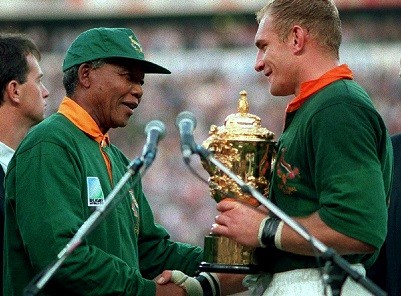
Sport can truly change the world, see how South Africa’s Sprinbok team transformed their nation with a little help from Nelson Mandela in 1995.

Fast Forward 17 years after Nelson Mandela’s speech at the Laureus Awards ceremony, although the Springboks did transform their nation that was once torn apart by Apartheid leading to his imprisonment for 27 years, we still have a lot of work to do to eliminate racism and intolerance in sport.

In 2008, True sport posted survey results where the second most serious issue facing youth sports today was intolerance and racism.

Intolerance towards aboriginal people, colour, gender, those with disabilities and members of the LGBT communities has been a focus of many organizations in recent years.

Like Nelson Mandela, I also believe that Sport has the power to change the world but it is not sport itself, that develops character, teach life lessons of facilitate change, it is the coaches in sport that does.  Ensure that you have a zero tolerance policy as a coach for any forms of harassment, intolerance or racism.

Although some youth sports coaches and parents are leading to the myriad of issues that go viral on social media literally daily, there are so many GREAT coaches out there that will change it for the better.

We have our work cut out for us, but I believe as coaches continue to add to their toolbaskets, continue their education and recognize there is so much more to coaching than the X’s and O’s we will create the positive youth sports experience so kids remain in the game well beyond current trends where 70% are quitting by 13 years of age.

Kudo’s to all those volunteer coaches that spend 100’s, if not 1000’s of hours to help kids become not only the best athletes, but the best people they can be.

Remember, as coaches you don’t make a living, in lieu your purpose is to make a difference by developing youth into adults.

Thanks Coach – for everything that you do.


Let’s continue to work together to bring the game back to the kids … where it belongs.
 

Don`t be a kids last coach