How do you shave years off your learning curve? Find a mentor.
Posted Posted in Athlete, Coach, Organization Executive, Parents


As we head into the upcoming fall season for many sports, I wanted to reinforce the importance for coaches to recognize the importance of lifelong learning.

Mentorship has always been something that I have believed in since I started coaching, initially as the mentee seeking the mentor, then as the years evolved it was I that was asked to provide insight to fellow or younger coaches as the mentor.

Last spring, I wrote about the importance of mentoring in “Coaching Skills in Sport and Skills in Life” that thinking back I should have titled the post “Ode to Glenn Zwick” as it was a tribute to the coach who acted as my mentor for many years who had probably forgotten more about hockey and softball than I will ever know.

Since that point I have had the opportunity to interact with some of the worlds top experts in sport across the globe while hosting our online events hosted thru our digital arm “For the Love of the Game” and one of the questions that I ask all guests is what coaches can do to shave 5 years off their learning curves.

To which many of the top experts I talked to shared what I truly believe in as well …

 Find a Mentor.”

One of which who shared that with me was John Kessel, Director of Sport Development for USA Volleyball, who has been coaching now for over 5 decades and has worked with thousands of players and coaches.

Had it not for Glenn’s mentorship when I first started coaching softball and hockey and then evolving into other sports, I can say I would have made many more mistakes (even though still had a fair share) and I also would not have recognized the importance of lifelong learning.

When I first graduated from my many years of university and college that last thing that I wanted to do was EVER read a book, particularly a textbook, or sit in on a clinic, course, conference or what have you.

Then I came across this quote by Clare Drake years after I graduated…..
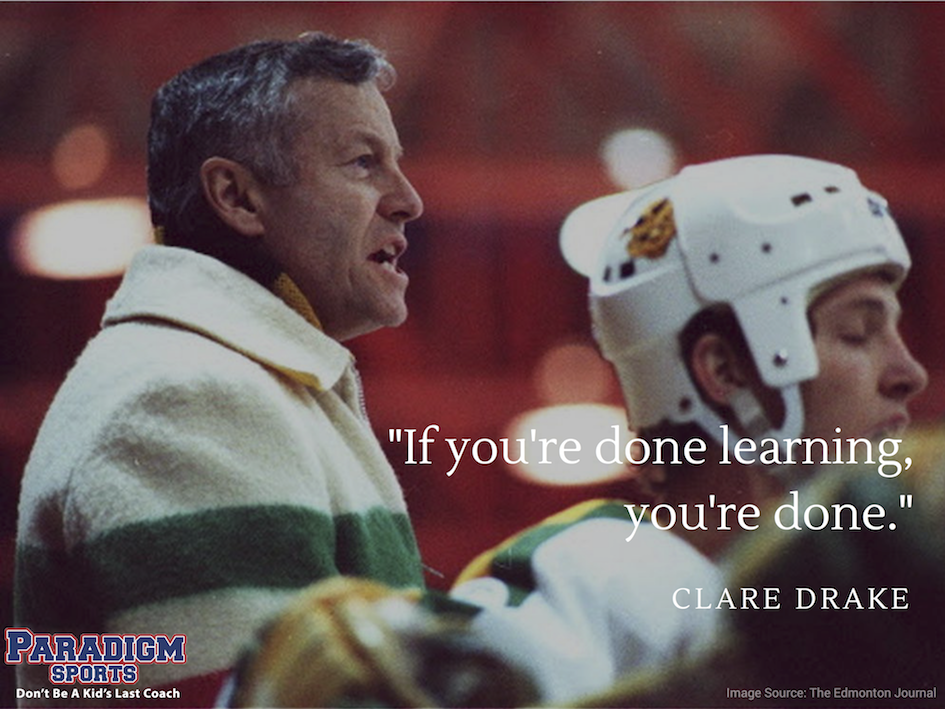
Clare (Canada’s John Wooden) was infamous for speaking at conferences well after they retired and after they did so would go sit with the attendees and take pages of notes.

When prompted why they did so their answers would be … because I may learn something.

Great coaches recognize the importance of lifelong learning.

Having coached now for over 25 years, I can honestly say any time I have the opportunity to either facilitate a clinic or course, deliver a keynote or be one of the attendees I jump at the opportunity.

Why?

Because now I can hardly wait to learn more, add to my toolbox so I can help others do the same.

Every time I run a clinic or workshop it is not only an opportunity for me to present the course materials but to have the opportunity to share insight and also learn from all those in the room.

I also have had the true privilege to mentor the next generation of leaders from my Alma Mater, UBC Kinesiology, as a Mentor but also for various co-op students that have worked with us over the years who have been instrumental in our growth as an organization.

A year ago I highlighted many of those other co-op students who contributed in prior post à bientôt which I shared with the two students as they finished their summer co-op term last week and today our 16th co-op student started.

I am not a fan of saying goodbye, rather the French saying I learned long ago (at one point I was pretty good in French but as they say, if you don’t use it, you lose it) as I have had the opportunity to connect with many of our former co-op students over the years.

One reached out to me a few weeks back and said “let’s go for a beer” which was pretty cool and he shared all the different projects was working on and how happy he was to see our growth since he did the second pass of our PARADIGM Sports Website now 2 years back (hard to believe how fast time has flown).

I have also had students provide testimonials, even recommendations for co-op supervisor awards and the biggest honour I received to date was when I was nominated for an alumni builder award by my Alma Mater, UBC School of Kinesiology, for mentoring, participating in expert panels and career fair.
 

I truly value mentoring and now jump at the opportunity whenever I get a chance to do so, as without someone to mentor you, how are you going to become better as a coach to help your players do the same?

In the last couple of weeks, I was asked to present at the PCAHA (Pacific Coast Amateur Hockey Association) Coach Coordinator meetings regarding the changes that BC Hockey has made to the practice evaluation process for competitive coaches.

Our goal is to have every coach that attends a clinic complete their certification for all clinic requirements in one season, and the practice evaluation is the opportunity of coach coordinators, technical or athletic directors are various minor hockey associations to provide insight during a practice evaluation.

The whole intent of the practice evaluations is for coaches to be mentored from tenured coaches and receive feedback on what they are doing well as well as what areas they could work on.

So as John Kessel (Kess) shared when I talked to him this summer, you coach these kids, who coaches you?

Another reason why you want to seek out a mentor is so you have someone to reach out to when you run into situations or issues unsure how to deal with to get advice, many times early on in my youth coaching days I made phones calls to or picked Glenn’s brain on the bench when girls were warming up about various challenges I was having.

In many instances he would merely state ”I really wish the adults would recognize it should be just about the kids and not focus on the results (wins, banners), at the end of the day we should help the kids become great people”

Fast Forward many years after he passed away, I now have been able to share many words of wisdom with coaches across Canada and like all of those that shared with me #1 tip I would share for you is to find a mentor.

Reach out to your coach coordinator for recommendations or go to an older teams practice to see how they run it, ask the coach if has time to share some words of wisdom over a coffee and you would be amazed how many are more than happy to do so.

Why?

Because for the most part (except the vocal minority that the tournaments and banners are the drivers), we are all in it for one reason, the Kids.

If we can help a younger coach hone his or her craft, it is our way of paying it forward so they can help their players do the same.

I also would recommend that you reach out to coaches in other sports, not just the one you are coaching for insight as never know what tips you will get.

Lastly, remember that whatever clinic you took for your coaching level is just the start of your journey, continue to read, attend conferences (our online event is a great way to learn from global experts 8-)), listen to podcasts, read books etc. so you can become the best coach you can be.

Why should you do so?

Because our purpose is not to make a living.

In lieu, our calling or rai·son d’ê·tre (reason for being) is to make a difference by developing youth into adults.

Please ensure that your legacy is a positive one and you are not a kid’s last coach.

Per Kess, I would be remiss in not sharing out his touching acceptance speech when he was inducted into the American Volleyball Coaches Association Hall of Fame where he thanks many of past and current mentors as well as his challenge to all coaches to “Never Be a Child’s Last Coach

We concur.

(In our chat he and I had a good laugh how much our philosophies were similar as I have shared “Don’t be a Kid’s Last Coach for years)

Let’s all work together to bring the game back to the kids … where it belongs.

BONUS – Download a FREE printable PDF version of this blog HERE

 

Play Like A Champion Today

Posted Leave a commentPosted in Uncategorized


BONUS – Download a Free Copy of this Blog in PDF Format HERE  

I have been a fan of Notre Dame football since the glory days when they were coached by Lou Holtz and had many seasons of greatness and winning bowl games.  For many year’s thereafter they struggled to re-build their championship program since Lou Holtz retired with a record of 100-30-2 and a National Title (pre-BCS days) in 1988.

Lou Holtz’s overall winning percentage over 11 years was 0.765 and since that point Notre Dame has struggled to get back to championship form under a myriad of coaches since 1996 when Lou retired

1997 – 2001 – Bob Davie – 5 Seasons – 0.583

2001 – George O’Leary – 0 Seasons – 0.000 – although George was hired, he was let go soon after the board found out he misrepresented his academic credentials

2002-2004: Tyrone Willingham – 3 seasons – 0.583 winning % (same as Bob Davie)

2004 – Kent Baer – one game, served as interim head coach after Tyrone was fired

2005-2009: Charlie Weis – 5 seasons – 0.565 winning %

In 2010 they replaced Charlie who was a former offensive coordinator in the NFL, including the New England Patriots where they won three of their Superbowl’s with Brian Kelly.

Under Brian Kelly, the Fighting Irish have gotten back to their winning ways, Brian has lead them to a 66-33 record and 0.667 winning % and are now ranked #3 in the USA 7-1 behind #1 Alabama and #2 Georgia and are vying for a trip to the National Championship Game as a result.

Am I happy to see Norte Dame back to glory – You betcha – GO IRISH !

Several years back a work colleague of mine reached out to me and asked if I would like to see the Fighting Irish Live in North Bend and I jumped at the opportunity.  He was an alumnus of Boston College and each time BC played Norte Dame in North Bend he had access to 6 tickets (albeit they were far up in the stands as in the end zone as possible).

I will never forget that cold Day in November, when we arrived joining all the others that were tail gating pre-game (we must of all been nuts drinking beer when it was literally freezing out but thousands did the same) and then walking down the historic campus past the Golden Dome that all is emulated on the very same Norte Dame Helmets for their weekly Saturday games.

I got so distracted being in awe of the campus that I was separated from our group, but did find them later in the stadium where all seats are filled each and every Saturday.


Once in the stadium from our nose bleed seats, I was still like a kid opening a present I had been anxiously waiting for on Christmas day while I watched the game, the band during half time as they played the traditional fighting Irish song.  Below is a short video outlying the history and evolution of Notre Dame with the lyrics of the song that the fans and players sing after each and every game.


Not only has Norte Dame had some “pretty good” coaches, but they also have had some pretty good players over the years.  The reason I became hooked as a fan was watching Joe Montana before he went on to the NFL and lead the 49’s to 4 super bowl victories (thanks largely to have a pretty good wide receiver to throw to -Jerry Rice) and Hall of Fame inductee and I have followed the Fighting Irish with great interest on Saturdays in the fall every year.

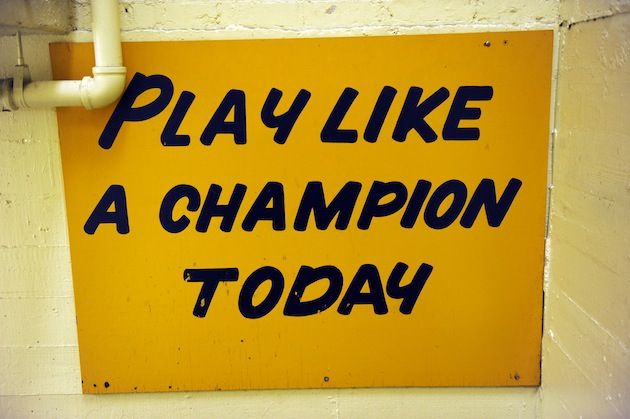
The video ends with the poster that is at the bottom of the stairs as the players head out to the field “Play like a Champion Today” and each player touches it as they go thru the tunnel onto the field.


It is also the reason why Rudy is one of my favorite sports movies of all time, the story of a Rudy Ruettiger (brilliantly acted by Sean Astin) what wants to play at the University of Norte Dame but does not have the money, the grades and many argued the physical characteristics and skills to play there.

Although he was small in stature, his heart was HUGE and was determined to play for ND and after he lost a close friend due to an accident at the steel mill he and many of his family worked at he quit his job and went to that same campus in Indianna to chase his dream.

He was advised that he had to get his grades up first and foremost, then if he did, perhaps he would be accepted but playing for the actual football team was another story in itself.

Rudy connected with a good friend at junior college across the lake a priest on the main campus helped him get into, worked thru dyslexia and got his grades up after 3 years to be accepted to Norte Dame in his last and final year as a senior.

He subsequently made the practice roster of the football team, and although was the smallest player on the field, and was thrown around like a tackling dummy by the starters, his heart transformed the team and coaches where they permitted him to dress in the last game of the season against Georgia.

Rudy was given an opportunity to play the last couple of downs of the game, got a sack in the waning seconds to fulfil his dream, not only of going to one of the top Ivy league schools in the USA, but suit up and played like a champion that day for the historic football team.

Although the movie scene was embellished, Rudy is only one of two players in Notre Dame history to be carried off the field on the shoulders of his team mates. It also happened to be the first season that Joe Montana was on the team as freshmen quarterback.

I don’t think any would argue that John Wooden was the greatest coach of all time.

I believe that Lou Holtz was another one of those great coaches.

Why?

Because like John who developed a winning tradition for UCLA, Lou was instrumental in doing the same for the Fighting Irish and his tenure began in 1986 by bringing back the “Play like a champion today” sign back to the bottom of the tunnel where it once was. He came across in a book before his coaching tenure started in 1986 and asked for it to be recreated and placed at the bottom of the stairs.

He relayed to the players he brought it back due to the storied tradition of Notre Dame, the great coaches and players before them and asked they tap the sign before each game as others had done before them.

Tap it for the sacrifices they had made, the ones their parents had made and the sacrifices and hard work they had made to play for such an iconic university.

He also reminded them that each time they tapped the sign the obligation they had to their team mates to truly play like a champion and not let their team mates down.

The third Rule that John Wooden had with his teams that I have expanded on in part for my teams was “never criticize your team mates” similar to Lou’s commitment to your team mates. My third rule (AKA standard) for my players is to respect all aspects of the game (yourselves, your team mates, coaches, officials, other teams, parents, class mates, teachers, elders and so on).

By respecting the tradition of the sign and reasons behind it, the players under Lou’s and coaches since he retired learned the tenured history of Notre Dame who played their inaugural game 130 years ago on Nov 23, 1887.

Below is a video where Lou talks about the history of the sign and the Fighting Irish including the statue that was created on campus as a tribute to him.


Lou felt he never coached football, he coached life and like John was there for his players for decades well beyond he coached them.

“Players are like your children, you love them for life.” Lou Holtz

Don`t be a kids last coach

Our role as coaches is not to make a living, but our calling/purpose is to develop youth into adults.

Please ensure that the legacy that you leave behind is a positive one like John Wooden’s, Lou Holtz and all the other great coaches out there whose athletes in turn have left positive legacies behind.

Let’s work together to bring the game back to the kids … where it belongs.


Lack of Fair Play – The Other Reasons Why Kids Quit Sports

Posted 2 CommentsPosted in Coach

Lack of Fair Play –  The Other Reasons Why Kids Quit Sports


Playing just your starting lineup isn’t only hurting your kids, but your team as a whole!

Part II


Glen Mulcahy

May 18, 2017

BONUS – Download a Free Copy of this Blog in PDF Format HERE  

This blog post is a continuation of last week’s Part I post Poor Sportsmanship – The Other Reasons Why Kids Are Quitting Sports


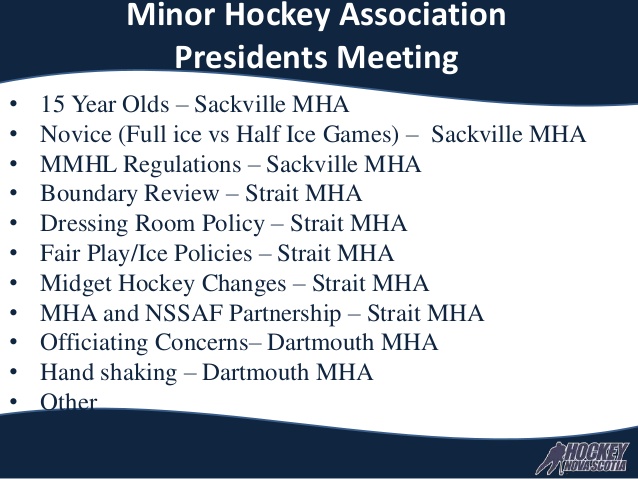
When I first began researching fair ice policies a few years back, there were only a couple that came up when I used my good friend Google. One I found was Hockey Nova Scotia which had fair play in addition to their policies for all levels including house, female and even competitive rep.


Nova Scotia Hockey AGM Agenda


Above is an image from last year’s Hockey Nova Scotia AGM. If you happen to follow the NHL at all, there are a couple of pretty good players that came from there. One happens to be the captain of the defending Stanley Cup Champions, Sidney Crosby; the other is Nathan McKinnon who many feel is the fastest player in the NHL with the puck.

I just did the same search I did four years ago in 2013 and the good news is, there is change coming. Currently the entire first page of Google outlines the fair ice policies that various hockey and ringette associations have adapted. As far as I am concerned as a coach and educator, the sooner that all major Hockey and Ringette associations implement these policies the better.

One of the top 5 reasons why players quit any sport is due to the fact that coaches play their favorites more than they do other players. In doing so, they are sending the message to those that sit that they are not good enough. As my son so eloquently shared with me after he sat on the bench for the better part of a game for non-disciplined reasons as a result of coaches’ strategy backfiring on him, he was “deprived of the opportunity to contribute to the outcome of the game.”

90% of kids would rather play on a losing team – emphasis on the word “play” in all situations – than sit on a bench for a winning team.

The only reason why players should be sitting on the bench when it comes to their turn to get out on the court, field or ice is for discipline. This could be anything from not being penalized when they should’ve been, to using bad language, to demonstrating poor sportsmanship and more. Aside from behaviour correcting actions, coaches need to take on their inherent responsibility of developing ALL of the players they’ve chosen to be part of their club, and not to rely on who they feel are their top players.

When I reached out to Cory McNabb (senior manager of player development for Hockey Canada) if he agreed with the short bench tactics that coaches in minor hockey are using, his reply was simply “Nope, if you pick ’em, you play them.”

Translation – regardless if the team in question is a house (rec) or competitive (rep) level, coaches choose the players for their team whether through tryouts, evaluations or drafts. To rely on a few players who in their subjective view are the cream of the crop,  coaches are not investing in developing all their players; something that should unquestionably be a priority above a win in the short term.

Just for a second, think back to the last 5 or more Stanley Cup Championships where commentators and coaches alike are saying they need to have all 4 lines contributing in order to win the Cup. This principle is not one that remains at the elite of the elite level. It is relevant all the way back to when kids are just beginning to develop their athletic careers at six or seven years old.

This year during my experience coaching high school rugby, the athletic director shared with me that there is no fair play code in high school sports other than grade 8 (13 year olds). The remainder of coaches for teams grade 9 and up are both allowed and encouraged to only play their top players in every game.

I had to deal with this experience first hand with my developing Rugby team this past year, which struggled to get a full field (15 players) out to any game on a good day. One match that’s been unfortunately etched into mine and my players brains was against a highly competitive school who brought out almost 30 players. Before the first half was over the ref came to me and asked what I wanted to do as we were already down 48-0.  We spoke to the athletic director of the other team and asked if they could sub in their second line players and, unfortunately, it went on deaf ears… the head coach continued to run the score up as he was focused on winning the provincials.

This I know now is the reason my son was deeply discouraged about playing different sports. A couple years ago he quit playing hockey, in large part to experience other sports and teams. When he signed up for grade 10 high school volleyball, just a few practices in, he was told point blank by the parent coach that he was only going to play his top players in games (one of whom was, of course, the coaches son).

Until the NSO/PSO/RSO and secondary school sporting bodies recognize that one of the top 5 reasons why kids are quitting any sport (just as in the case that ALA found in their survey) is because of a lack of fair play policies, attrition rates in youth sports are going to continue to grow!

Even if they implement fair play policies alone, I truly believe it will lessen that insanity in the stands which every parent knows all too well when it is time for their son or daughter to play. When the kids sit on the bench for non-disciplined reasons they get frustrated and after a season of it, it is no wonder why both player and parent opt to go down a different path (not that it is any greener on the other side of the fence).

It also will bring the love of the game back to the kids vs. the adults competing against each other through their kids.

Just because many kids may not have reached their potential at a young age doesn’t mean that they won’t be able to with future opportunities. If they are deprived of the chance to contribute it’s likely that they will quit.

Imagine if these “pretty good athletes” that went on to have insanely successful careers like Sydney Crosby and Nathan McKinnon were not given the opportunity to “play” early on in their development and were one of the 70% that quit by the age of 13 as a result.

Let’s work together to bring the game back to the Kids … where it belongs.


Glen Mulcahy


PS Tagline - Dont be a kids last coach

Poor Sportsmanship – The Other Reasons Why Kids Are Quitting Sports

Posted 2 CommentsPosted in Athlete, Coach

Poor Sportsmanship – The Other Reasons Why Kids Quit Sports

Lack of respect in youth sports today is killing our athlete’s motivation!
Part I

Glen Mulcahy

May 10, 2017


other reasons kids quit part 1


BONUS – Download a Free Copy of this Blog in PDF Format HERE  

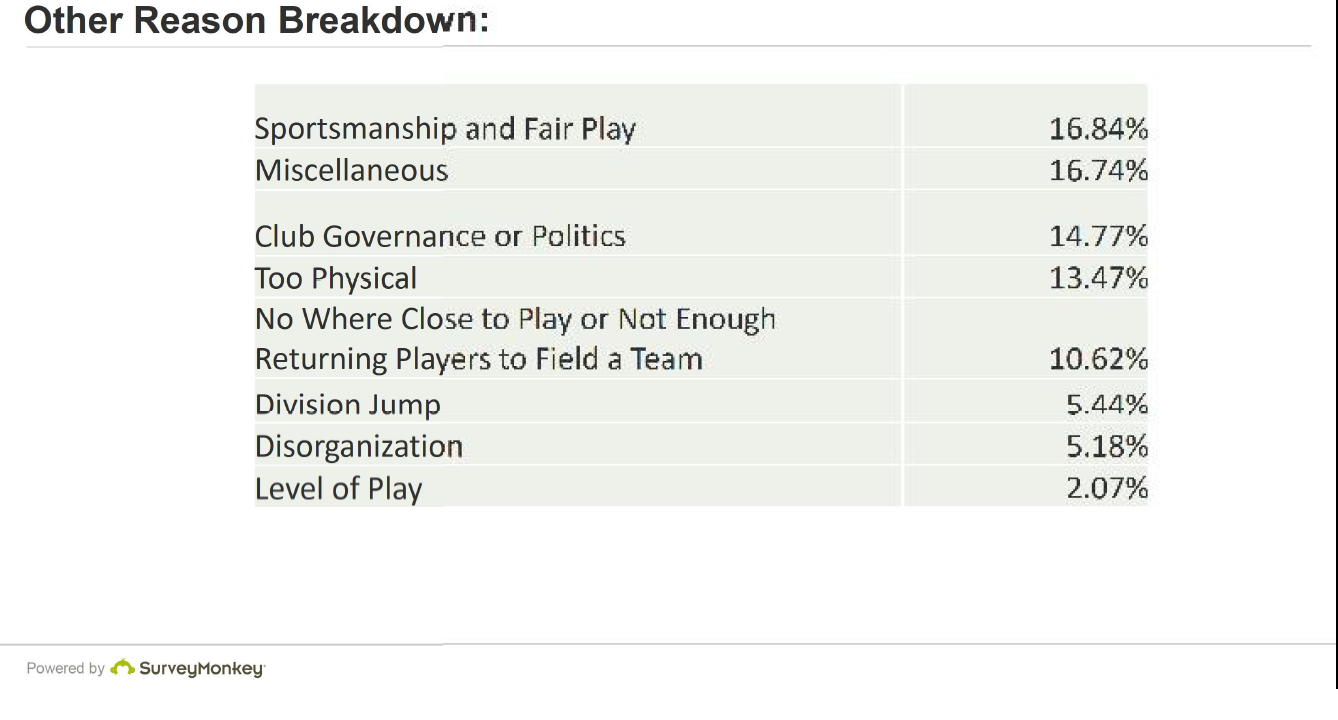
Lack of sportsmanship is a large part of the reasons our young athlete’s are becoming discouraged so early in their athletic careers. Although the second reason kids are leaving lacrosse is to specialize in other sports as I outlined in prior article Why Kids Quit Lacrosse, the primary reason why kids are leaving lacrosse are a myriad of combined problems within the sport (20.6% of the responses of the 1100 families surveyed by Alberta Lacrosse Association) that are outlined in the table below:


poor sportsmanship reason breakdown

Source: 2014-16 Retention Report – Alberta Lacrosse Association


Of these, the most significant reason was (poor) Sportsmanship and (lack of) Fair Play, the later of which we will talk about in Part II later this week.

Although the retention report was specific to lacrosse, I would argue based on my involvement in various other youth teams with coaches, parents, officials and athletes that the same would hold true in almost all other youth sports today.


Poor Sportsmanship

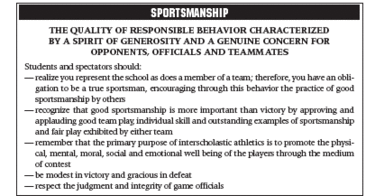
Have you come across a sign like this at your local arena, soccer field, lacrosse box etc? 


poor sportsmanship signboard


How many times have you been to a youth sports game in recent years and seen either players or coaches demonstrating poor sportsmanship? This could include any of the following, all of which that I’ve experienced firsthand;

  • Throwing or breaking their sticks because they missed a shot on goal
  • Screaming at a young official as they missed a call
  • Playing with the intent to injure – knee on knees, elbows to the head, helmet to helmet contact, cross checks or hitting players in the numbers (in the back)
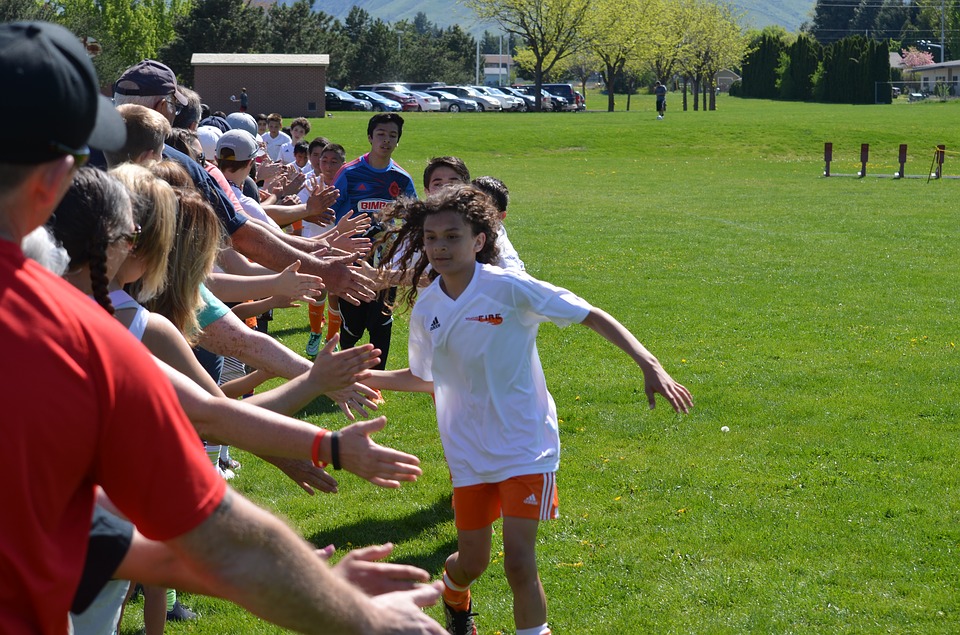
  • Disrespectful when shaking hands after a game, or worst case coaches slew footing (tripping) a player or vice versa. (At one of the games I coached a player on opposing team tried to trip me as a prank while shaking hands and was suspended for 5 games as a result!)
  • Entering the penalty box throwing helmets, gloves, sticks and using language that is not appropriate even for adults in ANY environment
  • Players excessively celebrating goals even when their team is up on the other team by a significant margin (AKA rubbing salt into the wound)

The list goes on and on for the escalating lack of sportsmanship I have seen over the years. I strongly believe this is due largely in part to the fact that many coaches and parents have not been reinforcing the importance of respect; whether for themselves, team mates, coaches, other teams, officials, parents, or others in their community. This includes the apparent lack of understanding that you should win with humility and lose with dignity.

I am coaching High School Rugby this year and our number one agreed upon core value is respect. Even when the going gets tough (which believe me, it has) I’ve taught my athletes to still call the ref sir, and that even though some feel it is a Hooligan’s game … it is played by gentlemen.

Our rugby team’s first game of the season we got, for lack of a better word, thumped. But as I knew going into this season we would be in for some tough games I did two things to kick off the season;

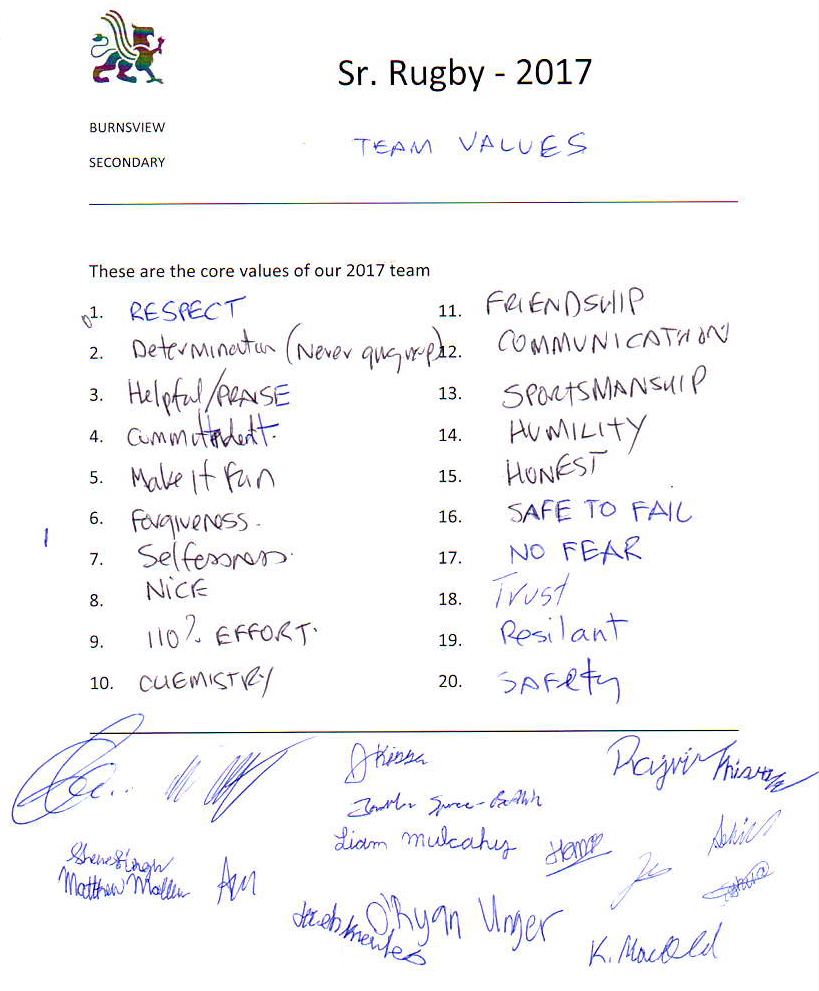
First – I asked every player to write down the top 3 characteristics they wanted to see from their team mates.

Below is the team values summary in no particular order where every player contributed. As you can see, one of our team values is sportsmanship, along with other core values like effort, chemistry, resilience and so on.


Team Values


Second – We have a circle of trust where the players form a circle, lock arms, and at each practice or game a different player leads the circle strongly stating the following:

“I have your back”

“I will respect you”

“I will be fearless”

“I will not criticize you”

“We will win with humility and lose with dignity”


The sayings for our circle of trust came from the subsequent question in which I asked all of my players what they did not like about youth sports. The top three answers were:

  1. When their team mates were not committed
  2. When the coach or team mates do not respect me
  3. When coaches played their favourites


The repetition of “We will win with humility and lose with dignity” is to reinforce the importance of good sportsmanship, regardless of the outcome of a game. When players leave the dressing room or field those that see them should not know whether they won or lost and as the old cliché goes, how you played the game is what matters. Having a focus on this is what breeds a healthy and positive relationship with the sport they love and is what will encourage young athletes to continue to love it long after they’ve stopped playing youth sports.

Probably the one of the greatest examples of sportsmanship I have ever come across was W. Oregon’s Sara Tucholsky who hit her first ever home run and the other team showed what playing for the love of the game truly means.


Let’s work together to bring the game back to the Kids … where it belongs.


Glen Mulcahy


Don`t be a kids last coach