Why running short benches is NOT a good thing
Posted Leave a commentPosted in Athlete, Coach, Organization Executive, Parents

BONUS – Download a Free Copy of this Blog in PDF Format HERE

Last night I had dinner with my wife’s siblings as my sister in law was in town for a conference.

During dinner, my sister in law shared with me that my 12-year-old nephew had quit Hockey.

WHAT?  My nephew quit a sport he once loved and when I asked her why her response was “he quit because a lot of teammates were not getting play when it was their turn as the coach was focusing on winning games”

He was playing peewee recreational team and was one of the stronger players because two years ago when he aspired to play rep (competitive level) they were advised by several parents that the only way he would make one of the rep teams (the association had 3 rep teams for peewee age group at the time) is if they signed a contract that was the only sport he was going to play.

Again, WHAT?

He opted to keep playing rec (house) so could continue to play soccer, ski, and other activities.

My head was spinning,

  1. He was playing rec (house) and coaches are not permitted to run short benches.
  2. He would have to sign a contract to play only hockey when he loved many other sports?

She further shared that parents they have talked to in the community have said their kids also quit hockey for the same reasons and the associations overall membership has dropped by a few hundred kids the last few years as a result.

This is a MINOR hockey association who have recreational coaches focusing on winning at all costs and not promoting multi-sport participation which are two of the major issues that is leading to kids quitting.

This just a couple of days after I shared an article on our social media pages called “Why ‘Shortening the Bench’ in competitive youth sports” can be a good thing written by Jamie Strashin for CBC Sports.
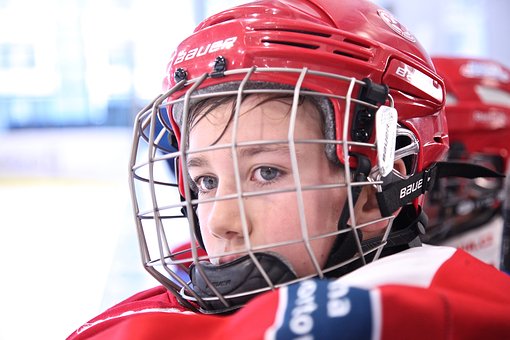
 

Soon after I posted, I received comments from parents in Canada and Australia who shared the same belief as I, that it was so short-sighted, although kids may win a game, perhaps get more games as a result, kids just want to play and in the instance of my nephew he quit because he did not think it fair for his teammates to sit on the bench when it was their turn to play.

Why did they sit?  Not because they were tired or were being disciplined, but an adult pulled them back to one their “more skilled” teammates out in their place.

I have been against short benches since I started coaching youth sports and still am, regardless if it is competitive or recreational levels.  The very fact that my nephew quit because his teammates were being deprived of ice time shows that he GETS IT even at 12 years old and I will applaud him for doing so when I see him next.

Ironically when I was up in Whitehorse running clinics this past season, I had one of the coaches come to me and expressed the very same concerns, her son was one of the top players on his atom “development” team and was getting much more ice time than his teammates, at times he was being told by coaches to stay out for 2-3-4 minutes at time.

Like the 10 year old player reference in the CBC article, her son was also 10, but in lieu of being held back for another player to take his turn, in his case stay out for shifts much longer than should have had.

Just two more examples of the adultification of youth sports.

Here is my take on running short benches;

#1 – Coaches choose the players for their teams, whether it be competitive or recreation

If you PICK THEM – you play them.

The coach that was quoted in the CBC article, whom is a non-parent coach, “I chose them to be on the team because I thought they were good enough.  If they aren’t in a position to succeed, it’s my fault”

I could not agree more, it the coaches responsibility to develop ALL players on the team and they focus on doing so early in the season, as the season evolves and all players improve, collectively the team improves and ‘Voila’ Winning is a byproduct not the focus.

#2 – I believe that coaches that run short benches either (a) don’t have the training needed to develop the skills of all players or (b) think that winning at all costs is more important than giving all players an opportunity to contribute in all situations

90% of kids would rather play on a losing team than sit on the bench for a winning team

#3 – All parents pay the same fees, so all players PLAY. There are already lawsuits in the USA coming forth from parents due to the thousands of dollars they are paying for their kids to play to be reimbursed for their prorated fees and have others pay more for their kids that PLAY more.

#4 – Having surveyed hundreds of kids on my teams over the years what is not fun about youth sports, one of the top 3 answers I have received is “when coaches play their favorites” especially when it comes to crunch time in close games where associations have implemented fair ice policies to permit coaches to use their discretion to win games. Again, kids just want to have their opportunities to contribute to the outcomes of the games just like all their other teammates.

‘YOU WIN OR LOSE AS A TEAM’

There are so many examples I can cite, not just from Hockey, but others sports now as we continue to partner with various sports groups but the one that comes to mind for me over and over was a player whom I invited to play with our 3 on 3 hockey teams who was a great kid with great parents.

In our last season when all the boys were aging out of minor hockey (17 years old), we opted to play both small ice and full ice 3 on 3 and in our first couple of games of each, he would go out for a few shifts and I noticed he was gasping for air.

In the second game I walked up to him and said T, you ok?

To which he said with a big smile on his face, yep, just need to get back into game shape.

I then asked … “but you played on the Midget A2 this year (where they would have had 2 practices, 2 games, a dryland per week) so don’t understand why not in game shape”?

He replied “because I quit with 10 games left in the season because I was only getting a handful of shifts per game.  The coaches was playing his favorites most of the games including power play, penalty kill, pissed me off as I just wanted to play so I quit”.

“My dad complained to the executive but they did not do anything, argued that it was rep hockey and only house had fair ice policies (where coaches are not permitted to run short benches).”

I shook my head in disbelief, just as I do every time I think of it.

#5 – In this particular article, 10-year-old players were the focus, which it he Atom age group, and regardless if they are playing recreationally or rep it is still a development age group

All kids, regardless of level, are to play and if a coach in BC had ran short bench in Atom he would have been suspended for doing so.

The main reason why coaches should not run short benches is the message you send to the kids, their parents …. Sorry kid, you are just not good enough be out there in key situations or give us a chance to score.

I believe this is one of the contributors why parents act up in the stands, if they come to game after game as I have and many other parents I know and watch their son or daughter sit on a bench when it is their turn to play knowing we all paid the same for them to do so, is no wonder why parents get emotional, angry as is evident daily in print, TV and social media.

Don’t get me started on the coaches that think they get a get out of jail free card for peewee and above, they should still be rolling all their lines all the way through minor hockey, when they are no longer playing to play, then they can earn their ice time (i.e. Major Junior and above)

The ONLY exception where you would tell kids to sit on the bench depriving them of playing time (or any minor sport for that reason) is if you have to discipline your players.

As the same coach in the article referenced, if they are not listening, screwing around may have to sit them a few shifts.

Other reasons, if they take a bad penalty or don’t get a penalty called on them for things like slashing, cross checking, knee on knees, head contact, hitting from behind, poor sportsmanship, using foul language, criticizing their team mates or not respecting their coaches, fellow or opposing players/coaches or officials including the scorekeeper/time keeper.

The very reason why short benches have become so common and we are turning a blind eye towards same is the shift in youth sports to win at all costs in lieu of just letting kids play kids for the love of the game.

Look at the past decade when teams go deep into the Stanley Cup Playoffs, when players or coaches are interviewed after games, including when they put the hardest trophy in sport to win above their head they say “all 4 lines contributed, we had a lot of confidence and we HAD FUN.

Hmmm .. aren’t these the best players in the WORLD?  Making Millions of Dollars a year even in the salary cap era?

Here is a great presentation from one of our For the Love of the Game Virtual Event guest speakers, VJ Stanley, that he did for a USA Hockey Level 4 coaches (equivalent to HP 1 level Coaches in Canada) and early in his presentation shares insight why coaches should PLAY all their kids in minor in hockey. About 7 minutes in to the presentation shows a vide when he talked to Ryan Callaha when he was captain of the New York Rangers.


Any coach can run short benches and play their “favorites” to win games.

GREAT coaches develop all their players and provide them the opportunity to contribute to the outcome of games and in doing so build their confidence and competence and winning becomes a byproduct as a result.

 

Don`t be a kids last coach


Playing For the Love of the Game

Posted Leave a commentPosted in Athlete, Coach, Organization Executive, Parents


This coming Monday I will be returning back to Nanaimo to speak on behalf of Changing the Game Project hosted by Nanaimo Minor Hockey who is working with various other sports groups to develop an amazing sports experience for the kids in their community.

As I was when I made the ferry trip in October, I am truly honored to be invited to share nuggets but also interact with so many amazing people who are passionate about quality sport.

I came across some great nuggets the last few weeks that I will be sharing in the presentation that thought would be great to share on this week’s newsletter as well.

Why do Kids play Sports?

Simple, they play because they’re fun, they quit when they’re not.  It’s NOT Rocket science.

This is the quote that I have shared for years and it really comes down to just that.   What our role as parents, coaches should be, however, is not just making sure that youth sports are fun, but they should also ensure that kids love the sports they are playing more at the end of a SEASON than they did at the beginning.

Due to the growth of early sports specialization, however, there are no more seasons to youth sports, and in lieu of PLAYING sports, kids WORK sports for over 10 months of the year

As Wade Gilbert, the Coaches Doc, shares in many of his talks … do kids ask you Mom, Dad can I WORK Hockey? WORK Soccer?  No, they ask you if they can PLAY baseball, PLAY football and so on.

The more I thought about the reason why kids played a sport for more than one season is this held true, I Loved the Sport more at the end of a season that I could hardly wait to return to play again.  This was because when the season ended in March, I hung up my skates to play baseball, golf, go to the beach, ride bikes, hike, swim, tennis and so many other activities so when the season started again in Sept I missed the rink, my buddies, coaches and was eager to start another season.

Thank you for being a sport that helps me with other sports.


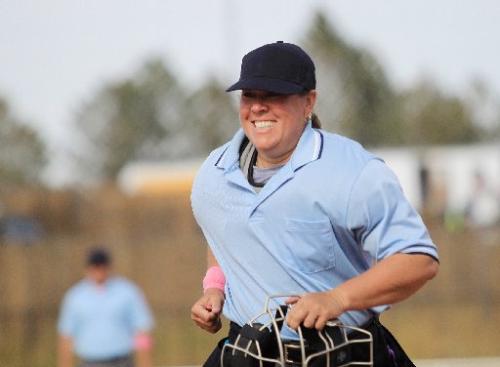
Why then do Officials (refs, umpires) start or continue to officiate?

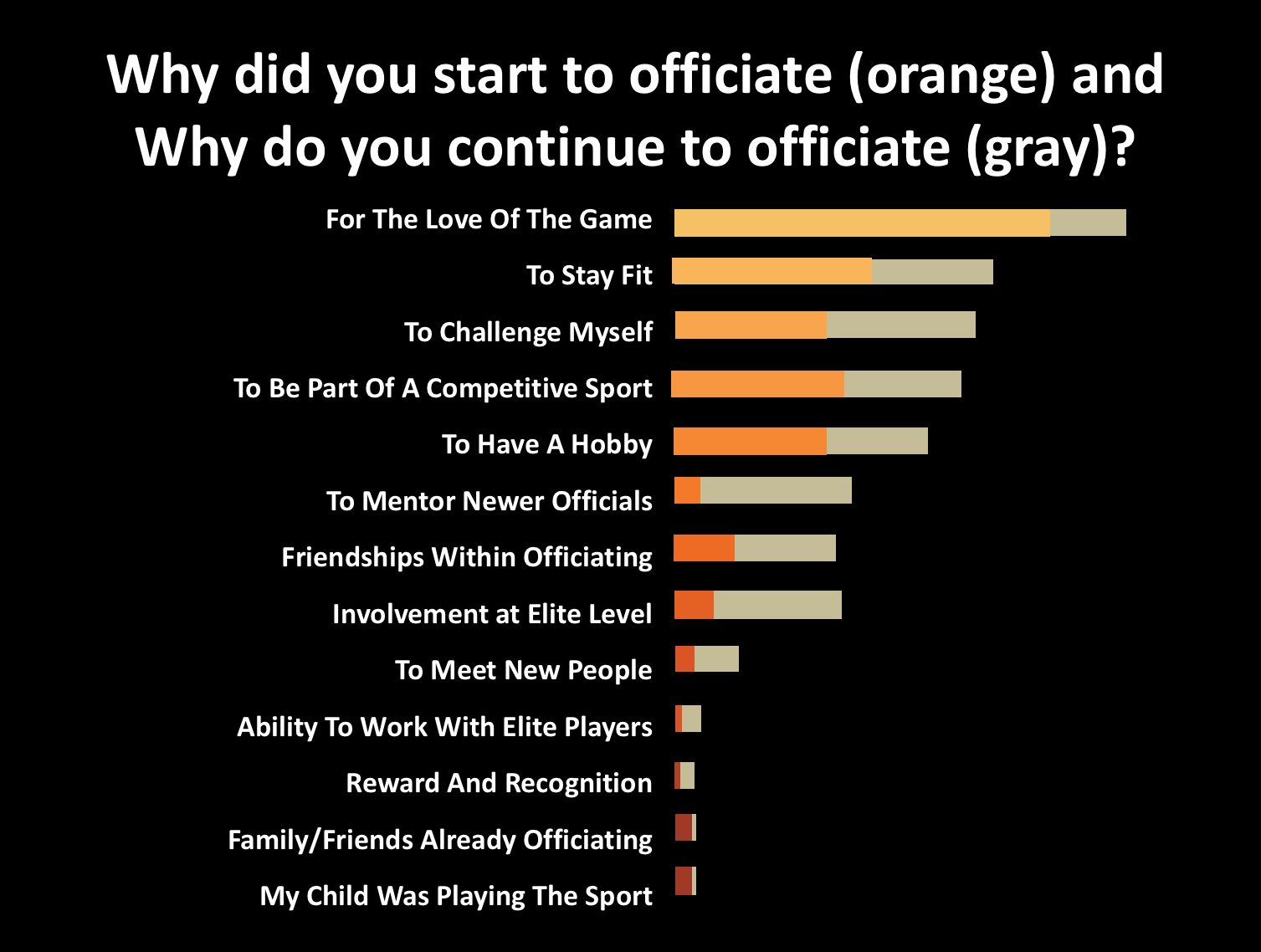
According to the largest survey I have come across today over 17,000 officials were asked why and the #1 Answer was “For the Love of the Game”.

See below for the other top 10 reasons why they started and continue to be officials.


Other reasons included staying fit, challenge self, be part of the competitive sport, have a hobby and near the bottom was reward/recognition and lowest motivator was the fact that they had a child playing the sport.  This is probably due to the fact that a lot of officials start before they are parents, and ironically one of the motivators that organizations do is provide stipends for refs to do so so if get enough games, they can have a decent part-time income of the course of those seasons.

Why do Coaches Coach?

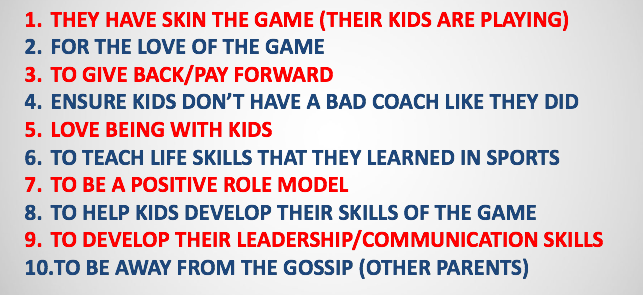
Ironically, when I have surveyed grassroots coaches over the years in clinics or talks and asked them why they coached, the #1 answer is because they had skin in the game, they stepped up to coach because their kids were playing and either asked them to coach OR a board member runs around the field, rinks at the beginning of the season asking for help.

I was one of those “suckers” initially putting my hand up to help on ice when board members came calling when my son was 5 starting hockey or my 7-year-old daughter in softball and 15 years and hundreds of kids later, I still put my hand up, now is to mentor the coaches of kids so they can help them become the best people they can become.

See below for the other reasons why Coaches Coach that I hear over and over again when I prompt coaches why they are coaching;

The second reason, whether they are a parent or not, is coaches step up to coach For the Love of the Game, they love the game and everything that it did for them, that they want to give back/pay it forward to help others reap the same benefits.

Many of which shared they are coaching so kids don’t have a BAD coach like they did when they grew up (which sadly there are still coaches even with all the certification coaches have today that coach the way they had been coached)

One reason that parents may not be aware of, coaches have also shared with me and I can relate, they are at the games anyway, drive to the practices and no point going home, so they put their hand up to help coach.  They also do so, as I did, to be away from the gossip that parents at times will share amongst themselves or worse yet those would be too vocal and scream coaching instructions at their kids or critique them/coaches or officials.

Another interesting stat came out of official vs. coach surveys, although officials receive fees and some coaches get honorariums for coaching now, neither officials or coaches stated when surveyed they started or continued to do so for the $$ in their top 10 reasons for doing so.

They do so not only because they love the game, and a few weeks into a season realize they also love being with kids as they have adopted large families when they start coaching.

Now let’s talk about why these three key stakeholders QUIT the Sports they once loved

Why do kids Quit Sports?

They not only quit because they are no longer fun, but they quit because the lost the passion, love for the game they once had and for various reasons lost their way in a sense.

More often than not, they no longer love for the game as they have been deprived of the opportunity to play in all key situations in games, have had adults screaming at them when made mistakes or have been on teams where harassment has taken place to some extent.

They quit because the games are no longer about what snacks they get after the games and being with their buds in the dressing room, hanging out in dugouts or sidelines it is about the results of the game that takes the focus due to winning at all costs.

They also quit because they can’t afford it any longer due to travel, equipment, spiraling fees and all the other costs now associated with youth sports unlike the “good old days” where you community sports were just that, played in the community or at high schools with low, no fees and even could use the same pair of cleats for 3 different sports as I did (baseball, rugby and football)

Why Do Officials Quit?

#1 Reason Poor Sportsmanship

As I shared in a prior post “Why do officials officiate” the #1 reason why officials quit is due to poor sportsmanship.

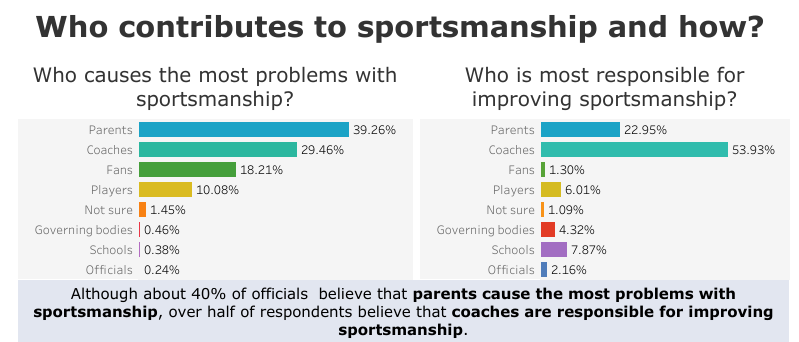
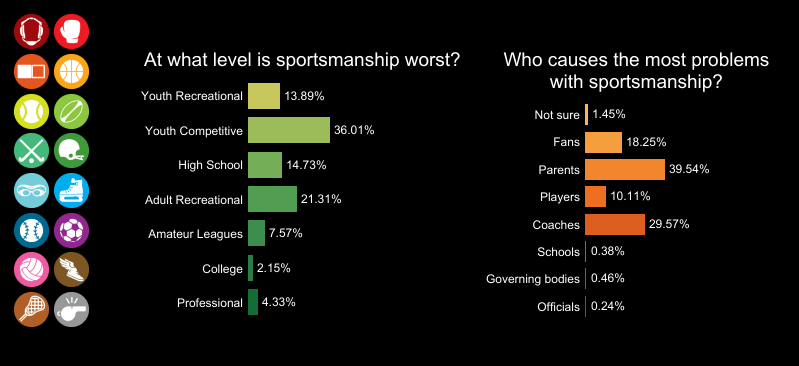
In the NASO study of over 17,000 officials, almost 40% of the respondents stated that parents caused the most problems with sportsmanship, followed by just shy of 30% of coaches.

When asked who is responsible for improving sportsmanship, over half stated coaches were.

Why?

Because they are the catalysts for change.

They interact with their players, assistant coaches, officials, board members and parents but also coaches and players of other teams, perhaps even their parent groups.

If coaches do not talk the talk but also walk the walk and demonstrate and expect good sportsmanship then whom is going to improve it?

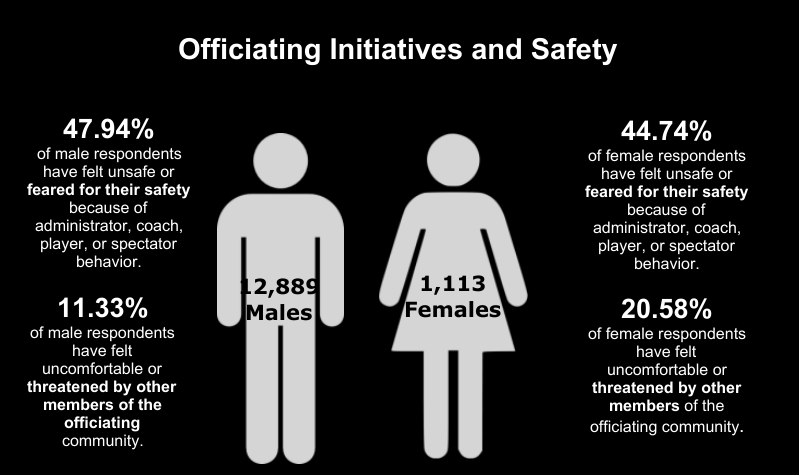
They also quit because they are concerned about their safety, over 40% of male and female officials are due to administrator, parent, coach or player behavior

Even worse, they are intimidated by their fellow officials who will criticize them during games?

I just came across this extreme video where one parent kept telling the refs after a call he did not agree with “would see them after the game” (meaning we will duke it out in the parking lot – really?), but the entire group of parents and fans were ejected from a youth soccer game due to their behavior and threats towards young officials (about the same age of the players they were officiating)

This after each day I came across similar parental behavior, coach abuse towards players or officials, series of articles about sexual abuse, or various issues at minor hockey associations I shared in last week’s post “When will the culture of Youth Sports change for the better?”

Why do Coaches Quit?

Coaches, like players and officials, are either not putting their hand up, to begin with due to lack of willingness to “deal with” parents OR are quitting due to frustrations of the problems they had “dealt” with over their coaching careers.  This is why the most common ask I receive is “who do I deal with parents” to which I counter, it is not about dealing with parents, it is all about how you engage them as allies.

Over 80% of coaches surveyed by Syracuse.com stated that parent issues had gotten worse over their careers, the #1 problem they dealt with by over 80% of the respondents was parents complaining about their kids playing time.

IF a coach is playing everyone equally so they all have an opportunity to contribute to the outcome of the game in ALL situations this would be a non-issue (the exception being when kids need to be disciplined for behavioral issues).

I argue that coaches in a sense are a victim of their own demise, due to our winning at all costs culture, many coaches who may have had the best of intentions when they started coaching fall into the trap of running short benches starting from the beginning of the game and parents are merely venting their frustration as they ALL PAY THE SAME $ so expect all kids to PLAY THE SAME amount of time.

Again it comes down to pointing fingers at one of the key stakeholders that impacts what should be a quality and positive sports experience and the majority of the issues could be avoided from the GET GO.

In lieu, the officials blame the parents, the coaches blame the officials, players or parents, the parents blame the coaches, officials or board members blame the parents and goes round and round in circles like the merry go round at schools I loved when I was a kid (which kids can’t ride anymore as they may get hurt?)

When then are we going to stop pointing fingers at each other and understand the motivation for the players, officials, coaches to begin with?

They started because wanted to try a sport For the Love of the Game, they continue to do so for the same reason, and they quit because they lost that Love and passion they had to start with due the various issues that have taken the Play out of Play Ball.

In lieu of pointing fingers, what I suggest to all parties concerned is bury the axe, work on collaborating so it is a quality sports experience for ALL stakeholders so they all can do so For the Love of the Game.

Let’s all work together to bring the game back to the kids ….. where it belongs.


Why Officials Quit (2019)

Posted Leave a commentPosted in Athlete, Coach, Organization Executive, Parents

A couple of years back I posted Why Officials Quit and have continued to do a lot of research on the subject due to the fact that every sport organization that I work with is not only having challenges with player attrition, they also are losing officials to the point where many say they have to scale back on number of teams or games as a result, and in some states in the USA they have declared many of their sports programs are in jeopardy due to lack of officials.

This weekend I will be doing a talk on that very subject for Softball BC, titled “How to attract, retain and increase the number of officials in your organization”

It is based in part on the post I followed up with last year called “Why do Officials Officiate” but for purposes of this post wanted to share why we are losing so many officials year after year.

Top Reasons why officials are quitting are;

  1. It is not safe to fail:

Having talked to many officials and those responsible in various sports organizations, the trends are consistent, as I shared prior Hockey Canada loses 30% of their officials every year, as does every sport that I have talked to as we started to partner with various other sports organizations.

Why?  Because the officials who take a lot of pride in not make mistakes, are quitting because of the abuse that they are taking from adults (parents, coaches or fans) when they do make a mistake OR when they believe they made a mistake.

This is one of the videos I came across that shows very clearly that the umpire made the right call, but received 17 different abusive phrases from parents who were seated in the visitor section (along the 1st base line) who did not have the same perspective as the umpire.

He clearly made the right call as did have the right perspective, but all the parents on the visiting team thought nothing of screaming out their perspective which was wrong.


  1. Poor Sportsmanship: 

Above are the results for the largest study I have come across where over 17,000 officials replied to a survey from multiple sports done in 2017.  Almost 40% stated it was the parents that were causing the problems, followed by almost 30% of coaches, combining for approx. 70%.

Poor Sportsmanship was also one of the top 3 reasons that were the reasons why 11,000 players quit playing lacrosse in the retention report Alberta Lacrosse shared with me.

No matter what organization that I reach out to potentially partner with across Canada regardless of the hat I am wearing, even though 70% of the issues leading to officials quitting which goes hand in hand with the players is poor sportsmanship, when I ask what they are doing to curve the problem, they say they don’t have budgets for coach or parental education.


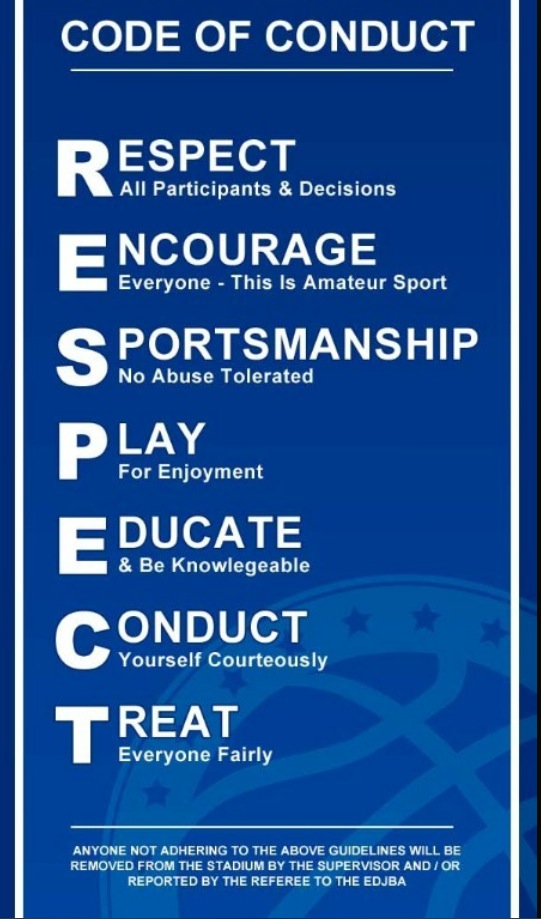
Translation: They keep doing the same thing over and over again expecting different results (Insanity), posting signs at rinks or fields like the ones above, making it mandatory for parents and coaches to take respect in sport online course for approximately 3 hours but don’t rigidly enforce policies for a zero tolerance for ANY forms of harassment.


When asked at what level is sportsmanship the worst, 36% of the officials stated it was the youth competitive level, followed by 21.3% adult recreational level.

These results did not surprise me at all.

Youth Competitive due to high expectations from parents due for a return on investment for the tens of thousands of dollars they invest in their child’s completive youth sports experience to get an NCAA scholarship or play professionally is what is translating to the vocal minority of parents screaming and umpires when they perceive they made a bad call.

Parents – the majority of these officials are just a level above your son or daughter, and many officials start at the age of 12 years old, and within 3 years associations are starting all over again to recruit officials as most have quit.

The second highest level, adult recreational, having played adult rec hockey, as well as slo-pitch for many years, I saw it firsthand how many who were playing adult rec thought they were living the dream playing professionally and took it a wee bit too far and would go at refs or umpires like they lost a Stanley Cup or World Series Game.

Every time I would approach them and say, relax, it’s just a game (yet another PSA campaign by Hockey Canada in 2004 when things really started to ramp up in terms of parental behavior in the stands).

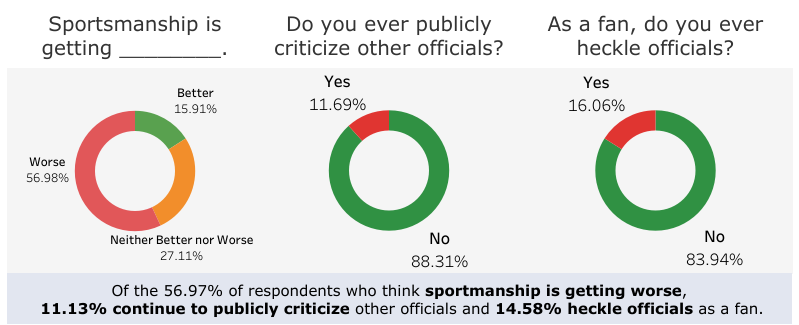
When officials were then asked if Sportsmanship is getting _______, almost 57% said it was getting worse, 27% neither better or worse but thankfully the remainder, close to 16%, stated that sportsmanship was getting better.

This I believe is due to all the organizations and awareness campaigns that have come to fruition in the last decade (including our own) to combat the impact of poor sportsmanship that is impacting the quality of the youth sports experience for kids.

What I was truly surprised with, however, was the fact that some officials responded (11.69%) publicly criticized other officials and when a fan at games, just over 16% confess they heckle their own fraternity.  If truly are going to change the way officials are treated, they must adhere to the very same Respect rule I have for all my teams and NEVER criticize your teammates.


  1. Fear for their Safety

I shared this in the prior post that Almost 48% of the male respondents, and 45% of the female respondents shared they feared for their safety because of administrator, coach, player of spectator behavior?

What I did not highlight is just over 11% of male and 20% of female official felt uncomfortable or threatened by members of their very own officiating community.

Really?

What happened to all being it in together as a team?  Again, officials have to respect all others and avoid threats towards others in their community if we are going to reverse their fear for their own safety.

How then do organizations reverse these trends by ensuring that officials have a safe to fail environment, take pride in becoming the best they can be, are not in fear, that sportsmanship includes respecting ALL calls made by officials?

Organizations have to stop putting up signs, sending out public service announcements and as a means “to deal with parents”.  Most people don’t read signs anyway (thanks to my past experience working in the hospitality industry) and the time for PSA’s/Whitepapers is OVER.  It has come time to activate strategies so that sports organizations are accountable for everyone’s safety and creating a quality sporting experience.

In lieu, invest in parent education and teaching their coaches how to engage parents in lieu.

The vast majority of parents are AMAZING people who are doing everything they can to support their kids navigate what has become professional youth sports in lieu of kids playing kids like it was when I grew up.

They also have to recognize that officials are key stakeholders to ensure that today’s youth have a positive sporting experience, without them, kids will merely be having practices.

I worked at BC Place Stadium in security for many years and worked many BC Lions games as well as concerts and if fans became unruly (more often than not due to drinking too much) it was really simple, they were removed from the facility.

If they got into a fist of cuffs with fellow fans, we escorted them to the Police Wagon where they were brought to the station and potentially charged.

If we did so at professional sports events, why then do we not do it at youth sports events?

In lieu of having security surveying the stands, coaches and parents should be doing the same just as they did a generation removed.  If someone was acting up, a coach, parent or board member would approach them and eject them from the facility.

If a parent, coach or fan becomes unruly, too emotional, abusive, they should be removed so they can calm down and not permitted to return no differently when coaches are ejected.  The vocal minority of parents that do so be held accountable to the point where future incidents are treated with longer suspensions and using the same 3 strike rule, if a repeat offender;

Sorry we will miss you.

Meaning, we will not permit you to be a member of our organization.  Just like playing youth sports is a privilege (now more than ever due to pay to play model), so is that of being a member of the organization as parent, official, board member.

As far as I am concerned, no one, whether it be player, coach, official or board member should be in fear or a victim of verbal, worse yet potentially physical abusive threats and we need to bring the game back to the kids.

It’s time to stop doing the same things over and over again and expecting different results (Insanity)

Just like we should see the smiles on players when they are at games, the same should hold true for officials of any sport, they too should have a quality sport experience, otherwise the trends where 30% quit every year will just get worse.


Let’s all work together to bring the game back to the kids … where it belongs.


Don`t be a kids last coach

Humboldt Bronco's Reforming stage blog thumbnail

Humboldt Bronco’s (Re) Forming Stage

Posted Leave a commentPosted in Athlete, Coach, Organization Executive, Parents, Uncategorized

Earlier this year I wrote on Tuckman’s development model of small groups and I read a great article this weekend in the National Post talking about Humboldt’s Comeback and they continue going thru their grieving period with a new team and organization for this season.

Below is a video recap interviewing the new head coach Nathan Oystrick as he talks about the challenges he faces rebuilding the proud franchise after the tragic accident earlier this year that reached millions of people across the globe.


Nathan grew up in Saskatchewan, played junior hockey in Canada then was on a journeyman path playing college, then various professional stints in Europe and North America including 65 games in the NHL with the Atlanta Thrashers organization.

When management was queried what they were looking for in the new coach, they shared they wanted “someone that was going to care about their kids” which is the most important aspect of coaching.

At no point did they say they wanted a coach that ran certain power play systems, breakout and regroups or other tactics and systems that too many youth minor hockey coaches focus on.

In a whiteboard pregame talk in the video, Nathan tells the players to go out there and have fun and compete.

This coming Wednesday, Sept. 12th, the NEW Humbolt Bronco’s will be hitting the ice to play their first regular season game which will be broadcast live by both TSN and CTV Saskatchewan 5:30 PM, 6:30 PM Central Time, 8:30 PM EST.

The very fact that this game is going to happen in the first place just shows how resilient the members of the Humboldt community are they lost their head coach/general manager, assistant coach, radio analyst, driver, trainer and 11 players.

The remaining players on the bus were injured, some seriously, some were able to walk away with scrapes and bruises but the end result was Humbolt, Junior Hockey and Sports, in general, was tragically impacted that day, April 6th, 2018.

They have now completed the forming stage, the first stage of group development according to Tuckman’s work, the big unknown is how are they going to deal with the remaining stages?

The next stage, storming, I suspect will start this coming Wednesday when the team hits the ice, coaching staff, trainers and all the fans including families of those lost and injured in the crash, friends, colleagues, former players and numerous others.  Although I suspect there will be a moment of silence, the world will be cheering for Humboldt as they continue to go thru their healing process.

Nathan gets teary-eyed in the interview when talking about what people are going to say, how are they going to react when the team takes the ice at home for their first regular season game?

I suspect there will be a lot of teary eyes in the stands and I for one plan to be streaming the game including pregame ceremonies to see how they go thru their storming stage so can get to some sense of normalcy (if there will be such a thing this season) so they can perform and compete as the season goes on.

I also believe I won’t be the only one that is watching Nathan and the team with great interest to see how they build on the proud legacy of #Humboldt Strong as the world found out not that long ago in April.

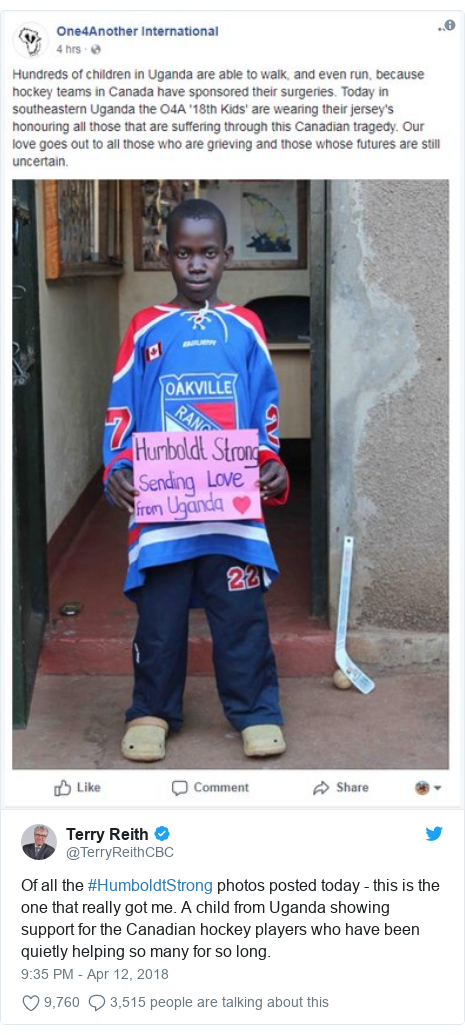
The gofund me campaign that reached over $1 Million dollars in what seemed like minutes and to date has raised over $15 Million, the press coverage they received including images from supporters worldwide including their pic that was tweeted (and subsequently retweeted by thousands) of the child from Uganda with stick by the door who received funding from Humboldt as one of their designated charities prior to the charity.


This is why Humboldt’s tragedy, their rebuild as an organization will be followed with great interest as they continue to go thru the group development stages.

I for one can hardly wait for them to get to the performing stage and be a contender and compete in playoffs as new head coach Nathan aspires them to.

Until then, we all must be patient and recognize that it may be a season or more before that happens.

Until then, I plan to just Love Watching them play, as I did all of the teams I have coached to date as recommend parents of young boys and girls do the same.

#Humboldt Strong #leaveyoursticksout

Don`t be a kids last coach


Make it Safe

Posted 1 CommentPosted in Uncategorized


One of the key takeaways that I share in every presentation that I do is the importance of making it safe to fail and from all forms of harassment, in this post I will expand on the latter.

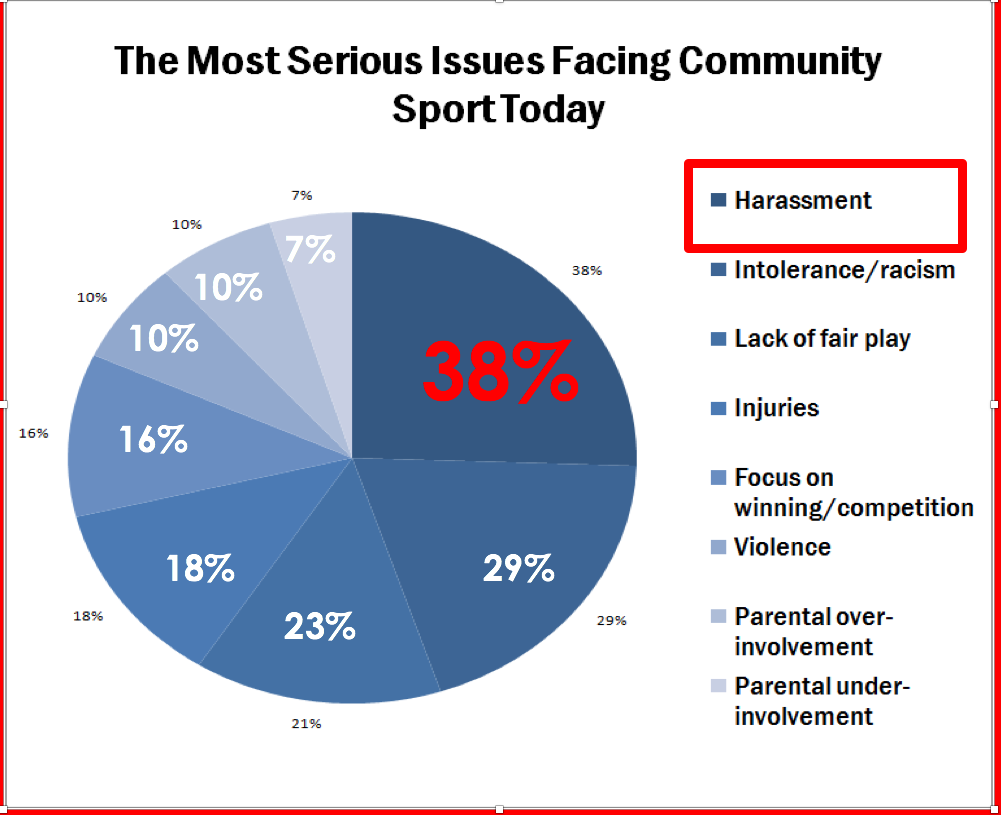
Below is a summary of survey results of a study that True Sport posted in their 2008 report where respondents stated what they felt the most serious issues facing youth sports.

BONUS – Download a Free Copy of this Blog in PDF Format HERE  


Source: 2008 True Sport Report

1.  38% of those surveyed stated that the most serious issue facing community sports was Harrassment.


This includes bullying, cyberbullying, sexual harassment and hazing.


Sadly, I have either dealt with various forms of harassment personally as a parent or coach, or heard thru various colleagues who have.  The biggest challenge that we all have is many parents don’t know the differences nor do they know how they can escalate to the point where it can cause serious psychological, even physical harm to those who are victims of harassment.


Several initiatives have evolved the last two decades to remove harassment from sport but we still have so much work to do to educate coaches, parents and sports administrators what the various forms of harassment are and what we can do to remove for sport.


  • Respect Group – formed by Sheldon Kennedy in 2004 as a result of the physical abuse he suffered while playing junior Hockey. They are responsible for the respect in sport program that parents, coaches, officials must take and now take refresher online course every few years.

Website:  www.respectgroupinc.com

  • Erase Bullying – Established to eliminate bullying from sport.

Website:  www.erasebullying.ca

Here is a great video from some of sports icons in British Columbia in partnership with ViaSport


  • Prevnet – Canada’s authority on research and resources for bullying prevention

They provide resources as well as links to all the other initiatives in Canada that are working on eliminating bullying from sport.

Website: www.prevnet.ca

  • Stop Hazing – A Leading Resource for Hazing Research and Prevention

Website:  www.stophazing.org

Facebook: Make Hazing Stop

Hazing has traditionally been the right of passage for those pledging for universities and collegiate sports programs, but is now happening in youth sports.

Hazing differs from bullying as it is more about inclusion to participate (making the teams) vs. excluding individuals and it can start with subtle hazing (rookies having to pick up the pucks in practices) to hazardous hazing including drinking excessive alcohol, having to digest chewing tobacco and other vile substances or various forms of sexual harassment.

In 2005, one of Canada’s most prestigious universities, McGill, scrapped their football season due to a hazing incident and since that time there has been 40 other reported hazing incidents in Canada and the USA.

The biggest issue with Hazing, is that majority of incidents are NOT reported as the victims do not want to be the whistleblowers and jeapordize their opportunities to be included or accepted on the teams they are rookies on.  Some even feel that going thru hazing is the right of passage and any identifying marks they receive are “badges of honour”.

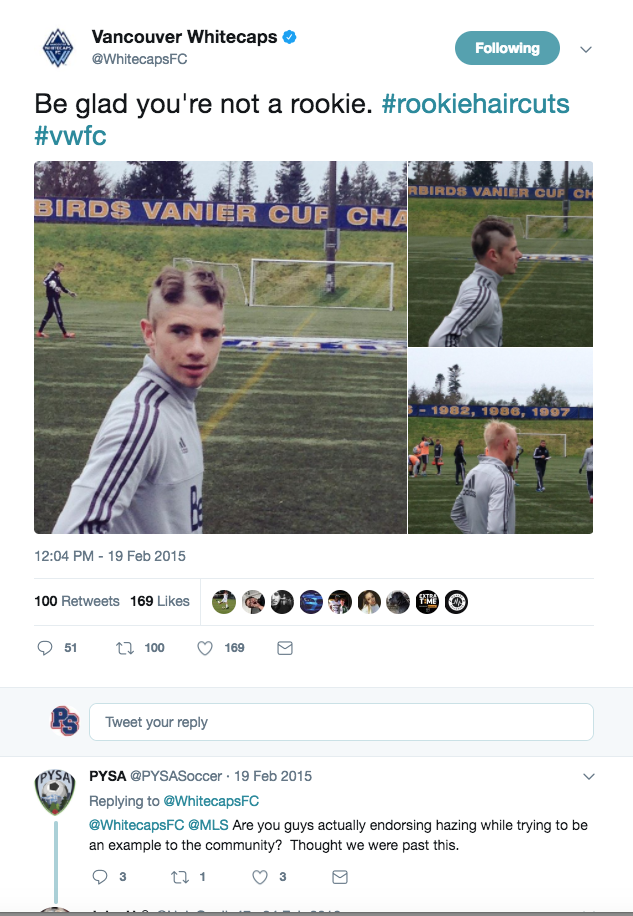
Below is another recent example where rookies on the Vancouver Whitecaps had their heads shaved (badge of honour) by their team mates;


If you go to the original tweet and review the comments, approximately 100 people tweeted and all but a few were beside themselves that rookie initiations like this were still happening.

  1. The second most serious issue by 29% of the respondents was intolerance or racism.

Many organizations have developed campaigns to address the intolerance towards minorities, LGBT or those with disabilities.

Here are just a few that are doing great work

Here is a short clip from Team Canada Athletes standing up for inclusion in sport


  1. The 3rd most serious issue (23%) was the lack of fair play, click here to read prior post how lack of fair play policies are one of the reasons why kids are quitting sports.

It still amazes me how one of the most serious issues facing youth sports contributing to the 70% drop out rate by age of 13 how few NSO/PSO or Regional/Local sporting associations don’t have fair play policies.  Even when they do, will turn a blind eye or sweep under the rug vs. disciplining towards coaches that breach the policies.  The argument that I receive all the time is it is so hard to get coaches to volunteer so associations would rather have challenges with retention than removing coaches who violate fair play policies?

In my third year coaching minor hockey, I found out that a player who was on our “team” (initiation no formal games played) who was 5 years old was sat on the bench for all games in his second year as the coach (who did not return to our association) sat him “because he was too small to play”

HE WAS 6 Years old!!!

The following year I reached out to his coach to do what he could to get him back on the horse, ensure he got playing time in games (which he said was a no brainer) but he quit hockey as too much damage was done the prior year.

Almost every year thereafter I heard similar stories, kids being deprived the opportunity to contribute to the outcome game after game and as a result, would quit a sport they once loved.

  1. 18% of those surveyed stated injuries that kids were sustaining in youth sports.

This I believe is due to the early sport specialization phenomena that has arisen over the last decade where private business reach out to parents of kids are early as 7 years old to invest in private instruction, equipment and play year round to chase the dream of a NCAA scholarship or playing professionally.

Click here to read prior post on how early sport specialization does more harm than good

  1. The fifth most serious issue from 18% of the respondents was focusing on winning/competition.

In the last couple of weeks two instances have arisen in the USA that we shared on our Facebook page.

The first was when the coach of little league world series team consisting of 12 year players agreed to accept a 2 game suspension in lieu of permitting one of his players bat when it came his turn in the batting order.  Really?  The kids were 12!  The little league world series is just that, LITTLE LEAGUE.  Another example how adults are competing with other adults thru kids.

Click Here to read the article

The second how a California High School Baseball Player is suing his former coach for $150,000, claiming that benching him was bullying.

Click here to read the article

Bullying Definition: The abuse and mistreatment of someone vulnerable by someone stronger, more powerful.

His lawyer is arguing the player was benched in 14 games over the course of 4 months as a result has not had an opportunity to demonstrate his offensive or defensive capabilities …“is an abuse of the coach’s discretion.”

Is it bullying or is it a coach having a fall-out with his player (AKA in the doghouse)?  Does it warrant the player filing a lawsuit for $150,000?

It has created a lot of debate amongst those in the youth sports space where in fact it is bullying or not.  Also if it warrants suing his head coach but only time will tell if it does go to court, and if so, it will be a precedent setting case for either side of the argument.

If you are a coach, administrator or the parent of a youth sports athlete, please do your research to understand the various forms of harassment affecting youth sport today so that we erase all forms so kids don’t suffer psychological or physical harm.

In lieu, provide them the opportunity to be included in a positive environment and instil the love of the game so they come back each year ultimately with a big smile on their faces and are active well into their adulthood.

Let’s work together to bring the game back to the kids … where it belongs.


PS Tagline - Dont be a kids last coach