Kudos to all Coach Parents

Posted Leave a commentPosted in Athlete, Coach, Early Sport Specialization, Organization Executive, Parents

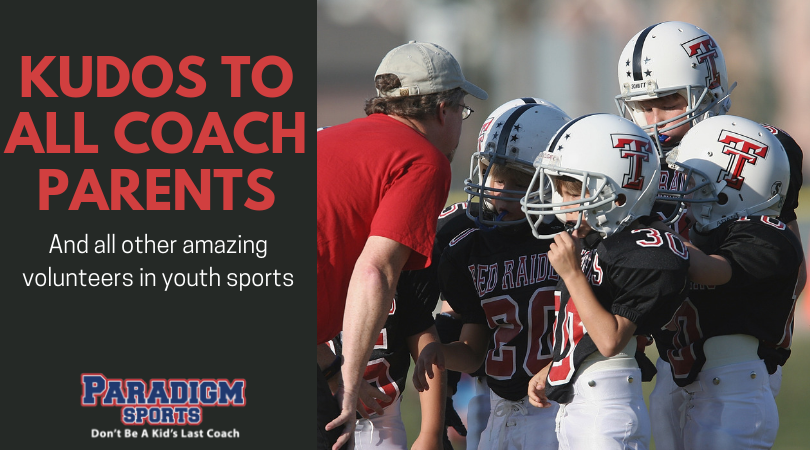
And all other amazing volunteers in youth sports

BONUS – Download a Free Copy of this Blog in PDF Format HERE


In celebration of National Volunteer Week, I wanted to take this opportunity to provide Kudos to all the AMAZING people that I who have volunteered their time unselfishly so kids can play organized youth sports.

Although the model in the competitive stream has been evolving more to non-parent paid coaches who many feel are “more qualified” I beg to differ, there are many coach parents out there with decades of coaching experience that are AMAZING coaches whom those non-parents could learn from.

A couple of weeks ago I did a talk for North Shore Fastpitch and will be doing two talks for Langley Fastball next Monday and reminded me of my tenure coaching softball with the most dedicated volunteer EVER, Glenn Zwick, whom I highlighted in “Coaching Skills in Sport and Skills in Life

Glenn was the head coach of my daughter’s softball teams all but one year that she played softball, the one year she played rep and had such a sour experience that she opted to return back to C ball.

Ironically she, like I, learned more about Softball and life under Glenn’s leadership than either of us working with other coaches or sports leaders.

The focus of that article was the importance of mentorship and how many people do so unselfishly.

What I want to highlight this go around are all the other volunteers that permit kids to play youth sports, to begin with.

Although much research coming forward is showing the optimal pathway for kids to develop their sports skills is to augment organized sports with unstructured free play, if people did not step up in various capacities in youth sports, kids would not be able to play they love (and hopefully love for years to come)

Kudos to all those that put their hand up to help coach various youth sports, in my case I coached softball, baseball, hockey, rugby and ball hockey after coaching adult co-ed slo-pitch which is hard to believe has been over 25 years of coaching and I still love it as much now as I did when I started.  The difference now is I am coaching coaches, supporting parents, volunteer board members, officials to attract, retain and grow their memberships and in doing so have the opportunity to reach so many more kids than just coaching one team at a time.

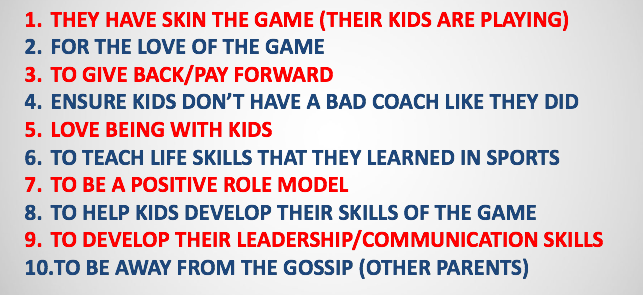
The majority of those that step up to coach share when prompted why they do so is due to the fact that they have skin in the game, their son or daughter are playing.

Probably the saddest example that a parent coach shared with me last year was the reason that he stepped up to coach hockey is his 9-year-old daughter told him after her first year of Atom Hockey that she was going to quit because she was scared of making mistakes and gave examples why.

Why?

Because the coach she had that season did not realize the impact of his words on his players and the importance of making it safe for them to fail.  He would single kids out for making mistakes in games, practices, at times with language not appropriate for any age group.

When the parent shared the story, literally everyone in the room, the majority of which were middle aged parents themselves (both Dads and Moms) eyes weeped up and even when I think about it now mine do as well.

Even though I believe her coach had the best of intentions when he started as all do, because of the current winning at all costs focus in many sports and most of the coaching certification provided to coaches relates to tactics, skill analysis, systems, rules, practice and game management they don’t develop their soft skills, how to coach, which is the basis of all of our modules.  They don’t know the best practices of coaching like growth mindset, the importance of connecting with their players and the emotional intelligence that the greatest coaches of all time developed after decades of coaching.

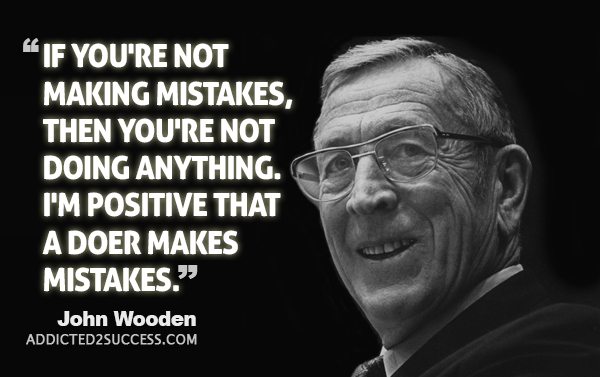
The greatest coach of all time, John Wooden, took 16 years to hone his craft before he won his first of many national championships as he knew the importance of being a great teacher of the game. He also believed in the importance of providing an environment for his players that was safe to fail.
 

Coaching girls who are playing on boys teams vs. all girls teams, coaches must adapt their coaching styles as there are differences when coaching girls vs. boys.

Coaches also must learn how to connect with their players, how to engage parents on their teams, how to make it safe (to fail and all forms of harassment), how to coach today’s generation Z, characteristics of great leaders, how to communicate effectively and so forth.

What I can say as I have traveled the country and interacted with thousands of coaches and all other volunteers that we rely on for kids to be able to play youth sports, I believe that there many more coach parents out there that are doing an AMAZING job as they truly are in it not just for their kids, but as I share with every coach when they say they are coaching because of their kids, “You have figured out that you adopted 10+ other kids also?”

To which they all say, yes, and they love being with all the kids and seeing not only develop their athletic skills, but as people.

Below is a great video which is a great perfect example why Kudos should be relayed to all of the coaches that Dwayne Wade had in his youth that not only guided him to become the future hall of famer he will be, but an amazing person.

Get your Kleenex out for this one.

I also want to take this opportunity to thank all of my amazing volunteer coaches who took me under their wing after my father passed away when I was 8 years old.

My father was a really good athlete, he played junior football and baseball to semi-pro until his 20’s and both I and my brother inherited his athletic genes.  In my youth, I played EVERYTHING, a lot of unstructured free play, but also a number of organized sports and had the opportunity to play on provincial winning teams in Hockey, Football and Rugby lead by GREAT Coaches.

Why were they great?

They pushed me to become the best I could be.

They taught me so many life lessons that I wish I had learned from my Dad, values like winning with humility, losing with dignity, respect, sportsmanship, selflessness, team work and important life skills like resiliency, leadership, communication, accountability, punctuality, commitment.

Another challenge that I had growing up is the fact my father had to live close to government buildings that he managed as a stationary engineer so every year from K to High School we moved so I was in a different school, different sports program which made it very difficult to develop friendships but the one constant for me was playing sports and I had so many amazing coaches that truly cared about me and were very passionate about the sports I played.

Those stops included many suburbs in Montreal,  Ottawa, Baffin Island (Northwest Territories), Vancouver, back to Montreal, Toronto then finally back to Vancouver and have resided there since.

There were in a sense, the very model for why I mentor coaches, students and even employees now and do so to give back as those coaches did for me.

It is one of the driving reasons why I wanted my kids to grow up in the same place and go to same schools year after year and also why every time they asked me to coach I did so with no hesitation.

When I entered High School we finally stopped moving year after year, my mother continued to support me and my brother to play 3 organized sports per year and went thru a real tough few years as became bitter having not had a father but when I look back at it, I had MANY fathers.

This is why I focus on mentoring grass roots coaches, the mothers and fathers who put their hands up every year to coach kids For the Love of the Game, to Give back/pay it forward and all the other reasons I shared in “Why do you Coach

One of the tips that I share in talks is the importance for coach parents to wear their coach hat at the rink, court, field and their kids call them coach and when they leave (to/from) that they put their Mom or Dad hat on and vice versa.

Don’t coach your kids at home, the dinner table or in the car otherwise they may become one of the 70% of kids that are quitting youth sports before high school.

A Dad came to me when I was doing a clinic last year after I shared that anecdote and he said to me with tears in his eyes “my son told me he wanted to quit hockey because was not having fun and I did not even think I was over coaching him”

It’s a fine line for coach parents but without the 10’s of thousands that put their hand up across Canada, undergo all the certification that is being asked of them and now ongoing professional development credits, please ensure that your son or daughter treat them with respect, thank them for everything they do and if you are a parent and not coaching do the same.

Being a coach requires hundreds of hours of time to plan practices, manage games and all the stuff that goes on behind the scenes with managers, board members, officials to ensure that kids have an opportunity to play a game they love.

Thanks Coach for everything that you do.

Even though at times it may seem like a thankless gig, when one of your players comes to thank you at the end of the season or better yet shows up on your doorstep to say hi or as they even get older to go for a bevie, reach out to thank you for everything that you did, it is all worthwhile.

Thanks also to all the other amazing volunteers that keep the cogwheels of youth sports turning, board members, scorekeepers, timekeepers, managers, trainers, risk managers and all others that make it possible for kids to play youth sports.

Coaches, please ensure that you keep the game in perspective and remember the initial reasons that you started coaching, to begin with:

  • Make it Fun
  • Make it Safe
  • Teach Skills
  • Care Passionately

And most importantly …..

Don’t be a Kid’s Last Coach

Please ensure that the legacy that you leave behind is like Glenn’s and all the coaches that I had in my youth and it is a positive one and you are not a kid’s last coach.

Lets all work together to bring the game back to the kids … where it belongs.


Why do kids play Video Games?

Posted 3 CommentsPosted in Athlete, Coach, Early Sport Specialization, Organization Executive, Parents

Earlier this week I received a call from a writer for CBC who wanted to get insight from my interaction with coaches across Canada regarding the impact of Fortnite and other video games on the grassroots level of youth sports.

The subject comes up literally every time I do a presentation or connect with coaches on a call, as it is one of the many screens that kids have turned to in the digital era replacing their former active play time with inactive screen time.

The main reason why it is not only impacting grassroots but all the way up to the professional level is the fact that many athletes are playing video games for hours on end into the early morning hours, in particular when traveling to road games, leading to sleep deprivation which is impacting their performance during “real” games of the sports they play.

Why do Kids Play Video Games?

#1 – Fun

No different that youth sports, kids play video games because they’re fun.  It’s not Rocket Science and the video game developers invest Millions of dollars into R&D to develop games so they are fun, whether it be for PC, Mac, Video Game Consoles, Tablets or Smart Phones.

#2 – Social 

Also one of driving reasons why kids play Youth Sports, they play video games with their friends or meet new friends either in their communities by going to houses or as many games can be played online, they meet friends from all over the globe.

#3 – Safe

Two reasons why video games are safe;

a. They are safe to fail

There are no adults present like they are in the professionalized youth sports era today, no parents or coaches telling them what to do, no officials enforcing the rules and if they don’t like the preset rules of the games they change them and can play levels that they are comfortable playing.

If you die or the game is over … all kids do is press the reset button and PLAY AGAIN.

It would be a great way to test Carol Dweck’s research in terms of growth mindset, I suspect kids with a fixed mindset always play at a lower level so they can get the desired result vs. those with a growth mindset would also want to play at a higher level to push themselves to get better.

b. They are safe from all forms of harassment

When is the last time you saw a social media post or a news article in print or on TV that gamers have been victims of bullying, cyberbullying, sexual harassment or abuse, hazing?

Compare that to youth sports, it seems like every day I open the paper, check news feeds or social media that I come across yet another article where players, officials and even coaches are victims of one form of abuse.

As ESports continues to evolve and competitions ramp up I suspect this may creep into their sector as it has in youth sports, but the very nature of esports is inclusive, regardless of your nationality, economic status, sexual orientation as long as you can play, you PLAY without the fear of being harassed by adults (coaches, parents) or even teammates.

#4 – Addictive Nature

Video games since the onset have been addictive forms of entertainment, how many of you remember some of the original games

Fast forward to ones developed for Smart Phones?


The developers would not be doing their jobs if they did not make the games addictive so that (a) you purchased the games and (b) kept buying the newest versions of same.

Think of the various EA Sports top-selling games, every year they add to the games so you ante up 50-100.00 to purchase the newest version like Madden, Fifa, NHL and various others.

I would even argue they lead to the very same release of the neurotransmitter Dopamine that Simon Sinek touched on in his infamous rant about the Millenials in the Workplace we shared in our prior post This is the Future.  Fortnite, in particular, has kids and even adults playing for hours one end into the wee hours of the morning.

Youth sports also can be addictive, if kids play for the love of the game, they will play for HOURS just like we did as kids.

#5 – Competitive

Many kids will say they play because they love to compete with their friends, which is no different than pick-up games when we grew up, there was nothing better than a close game of shinny, basketball, football, British Bulldog or what have you to get the adrenalin juices flowing.

The difference between kids playing video games and organized youth sports today vs. when I grew up, is the adults have turned youth sports into winning at all costs environment in lieu of playing for the love of the game, the spirit of competition, playing with your friends and FUN.

Youth Sports Organizations could learn “just a wee bit” for the Video Games Business Model and if did so could reverse the negative trends that youth sports are seeing today where 70% of kids are quitting youth sports by the age of 13.

How can Youth Sports Attract, Retain and Grow their membership?

#1 Focus on FUN at all costs, not winning at all costs.

As I have shared for many years with parents, coaches and board members;


Kids play sports is that they are fun, they quit when they’re not.

IT’S NOT ROCKET SCIENCE.

# 2 – Recognize the importance of kids playing with their friends

In the most recent survey we shared “Why Kids Play Soccer“, over 2300 kids stated the #2 reason why they played soccer was to play with their friends or meet new ones.

# 3 – Make it Safe to Fail and from all forms of harassment

In the last few weeks there have been so many articles or videos shared in social media or on TV regarding various forms of abuse that kids have bee victims and the level of abuse that officials are seeing is leading to many states in the USA declaring official attrition is a state of emergency as it will jeopardize number of games and programs they can support.

Why is this happening? Because parents think youth sports is a meal ticket to save the costs for a university education via a full ride scholarship or even better, their kids will get a professional contract to play sports.

The reality is less than 1% of kids will play collegiately with a scholarship, most of which are partials and less than 0.1% will play professionally.

In the last few weeks Kirsty Duncan, minister of Sport for Canada, has started the ball rolling to create a harmonized code of conduct with the Coaching Association of Canada as well as recently announced that there will be a 3rd party independent reporting organization and toll-free support line for any athletes that have been victims of any form of harassment.

The big unknown is how long this will take to be in place AND if the much needed cultural shift that needs to happen in youth sports will follow.

# 4 – Promote the benefits of Free PLAY.

Gone are the days where kids will play outside for hours on end as Generation X did (those born before 1984) BUT we must find a happy medium where kids have the opportunity to develop the very same addiction we had for being active and being outside so we don’t lose another generation like Simon Sinek eluded how we let the Milennials down.

There was nothing better for me and all the global experts that I have had the opportunity to talk to than going outside and playing pickup games, climbing trees, swinging into lakes, racing our bikes and so on without any adult supervision (no coaches, parents, officials)

A great example is an initiative that a coach started in Oklahama called “Unorganized Baseball” highlighted in the video below;

What does the kid say … playing baseball with my friends, I like this more

Should I tell your dad you said that?

YES.

Why?

Because the rules of unorganized baseball are there are NO RULES other than parents need to be quiet, coaches can’t coach, the kids pick sides and form their own teams, they make their own rules and enforce them.  No GROWN-UPS involved.

Hmmmm .. sounds like the good old days doesn’t it?

Kids just want to play … play with their friends in their local communities, not travel and have to play sports year round (early specialization), travel, aren’t concerned about trophies or medals (participation trophies) and have FUN.

THIS IS WHY VIDEO GAMES ARE THRIVING.

# 5 – Provide a quality sports experience

The focus of youth sports should not be winning at all costs, the focus should be a positive experience where kids learn not only the skills of the game, but the skills of life.

I know there is a lot of work being done at the academia level and sports organizations to define what is quality sport, and the best one I have come across to date is one drafted by Sport Canada;

Quality sport is led by Qualified Coaches, is delivered in a Safe and Ethical manner, is administered by Sport organizations who are aiming to achieve Organizational Excellence, is Inclusive and Accessible and is Developmentally Appropriate.

Hmmm … Qualified Coaches, Safe and Ethical, Organizational Excellence, Inclusive and Accessible and Developmentally Appropriate?

If youth sports organizations would follow suit and check all the boxes, in lieu of suffering the rates they have been experiencing the last 2 decades, they could buck the trends and attract, retain and GROW their memberships. One of the biggest shortfalls in youth sports is there is no measurement to ensure that kids DEVELOP, merely rely on outcoms (game scores, goals and assists) but ask any kid what quality sport is and they are tested beginning, mid and end of season to show how much they IMPROVED, not how many wins the team got.

Ironically, as I was putting the finishing touches to this post I read in one of our online local papers that a new esports tournament stadium is going to open in Richmond (lower mainland of Vancouver) BC as one of the principals stated “We know there is a community of gamers here in the Greater Vancouver area…we’ve done our market research, so we are pretty confident,” he said.

Rendering what the new stadium will look like


Hmmm … Market Research?  What a concept.

The very reason why Video Games and eSports have evolved into multi-billion industries is that they do their research, focus groups, surveys, testing so they can develop games with all the features that their customers want and focus on continuous improvement so they not only attract, but they retain and grow their customer base year after year.

Video Games now are a $180 Billion Industry Worldwide so they know a “wee bit” about attracting, retaining and growing their membership year over year.

Youth sports have to stop running their models as not for profits and understand that they are in the business of developing youth into adults.

Let’s all work together to bring the game back to the kids …. where it belongs.

Don`t be a kids last coach


Playing For the Love of the Game

Posted Leave a commentPosted in Athlete, Coach, Organization Executive, Parents


This coming Monday I will be returning back to Nanaimo to speak on behalf of Changing the Game Project hosted by Nanaimo Minor Hockey who is working with various other sports groups to develop an amazing sports experience for the kids in their community.

As I was when I made the ferry trip in October, I am truly honored to be invited to share nuggets but also interact with so many amazing people who are passionate about quality sport.

I came across some great nuggets the last few weeks that I will be sharing in the presentation that thought would be great to share on this week’s newsletter as well.

Why do Kids play Sports?

Simple, they play because they’re fun, they quit when they’re not.  It’s NOT Rocket science.

This is the quote that I have shared for years and it really comes down to just that.   What our role as parents, coaches should be, however, is not just making sure that youth sports are fun, but they should also ensure that kids love the sports they are playing more at the end of a SEASON than they did at the beginning.

Due to the growth of early sports specialization, however, there are no more seasons to youth sports, and in lieu of PLAYING sports, kids WORK sports for over 10 months of the year

As Wade Gilbert, the Coaches Doc, shares in many of his talks … do kids ask you Mom, Dad can I WORK Hockey? WORK Soccer?  No, they ask you if they can PLAY baseball, PLAY football and so on.

The more I thought about the reason why kids played a sport for more than one season is this held true, I Loved the Sport more at the end of a season that I could hardly wait to return to play again.  This was because when the season ended in March, I hung up my skates to play baseball, golf, go to the beach, ride bikes, hike, swim, tennis and so many other activities so when the season started again in Sept I missed the rink, my buddies, coaches and was eager to start another season.

Thank you for being a sport that helps me with other sports.


Why then do Officials (refs, umpires) start or continue to officiate?

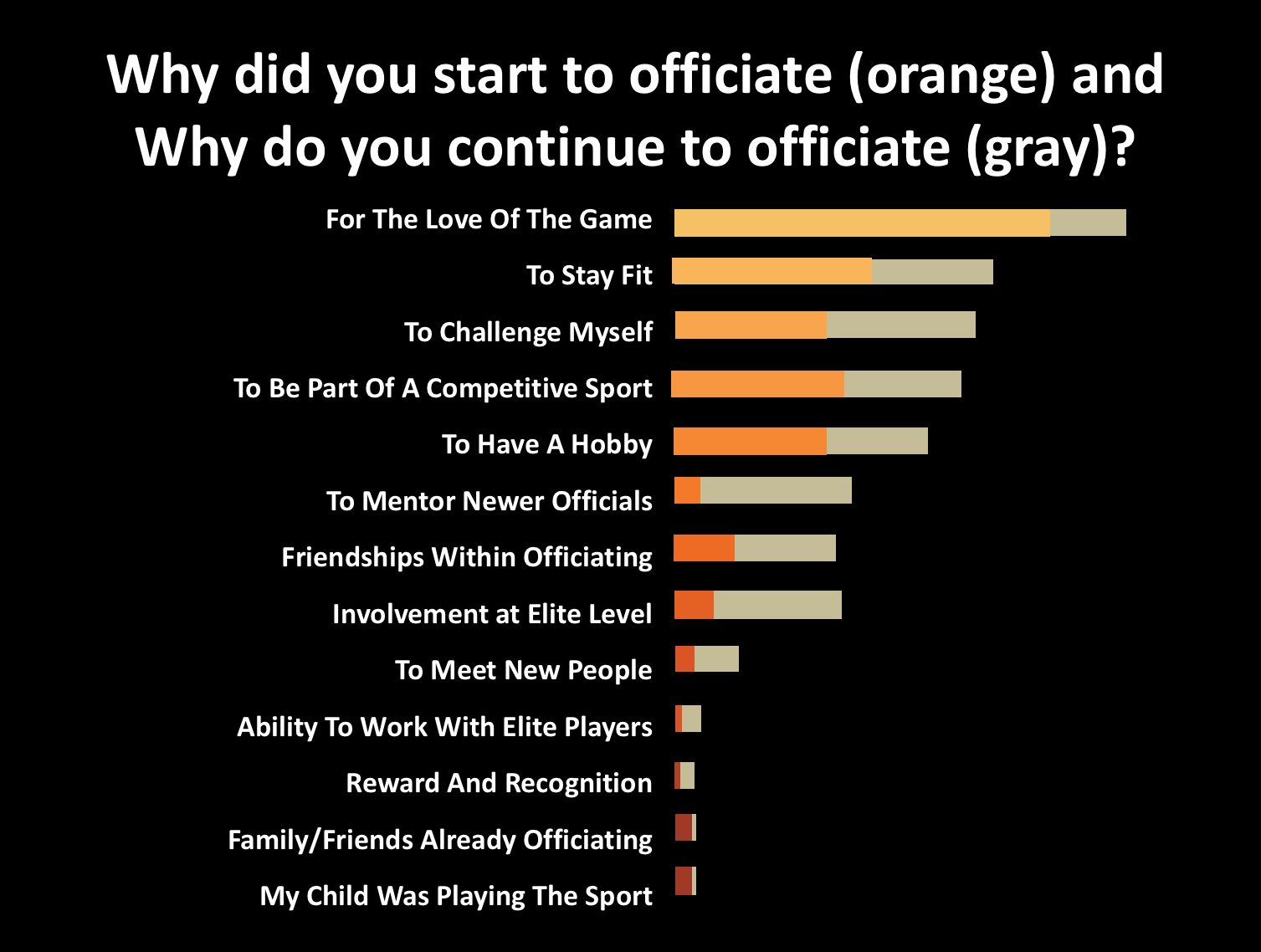
According to the largest survey I have come across today over 17,000 officials were asked why and the #1 Answer was “For the Love of the Game”.

See below for the other top 10 reasons why they started and continue to be officials.


Other reasons included staying fit, challenge self, be part of the competitive sport, have a hobby and near the bottom was reward/recognition and lowest motivator was the fact that they had a child playing the sport.  This is probably due to the fact that a lot of officials start before they are parents, and ironically one of the motivators that organizations do is provide stipends for refs to do so so if get enough games, they can have a decent part-time income of the course of those seasons.

Why do Coaches Coach?

Ironically, when I have surveyed grassroots coaches over the years in clinics or talks and asked them why they coached, the #1 answer is because they had skin in the game, they stepped up to coach because their kids were playing and either asked them to coach OR a board member runs around the field, rinks at the beginning of the season asking for help.

I was one of those “suckers” initially putting my hand up to help on ice when board members came calling when my son was 5 starting hockey or my 7-year-old daughter in softball and 15 years and hundreds of kids later, I still put my hand up, now is to mentor the coaches of kids so they can help them become the best people they can become.

See below for the other reasons why Coaches Coach that I hear over and over again when I prompt coaches why they are coaching;

The second reason, whether they are a parent or not, is coaches step up to coach For the Love of the Game, they love the game and everything that it did for them, that they want to give back/pay it forward to help others reap the same benefits.

Many of which shared they are coaching so kids don’t have a BAD coach like they did when they grew up (which sadly there are still coaches even with all the certification coaches have today that coach the way they had been coached)

One reason that parents may not be aware of, coaches have also shared with me and I can relate, they are at the games anyway, drive to the practices and no point going home, so they put their hand up to help coach.  They also do so, as I did, to be away from the gossip that parents at times will share amongst themselves or worse yet those would be too vocal and scream coaching instructions at their kids or critique them/coaches or officials.

Another interesting stat came out of official vs. coach surveys, although officials receive fees and some coaches get honorariums for coaching now, neither officials or coaches stated when surveyed they started or continued to do so for the $$ in their top 10 reasons for doing so.

They do so not only because they love the game, and a few weeks into a season realize they also love being with kids as they have adopted large families when they start coaching.

Now let’s talk about why these three key stakeholders QUIT the Sports they once loved

Why do kids Quit Sports?

They not only quit because they are no longer fun, but they quit because the lost the passion, love for the game they once had and for various reasons lost their way in a sense.

More often than not, they no longer love for the game as they have been deprived of the opportunity to play in all key situations in games, have had adults screaming at them when made mistakes or have been on teams where harassment has taken place to some extent.

They quit because the games are no longer about what snacks they get after the games and being with their buds in the dressing room, hanging out in dugouts or sidelines it is about the results of the game that takes the focus due to winning at all costs.

They also quit because they can’t afford it any longer due to travel, equipment, spiraling fees and all the other costs now associated with youth sports unlike the “good old days” where you community sports were just that, played in the community or at high schools with low, no fees and even could use the same pair of cleats for 3 different sports as I did (baseball, rugby and football)

Why Do Officials Quit?

#1 Reason Poor Sportsmanship

As I shared in a prior post “Why do officials officiate” the #1 reason why officials quit is due to poor sportsmanship.

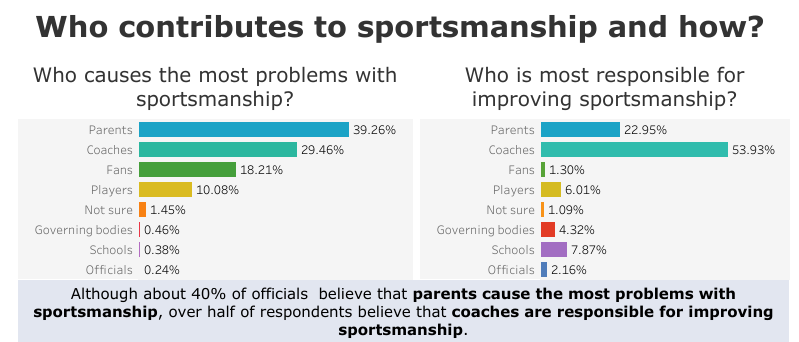
In the NASO study of over 17,000 officials, almost 40% of the respondents stated that parents caused the most problems with sportsmanship, followed by just shy of 30% of coaches.

When asked who is responsible for improving sportsmanship, over half stated coaches were.

Why?

Because they are the catalysts for change.

They interact with their players, assistant coaches, officials, board members and parents but also coaches and players of other teams, perhaps even their parent groups.

If coaches do not talk the talk but also walk the walk and demonstrate and expect good sportsmanship then whom is going to improve it?

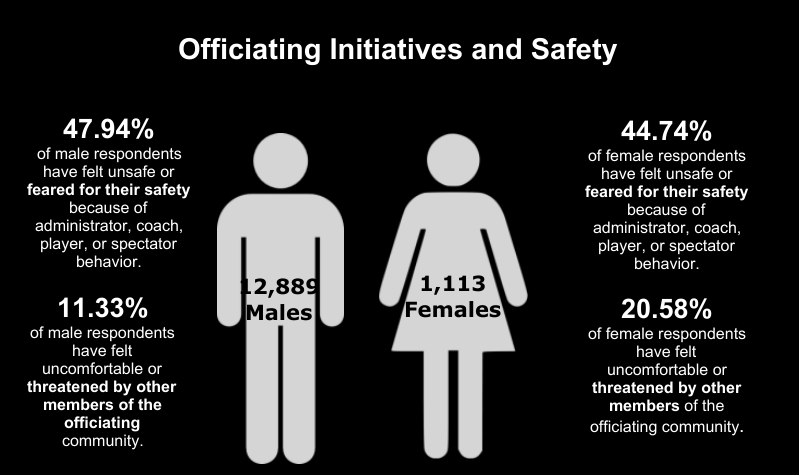
They also quit because they are concerned about their safety, over 40% of male and female officials are due to administrator, parent, coach or player behavior

Even worse, they are intimidated by their fellow officials who will criticize them during games?

I just came across this extreme video where one parent kept telling the refs after a call he did not agree with “would see them after the game” (meaning we will duke it out in the parking lot – really?), but the entire group of parents and fans were ejected from a youth soccer game due to their behavior and threats towards young officials (about the same age of the players they were officiating)

This after each day I came across similar parental behavior, coach abuse towards players or officials, series of articles about sexual abuse, or various issues at minor hockey associations I shared in last week’s post “When will the culture of Youth Sports change for the better?”

Why do Coaches Quit?

Coaches, like players and officials, are either not putting their hand up, to begin with due to lack of willingness to “deal with” parents OR are quitting due to frustrations of the problems they had “dealt” with over their coaching careers.  This is why the most common ask I receive is “who do I deal with parents” to which I counter, it is not about dealing with parents, it is all about how you engage them as allies.

Over 80% of coaches surveyed by Syracuse.com stated that parent issues had gotten worse over their careers, the #1 problem they dealt with by over 80% of the respondents was parents complaining about their kids playing time.

IF a coach is playing everyone equally so they all have an opportunity to contribute to the outcome of the game in ALL situations this would be a non-issue (the exception being when kids need to be disciplined for behavioral issues).

I argue that coaches in a sense are a victim of their own demise, due to our winning at all costs culture, many coaches who may have had the best of intentions when they started coaching fall into the trap of running short benches starting from the beginning of the game and parents are merely venting their frustration as they ALL PAY THE SAME $ so expect all kids to PLAY THE SAME amount of time.

Again it comes down to pointing fingers at one of the key stakeholders that impacts what should be a quality and positive sports experience and the majority of the issues could be avoided from the GET GO.

In lieu, the officials blame the parents, the coaches blame the officials, players or parents, the parents blame the coaches, officials or board members blame the parents and goes round and round in circles like the merry go round at schools I loved when I was a kid (which kids can’t ride anymore as they may get hurt?)

When then are we going to stop pointing fingers at each other and understand the motivation for the players, officials, coaches to begin with?

They started because wanted to try a sport For the Love of the Game, they continue to do so for the same reason, and they quit because they lost that Love and passion they had to start with due the various issues that have taken the Play out of Play Ball.

In lieu of pointing fingers, what I suggest to all parties concerned is bury the axe, work on collaborating so it is a quality sports experience for ALL stakeholders so they all can do so For the Love of the Game.

Let’s all work together to bring the game back to the kids ….. where it belongs.


Why Officials Quit (2019)

Posted Leave a commentPosted in Athlete, Coach, Organization Executive, Parents

A couple of years back I posted Why Officials Quit and have continued to do a lot of research on the subject due to the fact that every sport organization that I work with is not only having challenges with player attrition, they also are losing officials to the point where many say they have to scale back on number of teams or games as a result, and in some states in the USA they have declared many of their sports programs are in jeopardy due to lack of officials.

This weekend I will be doing a talk on that very subject for Softball BC, titled “How to attract, retain and increase the number of officials in your organization”

It is based in part on the post I followed up with last year called “Why do Officials Officiate” but for purposes of this post wanted to share why we are losing so many officials year after year.

Top Reasons why officials are quitting are;

  1. It is not safe to fail:

Having talked to many officials and those responsible in various sports organizations, the trends are consistent, as I shared prior Hockey Canada loses 30% of their officials every year, as does every sport that I have talked to as we started to partner with various other sports organizations.

Why?  Because the officials who take a lot of pride in not make mistakes, are quitting because of the abuse that they are taking from adults (parents, coaches or fans) when they do make a mistake OR when they believe they made a mistake.

This is one of the videos I came across that shows very clearly that the umpire made the right call, but received 17 different abusive phrases from parents who were seated in the visitor section (along the 1st base line) who did not have the same perspective as the umpire.

He clearly made the right call as did have the right perspective, but all the parents on the visiting team thought nothing of screaming out their perspective which was wrong.


  1. Poor Sportsmanship: 

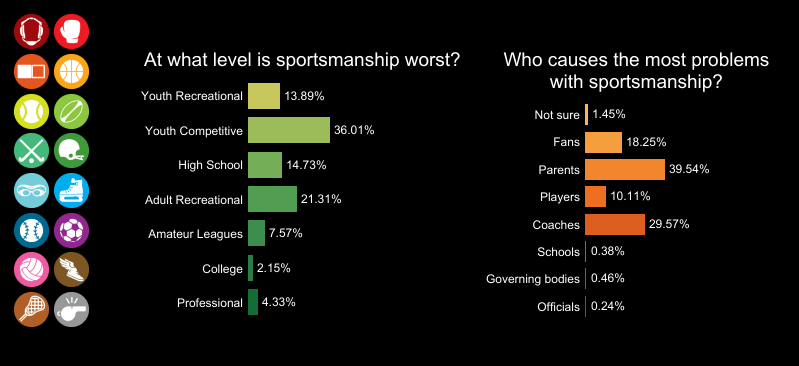
Above are the results for the largest study I have come across where over 17,000 officials replied to a survey from multiple sports done in 2017.  Almost 40% stated it was the parents that were causing the problems, followed by almost 30% of coaches, combining for approx. 70%.

Poor Sportsmanship was also one of the top 3 reasons that were the reasons why 11,000 players quit playing lacrosse in the retention report Alberta Lacrosse shared with me.

No matter what organization that I reach out to potentially partner with across Canada regardless of the hat I am wearing, even though 70% of the issues leading to officials quitting which goes hand in hand with the players is poor sportsmanship, when I ask what they are doing to curve the problem, they say they don’t have budgets for coach or parental education.


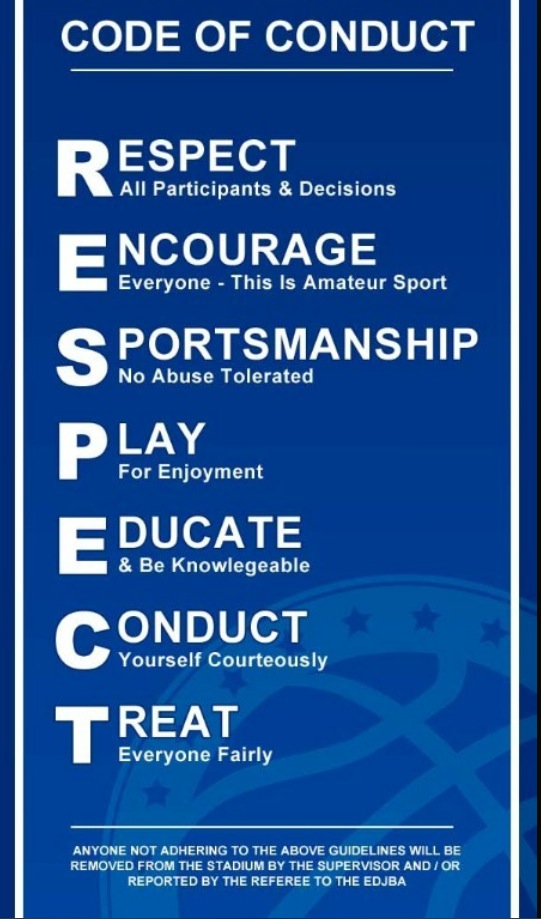
Translation: They keep doing the same thing over and over again expecting different results (Insanity), posting signs at rinks or fields like the ones above, making it mandatory for parents and coaches to take respect in sport online course for approximately 3 hours but don’t rigidly enforce policies for a zero tolerance for ANY forms of harassment.


When asked at what level is sportsmanship the worst, 36% of the officials stated it was the youth competitive level, followed by 21.3% adult recreational level.

These results did not surprise me at all.

Youth Competitive due to high expectations from parents due for a return on investment for the tens of thousands of dollars they invest in their child’s completive youth sports experience to get an NCAA scholarship or play professionally is what is translating to the vocal minority of parents screaming and umpires when they perceive they made a bad call.

Parents – the majority of these officials are just a level above your son or daughter, and many officials start at the age of 12 years old, and within 3 years associations are starting all over again to recruit officials as most have quit.

The second highest level, adult recreational, having played adult rec hockey, as well as slo-pitch for many years, I saw it firsthand how many who were playing adult rec thought they were living the dream playing professionally and took it a wee bit too far and would go at refs or umpires like they lost a Stanley Cup or World Series Game.

Every time I would approach them and say, relax, it’s just a game (yet another PSA campaign by Hockey Canada in 2004 when things really started to ramp up in terms of parental behavior in the stands).

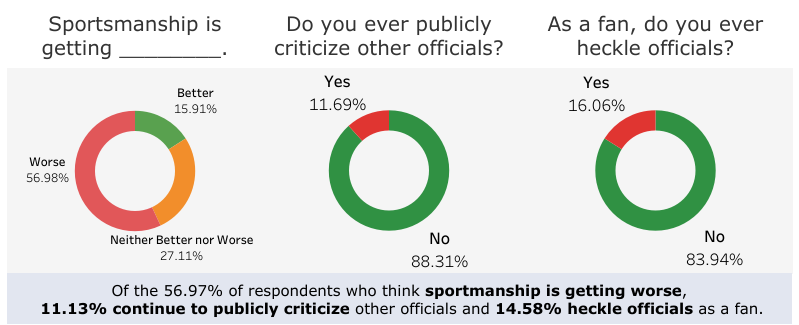
When officials were then asked if Sportsmanship is getting _______, almost 57% said it was getting worse, 27% neither better or worse but thankfully the remainder, close to 16%, stated that sportsmanship was getting better.

This I believe is due to all the organizations and awareness campaigns that have come to fruition in the last decade (including our own) to combat the impact of poor sportsmanship that is impacting the quality of the youth sports experience for kids.

What I was truly surprised with, however, was the fact that some officials responded (11.69%) publicly criticized other officials and when a fan at games, just over 16% confess they heckle their own fraternity.  If truly are going to change the way officials are treated, they must adhere to the very same Respect rule I have for all my teams and NEVER criticize your teammates.


  1. Fear for their Safety

I shared this in the prior post that Almost 48% of the male respondents, and 45% of the female respondents shared they feared for their safety because of administrator, coach, player of spectator behavior?

What I did not highlight is just over 11% of male and 20% of female official felt uncomfortable or threatened by members of their very own officiating community.

Really?

What happened to all being it in together as a team?  Again, officials have to respect all others and avoid threats towards others in their community if we are going to reverse their fear for their own safety.

How then do organizations reverse these trends by ensuring that officials have a safe to fail environment, take pride in becoming the best they can be, are not in fear, that sportsmanship includes respecting ALL calls made by officials?

Organizations have to stop putting up signs, sending out public service announcements and as a means “to deal with parents”.  Most people don’t read signs anyway (thanks to my past experience working in the hospitality industry) and the time for PSA’s/Whitepapers is OVER.  It has come time to activate strategies so that sports organizations are accountable for everyone’s safety and creating a quality sporting experience.

In lieu, invest in parent education and teaching their coaches how to engage parents in lieu.

The vast majority of parents are AMAZING people who are doing everything they can to support their kids navigate what has become professional youth sports in lieu of kids playing kids like it was when I grew up.

They also have to recognize that officials are key stakeholders to ensure that today’s youth have a positive sporting experience, without them, kids will merely be having practices.

I worked at BC Place Stadium in security for many years and worked many BC Lions games as well as concerts and if fans became unruly (more often than not due to drinking too much) it was really simple, they were removed from the facility.

If they got into a fist of cuffs with fellow fans, we escorted them to the Police Wagon where they were brought to the station and potentially charged.

If we did so at professional sports events, why then do we not do it at youth sports events?

In lieu of having security surveying the stands, coaches and parents should be doing the same just as they did a generation removed.  If someone was acting up, a coach, parent or board member would approach them and eject them from the facility.

If a parent, coach or fan becomes unruly, too emotional, abusive, they should be removed so they can calm down and not permitted to return no differently when coaches are ejected.  The vocal minority of parents that do so be held accountable to the point where future incidents are treated with longer suspensions and using the same 3 strike rule, if a repeat offender;

Sorry we will miss you.

Meaning, we will not permit you to be a member of our organization.  Just like playing youth sports is a privilege (now more than ever due to pay to play model), so is that of being a member of the organization as parent, official, board member.

As far as I am concerned, no one, whether it be player, coach, official or board member should be in fear or a victim of verbal, worse yet potentially physical abusive threats and we need to bring the game back to the kids.

It’s time to stop doing the same things over and over again and expecting different results (Insanity)

Just like we should see the smiles on players when they are at games, the same should hold true for officials of any sport, they too should have a quality sport experience, otherwise the trends where 30% quit every year will just get worse.


Let’s all work together to bring the game back to the kids … where it belongs.

 

Don`t be a kids last coach

That was then, this is now

Posted Leave a commentPosted in Athlete, Coach, Organization Executive, Parents

This has been a week full of meetings with various colleagues and associates as we all were trying to get as much done before our May long weekend.

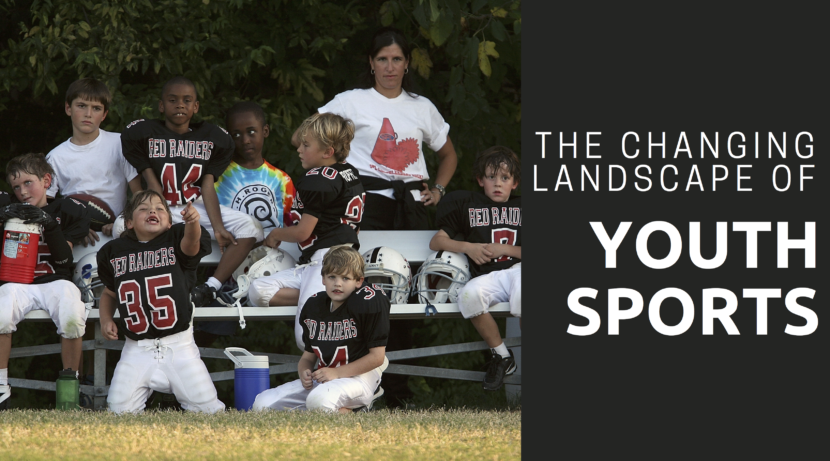
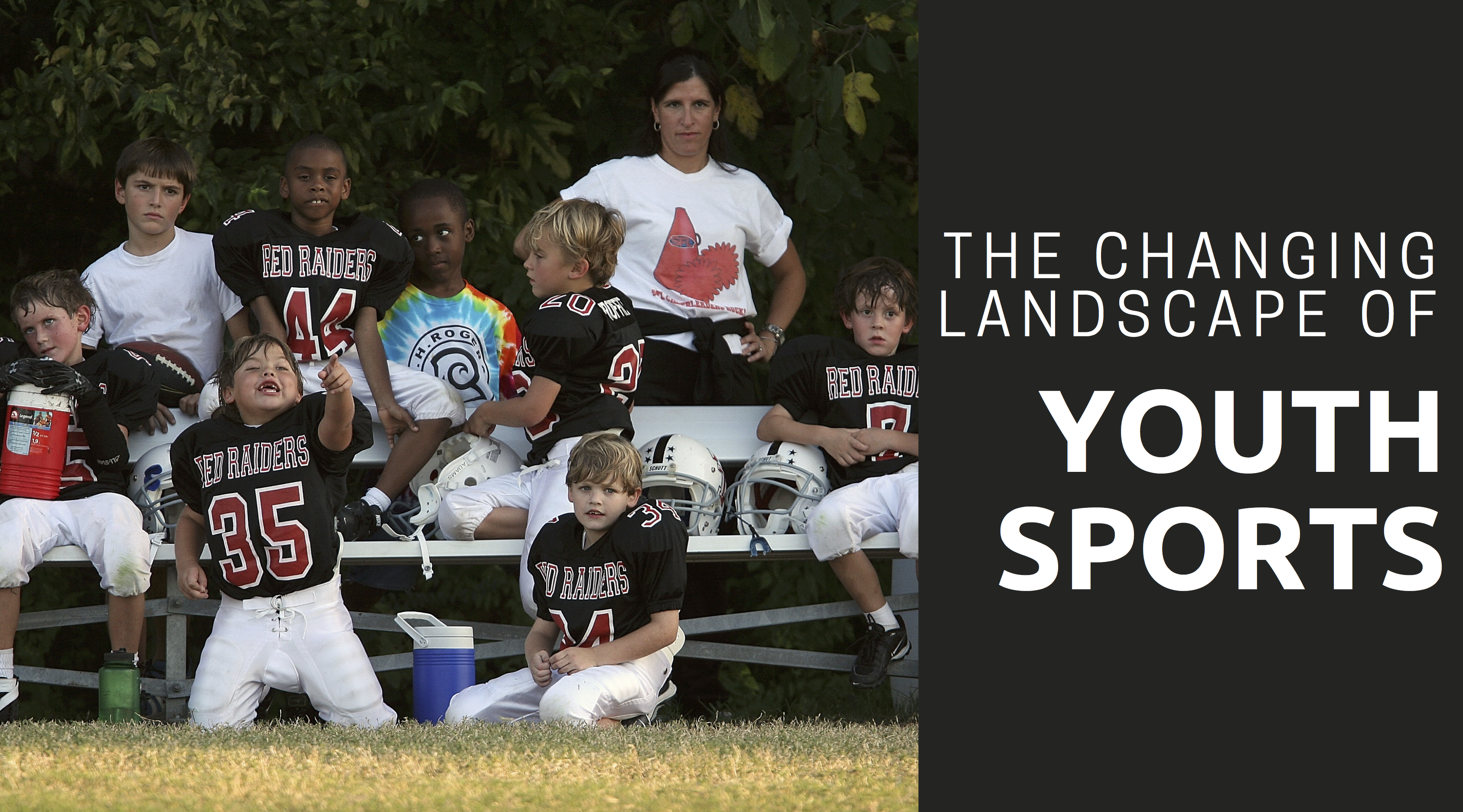
Yesterday, however, I received a call from one of Canada’s National Magazines (once the article goes to print will share out the digital edition) to ask for my insight on the changing landscape in youth sports, in particular, the professionalization and pitfalls of early sport specialization.

I thought initially we would be scheduling the interview for a later date but when the writer asked if I could do so in 20 minutes, I said sure, why wait until tomorrow if you can do it today.

We chatted about the various issues that revolve with early specialization including burnout, overuse injuries, lack of overall fundamental movement skill development as well as the costs, both financial and time when kids start specializing at such a young age.

Last week I wrote about the reality of one of the drivers for specialization, parents aspiring for their son or daughter to receive a NCAA scholarship to setup them up to potentially be drafted to their major professional team sports.

The Reality vs. the Dream of NCAA Scholarships and going to the Show.

I subsequently shared with the writer for the magazine article that the statistics of kids who play youth sports who go on to play at NCAA is approximately 2%, of those 1% will be drafted on average to major professional sports and only 0.04% will actually reach the level of PLAYING professionally at the highest level.

We also touched on the other area that I have identified is an issue with early specialization, the research shows that the key years for motor skill acquisition is between the ages of 6-12 years old which is why nations like Norway, Sweden, Iceland who have adapted Sport for Life’s LTAD model focus on core motor skill development, fundamental movement skills across a broad range of sports and activities during that time.

They also limit or do not permit competitive games until kids are 13 years old so they can learn those skills in a safe to fail environment without the pressure cooker that kids in North America face and other nations, that has lead to the winning at all costs environment in youth sports.

“That was then” is a slide that I created for talks that shows random pictures of kids participating in free play activities, the ones that I did where I learned the fundamental movement skills vs. the precursor to youth sports, the Physical Literacy Movement so that we reinforce the importance of kids developing confidence and motivation to be active, so they are ultimately active for life. (the top right picture is a mini me version of me from the great film Sandlot)


In lieu, should we not just be promoting and supporting kids to just go out and PLAY like our parents did?  Sadly, thanks to THIS IS NOW, kids are not motivated as we were to play outside, they are glued to screens over 7 hours a day in lieu.

One of the biggest changes to the youth sports landscape has been the evolution of the internet, the digital era, which like everything else new, is the direct cause and effect that has drastically changed the landscape of youth sports but EVERYTHING.

Now thanks to Google or youtube ANY coach can obtain ANY drill, ANY practice plan from ANYWHERE, there are thousands available on the internet.  This means that the tactics, strategies, skills, drills of sports are readily accessible so every coach can focus on the WHAT of coaching.

Gone are the days where coaches would even have to think of “stealing” a drill when they saw another coaches practice, they are readily available on the internet.

This is why so many coaches focus on the outcomes, by focusing on the what – skills, drills, practice plans then in turn focus on wins and losses so it becomes a vicious circle

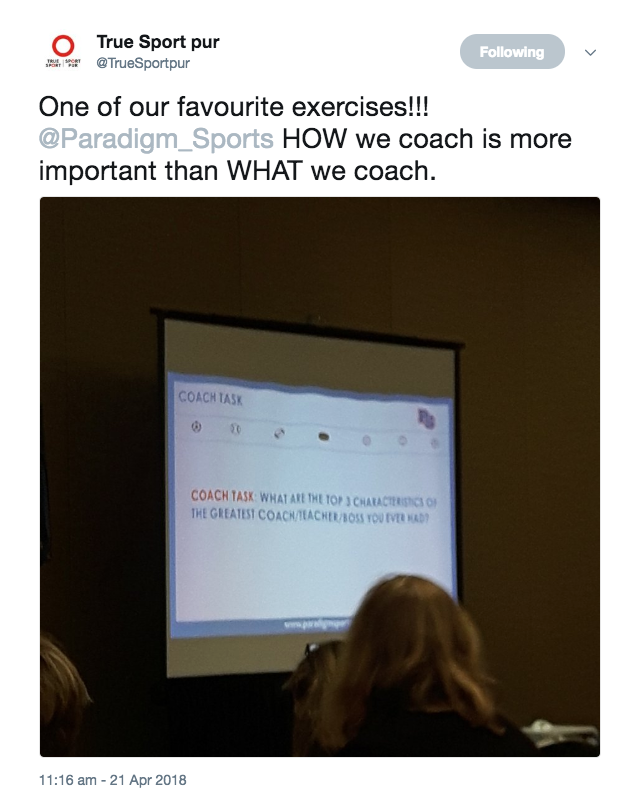
What is not readily available on line, or offered in courses, clinics, summits is HOW to coach.


It is the How, Not the What, that youth coaches need to focus on now more than ever if we are going to shift the needle to bring youth sports back to the kids.

  • Focusing on the process vs. the outcomes. Doing so, winning will be a byproduct in lieu of the focus.
  • Focusing on LTAD, Multi-Sport Participation vs. Early Sport Specialization
  • Focusing on zero tolerance for any form of harassment
  • Focusing on making youth sports fun again, so that 70% of kids don’t quit youth sports before they enter high school
  • Most importantly, coaches need to recognize the importance to care passionately, the #1 characteristic of great coaches is how much they care followed closely by how passionate they are about the sport. In lieu of just teaching the skills of the game (the what) focus on teaching the skills of life (the how).

It is our role as coaches to make a difference by developing youth into adults.

If we do so, we will move the needle so youth sports are just that, youth sports.

Let’s all work together to bring the game back to the kids … where it belongs

Don`t be a kids last coach